Chapter 27: I Don’t Need Your Mianzi

Character for good fortune
I didn't need mianzi from the family of the famous calligrapher, Tang.

Tang, the famous calligrapher and painter, and his wife, Zhang — my next door neighbors — lived a world as intentional as the eccentric style of Tang’s calligraphy scrolls that decorated the walls of their apartment. Tang painted and wrote calligraphy, often for dignitaries, officials, the elite — and they reciprocated lavishly. How did I know? Because Zhang told me, whenever I saw her in the hallway between our doors.

Renjia songde — a gift from others,” she would tell me, her lips pursed smugly as she held up the latest swag — from Amway vitamins to the expensive, first harvest green teas, all from the endless stream of guests that the couple entertained most weekends. Sometimes she would blather on about a free trip somewhere, such as an upcoming visit to Huangshan that included a river cruise.

Personally, I didn’t need Zhang — or even Tang — to talk about all of their gifts or free trips or extra apartments in the city. I already respected Tang as an artist. He was the one who memorialized my first date with John at the West Lake, in a painting. But I suspected Zhang couldn’t help it — as the wife of a famous artist, his fame and glory was all that she had, and all that she could feel proud of. There was a sad, lonely woman behind the swag. So I would stand there, smile and nod, as if I was a parent who knew better, listening to a child.

But I could do more than listen. Continue reading “Chapter 27: I Don’t Need Your Mianzi”

Ask the Yangxifu: How Western Women Can Meet Chinese Men in China

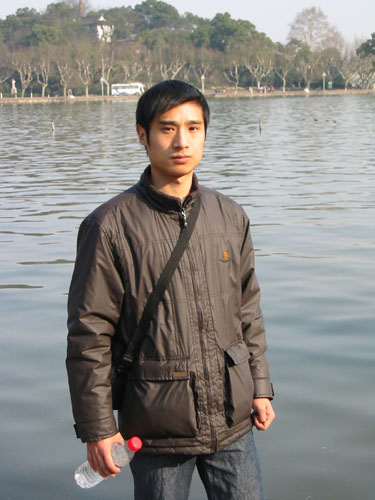
Chinese man, sitting on the campus of Suzhou University
How can foreign women improve their chances to meet good Chinese men -- in China? (Pictured: my Chinese husband, John, sitting on the campus of Suzhou University)

Priscilla didn’t ask me anything. But after reading her February 12 opinion piece in the Global Times, titled “Chinese men: pull your weight”, I thought she needed some answers — especially when it comes to finding a good Chinese man. So I decided to pre-empt my scheduled Q&A this week, to help Priscilla.

Here’s an excerpt, where she discusses her interest in dating Chinese men — but lack of suitors:

One girl in a circle of friends decides to give a Chinese guy a chance and is shocked to discover, he’s pretty cool. The others also start testing the waters: flirting with that cute Chinese guy in a uniform, dancing with the tall one at the club, maybe even venturing to have a fling or two. And once the blinkers are lifted, ladies, you’ll discover that you are actually surrounded by attractive men.

But I am writing this as an enlightened foreign lady with several foreign lady friends and I can’t think of a single one who is dating a Chinese guy.

….one reason I can personally attest to is a lack of effort by Chinese men.

She ends the piece by exhorting all would-be Chinese suitors to “man-up” — be a real guy, and get the courage to ask Western women out.

My response? Continue reading “Ask the Yangxifu: How Western Women Can Meet Chinese Men in China”

Chapter 26: Hello, Foreigner – and Goodbye, Generosity

Western woman hiding behind a mooncake box
Sometimes, you misunderstand China, or China misunderstands you. And all you can say is, I'm sorry.

As October 2002 went on, I fell deeper in love with my Chinese boyfriend, John, and found a new sense of belonging through lunches with Zhang Bin.

Yet, was I just fooling myself, to think I could masquerade as a local? I am a foreign woman. My face, hair and larger, curvier body made me a curiosity, no matter how standard my Mandarin pronunciation was.

I wasn’t a curiosity to Jason, an old college classmate of John’s that we met during the National Day holiday, on the way to our favorite restaurant near my apartment. I had met John’s xiongdi — “brothers,” or close friends — once before. Ever since then, I loved knowing anyone with a connection to John, and Jason seemed nice enough. We exchanged phone numbers, with the suggestion we might meet for lunch sometime. “I could practice my Chinese with him,” I whispered to John, as we walked in the other direction down the street, after meeting Jason. Continue reading “Chapter 26: Hello, Foreigner – and Goodbye, Generosity”

Chapter 25: No Chinese, No American, Just Lunch

Stir-fried chinese vegetables
John, my Chinese boyfriend, wasn't the only one who could make me feel less foreign in China.

When you have a Chinese boyfriend, you have a strange sensation, perhaps the first since your arrival to China — that maybe you’re not so foreign, or so different. The way John spoke to me, and cared for me, made me feel — if only for a moment here and there — that we were equals.

Yet after he left, I began to see that it wasn’t just John who had the capacity to see past my foreign face.

“We shouldn’t see each other as a Chinese and an American.” Those were the words of Zhang Bin, a friend who lived across the street from our office — and who agreed to make lunch with me during the weekdays.

Lunch had been a headache for me ever since I entered the company. The boxed lunches delivered daily to the office were too greasy, and had few vegetables to satisfy a vegan, driving me to find lunch alternatives outside the building. I found them in a variety of restaurants — from a local Zhejiang specialty restaurant to a Japanese noodle house — but usually had to enjoy lunch alone. Continue reading “Chapter 25: No Chinese, No American, Just Lunch”

How I Spent Chinese New Year, 2010

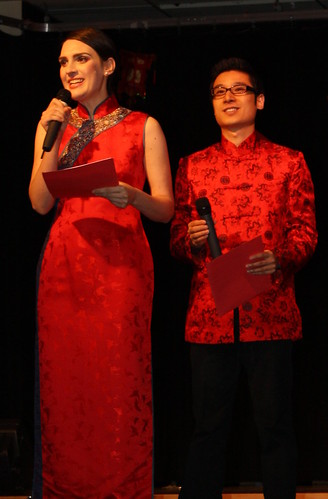
How did I spend this Chinese New Year? As a host — along with my Chinese husband, John — for our university’s “Chinese Night” on Feb 13, 2010, here in the mountain West of the US. It’s not CCTV’s Spring Festival Party (perhaps, thankfully so!), but it’ll do. 😉

My Chinese husband, John, and I dressed in auspicious red silk to host our university's Chinese New Year celebration.
My Chinese husband, John, and I dressed in auspicious red silk to host our university’s Chinese New Year celebration.

We had more than 12 programs to entertain the audience that evening. Here are a few of my own favorites. Continue reading “How I Spent Chinese New Year, 2010”

Chapter 24: Tied in Chinese Knots over John

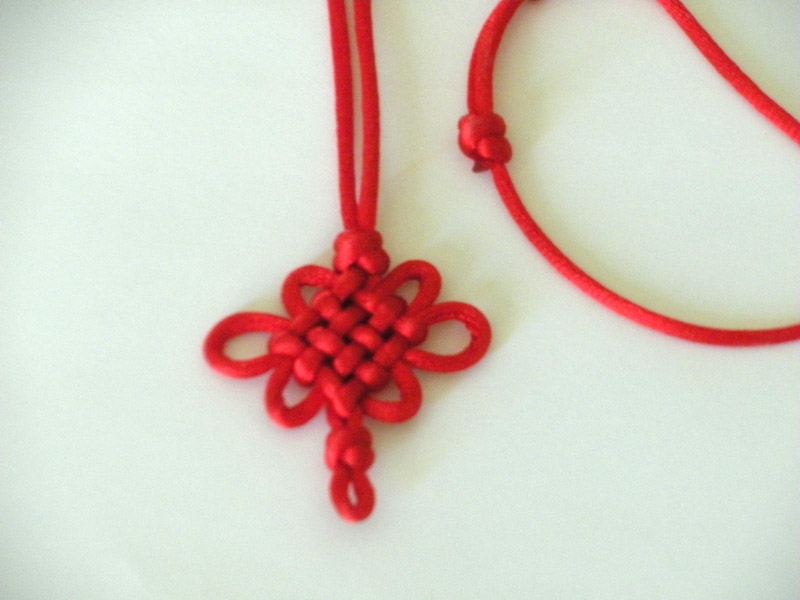
Red Chinese Knot
I was getting tied up in knots over my relationship with my Chinese boyfriend, John, when I never needed to. (Photo from Wikimedia, shot by Ucla90024)

As John, my Chinese boyfriend, and I spent more time together, it was as if we were creating a Chinese knot of our own, promising forever — a forever I had never known with anyone else. And I was tying myself up in knots, because in the world I had known before — where love came and went as effortlessly as the rain across the West Lake in Hangzhou — forever seemed so hard to find, and so hard to believe.

I found solace in my Chinese friend Swallow, one of the translators, a “spicy Sichuan girl” who knew John too. She gave me one of her easy smiles when I told her of my worries, and the experience I had with him during National Day. It was as if she had to laugh at all of the ridiculous mental knots I had created. Continue reading “Chapter 24: Tied in Chinese Knots over John”

Chapter 23: The Sound of Silence in Love

My Chinese boyfriend, John, by the West Lake in Hangzhou
My Chinese boyfriend, John, became increasingly quiet, and I wanted more words, instead of more silence.

In Chinese, you can say so much, with so little. Four-character idioms could say what a sentence or two in English might. One character could even do the work of a short sentence or sentiment.

But sometimes simplicity invites questions — when one character could mean so many different things. Think about the character 到 (dao). Depending on how you use it, it could say: arrive or reach; to go to; up until, or up to; or thoughtful.

After spending several days touring Beijing with John, our conversations went from so much to so little, where silence filled more of our moments, as if our relationship, like one character, could say more than so many words.

Yet, despite our understanding, I longed for words. I found strength and security in John — in us as a real, lasting couple — through words. Without them, questions began to fill in my mind as we passed National Day together. Continue reading “Chapter 23: The Sound of Silence in Love”

Ask the Yangxifu: A Big, Fat, Traditional Chinese Wedding?

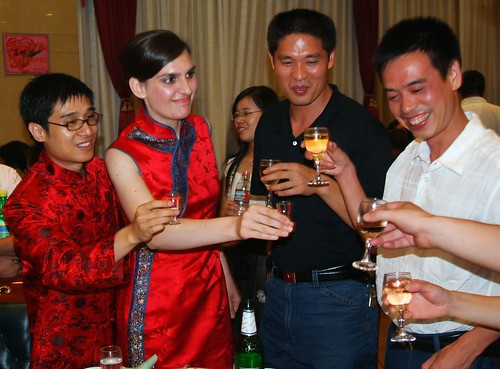
Western woman and Chinese man in a Chinese wedding

Ana asks:

I have a question about weddings. I am in my late twenties and recently engaged to my Chinese-American boyfriend,which I am really excited about.

But the wedding worries me. Initially I wanted a simple ceremony. I was raised Christian but he wasn’t, but I wouldn’t insist on a church. just maybe a simple ceremony then banquet with friends, some photos outdoors, etc. But when I suggested it to my boyfriend, he said his parents would never agree to it (his parents are from China), that they expect a big traditional Chinese wedding. I heard Chinese weddings can be very elaborate,exhausting with a lot of drinking, more than one dress,lots of guests etc. Seems overwhelming and not my style!! I haven’t brought it up in front of his parents but I feel kinda stuck now. I just really don’t want all this fuss and don’t understand why we cant make it simpler. I’m not sure I can survive a huge Chinese weddings. What should I do? Continue reading “Ask the Yangxifu: A Big, Fat, Traditional Chinese Wedding?”

Chapter 22: Hitting the Great Wall(s) of Beijing

The Great Wall of China, cascading over a mountain
Sometimes, you hit walls in life in China. And sometimes, you hit walls on the way to the Great Wall.

When I think of Beijing, I think of walls. I think of the Great Wall, that fortress meandering over a panoply of mountains surrounding Beijing, built to keep foreign invaders out of China.

Today, foreigners can be found all over Beijing, a city that in 2008 warmly welcomed them to the Olympic Games. But sometimes, no matter how open things seem to be, the walls still remain.

I was hitting a wall of my own in Beijing when I couldn’t get in touch with my Chinese boyfriend, John. It was past nine on the evening of September 28, and he had promised to arrive in Beijing on the morning of September 29. But he hadn’t called to say he would definitely come, or that he had bought a train ticket — and his cell phone had lost power, so I couldn’t call or send a text message. I was in my hotel room, without the distractions of the day — a walk around Tian’anmen Square, a visit to a replica of the home from a Dream of Red Mansions — and all I could think of was this vacation couldn’t move forward without John.

A bath, I thought. Just take a bath. So, as I slipped into the tub — my last refuge from a mental breakdown — and my phone rang. It wasn’t John’s number, but I picked it up.

And, sure enough, it was John. “I just got on the train — I’ll be arriving at 7:45am in the Beijing station.”

Just like that, his words broke through the barriers in my mind. He was coming. Our National Day vacation would happen. We would be together again.

Yet, all of my elation never prepared me for the walls that awaited us, after John arrived. Because, when you’re young, in love, and traveling independently — on a budget — in China, something’s bound to catch you, sometime. Continue reading “Chapter 22: Hitting the Great Wall(s) of Beijing”

Travel China with the Yangxifu: The Henan Museum, Zhengzhou, China

The Henan Museum
The Henan Museum offers extraordinary stories and relics, in one of China’s most overlooked cities — Zhengzhou. (photo courtesy of Wikipedia)

“The museum is under construction, so there are only two rooms open,” the woman behind the information desk told us in a droll voice in Mandarin. She probably had to say this same thing hundreds of times a day, every day.

But while this was just another day for her, this was the only day for John, my Chinese husband, and I to visit the the Henan Museum in Zhengzhou, Henan Province.

We just shrugged our shoulders in disappointment, and walked to the room to our right. It was painted in a forgettable beige — nearly the same color as the loess of the loess plains, where Zhengzhou is located — and seemed to hold, on first glance, an equally forgettable collection of artifacts that couldn’t match what we’d seen in Beijing, Shanghai and Changsha.

Yet, forgettable is hardly how we would describe our visit. That’s because the Henan Museum, opened to the public in 1998, is one of the few museums in China where you don’t feel as if you’ve seen this bronze or that porcelain 100 times before. Invest a little time, be curious, and you will be rewarded with extraordinary stories and unusual relics. Continue reading “Travel China with the Yangxifu: The Henan Museum, Zhengzhou, China”