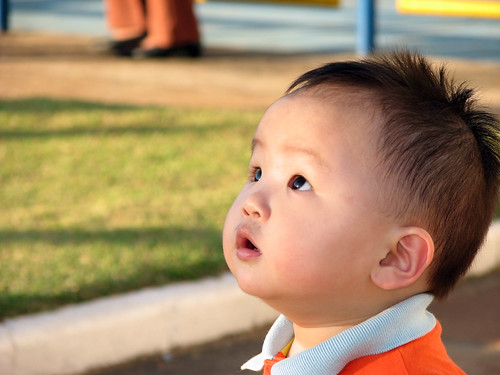
When my friend Peter already announced a baby boy, within a year of getting married, it made me wonder about the rush to have babies sooner in China (Photo by Erik Araujo)
This evening, I was so excited to find an e-mail from Peter, one of my closest Chinese friends. I expected to hear something about his work life, or perhaps his wife. But instead, I read this:
“We have some happy news to share with you. My wife just had a baby boy on February 15, 7 jin 3 liang. The mother is fine.”
Of course I was happy for him too, and I couldn’t wait to tell my Chinese husband about it. But then it hit me. Peter had only been married to his wife for about a year. And within that year, he and his wife had already turned double happiness into triple happiness. Fast. Continue reading “The China Baby Race”
It was Chinese New Year 2003 when I first met Yu Kaiqi, the boy who would become my nephew. Almost a year old, he was bundled up in endless layers, like a silkworm cocoon — and just as precious to my future father-in-law, Yu Huimin, 61, who carried him everywhere. I was stunned. If this boy were in the US, his parents and grandparents would have been letting him teeter and totter on the floor, taking his first steps to explore the world. But not here. For almost the entire day, he was tucked safely away in his doting grandfather’s arms.
Today, Yu Kaiqi, now seven years old, is still the family’s center of attention — but for all the wrong reasons. Throwing objects at the teacher. Lying. Sassing his parents. Daily temper tantrums. Not going to bed on time.
Unfortunately, Yu Kaiqi is no anomaly in China. Some studies, including a 2006 paper from Jinan University, suggest that 11 percent of young Chinese children misbehave. Others, including a 2002 Qingdao University paper, put the figure at 23 percent. Suppose you apply that lowest estimate — 11 percent — to the 2000 China census count of 95 million two- to seven-year-olds. That adds up to as many as 10 million Chinese children troubling their families.
And when they’re vexed by a naughty child, families look for explanations. Jin Genxiu, my 55-year-old mother-in-law, believes Yu Kaiqi’s bad temperament is the cause. Yu Huimin blames the school environment and declining standards in society. But there’s a culprit more close to home: parenting. Continue reading “China’s ‘Little Emperors’: Children in country tend to be indulged by families”
This website uses cookies to improve your experience. We'll assume you're ok with this, but you can opt-out if you wish.AcceptRejectRead More
Privacy & Cookies Policy
Privacy Overview
This website uses cookies to improve your experience while you navigate through the website. Out of these cookies, the cookies that are categorized as necessary are stored on your browser as they are essential for the working of basic functionalities of the website. We also use third-party cookies that help us analyze and understand how you use this website. These cookies will be stored in your browser only with your consent. You also have the option to opt-out of these cookies. But opting out of some of these cookies may have an effect on your browsing experience.
Necessary cookies are absolutely essential for the website to function properly. This category only includes cookies that ensures basic functionalities and security features of the website. These cookies do not store any personal information.
Any cookies that may not be particularly necessary for the website to function and is used specifically to collect user personal data via analytics, ads, other embedded contents are termed as non-necessary cookies. It is mandatory to procure user consent prior to running these cookies on your website.