“I can’t sleep,” I moaned as I flicked on the bedroom light at 3am on Friday morning. I shouldn’t have been up that early, and normally shouldn’t have imposed my restlessness on John. But when you’ve spent your entire Thursday afternoon retching into garbage cans, toilets and sinks — as I had — “normal” no longer applies.
What made me so ill? Maybe it was my overexhaustion. I woke up that Thursday morning already feeling nauseous from two nights of sleepless tossing and turning, and over a week of marathon writing and editing to meet a huge deadline on Wednesday. Whatever the culprit, I knew I desperately needed rest — a rest that didn’t come easy once the illness struck, and definitely seemed elusive at 3am that Friday morning.
John groaned as he staggered to his feet — he had only slept for three hours and it definitely showed. Still, he crept over to his laptop, determined to get me (and by extension, him) sleeping again. “Hmmm, let me consult some Chinese medicine websites.” Continue reading “How My Husband’s “Second Opinion” Helped Me Heal (And Sleep)”
My Chinese husband thinks pain killers are no good. And I think his arguments are just a pain. (photo by Aleksandra P.)
Last Monday night, I tossed and turned half the night from a painful skin infection. By 4:17am, I still hadn’t fallen asleep, and I could feel it throbbing all the way down my thigh. I slipped out of bed and into the living room, knowing exactly what I wanted to do — and why my Chinese husband would be so angry for it the following day. I decided to take a pain killer.
Sure enough, the pain subsided and I finally fell asleep. But when I told my Chinese husband about it the next day, he looked as red as the inflammation on my body.
“Why did you do that?” he admonished me while hovering over the sink, cleaning up the leftover dishes.
“I just couldn’t get to sleep. It was past 4am,” I explained.
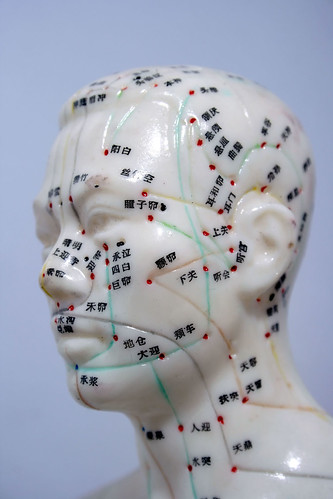
In Chinese traditional medicine, there is a saying: anger hurts your liver, melancholy hurts your lungs, thinking hurts your spleen, happiness hurts your heart. The thing is, we are all angry, melancholy, happy, or just thinking at different times in life. What hurts is when we do it too much, without balance.
John, my Chinese boyfriend, thinks my life has lost balance, ever since our time together during National Day — and my health hasn’t been the same.
My back and neck felt unusually sore after an evening swim Friday, October 11. The pain lingered uncomfortably for over a week, even after I received Chinese medical massage. So when John came in the weekend of October 18, he took me to the hospital for an X-ray.
“Your neck has straightened out,” the doctor said to me, looking at the black-and-white photo illuminated in his office. All of those days in the office, sitting at an office chair before a desk, had hurt my neck.
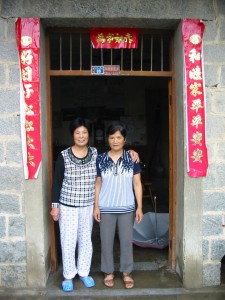
Peng Qiulan and Jin Genxiu, like most residents in China's countryside, have rural health insurance policies that only cover a fraction of their medical costs
Zhongshan, Tonglu County, Zhejiang, China — In a old wooden home hidden behind Zhongshan’s main street is a place where Ye Xianna, my husband’s 76-year-old grandmother, is quietly putting her trust in Jesus — to protect her against illness.
After sitting with for nearly four hours in the rows of turquoise-colored pews that felt like tiny park benches — witnessing speaking in tongues, singing hymns in Chinese, and preaching on the virtues of Christianity — it was one of the congregation who spoke the most important reason why Ye, like many others in the church, was present that morning.
A senior man in a tan-striped polo shirt and oversized brown pants, with squinty eyes, stubble and a mostly toothless smile, stepped behind the turquoise podium with a blood-red plastic cross attached to it, and began addressing the room.
He was speaking in the local dialect of Tonglu — one of the thousands of dialects in China that sounds different from the country’s official Mandarin Chinese — so I couldn’t understand his words, at first. “What is he saying?” I asked Ye, sitting next to me in the pew in a flowered blouse and pants, with her wiry, shoulder-length gray hair tied into two pigtails.
Ye, whose local dialect is better than her Mandarin Chinese, explained it to me as simply as she could: “His arm used to hurt. Then he believed in Jesus, and it stopped hurting.”
Her simple words spoke a powerful idea: that Jesus heals, literally.
Forward: I wrote this article many years ago, but was reminded of it by my recent trip to China, where I caught the flu twice — including having the interesting experience of getting in-home IV service. After all of these years, I am still a sensitive girl when it comes to getting ill in China. If you are too, you’ll enjoy this classic piece.
——–
Have you ever had such a severe case of the flu that it took away your voice? Have you experienced months of annoyingly frequent respiratory infections? Did you ever have cases of…er…diarrhea so horrible that you had to leave the room mid-sentence? Do you yearn for the days in your home country, when you only got ill once or twice a year?
If you’re a foreigner in China, you just might understand this. Getting up close and personal with a lot of odd colds, flus, and…yes, diarrhea…is all part and parcel of committing yourself to living in China.
But, for some of us foreigners, China’s illnesses have a wrathful hold. Look into our gentle, tired eyes, and you’ll see the tell-tale signs of multitudinous trips to hospitals, pharmacies, and practitioners of traditional Chinese medicine. Look in our homes, and you’ll find several Chinese traditional remedies hiding in the refrigerator, and boxes of prepared cold medicines strewn about the sitting room.
However, I discovered that surviving China’s illnesses goes beyond mere medicines, treatments, or therapy. Surviving demands that you take a holistic approach to your body and lifestyle.
This website uses cookies to improve your experience. We'll assume you're ok with this, but you can opt-out if you wish.AcceptRejectRead More
Privacy & Cookies Policy
Privacy Overview
This website uses cookies to improve your experience while you navigate through the website. Out of these cookies, the cookies that are categorized as necessary are stored on your browser as they are essential for the working of basic functionalities of the website. We also use third-party cookies that help us analyze and understand how you use this website. These cookies will be stored in your browser only with your consent. You also have the option to opt-out of these cookies. But opting out of some of these cookies may have an effect on your browsing experience.
Necessary cookies are absolutely essential for the website to function properly. This category only includes cookies that ensures basic functionalities and security features of the website. These cookies do not store any personal information.
Any cookies that may not be particularly necessary for the website to function and is used specifically to collect user personal data via analytics, ads, other embedded contents are termed as non-necessary cookies. It is mandatory to procure user consent prior to running these cookies on your website.

 In Chinese traditional medicine, there is a saying: anger hurts your liver, melancholy hurts your lungs, thinking hurts your spleen, happiness hurts your heart. The thing is, we are all angry, melancholy, happy, or just thinking at different times in life. What hurts is when we do it too much, without balance.