
This is the first in a four-part series of articles providing a snapshot of modern life in China ahead of October 1, 2009, the 60th anniversary of the founding of the People’s Republic of China. It was published September 20, 2009 in the Insight section of the Idaho State Journal.
————
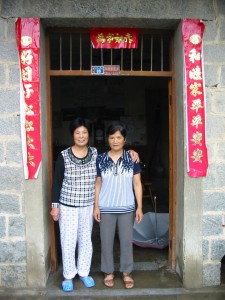
Zhongshan, Tonglu County, Zhejiang, China — In a old wooden home hidden behind Zhongshan’s main street is a place where Ye Xianna, my husband’s 76-year-old grandmother, is quietly putting her trust in Jesus — to protect her against illness.
After sitting with for nearly four hours in the rows of turquoise-colored pews that felt like tiny park benches — witnessing speaking in tongues, singing hymns in Chinese, and preaching on the virtues of Christianity — it was one of the congregation who spoke the most important reason why Ye, like many others in the church, was present that morning.
A senior man in a tan-striped polo shirt and oversized brown pants, with squinty eyes, stubble and a mostly toothless smile, stepped behind the turquoise podium with a blood-red plastic cross attached to it, and began addressing the room.
He was speaking in the local dialect of Tonglu — one of the thousands of dialects in China that sounds different from the country’s official Mandarin Chinese — so I couldn’t understand his words, at first. “What is he saying?” I asked Ye, sitting next to me in the pew in a flowered blouse and pants, with her wiry, shoulder-length gray hair tied into two pigtails.
Ye, whose local dialect is better than her Mandarin Chinese, explained it to me as simply as she could: “His arm used to hurt. Then he believed in Jesus, and it stopped hurting.”
Her simple words spoke a powerful idea: that Jesus heals, literally.
And for many churchgoing senior citizens in China’s countryside, like Ye, it’s the one thing they can count on in the face of a rural healthcare system that is still far from ideal. Continue reading “For Many of China’s Rural Residents, Health Insurance is Not Enough”