John and I may have lived in a Shanghai district called "Long Peace" -- but nighttime was anything but peaceful once we discovered the nighttime garbage collection.
Changning, the district where I live, may be called “long peace” — but there’s nothing peaceful about evenings in our community.
Every night at 3am, 4am or 5am, so, a garbage truck growls outside of our window, its grrrrrrrrrrrr like the overture to this reckless opera outdoors. Then comes the clang, clang, clang signaling the swift climax, as the garbage lands into its final resting place. This nightly drama has John and I restless — literally.
Are you engaged in China? Consider a visit to Suzhou’s Wedding Gown Street, where bridal beauty of your dreams is a bargain. My tailor-made dress, pictured above, cost only 400 RMB, including a bridal veil and gloves.
When you’re engaged and in China, thoughts of fancy might turn to, well, Suzhou. Not for the traditional Chinese gardens or homes. And not even for photo ops at the pagoda or Tiger Hill. You want Suzhou, because Suzhou is home to a fantastic wedding gown street (苏州婚纱一条街) — where you can get a tailor-made dream for less.
Located on a sprawling block within walking distance of Tiger Hill, Suzhou’s Wedding Gown street has none of the grace of its more famous neighboring attraction. It’s a depressing conglomeration of one- and two-story concrete stores with photoshopped signs and dresses that look dull under cheap fluorescent lighting — almost as if it were the wedding village for jilted fiancees. Yet, there are treasures behind those doors for the patient and persistent bride-to-be — with bargains that’ll have you saying a resounding “I do.”
While SARS plagued China in May 2003, SARS propaganda plagued the TV reels on the bus I took to work (image of 1958 China propaganda from Wikimedia Commons).
The slogan of Oriental Pearl Moving Television — broadcasted on LCD TVs installed in the buses I rode downtown — was this: “you can learn about all of the news under the sun without stepping foot off the bus”.
But during SARS, it was more like: “you can hear all of the SARS propaganda under the sun, without stepping foot off the bus.”
In the thirty minutes or so I spent on the bus, I saw five different spots — repeated at least three times:
1. Moments from real people “on the front lines” fighting against SARS. A woman passes out propaganda sheets about SARS. A public servant examines travelers at the railway station. A factory worker sews up masks. A cleaning lady disinfects subway cars. A little girl washes her hands. A doctor appears in a mask. The ending message? “This is our battlefield. Fight to the end, we’ll certainly be successful.” Continue reading “Chapter 65: SARS Propaganda and False Security”
As a friend goes into quarantine, and the virus closes in on John's hometown in the countryside, I had to learn how to live with the threat of SARS, everyday.
I could have been quarantined.
One of the employees at Alibaba — the Internet company I interviewed at in Hangzhou — contracted SARS while attending the Canton Fair. On her second visit to the hospital, she discovered her illness was no typical flu. And just like that, everyone who worked in Alibaba — and other companies sharing the office building — was put under quarantine in early May, 2003, including John’s high school classmate, Douglas.
I wanted so much to stay in Hangzhou only months before, and work for Alibaba. Weeks after I moved to Shanghai and began work for the global media company, Alibaba even called to offer me the job — which of course I turned down. I came so close to this company. I could have been another casualty of SARS.
First comes SARS, then comes panic, then comes scare-buying. I discover the local pharmacies are all sold out of cleaning alcohol during SARS, and I wonder -- what will be next?
It was mid-May, 2003, in Shanghai — in the midst of the SARS epidemic — and I had just stopped at a pharmacy, to buy some alcohol for disinfecting our home. Or so I thought. “Meiyou — we don’t have any.” The shopkeeper, a matronly woman with a cap of silvery curls, said the words I feared.
I trudged back to our apartment, with the news. “I can’t believe it — they’ve sold out of alcohol!”
John looked towards me, his calm face the opposite of the near-panic and frustration I harbored within. “Scare-buying.” He said it as if he was announcing what we’d have for lunch, or mentioning an interesting news story.
Except there was nothing common about it, to me. “Great.” Here we were in the midst of SARS, and an important tool — alcohol — was now out of my reach.
The SARS epidemic turned China's May holiday into the quietest one I had ever seen, with abandoned streets, shopping centers, and even public transit. (image by zh-wp, courtesy of Wikimedia Commons)
Never had a country of over 1.2 billion people seen such a quiet holiday.
Historically, May 1 began one of China’s “golden weeks” — seven days of unadulterated travel, shopping or even just relaxing with family and friends. Of course, with everyone on break at the same time, travel was either too expensive, too crowded, or too hard to get tickets — and shopping meant you had to elbow your way in with the masses to get a good deal. The holiday, arguably, was a perfect example of the Chinese concept of çƒé—¹ [rènÉ‘o] — the lively, bustling, crowded, fire-breathing nature that is China, home to the descendants of the dragon.
There was no renao on this May 1, in 2003, since the Chinese government had canceled the holiday because of SARS. That cut the usual seven days down to five for most of us — except for John. Continue reading “Chapter 62: The Quietest May Day Ever”
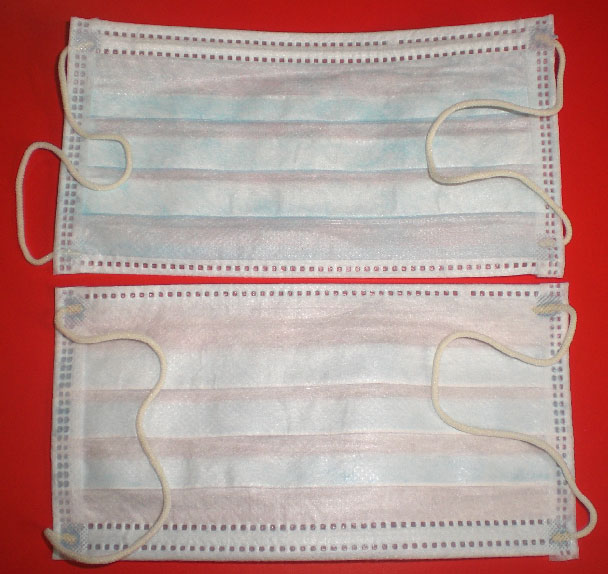
When surgical masks appeared on the faces of coworkers, I knew the SARS panic had infected our office. (image by Blossoma, courtesy of Wikimedia Commons)
You know there’s something wrong when the entire Sales Department starts wearing surgical masks.
That’s what I saw one afternoon on April 22, 2003, after returning to the office from my lunch break. Only Sales hid their faces behind sterilized gauze, turning our office into a corporate version of an ER triage department. And like triage, those of us sitting at our desks were no better than the families awaiting their loved ones in surgery — hiding worries behind a calm countenance.
As we approached the National Day Holiday — a week long national holiday in China from May 1 to May 7 — I had my own concerns. According to the Chinese government, we only technically had five, not seven, days off — even though they gave us a weekend in there somewhere. So that meant we had to sacrifice a weekend before or after the break to “pay” for this. In my case, I’d have to work through the coming weekend, facing a tiring ten-day work week.
“Are you ready for our ten-day work marathon?” I joked to my coworker and trainer, Steve, April 21 — Monday morning — when I came into the office.
Just as SARS began, and panic slowly began to mask the public, it felt odd to be so in love, in China. (Image from www.wired.com)
I’d been working for barely a month in Shanghai, when news of SARS began to spread like the virus itself.
Masks quietly spread around the bus I rode into downtown Shanghai.
The women’s bathroom became our morning decontamination station, as everyone washed their hands more obsessively than Lady MacBeth — over conversations about whether or not to buy face masks.
E-mails about Hong Kong infected my inbox, with seemingly fictional photographs of people muzzled with face masks, and health workers dressed in outfits straight out of the Andromeda Strain.
In Shanghai, my Chinese boyfriend and I were almost as close as husband and wife. All of the signs said we were headed to a wedding -- so why did I have to ask?
There was no history of casual dating in John’s family. His maternal grandmother was a child bride, sent to live with her grandfather’s family when she was seven or eight, without the ability or understanding to contest her fate. She went from being a virginal pre-adolescent to a wife who would immediately bear children.
John’s mother, her daughter, married during the Cultural Revolution, in 1972 — with a “revolutionary marriage certificate,” stamped in red, to prove it. She was never a child bride, but still a stranger to this man, introduced to her through a matchmaker in the village, with a courtship that fast-tracked them straight to a wedding. Marriage was simply a practical matter, solving what the Chinese often refer to as their “personal problem.”
As I began work at the global media company in Shanghai, I discovered that sometimes, the customer is not always right -- and definitely, is not your lover. (image from EEfocus.com)
Silvery electronic components, in a swirling tornado shape. It was an unnatural disaster, against an electric blue background, that actually hoped to spin a tale — a tale of a Chinese manufacturer of electronic components. But the details were lost in the storm of objects, so instead of being informed or interested, I fought to hold back laughter.
It was hard not to laugh in the presence of Steve, a jovial thirtysomething American with a slight paunch, five-o-clock shadow and a shock of short wavy hair that was perhaps the only reminder of his nomadic Dead Head years. Steve had since gone corporate in joining the company, after years of work in public relations and copywriting. He was the Senior Copywriter for the ad production team I just joined in Shanghai, but even the training session he gave me this one morning, on how to write good ads for Chinese advertisers, bordered on comedic monologue — as we looked through the old magazine ads and the handbook, discussing how (or in the case of the vortex of components, how not) to make good ads. Continue reading “Chapter 57: Customers Are Our Lovers”
This website uses cookies to improve your experience. We'll assume you're ok with this, but you can opt-out if you wish.AcceptRejectRead More
Privacy & Cookies Policy
Privacy Overview
This website uses cookies to improve your experience while you navigate through the website. Out of these cookies, the cookies that are categorized as necessary are stored on your browser as they are essential for the working of basic functionalities of the website. We also use third-party cookies that help us analyze and understand how you use this website. These cookies will be stored in your browser only with your consent. You also have the option to opt-out of these cookies. But opting out of some of these cookies may have an effect on your browsing experience.
Necessary cookies are absolutely essential for the website to function properly. This category only includes cookies that ensures basic functionalities and security features of the website. These cookies do not store any personal information.
Any cookies that may not be particularly necessary for the website to function and is used specifically to collect user personal data via analytics, ads, other embedded contents are termed as non-necessary cookies. It is mandatory to procure user consent prior to running these cookies on your website.