
Chapter 40: Negotiating For My Life in China

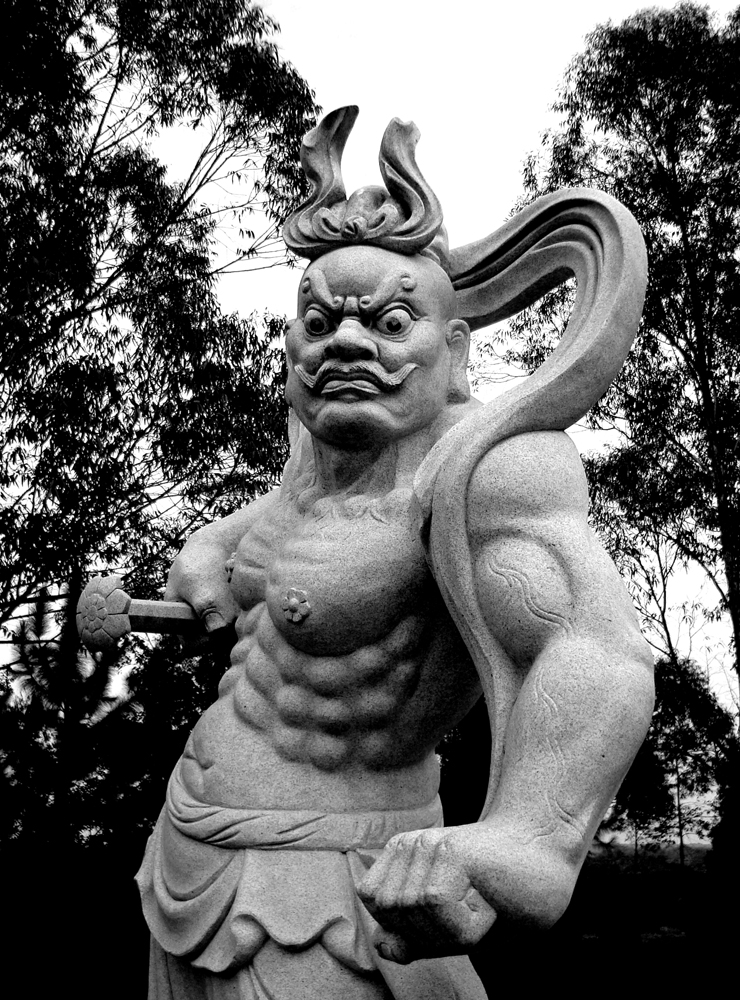
Chinese warrior statue

Chinese warrior statue
Going to negotiate with my Chinese boss, Mr. CEO, felt like facing a barbarous warrior.

After Mr. CEO had massacred my job and visa, I didn’t know how to negotiate with him. In my mind, he had become another Cao Cao — the barbarous warlord of Romance of the Three Kingdoms. I’d imagined our meeting on January 22, 2003 again and again — how he shot me down into a timorous, tearful woman.

But this would be different. Just as the sensitive Liu Bei, the compassionate leader of the Kingdom of Shu in the Three Kingdoms, had his strategist, Zhuge Liang, so I had John, my Chinese boyfriend. John didn’t have the arresting appearance of a warrior — but he had an arresting sense of justice. This moved him to challenge the stone factories in his hometown. Now, he wanted to help me challenge my boss.

The night before, he turned my apartment into battle headquarters, where we developed a list of demands for Mr. CEO. If I was to go to Hong Kong for a visa renewal, we wanted Mr. CEO to pay. We expected a guarantee on my company apartment, to stay until the end of February, and my salary for January. And, finally, John added what might just be the most wishful demand of all — an apology. “I’ll accompany you tomorrow, as a witness,” John promised.

Tomorrow morning, John and I advanced into enemy territory — Mr. CEO’s office. Continue reading “Chapter 40: Negotiating For My Life in China”

Chapter 39: On the Border, at the Public Security Bureau

PRC Police Station
I was on the legal border when I went to the Public Security Bureau, after my visa had expired for two days. (Photo courtesy of Wikipedia, user Gzdavidwong)

Leaving Mr. CEO’s office, after he told me — indirectly — that I no longer had a job (and, by extension, no visa or apartment), was like a march to an exile to China’s far West, just as the country used to do for its rogue criminals. I used to be a part of Mr. CEO’s inner circle. But, now, I could have been in a border town, for all he cared.

I might need to run for the border, in fact. The morning of January 23 — one day after that confrontation with Mr. CEO — I finally retrieved my passport from the secretary, only to find it expired January 21, two days ago. I was now illegal.

When you’re illegal, you do desperate things — like leaving the workplace entirely, without informing anyone (except for my closest friend, Caroline). John, who I had called the day before, returned from his hometown the morning of January 23 just to help me. Once I received his call, I quietly dashed out of the office, down the stairs, to meet him and make the march together — to the Public Security Bureau (PSB). Continue reading “Chapter 39: On the Border, at the Public Security Bureau”

Chapter 38: No Job, No Visa

Getting the axe from your job
My job and visa in China got slaughtered during one brutal afternoon conversation.

Jing Ke, sent by the Yan State to assassinate Qin Shihuang (the despotic future emperor of the first united China, under the Qin Dynasty), knew he was heading to his own slaughter. He wrote, in his poem titled “On Yi River Ferry” (渡易水歌):

Winds moan, Yi water chilly,
风萧萧兮易水寒,
Warrior once gone, never again return.
壮士一去兮不复还.

He knew the warrior — himself — would never come back. He knew what would happen.

I should have known my job at the Chinese Internet company would be slaughtered.

By early January, my contract had already expired. Yet, Mr. CEO refused to discuss my contract, shooing me away. “Sorry, I have other matters to attend to now.” He said something like this every time I breached the subject with him.

The secretary, who had processed my visa before, let my paperwork sit idle on her desk. By January 22, 2003, she had still done nothing — while I began to wonder if my visa was even valid.

But the most piercing evidence came from the company website. I opened it up on January 22, to find new English content written by someone else, instead of me.

Just as Jing Ke faced Qin Shihuang, so I faced Mr. CEO, the afternoon of January 22 — a standoff that felt more like a slow execution. Continue reading “Chapter 38: No Job, No Visa”

China Blogs by Western Women who Love Chinese Men

Western women who love Chinese men
Some Western women who love Chinese men can blog too. Let’s celebrate these unique voices on the web!

(NOTE: For the most up-to-date list of these blogs, read my 2018 update of this list)

March is women’s history month, and just last week, March 8 was international women’s day. As we remember the women who make a difference in our world, there’s one minority voice we shouldn’t forget — the Western women who love Chinese men.

China blogs are still a man’s world, so our voices are often lost in the comments and trackbacks. But Western women who love Chinese men have a unique perspective to a woman’s experience in China — which makes their blogs even more valuable in the blogsphere. Here’s my list, in alphabetical order (according to the blog’s name). Continue reading “China Blogs by Western Women who Love Chinese Men”

Ask the Yangxifu: Indirect Dating and Chinese Men

Western woman and Chinese man
How do you know if a Chinese man wants to date you -- or is dating you?

Anonymous asks:

I am an American female and began an international graduate program this January here in the US. Most of my classmates are foreign and I’ve gotten the attention from a Chinese male. There is a good chance our relationship is going to blossom, so I have a few questions for you.

At first, it didn’t dawn on me that he was interested, so he stepped it up a notch. He started waiting for me after class, sitting near me in class and initiating conversations. We have spent some time together outside of class. Our most recent encounter was a trip to the movies, where he picked me up and got a chance to meet my grandfather (he was very excited to meet Grandpa). He is currently on a trip for spring break and has phoned me a few times.

Here is the kicker and where my questions come in. He is very indirect. While I’m 99% sure he is courting me, he has never expressed in words his desire to date me (although it is still early). Should I wait for him to initiate that conversation? Additionally, he asks questions in a very indirect manner. For example, instead of asking if he can walk walk with me to the library, he asks where I am going next… I think it is a combination of his culture combined with being male haha. His English is also very choppy, so we have a communication barrier. I do not speak or read Chinese at all.

His indirectness combined with limited knowledge of the English language is difficult for me to understand his intentions at times (especially when he is hinting that he’d like to get together). I am an outgoing and honest person, so it’s difficult for me to know how to react to him. He is also very introverted and independent, kind of a homebody.


I guess I’m writing you for some advice. I don’t want to be too forward by asking him direct questions or disclose too much information that may turn him off. My instincts are telling me to find the balance between expressing interest and letting things happen naturally. I don’t know him well enough yet to know how I feel about him, but so far he’s caught my attention. Any advice/suggestions would be helpful. Continue reading “Ask the Yangxifu: Indirect Dating and Chinese Men”

Chapter 37: Forgotten Workers and Contracts

Lonely person standing at a sunrise
My Chinese Internet company had a history of forgetting workers and contracts. And, soon, it would forget me, too.

By January 14, 2003, the Chinese Internet company where I worked had already begun taking its first steps towards a possible listing on the Hong Kong stock market. But on that same day, I had only begun to take my first steps into the workplace — after two weeks of recovery from a sprained ankle.

And some people, on the other hand, had taken their last steps at work. Such as Ayi Zhong, the fiftysomething woman with a cap of salt-and-pepper hair who cleaned my apartment once a week, and the company offices several times a week.

She told me about it the evening of January 14, when I found her arranging my apartment, as she did every week. “The new office is twice the size of the old place, but they would not increase the salary.” The company only paid her 250 yuan (almost $37) a month, a pittance for her services.

Still, Ayi Zhong wasn’t the only company casualty. Continue reading “Chapter 37: Forgotten Workers and Contracts”

Interview on China Travel 2.0

Jocelyn Eikenburg in Xintiandi, Shanghai
China Travel 2.0 interviewed me about travel to China, my China impressions and more.

Winser Zhao of China Travel 2.0 interviewed me, and the article — called Meet a Yangxifu and Ask for More About China – Jocelyn and Her Love Story — just appeared on their blog today. Some of the things I talk about include:

  • My first impressions/experiences in China
  • Why I love China
  • How I learned Chinese
  • My Chinese inlaws’ first impressions of me
  • My own travel experiences, and advice on traveling in China

If you have a chance, have a look. And if you like what you read, feel free to share with your friends.

Thanks, as always, for reading. 🙂 And special thanks to Winser Zhao for thinking of me for this interview.

Travel China with the Yangxifu: Yuelu Academy and Yuelu Mountain, Changsha

The grounds of Yuelu Academy in Changsha, Hunan
Yuelu Academy -- built at the foot of Yuelu Mountain -- is a refreshing, and even inspiring, retreat for any China traveler.

When I think of Yuelu Academy — one of China’s oldest academic institutions — I think of peace, and the peaceful moment my Chinese husband, John, and I had there one afternoon. We strolled in and out of galleries and open-air courtyards, until we came upon a tiny courtyard nestled in a corner with a 100-year old Chinese privet. The privet rained its fragrance — from the tiny, yellow star-shaped flowers — all over the courtyard, filling the air with a rare sweetness on a sultry summer afternoon. I breathed it all in, feeling a sense of renewal, as if this was the very scent of inspiration.

Inspiration seems central to Yuelu Academy. Like all of China’s academies of classical learning (institutions where scholars could teach and study the Chinese classics), the planners for Yuelu chose a remote, picturesque setting for the academy, establishing its network of Chinese-style courtyards and open classrooms on the Eastern side of Yuelu Mountain beginning in 976. Such a place offered a quiet, meditative environment conducive to the study of Confucian classics.

Today’s Yuelu Academy is tucked within a neighborhood surrounding the modern university that has continued its legacy — Hunan University. While the remoteness seems a memory, the picturesque quiet still remains, like the venerable trees blanketing the school grounds. Continue reading “Travel China with the Yangxifu: Yuelu Academy and Yuelu Mountain, Changsha”

Chapter 36: Leaning on Your Chinese Friends and Lovers

Western woman and Chinese woman, leaning on each other
When you're helpless in China -- because of language, or even a sprained foot -- sometimes all you can do to survive is lean on your friends

When you live as a foreigner in China, sometimes you can’t help but feel like a child. Maybe it’s because you can’t speak the language — or stumble through it, like a toddler playing with sounds and words. Maybe it’s because you don’t read the signs, and feel as lost as a little kid, abandoned by their parents in a strange world. Maybe it’s the culture, where you commit the sort of faux pas that your parents would have admonished you about after visiting grandma’s house.

And, maybe, it’s because you depend on your Chinese friends and lovers so much, that they become your caregivers all over again.

When my left ankle was put into a cast — after clumsily spraining it outside a shopping center in Hangzhou — the hospital had no crutches, and no protective sheath that would allow me to walk outside. I had leaned on my Chinese friend Chris for a lot of things before — advice, Chinese lessons, help at the hospital — but now I leaned on him, physically, just to leave the hospital grounds.

Yet, leaning could only take me so far. Continue reading “Chapter 36: Leaning on Your Chinese Friends and Lovers”

Chapter 35: The Wrong, Painful Step

Shoe stepping into the water
Sometimes, you lose your way in China, and one small step can change your life.

When you live in a foreign country like China, it’s easy to get lost, to stumble, to make a wrong turn. But the wrong turn — or step — can cost you your time, your health or even, your trip to Hong Kong.

On the evening of December 28, 2002, I took the wrong step outside of a shopping center in downtown Hangzhou. It was the kind of place I shouldn’t have even been — a dark alley right beside the center, littered with the sort of unpatched, gaping potholes that just didn’t match the gleaming glass facade of the new building. I’d already lost my sense of place on the way there, when I missed the closest bus stop and had to walk 15 minutes to backtrack to the shopping center. The dark and disorientation merged together, right there in that alley. And then it happened — one step sent me tumbling face down to the concrete, sending a sharp pain through my left ankle. I was so stunned that, for a few moments, I couldn’t even stand. But I finally did get up, because no one was there to rescue me.

No one was there to shield me, either, from the perils of being alone on an evening in China. Continue reading “Chapter 35: The Wrong, Painful Step”