Chapter 34: Love in the Time of Stomach Inflammation

IV drip
Sometimes you hope for romance in China -- and instead, you end up with an IV drip, and your Chinese boyfriend caring for you.

When you’re in love, and only see each other every two weeks, on the weekends, you romanticize every meeting. You want it to be as perfect as a Tang-dynasty couplet, and script out the possibilities even before your lover arrives. You practice a new phrase, such as wàngchuānqiūshuǐ (望穿秋水 – awaiting you with great anxiety), to say when he comes, and might just even stand on the streets with roses to greet him — just as I had before.

After my painful meeting with Mr. Fang, I romanticized the arrival of John, my Chinese boyfriend, on the weekend of December 13, 2002, even agreeing to meet John at the Hangzhou railway station, as if I was starring in some dramatic reunion scene in a movie.

Except, real life often departs from your own script. Sometimes, you hope for romance — and what you get, instead, is stomach inflammation.

I should have felt it coming, the way I inexplicably collapsed into his arms during the taxi ride home. It wasn’t like me to feel so drained. I expected it was simply the lingering stress of Mr. Fang’s confrontation, weighing on my exhausted frame. A good night’s sleep, with John, my Chinese boyfriend, by my side, would surely restore me.

Or not. Continue reading “Chapter 34: Love in the Time of Stomach Inflammation”

Chapter 33: My Chinese Boyfriend’s Dormitory Despair

Door in a Chinese university
John, my Chinese boyfriend, was left in the dark at university when he faced a semester of dormitory despair.

While I faced a spamming dilemma in my company in Hangzhou, my Chinese boyfriend, John, faced a dormitory dilemma at his university in Shanghai.

John lived in a men’s graduate dormitory on campus, an older brick building with four floors that stood next to the school cafeteria. John’s initial dorm room, on the second floor, had a window perched just above some large fan or boiler unit for the cafeteria that looked like a large white mushroom made of metal.

John didn’t mind sharing a room with three others, or the smell of the drab, institutional bathrooms, or even the usual 11pm lights-out, power-off policy typical of a Chinese university. But he did mind the noise of the cafeteria — from that strange unit outside the window — which disrupted his sleep every morning, around 4:30am. Continue reading “Chapter 33: My Chinese Boyfriend’s Dormitory Despair”

Chapter 32: To Spam or Not To Spam

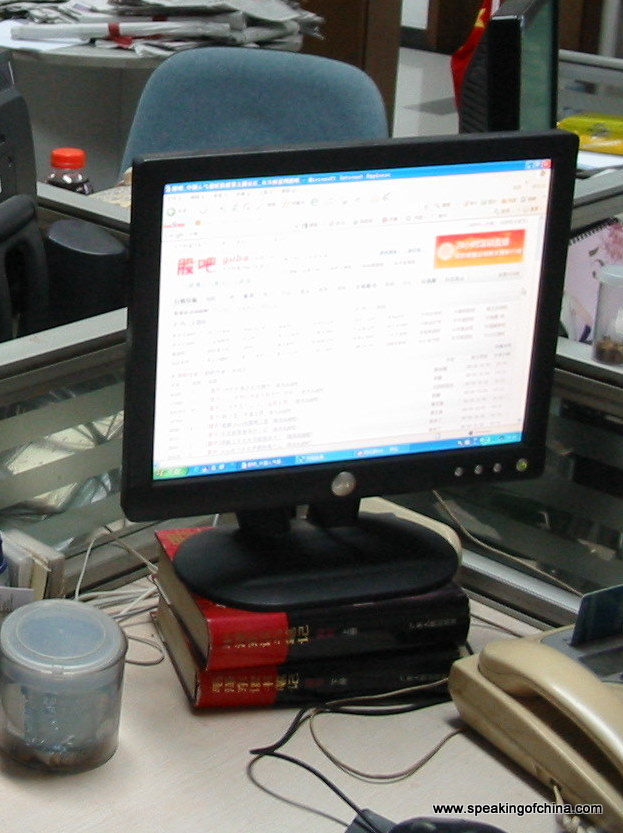
Computer screen in China
To spam or not to spam? That was my dilemma, after the company asked me to do some "international marketing."

By December 2002, I had seen a lot of things at the Chinese Internet company in Hangzhou, where I worked. But spamming wasn’t one of them — until, in mid-December, when my supervisor, Mr. Fang, had a talk with me.

I was already worried when Mr. Fang asked me to follow him to the conference room. And, after I nervously slid into one the black chairs surrounding the solid black conference table, Mr. Fang did nothing to quell my fears.

“So, I was wondering if you could tell me about what activities you’ve been doing at work these days. Ideally, if you could tell me, down to the hour, that would be great.”

It was the kind of thing that “consultants” usually asked, before recommending an employee’s dismissal — except I was the employee, and Fang was no consultant, but my supervisor. “Is there a problem?”

Fang smiled — a meaningless workplace kind of smile that is either there to comfort others, or simply mask the unfathomable emotions within. Either way, I didn’t know where this was going, until Fang spoke the words. “Well, actually, we have a new task for you. International marketing.”

International marketing? Continue reading “Chapter 32: To Spam or Not To Spam”

Chapter 31: An Unintended Splash at the Hangzhou Pool

As a foreigner in China, sometimes you touch people in ways you never realized. Something you say or do in a moment — a small, forgettable thing to you — becomes a lasting impression to someone else.

I didn’t think much about swimming at the Chenjinglun pool in Hangzhou. I’d been going there since September. By early December, 2002, it was just a part of my routine — a way to get some exercise, while my usual gym was closed for renovation.

Chenjinglun was a typical indoor pool in China. It had lanes roped off for lap swimming. Yet, with the evening demand, you often shared a lane with as many as two or three people. I didn’t mind the sharing. But more people together means more collisions — such as getting clipped by a scissor kick, or clobbered by a front crawl.

That’s why my swimming routine also included flexing my language muscles. Because, if anyone got too close to me, or bumped me, I’d let them know with a firm, but polite, “Xiaoxin!” (Be careful) It was simply communication, acting as my lifeguard.

But, in fact, it’s not so simple when you’re a foreigner, speaking Chinese in China. Continue reading “Chapter 31: An Unintended Splash at the Hangzhou Pool”

Chapter 30: One Lonely, Post-Thanksgiving Saturday in China

I wanted it to be just another Saturday — as it was to my Chinese coworkers. I rode the number 44 bus to the office, as always. I took the elevator up to floor 12. And when I came to my desk, there was my ex-Chinese boyfriend, Frank, still sitting next to me, as usual.
In a strange way, even Frank’s presence was more comfortable than the truth — that I was lonely, because two days had passed since Thanksgiving, with no sign of a holiday.

This wasn’t the first time I hadn’t celebrated Thanksgiving in China. Last year, in 2001, when I still worked for the NGO, I didn’t celebrate, either. Of course not — I was so entangled in the painful imbroglios that eventually drove me to quit by mid-December, that I had to put aside the pleasures of ordinary life. Including holidays.

But, things had changed. Continue reading “Chapter 30: One Lonely, Post-Thanksgiving Saturday in China”

Chapter 29: An Indecent English Teaching Proposal

When you’re a foreigner in China, the most common phrase you might hear is: “Can you teach me English?” Your foreign face is like a walking advertisement that new friends or friends of friends can’t help but answer — because they live in a world where English could determine their future, or change their destiny.
Chinese must study English to pass the college entrance exam. In college, Chinese must pass the band-four English exam to get a four-year diploma. With good English, a Chinese could study abroad — leading to a new life in a new country, or a prestigious job upon returning to China — or build their career in a multinational company. To the Chinese — especially Chinese parents — learning English can change lives and fortunes.

And sometimes, you, as a foreigner, have the fortune — good or bad — to meet someone who wants you…to teach English.

My next-door neighbor, Zhang, asked me to teach her English the first day we met — and she discovered she had a foreigner living across the hall. Continue reading “Chapter 29: An Indecent English Teaching Proposal”

Chapter 28: Of Chinese Medicine and Balance

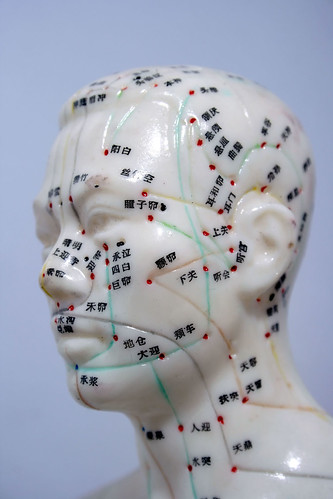
In Chinese traditional medicine, there is a saying: anger hurts your liver, melancholy hurts your lungs, thinking hurts your spleen, happiness hurts your heart. The thing is, we are all angry, melancholy, happy, or just thinking at different times in life. What hurts is when we do it too much, without balance.

John, my Chinese boyfriend, thinks my life has lost balance, ever since our time together during National Day — and my health hasn’t been the same.

My back and neck felt unusually sore after an evening swim Friday, October 11. The pain lingered uncomfortably for over a week, even after I received Chinese medical massage. So when John came in the weekend of October 18, he took me to the hospital for an X-ray.

“Your neck has straightened out,” the doctor said to me, looking at the black-and-white photo illuminated in his office. All of those days in the office, sitting at an office chair before a desk, had hurt my neck.

But once John and I left the doctor’s office, it was as if the doctor was still in — the doctor of Chinese traditional medicine and wisdom. Continue reading “Chapter 28: Of Chinese Medicine and Balance”

Chapter 27: I Don’t Need Your Mianzi

Character for good fortune
I didn't need mianzi from the family of the famous calligrapher, Tang.

Tang, the famous calligrapher and painter, and his wife, Zhang — my next door neighbors — lived a world as intentional as the eccentric style of Tang’s calligraphy scrolls that decorated the walls of their apartment. Tang painted and wrote calligraphy, often for dignitaries, officials, the elite — and they reciprocated lavishly. How did I know? Because Zhang told me, whenever I saw her in the hallway between our doors.

Renjia songde — a gift from others,” she would tell me, her lips pursed smugly as she held up the latest swag — from Amway vitamins to the expensive, first harvest green teas, all from the endless stream of guests that the couple entertained most weekends. Sometimes she would blather on about a free trip somewhere, such as an upcoming visit to Huangshan that included a river cruise.

Personally, I didn’t need Zhang — or even Tang — to talk about all of their gifts or free trips or extra apartments in the city. I already respected Tang as an artist. He was the one who memorialized my first date with John at the West Lake, in a painting. But I suspected Zhang couldn’t help it — as the wife of a famous artist, his fame and glory was all that she had, and all that she could feel proud of. There was a sad, lonely woman behind the swag. So I would stand there, smile and nod, as if I was a parent who knew better, listening to a child.

But I could do more than listen. Continue reading “Chapter 27: I Don’t Need Your Mianzi”

Chapter 26: Hello, Foreigner – and Goodbye, Generosity

Western woman hiding behind a mooncake box
Sometimes, you misunderstand China, or China misunderstands you. And all you can say is, I'm sorry.

As October 2002 went on, I fell deeper in love with my Chinese boyfriend, John, and found a new sense of belonging through lunches with Zhang Bin.

Yet, was I just fooling myself, to think I could masquerade as a local? I am a foreign woman. My face, hair and larger, curvier body made me a curiosity, no matter how standard my Mandarin pronunciation was.

I wasn’t a curiosity to Jason, an old college classmate of John’s that we met during the National Day holiday, on the way to our favorite restaurant near my apartment. I had met John’s xiongdi — “brothers,” or close friends — once before. Ever since then, I loved knowing anyone with a connection to John, and Jason seemed nice enough. We exchanged phone numbers, with the suggestion we might meet for lunch sometime. “I could practice my Chinese with him,” I whispered to John, as we walked in the other direction down the street, after meeting Jason. Continue reading “Chapter 26: Hello, Foreigner – and Goodbye, Generosity”

Chapter 25: No Chinese, No American, Just Lunch

Stir-fried chinese vegetables
John, my Chinese boyfriend, wasn't the only one who could make me feel less foreign in China.

When you have a Chinese boyfriend, you have a strange sensation, perhaps the first since your arrival to China — that maybe you’re not so foreign, or so different. The way John spoke to me, and cared for me, made me feel — if only for a moment here and there — that we were equals.

Yet after he left, I began to see that it wasn’t just John who had the capacity to see past my foreign face.

“We shouldn’t see each other as a Chinese and an American.” Those were the words of Zhang Bin, a friend who lived across the street from our office — and who agreed to make lunch with me during the weekdays.

Lunch had been a headache for me ever since I entered the company. The boxed lunches delivered daily to the office were too greasy, and had few vegetables to satisfy a vegan, driving me to find lunch alternatives outside the building. I found them in a variety of restaurants — from a local Zhejiang specialty restaurant to a Japanese noodle house — but usually had to enjoy lunch alone. Continue reading “Chapter 25: No Chinese, No American, Just Lunch”