Chapter 43: Going to John’s China Hometown

Mountains in the countryside of Zhejiang Province
John's ancestors come from the area near Huangshan -- one of China's most impressive mountains. But his family lives in a countryside ravaged by economic development, worlds away from what his ancestors knew. (pictured: me before the fields opposite John's home, Chinese New Year 2003)

“五岳归来不看山,黄山归来不看岳” — After China’s Five Sacred Mountains, you needn’t see another mountain; after Huangshan, you needn’t see China’s Five Sacred Mountains.

John loves this expression, and has told it to me many times in our relationship. There is truth to it. Huangshan is an impressive mountain, and has a greater scale than China’s Five Sacred Mountains — Songshan, Hengshan, Hengshan, Huashan, and Taishan. But many would argue that the Five Sacred Mountains have their own beauty, and a beauty worth seeing, even if you have visited Huangshan. I don’t mention this to John, because I know his words say more about him than Huangshan. He loves Huangshan, because his relatives lived in the shadow of its enormous spires. His people are mountain people, and come from a mountain that claims to overshadow the rest.

Though he didn’t grow up at the feet of Huangshan, he was born and raised in the mountains just southeast of Huangshan. On the top level of a double-decker bus, on a sultry summer evening in 2002, he turns to me and speaks of the beauty of the mountains in his hometown. “My hometown is a tourist destination,” he says proudly. He tells me it is Tonglu, but I have never heard of it. “We have mountains, rivers, and caves,” he says. And then he smiles gently and adds this: “You’re welcome to visit anytime.”

I don’t visit his village until six months after that — during Chinese New Year, 2003. Continue reading “Chapter 43: Going to John’s China Hometown”


Chapter 42: New Clothes for Chinese New Year

Chinese tangzhuang silk jacket
I wanted a new beginning in Chinese New Year. So, I made an outfit to make a good impression on John's parents, and, later, a new job.

In Chinese New Year, wearing new clothes means a new beginning. Before Chinese New Year in 2003, I desperately needed a new beginning — because I’d lost my job at the Chinese Internet Company, and I was about to meet John’s parents.

After the remark from John’s father — that foreign women make good friends, not girlfriends — I needed something to make a fresh start with his family. That’s what I told Caroline, my Chinese friend, days before John and I would travel to his countryside home. We had just had dinner together that evening, and on our post-meal stroll, came across the tiny, brightly-lit store of a tailor I knew all too well.

My eyes twinkled like a child before the tantalizing toys in a Christmas store window display. “She’s the one who made my qipao.” The same qipao I wore for my birthday celebration the summer John and I fell in love. “Let’s go inside and take a look.” Continue reading “Chapter 42: New Clothes for Chinese New Year”

Chapter 41: Losing Jobs and Gaining Chinese Friends

night walk in China
Sometimes, your Chinese friends -- and exes -- surprise you. During an evening walk, after cleaning out my desk, I discovered a surprising understanding from Frank, my ex-Chinese boyfriend.

Just as I lost my job and visa, Frank, my ex-Chinese boyfriend, was being groomed for management by Mr. CEO. The company rescued his desk from the impersonal production room, and safeguarded him behind the protective, sunshine-lit walls of a small office beside his. Frank and I had long had walls between us — but now, we could finally see them.

I wanted to stay far from Frank after my job and visa crisis. I didn’t see how he would understand me. He didn’t when we dated before, letting our relationship turn bitter like a neglected glass of green tea. Now that he and Mr. CEO all but drank from the same cup, how could Frank and I ever get beyond the shards of our past?

On January 28, 2003, I visited the Chinese Internet company in the afternoon, to remove sensitive information from my computer. I ducked into my cubicle in the production room, slouching in the corner in the hopes nobody — especially Frank — would see me there. Continue reading “Chapter 41: Losing Jobs and Gaining Chinese Friends”

Chapter 40: Negotiating For My Life in China

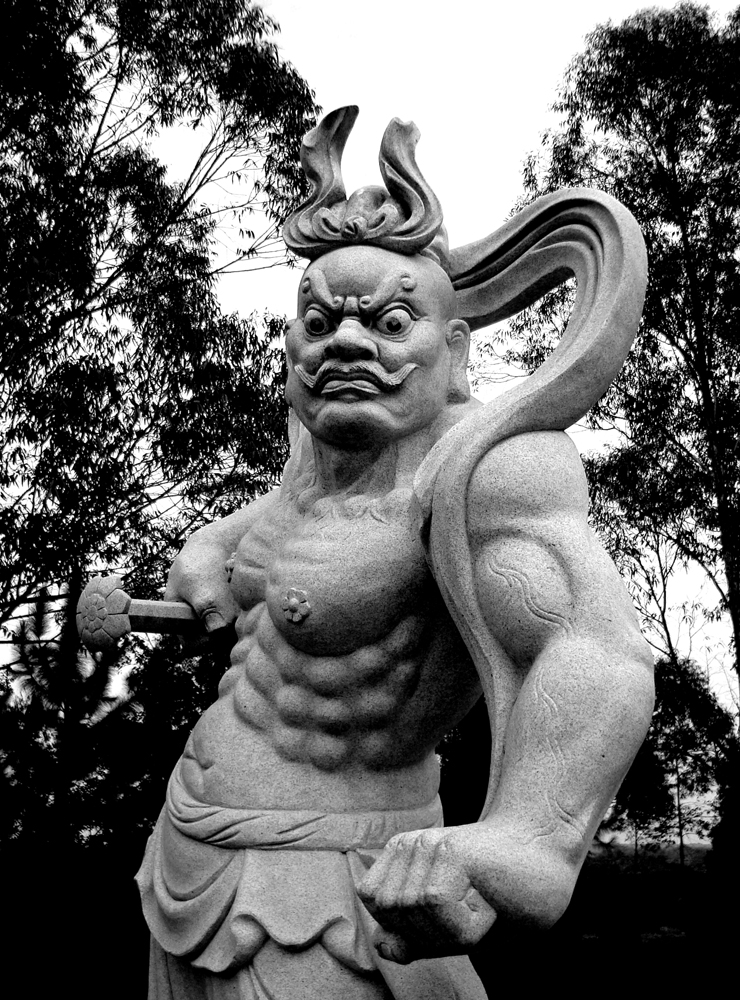
Chinese warrior statue

Chinese warrior statue
Going to negotiate with my Chinese boss, Mr. CEO, felt like facing a barbarous warrior.

After Mr. CEO had massacred my job and visa, I didn’t know how to negotiate with him. In my mind, he had become another Cao Cao — the barbarous warlord of Romance of the Three Kingdoms. I’d imagined our meeting on January 22, 2003 again and again — how he shot me down into a timorous, tearful woman.

But this would be different. Just as the sensitive Liu Bei, the compassionate leader of the Kingdom of Shu in the Three Kingdoms, had his strategist, Zhuge Liang, so I had John, my Chinese boyfriend. John didn’t have the arresting appearance of a warrior — but he had an arresting sense of justice. This moved him to challenge the stone factories in his hometown. Now, he wanted to help me challenge my boss.

The night before, he turned my apartment into battle headquarters, where we developed a list of demands for Mr. CEO. If I was to go to Hong Kong for a visa renewal, we wanted Mr. CEO to pay. We expected a guarantee on my company apartment, to stay until the end of February, and my salary for January. And, finally, John added what might just be the most wishful demand of all — an apology. “I’ll accompany you tomorrow, as a witness,” John promised.

Tomorrow morning, John and I advanced into enemy territory — Mr. CEO’s office. Continue reading “Chapter 40: Negotiating For My Life in China”

Chapter 39: On the Border, at the Public Security Bureau

PRC Police Station
I was on the legal border when I went to the Public Security Bureau, after my visa had expired for two days. (Photo courtesy of Wikipedia, user Gzdavidwong)

Leaving Mr. CEO’s office, after he told me — indirectly — that I no longer had a job (and, by extension, no visa or apartment), was like a march to an exile to China’s far West, just as the country used to do for its rogue criminals. I used to be a part of Mr. CEO’s inner circle. But, now, I could have been in a border town, for all he cared.

I might need to run for the border, in fact. The morning of January 23 — one day after that confrontation with Mr. CEO — I finally retrieved my passport from the secretary, only to find it expired January 21, two days ago. I was now illegal.

When you’re illegal, you do desperate things — like leaving the workplace entirely, without informing anyone (except for my closest friend, Caroline). John, who I had called the day before, returned from his hometown the morning of January 23 just to help me. Once I received his call, I quietly dashed out of the office, down the stairs, to meet him and make the march together — to the Public Security Bureau (PSB). Continue reading “Chapter 39: On the Border, at the Public Security Bureau”

Chapter 38: No Job, No Visa

Getting the axe from your job
My job and visa in China got slaughtered during one brutal afternoon conversation.

Jing Ke, sent by the Yan State to assassinate Qin Shihuang (the despotic future emperor of the first united China, under the Qin Dynasty), knew he was heading to his own slaughter. He wrote, in his poem titled “On Yi River Ferry” (渡易水歌):

Winds moan, Yi water chilly,
风萧萧兮易水寒,
Warrior once gone, never again return.
壮士一去兮不复还.

He knew the warrior — himself — would never come back. He knew what would happen.

I should have known my job at the Chinese Internet company would be slaughtered.

By early January, my contract had already expired. Yet, Mr. CEO refused to discuss my contract, shooing me away. “Sorry, I have other matters to attend to now.” He said something like this every time I breached the subject with him.

The secretary, who had processed my visa before, let my paperwork sit idle on her desk. By January 22, 2003, she had still done nothing — while I began to wonder if my visa was even valid.

But the most piercing evidence came from the company website. I opened it up on January 22, to find new English content written by someone else, instead of me.

Just as Jing Ke faced Qin Shihuang, so I faced Mr. CEO, the afternoon of January 22 — a standoff that felt more like a slow execution. Continue reading “Chapter 38: No Job, No Visa”

Chapter 37: Forgotten Workers and Contracts

Lonely person standing at a sunrise
My Chinese Internet company had a history of forgetting workers and contracts. And, soon, it would forget me, too.

By January 14, 2003, the Chinese Internet company where I worked had already begun taking its first steps towards a possible listing on the Hong Kong stock market. But on that same day, I had only begun to take my first steps into the workplace — after two weeks of recovery from a sprained ankle.

And some people, on the other hand, had taken their last steps at work. Such as Ayi Zhong, the fiftysomething woman with a cap of salt-and-pepper hair who cleaned my apartment once a week, and the company offices several times a week.

She told me about it the evening of January 14, when I found her arranging my apartment, as she did every week. “The new office is twice the size of the old place, but they would not increase the salary.” The company only paid her 250 yuan (almost $37) a month, a pittance for her services.

Still, Ayi Zhong wasn’t the only company casualty. Continue reading “Chapter 37: Forgotten Workers and Contracts”

Chapter 36: Leaning on Your Chinese Friends and Lovers

Western woman and Chinese woman, leaning on each other
When you're helpless in China -- because of language, or even a sprained foot -- sometimes all you can do to survive is lean on your friends

When you live as a foreigner in China, sometimes you can’t help but feel like a child. Maybe it’s because you can’t speak the language — or stumble through it, like a toddler playing with sounds and words. Maybe it’s because you don’t read the signs, and feel as lost as a little kid, abandoned by their parents in a strange world. Maybe it’s the culture, where you commit the sort of faux pas that your parents would have admonished you about after visiting grandma’s house.

And, maybe, it’s because you depend on your Chinese friends and lovers so much, that they become your caregivers all over again.

When my left ankle was put into a cast — after clumsily spraining it outside a shopping center in Hangzhou — the hospital had no crutches, and no protective sheath that would allow me to walk outside. I had leaned on my Chinese friend Chris for a lot of things before — advice, Chinese lessons, help at the hospital — but now I leaned on him, physically, just to leave the hospital grounds.

Yet, leaning could only take me so far. Continue reading “Chapter 36: Leaning on Your Chinese Friends and Lovers”

Chapter 35: The Wrong, Painful Step

Shoe stepping into the water
Sometimes, you lose your way in China, and one small step can change your life.

When you live in a foreign country like China, it’s easy to get lost, to stumble, to make a wrong turn. But the wrong turn — or step — can cost you your time, your health or even, your trip to Hong Kong.

On the evening of December 28, 2002, I took the wrong step outside of a shopping center in downtown Hangzhou. It was the kind of place I shouldn’t have even been — a dark alley right beside the center, littered with the sort of unpatched, gaping potholes that just didn’t match the gleaming glass facade of the new building. I’d already lost my sense of place on the way there, when I missed the closest bus stop and had to walk 15 minutes to backtrack to the shopping center. The dark and disorientation merged together, right there in that alley. And then it happened — one step sent me tumbling face down to the concrete, sending a sharp pain through my left ankle. I was so stunned that, for a few moments, I couldn’t even stand. But I finally did get up, because no one was there to rescue me.

No one was there to shield me, either, from the perils of being alone on an evening in China. Continue reading “Chapter 35: The Wrong, Painful Step”

Chapter 34: Love in the Time of Stomach Inflammation

IV drip
Sometimes you hope for romance in China -- and instead, you end up with an IV drip, and your Chinese boyfriend caring for you.

When you’re in love, and only see each other every two weeks, on the weekends, you romanticize every meeting. You want it to be as perfect as a Tang-dynasty couplet, and script out the possibilities even before your lover arrives. You practice a new phrase, such as wàngchuānqiūshuǐ (望穿秋水 – awaiting you with great anxiety), to say when he comes, and might just even stand on the streets with roses to greet him — just as I had before.

After my painful meeting with Mr. Fang, I romanticized the arrival of John, my Chinese boyfriend, on the weekend of December 13, 2002, even agreeing to meet John at the Hangzhou railway station, as if I was starring in some dramatic reunion scene in a movie.

Except, real life often departs from your own script. Sometimes, you hope for romance — and what you get, instead, is stomach inflammation.

I should have felt it coming, the way I inexplicably collapsed into his arms during the taxi ride home. It wasn’t like me to feel so drained. I expected it was simply the lingering stress of Mr. Fang’s confrontation, weighing on my exhausted frame. A good night’s sleep, with John, my Chinese boyfriend, by my side, would surely restore me.

Or not. Continue reading “Chapter 34: Love in the Time of Stomach Inflammation”