Travel China with the Yangxifu: Mao Zedong’s Childhood House, Shaoshan, Hunan

Mao Zedong's Childhood Home, Shaoshan, Hunan Province
Chairman Mao's Childhood Home in Shaoshan, Hunan is a delightful pastoral retreat from the city.

Nestled in the sun-kissed hills of central Hunan, there’s an ordinary yellow mud-brick peasant house with a not-so-ordinary neighbor — a permanent People’s Liberation Army guard station.

That humble — and now fortified — abode was laojia (老家, home) to one of China’s most commanding (and controversial) figures of the 20th century: Mao Zedong.

In a China hell-bent on modernization and the the whole idea of “out with the old, and in with the new” (旧的不去,新的不来), Mao’s home offers a delightful respite from the usual concrete-block urban depression. Yes, delightful — even if you’ve sworn off the Chairman for personal reasons, or after reading Wild Swans (or, more likely, Mao: The Unknown Story).

That might be hard to believe when you’re touring his home. People’s Liberation Army soldiers had us bustle through in a neverending line of tourists, leaving no more than a moment or two to admire the wooden canopy beds, or imagine the fiery aroma of local Hunan dishes being cooked over the old-style hearth. (At the very least, the privilege of gazing upon the humble home of Chairman Mao comes gratis, in a China where, nowadays, there’s a price on everything.)

But then John and I rambled up a dusty trail above Mao’s home, between the terraced ponds and the fringe of forest beside us. Continue reading “Travel China with the Yangxifu: Mao Zedong’s Childhood House, Shaoshan, Hunan”

Travel China with the Yangxifu: Mawangdui, Hunan Museum, Changsha

mawangdui mummy
The over 2,000-year-old Mawangdui mummy is amazing, but it's not the only amazing thing on display at this special exhibit at the Hunan Provincial Museum (image from http://www.goutx.com/)

There’s something so fascinating about mummies, allowing human corpses to (no pun intended) survive for thousands of years.

It’s no wonder, then, that the Hunan Museum continues to pack in the visitors, with the body of Lady Dai — dating back more than 2,000 years ago — on display as part of the Mawangdui exhibit.

Of course, you won’t see the body right upon entering the exhibit. They’ve made it the climax, letting visitors, at last, see Lady Dai lay to rest safely beneath protective glass. And it’s just as well. In life, the journey itself is often as valuable as the destination — and in the Mawangdui exhibit, the artifacts are as curious and spectacular as Lady Dai’s mummy.

The Chinese discovered the Western Han Dynasty Mawangdui (translated as “horse king mound,” a reference to the saddle-like hills where the tombs lay) tombs in 1972 around Changsha, Hunan Province. While one (Tomb 2) had fallen prey to tomb robbers, Tombs 1 and 3 rewarded archeologists with a rich collection of historical artifacts, including lacquerware, silk texts and, of course, one amazing ancient corpse.

Besides the mummy, what makes the collection so special? Continue reading “Travel China with the Yangxifu: Mawangdui, Hunan Museum, Changsha”

Travel China with the Yangxifu: Yuelu Academy and Yuelu Mountain, Changsha

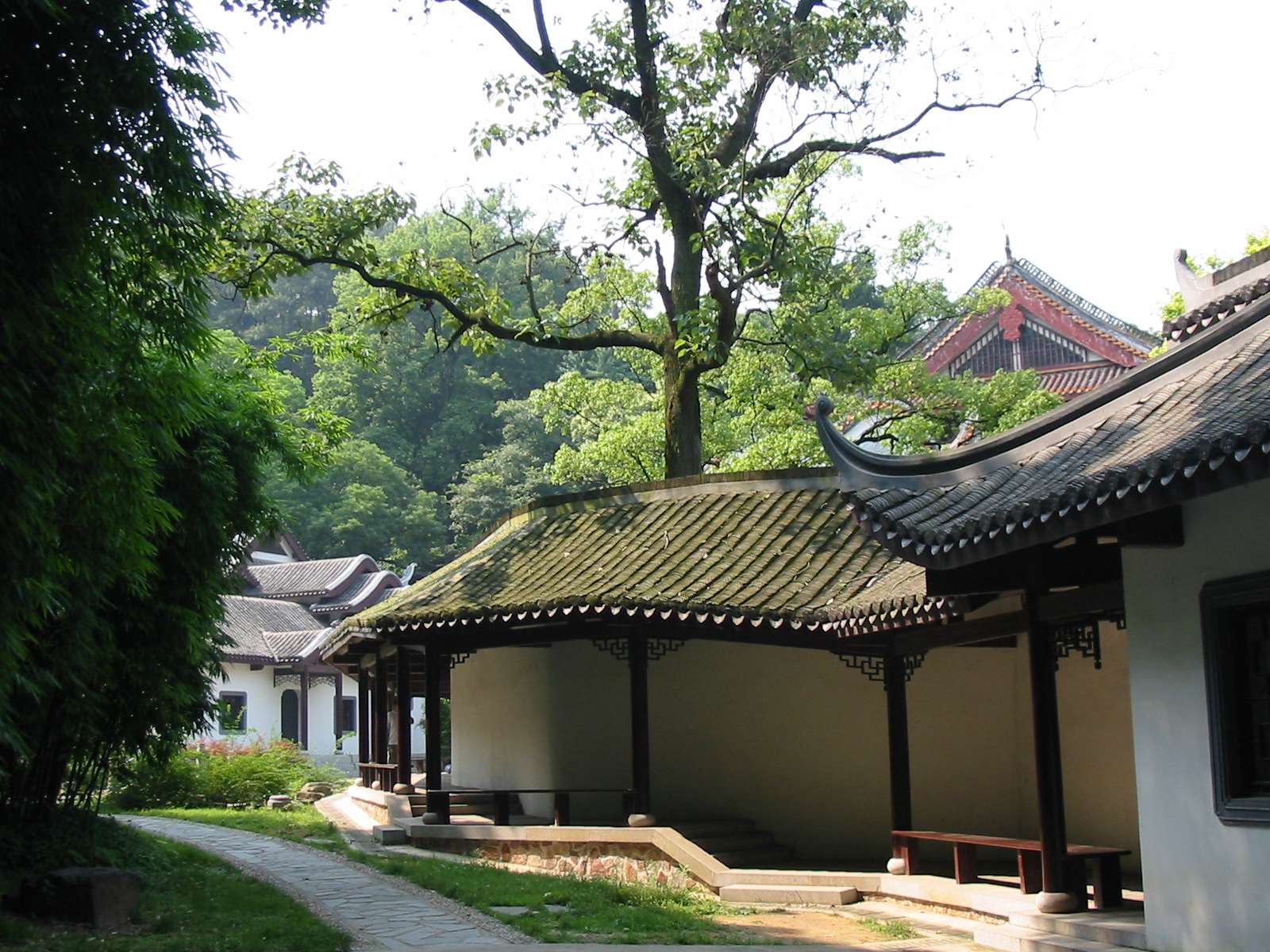
The grounds of Yuelu Academy in Changsha, Hunan
Yuelu Academy -- built at the foot of Yuelu Mountain -- is a refreshing, and even inspiring, retreat for any China traveler.

When I think of Yuelu Academy — one of China’s oldest academic institutions — I think of peace, and the peaceful moment my Chinese husband, John, and I had there one afternoon. We strolled in and out of galleries and open-air courtyards, until we came upon a tiny courtyard nestled in a corner with a 100-year old Chinese privet. The privet rained its fragrance — from the tiny, yellow star-shaped flowers — all over the courtyard, filling the air with a rare sweetness on a sultry summer afternoon. I breathed it all in, feeling a sense of renewal, as if this was the very scent of inspiration.

Inspiration seems central to Yuelu Academy. Like all of China’s academies of classical learning (institutions where scholars could teach and study the Chinese classics), the planners for Yuelu chose a remote, picturesque setting for the academy, establishing its network of Chinese-style courtyards and open classrooms on the Eastern side of Yuelu Mountain beginning in 976. Such a place offered a quiet, meditative environment conducive to the study of Confucian classics.

Today’s Yuelu Academy is tucked within a neighborhood surrounding the modern university that has continued its legacy — Hunan University. While the remoteness seems a memory, the picturesque quiet still remains, like the venerable trees blanketing the school grounds. Continue reading “Travel China with the Yangxifu: Yuelu Academy and Yuelu Mountain, Changsha”

A Chinese boyfriend/Chinese husband and foreign woman 30 years ago, through “Son of the Revolution”


As I’ve written before, Chinese men and foreign women — dating or marrying — are a rarity. But when Liang Heng and Judy Shapiro fell in love in China in 1979, they weren’t just a rarity — they were pioneers at a time when the idea of marriages between foreigners and Chinese were still questionable.

Most people read the 1983 book Son of the Revolution — written by the couple — to learn more about the experience of living through Chairman Mao’s rule and the Cultural Revolution. I, however, was anxious to know about the challenges they faced in their relationship, and how they overcame the odds to marry in a China that had barely opened up.

Liang Heng, studying to be a Chinese language teacher at Hunan Teacher’s College, first met Judy Shapiro, the resident English teacher and foreign expert, when he needed help with a translation. But pretty soon, the two made more than just beautiful prose together. This relationship — a Chinese man and an American woman — was something that not even the two of them could keep secret forever. Continue reading “A Chinese boyfriend/Chinese husband and foreign woman 30 years ago, through “Son of the Revolution””