Advice for dealing with your Chinese mother-in-law. Stories about having or relating to a Chinese mother-in-law. All from one Western woman with a Chinese husband.
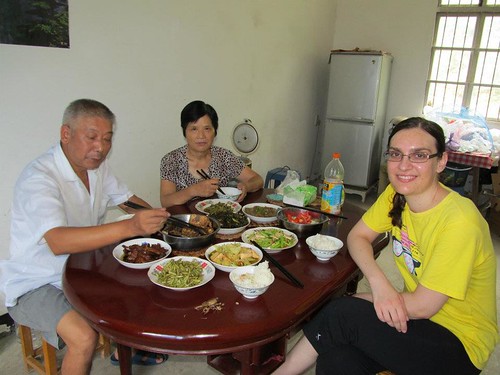
Can this vegan and her non-vegan Chinese family share the same table in harmony?
Allison asks:
I’m a vegetarian in China and am finding that in general vegetarianism is a really difficult concept for people to understand here. Did John always know you were a vegetarian? How did that affect you guys when you were dating? and is/was it awkward with his family?Continue reading “Ask the Yangxifu: On Being Vegan in a Chinese Family”
What would it be like if my Chinese husband were an only child? (photo by Joseph Hoban)
“How is it your husband has two brothers? What about the One-Child Policy?”
The question came out this afternoon while sharing stories from my summer in China at a party — and, more specifically, photos showing my husband actually has two older brothers. One of the women at the party suddenly blurted the question out, because the idea of siblings just didn’t mesh with the narrative she’d heard all along about China.
I told them he was born in 1978, the first year the One-Child Policy began, and he happened to be the youngest in the family. “But most of the men younger than him don’t have brothers or sisters.”
"Won't you graduate already?" That's the pressure my Chinese husband felt from family and friends, wondering why he was over thirty, with no career or children. (photo by shno)
My Chinese husband John shot me his weary, it’s-way-too-late-on-Sunday look. I expected him to vent about his PhD studies the way he always did when he appeared tired — the homework, the papers, the feeling that you’re always, despite your best efforts, just a little behind. Behind it all, though, I always felt his passion, his love for the path he’d chosen — to become a clinical psychologist.
But not tonight. “I’m tired of being a student,” he sighed.
I dashed into the living room, as if his words signaled some emergency, that his lifelong passion needed life support. “What do you mean?” I asked, staring into his eyes for signs of something, anything, that could tell me what was wrong.
He hid himself behind a generic smile, the kind that doesn’t really mean he’s happy. “My cousin is my age. He is settled down and has a family.”
“So? Your cousin also will never be able to do what you can do after graduating.”
When her Chinese boyfriend gets very critical with her, a Western woman wonders, is this normal, and what should I do? (photo by Rob Rosenhamer)
Anna asks:
I came to China about six months ago with the intention of staying for four years to study at University. Three months ago, I met my current boyfriend — Chinese, 24, owns his own hair salon — although we’ve only been “officially together” for roughly two weeks.
He’s from Henan, and his parents are very poor farmers, so he was never able to get a good education and some of our outlooks on life are very different (although we value that about each other). He’s very bright and intelligent, though, and he’s always been the sweetest person to me. He’ll even accompany my classmates and I to the bars and clubs on weekends, and doesn’t mind hanging around the international dorms even though he can’t speak any English. Point is, he’s a great guy.
I’m a digital artist, and a few days ago I showed him some of my artwork. He said he really liked it, and asked if I could do a digital portrait of him. Of course I said okay, and went straight to work that night. I worked really hard, and it turned out really well. I was so excited to show it to him! But… when I did… all he could say was, “You made me look too old. I look 53. I don’t really like it… did you make any others?”
My Chinese is just intermediate, so for a minute I thought he was just joking around and trying to be humorous. But then I realized he was dead serious. Now… I don’t really mind so much that he didn’t like the picture… everyone has their own tastes… and although, to me, he doesn’t look 53 but in fact looks younger, I understand that he might have a different perspective.
What I DON’T understand is why he was so critical about it right off the bat! He often offers me those scolding-words-of-encouragement that I’ve come to appreciate… but he’s never been so directly negative before, especially about a gift. He really hurt my feelings. Is it normal/cultural for Chinese boys to be so harsh about these sort of things? Did we cross into the super-critical-is-okay boundary when we declared ourselves official? He really hurt my feelings… but I don’t want to make a big fuss if it’s jut something normal. The last thing I want is to seem petty to him. What should I think? What should I do? Has anyone else had a similar experience?Continue reading “Ask the Yangxifu: My Chinese Boyfriend is Too Critical”
The way my Chinese in-laws said goodbye to John and I, it could have been any other morning. But it wasn't -- we were leaving for the US, for another two years. (photo by Alexandre Caliman)
It looked like every other morning when I’d left my Chinese in-laws’ home this summer. My Chinese mother-in-law grumbled about how large our bags were, but then proceeded to push more honey pears and mooncakes into our backpacks. As usual, my Chinese father-in-law paced around the first floor like an expectant father – and only stopped when we climbed into my oldest brother-in-law’s car. Through the window, they appeared with the same calm and content face I remembered every morning, pushing heaping plates of breakfast my way (on this day, I had vegetarian dumplings stuffed with tofu and pickled vegetables and sweet fried rice pancakes) while asking why I’d risen so late from bed.
But this was not just any morning. John and I left his home for the US – which meant we wouldn’t see his family for another two years. When I waved at my Chinese mother-in-law and father-in-law through the window, that was the closest to a “goodbye” that we had.
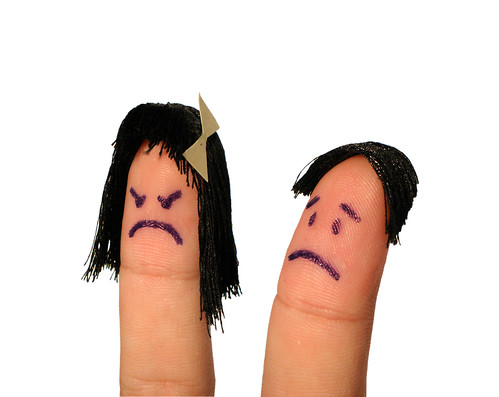
I didn't understand why my Chinese mother-in-law always argued with my Chinese father-in-law. But, according to my husband, maybe that's their way of showing love (photo by kamil kantarcıoğlu).
My Chinese father-in-law isn’t just a husband and parent in our home. He’s also a punchline, and a virtual punching bag.
I’ll never forget that day in May when I watched my Chinese mother-in-law storm out into the yard and holler up to my Chinese father-in-law. “You’re just like a Bodhisattva! Always staying up and never coming down!”
I don’t know what he did to deserve that Buddhist curse. But after spending more than two months here – where almost a day wouldn’t pass without my Chinese mother-in-law naming my father-in-law’s stupidity du jour – I can guess why. Continue reading “For My Chinese In-laws, Scolding is Love”
An American woman wonders why her Chinese in-laws seem upset every time she gives them a gift. Why do they always refuse what she buys for them? (photo by Irum Shahid)
Sam asks:
Recently, while I was at the grocery store, I saw a lovely bouquet of lilies. I thought they would look lovely in the kitchen, and decided to by them for my Chinese mother-in-law. I brought them home and put them in a vase. But when she came home and I told her they were for her, it seemed to stress her. She first tried to get me to say that they were just for myself, and then insisted that they were for the men in the house since Father’s Day had been the week before. We finally agreed that they were for everyone.
I can’t help but wonder if I did something wrong. My husband didn’t think so, but he’s been in the states for over 20 years now and isn’t always in the loop.
I had a similar experience when I came back from a trip. I had bought her a purse that I found on super-sale and thought she would like it. She kept on insisting that I would need it more than she would and that I should keep it for myself. It wasn’t until I told her I had bought myself something similar that she settled down and accepted it.
It is not uncommon for me to see something that I think a friend will like and buy it for them. Several times I’ve seen clothes that I know would fit my mother in law that would look good on her, but I am afraid I’ll terrify her or something. Do you have any insight?Continue reading “Ask the Yangxifu: Why Does My Chinese Family Refuse My Gifts?”
When my Chinese inlaws married in 1971, the marriage must-haves were a bicycle, sewing machine, radio and wristwatch. (image from www.soufun.com)
My Chinese in-laws married in 1971. Back then, marriage wasn’t house, car and money — it was bicycle, sewing machine, wristwatch and radio, the si dajian (四大件, four big items).
My Chinese father-in-law grinned as he recalled that time. “These were the kinds of things that gave you ‘face’ in your wedding. They were considered hard for people to afford then. Not everyone had them. If you couldn’t afford them, you would even borrow money to get them! Nowadays, it’s silly to imagine this. Everyone wants a home and a car and money for their wedding.”
So I asked if he borrowed money to buy his si dajian. “Eh! I had to borrow from another teacher at my school. It took me two to three years just to pay him back. The sewing machine cost 145 RMB or so. The bicycle 100 or so. The wristwatch 50 RMB, radio maybe 20, maybe 50. But back then I only earned 20 RMB a month! It look me more than half a year just to get one sewing machine!”
My Chinese mother-in-law, lounging on a cot in the corner of our dining room as she played with sister-in-law’s baby, bust out in laughter the entire time he told me all of this.
My Chinese father-in-law insisted that the new China included free choice in marriages. But it seemed like an illusion when he admitted he didn't freely choose his bride. (photo by miguel ugalde)
The other day, while talking about weddings in China with my Chinese father-in-law, we happened on the idea of parental involvement (or should I say, pressure) since the founding of the People’s Republic of China.
“It seems to me that parents still have a say in marriages today,” I said.
My Chinese father-in-law shook his head. “No, no, that’s the past,” he disagreed, referring to how Chinese parents used to arrange marriages for their children. “Now people have the freedom to marry whoever they want.”
But I bit my tongue. “What I mean is, Chinese parents have ideas about their children’s marriages. The parent will tell the child if they like the person or not. The child has free choice, but may want to be filial and not go against their parents.”
More than a week ago, my Chinese mother-in-law spent a whole day helping someone plant their rice paddy. That “someone” turned out to be a relative.
“She was out helping our Jiujiu plant the fields,” my sister-in-law told me at dinner. Jiujiu is the Chinese word for uncles on the mother’s side. But as far as I knew, we only had two uncles on John’s mother’s side — Da Jiujiu and Xiao Jiujiu. Neither of them needed assistance in the fields, especially Xiao Jiujiu who just became our village secretary. How could she possibly help someone called “Jiujiu?”
Then I remembered that, some time ago, my Chinese mother-in-law told me the godfather was a relative — but I’d forgotten how and asked my sister-in-law. “He’s the Gunainai’s son.”
This website uses cookies to improve your experience. We'll assume you're ok with this, but you can opt-out if you wish.AcceptRejectRead More
Privacy & Cookies Policy
Privacy Overview
This website uses cookies to improve your experience while you navigate through the website. Out of these cookies, the cookies that are categorized as necessary are stored on your browser as they are essential for the working of basic functionalities of the website. We also use third-party cookies that help us analyze and understand how you use this website. These cookies will be stored in your browser only with your consent. You also have the option to opt-out of these cookies. But opting out of some of these cookies may have an effect on your browsing experience.
Necessary cookies are absolutely essential for the website to function properly. This category only includes cookies that ensures basic functionalities and security features of the website. These cookies do not store any personal information.
Any cookies that may not be particularly necessary for the website to function and is used specifically to collect user personal data via analytics, ads, other embedded contents are termed as non-necessary cookies. It is mandatory to procure user consent prior to running these cookies on your website.