My Chinese Grandma, Frying Up Rice Noodles — And Lots of Love

11776026213_2e785c1720_nThe other day, John’s grandma invited the two us over all of a sudden for dinner at her house. When I say “all of a sudden”, I mean that she interrupted us in the midst of preparing handmade dumplings and told John and me we were dining on fried rice noodles instead.

As much as I love fried rice noodles, her invitation arrived on an evening when I had been craving the very handmade dumplings we were preparing with John’s father. But what could we do? Here was grandma, who had been hospitalized for two months in fall of 2013, standing at the door and asking us to dine on the noodles she had already finished preparing. It was the kind of situation with “just go with it” written all over it. Besides, my mother-in-law said we only had to eat a little, just to be polite. So I hid my dumpling disappointment behind a smile, hooked my arm in grandma’s arm, and strolled out the door with John beside us.

Once at grandma’s home, she immediately plunked heaping bowls of rice noodles in front of us — each bowl easily three times larger than her own. When she said dinner, boy did she mean it.

“Aiya, too much!” John said in protest, which I repeated in turn. What happened to just eat a “little bit”, like my mother-in-law said?
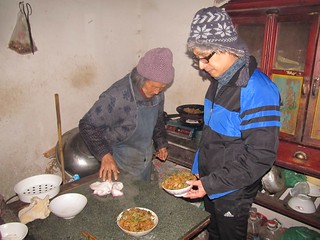
“Not too much!” Grandma said in a gruff voice, followed by nagging us to “Eat, eat!” as if we had to finish our bowls of rice…or else.

So we tucked into the rice noodles with our chopsticks and discovered that, if this was indeed a “responsibility”, it was the most delicious kind. I couldn’t help savoring the baby bok choy perfectly seasoned with garlic and dark aged soy sauce. It wasn’t too salty or overdone, and arguably it was the finest rice noodles she had ever fried up for us. So as I cleared the last of the noodles in my bowl, I couldn’t help but tell her, “So delicious!”

For grandma, that wasn’t praise but rather a cue to provide seconds. Before we could utter “bu yao!” grandma was on her feet, trying to shovel more rice noodles into our bowls. We each shielded the bowls with our hands, pleading to her not to add more. And when that failed, we simply rose from our stools and headed for the door itself.

Grandma chased after us with mandarin oranges, trying to press the fruits into our hands with far more strength than you might expect from a recently hospitalized woman over 80. But we pushed them back into her hands and then trotted outside, saying “Save them for next visit!”
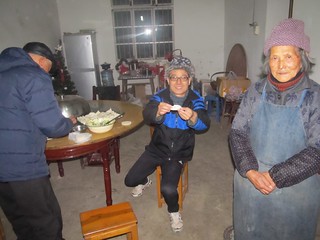
Grandma, interrupting our “regularly scheduled” dumplings for a spot of fried rice noodles at her place.

“You know, she shouldn’t have made us those rice noodles,” I said to John on the way back home, shaking my head. “She’s still recovering from her heart condition.”

John shrugged and smiled. “That’s how she shows her love for us.” His words echoed what my mother-in-law would say after we returned home: “She shouldn’t do it, but she wants to do it because she likes you.” You could say the same about the black striped polyester pants I never asked her to buy for me (and which I could barely squeeze into) or the hulking bag of puffed rice sweets she delivered to us one afternoon.

Grandma has never hugged or kissed me, nor told me she loves me. But these days — and especially after this impromptu dinner — I’ve never felt closer to her.

How I had mistaken a Winter Solstice family recipe for tangyuan

11496262656_7f543f100c_nAll these years, I had it wrong.

Whenever my husband mentioned the sesame balls they ate for Winter Solstice, I imagined a version of tangyuan, those delicious glutinous rice balls stuffed with sweet sesame or red bean paste traditionally served in parts of Southern China. Except John called them sesame balls or máqiú (麻球), not tangyuan. Maybe máqiú was just another name for tangyuan in the local dialect?

But then Saturday night I watched my mother-in-law prepare máqiú in her kitchen and had a double take. She dropped balls of glutinous rice dough straight into the boiling water without even filling them. Had she lost her mind? Where was the muss and fuss of filling the dough with sesame paste that I had to slog through all these years in the US?

When she fished them out of the boiling water and then rolled them in the black sesame seeds and sugar until every inch of the dough was covered in that sweet, black coating, that’s when I realized it. It was my mistake, not hers.

Sesame balls just fresh from the wok, coated in sesame seeds and sugar.

“Here, eat them while they’re hot,” my mother-in-law said as she pressed a steaming bowl of them into my hands.

“But that’s it?” I said, my face almost flushed with embarrassment. Could she tell that I had mistaken tangyuan for máqiú all along?

“Eh, it’s simpler! You don’t need to worry about all that trouble of filling them.”

Oh, I knew all about the trouble of filling them. All those years in the US, I had slaved hours upon hours to make so-called máqiú — never realizing the actual recipe was so easy and fast.

Sometimes, family traditions get lost in translation when you’ve never experienced them. I only learned about máqiú through long-distance phone conversations with John’s family over the years and through John himself (who definitely missed a few important details in his descriptions!).

Happy holidays from me and the family!

But aren’t you bound to misunderstand when you learn something secondhand? Today during our huge Solstice dinner, I tried explaining some of the foods we used to eat for Christmas — cranberry sauce, turkey and mashed sweet potatoes. How do you explain “cranberry sauce” to them when they’ve never even seen the actual berries at the heart of this sweet-and-tart holiday delight? How you can you describe the aroma of a turkey fresh from the oven when they’ve never eaten turkey and don’t have an oven? Even though sweet potatoes are native to this region, chances are they’ve never tried anything like my creamy, buttery sweet potato and parsnip mash. I wonder what went through their minds when I described Christmas dinners of the past?

Well, you live and learn — especially when you’re living with family. And actually, I’m kind of relieved about what I just learned. Never again will I have to mess around with filling rice dough in the name of tradition. Woo-hoo!

Happy holidays!

Winter Solstice Máqiú Recipe

I think of máqiú as “inside-out tangyuan” or even “tangyuan without the filling fuss”. They’re easy, delicious and a wonderful way to celebrate the holidays. They’re best eaten hot or steaming.

This comes straight from my mother-in-law, who approaches the whole process intuitively — hence, the lack of exact amounts.

Ingredients:

For the sesame coating:
Sugar
Black sesame seeds

For the rice balls:
Glutinous rice flour
Cold water
Oil (to protect your hands)

Toast your sesame seeds, then place them in a bowl. Toss them with sugar of your choice until sweet, and adjust according to your taste preference. Put the bowl of sugar/sesame seeds aside. (Note: this step can be done a day or two in advance).

Mix the glutinous rice flour with just enough cold water so the flour begins to stick together, but not more than that. You don’t want your flour to be too watery, so err on the side of less and then add small amounts of water as needed to clump the dough together.

Rub oil of choice on your hands. Pick up a small amount of dough — just enough to put in the palm of your hand — and squeeze it back and forth between your hands until the dough sticks together. Then, with as little pressure as possible (too much pressure will cause the dough to fall apart), roll the dough between your hands until it becomes a nice ball. Shoot for balls around 1 inch in size, give or take. Repeat until you’ve used up all the dough.

Boil water in a large pot or wok over the oven. Add the glutinous rice balls to the boiling water, and boil them until they float to the top.

Once you’re ready to fish them out, bring over the sesame seed/sugar mixture. After you remove the glutinous rice balls from the water, immediately roll them in the sesame seed/sugar mixture until fully coated. (Note: if you’re not sure that you’ve added enough sugar, sample your first one to determine whether it’s too sweet or not sweet enough). Repeat until you’ve coated every ball. Serve immediately.

On moving in with my Chinese in-laws

“My parents miss us,” said John, who beamed like a Mid-Autumn moon. “They want us to be back at home. They like it better when it’s renao,” or lively.
While working on to-dos for our trip back to China, my thoughts turned to living in the family home once again. And just like that, John reminded me of the warm welcome we’ll enjoy when we move back into the same two-story building his parents call home.

I felt that same welcome from John’s parents during the summer of 2009. On the phone, my father-in-law spoke of home renovations they planned to complete before our arrival. “Why are they wasting their money on that?” I once asked John. Turns out, the renovations were a whole new addition to the family home — including a two-bedroom and bathroom suite that my father-in-law would later dub our xinfang, that new home every newly married couple should have. “This is your home,” my father-in-law said to me once, after I claimed John and I didn’t have a home of our own.

In the US, this reads more like a fairytale — or even a myth. While your parents might kick in some cash for your wedding, they’re sure not likely to leave a “vacancy” sign on for you and your spouse to move in and call it home. And as for the married child, well, moving back home with your spouse is an utter embarrassment — or even life failure.

But John’s parents wanted us living with them so much they made room for us — literally.

And, strange as it may seem, I want nothing more than to live with them too. I love the way his father gets excited about the flowers in the garden and Chinese poetry and writing about the history of his ancient village. I love how his mother keeps me stuffed with the most sumptuous home-cooked vegetarian dishes, and won’t let me do my laundry, and teaches me how to cook with her fire-powered wok.

Maybe most Americans can’t understand why I’m excited about moving in with my in-laws. And that’s okay. The more time I’ve spent with John, the more I’ve realized that not everything about the white US culture I grew up in makes sense either. Sometimes, it’s not about what makes sense to the world or to others, but what makes sense to you.

All I can say is, I’m already missing my mother-in-law and father-in-law and can’t wait to be home with them.

Ember Swift Interview Part 2 – How China Changed Her Life

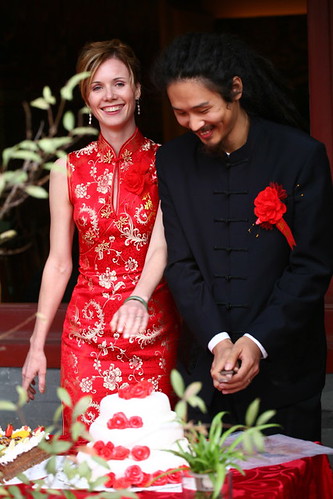
Ember Swift and Guo Jian, during one of their wedding ceremonies (photo courtesy of Ember Swift)

Last week, I introduced you to Canadian artist Ember Swift’s professional career — from how China changed her sound to what’s next for her as a musician/singer-songwriter and a writer. If you missed it, check out Part 1 of my Ember Swift interview. Also, you can purchase her music at iTunes and her website, peruse her must-read blogs, and follow her on Facebook, Twitter, MySpace and Sina Weibo.

But when it comes to her writing, Ember isn’t afraid to get personal. She has written about her marriage to Guo Jian — the lead singer/bassist of Long Shen Dao — from the unique perspective of a queer woman. She has also shared her experience of being pregnant, giving birth and raising a baby in China, including navigating life with a Chinese mother-in-law who assists with child care.

In Part 2 of our interview, I asked Ember about her personal life — from how she met Guo Jian to what it’s like raising a baby in a Chinese family.  Continue reading “Ember Swift Interview Part 2 – How China Changed Her Life”

From the Archives: Posts on My Chinese Inlaws’ Marriage

My Chinese mother-in-law in the kitchen
My Chinese mother-in-law in the kitchen.

I spent much of the past week in bed, and unfortunately, much of this weekend as well. So I’m sending you to the archives this Monday so I can catch my breath and rest up a little.

Those of you new to this blog may have missed my posts on Chinese marriage, through the eyes of my mother-in-law and father-in-law. I spent the summer of 2011 living with them, and one outcome of that summer was my newfound understanding of their own marriage. Enjoy!

My Chinese Inlaws’ Not-So-Free Marriage. My Chinese father-in-law insisted that the new China included free choice in marriages. But it seemed like an illusion when he admitted he didn’t freely choose his bride.

The Four Big Items For My Chinese In-laws’ Marriage. When my Chinese inlaws married in 1971, the marriage must-haves were a bicycle, sewing machine, radio and wristwatch.

For My Chinese In-laws, Scolding is Love. I didn’t understand why my Chinese mother-in-law always argued with my Chinese father-in-law. But, according to my husband, maybe that’s their way of showing love.

Ask the Yangxifu: My Chinese Family Speaks Local Dialect at Dinner, Not Mandarin

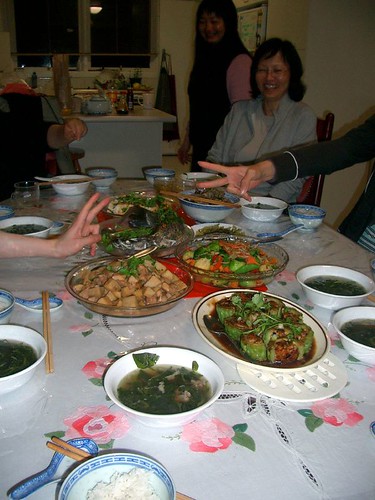
A family dinner at home in an Asian household
(photo by avlxyz)

Lixifur asks:

I am sitting in Beijing after spending 20 days in Southern China visiting my in-laws. I just found your blog and find it most timely. I am writing because I find myself so lost when it comes to the endless, dreaded family gatherings. My Mandarin is intermediate level and I’ve only travelled to China many times. Each time I come, I hope I can improve my skills but I am always disappointed by the fact that I almost never hear Mandarin, except on TV. Even more challenging is that while my mother-in-law is from the city, my father-in-law is from a bit further north in the province and he speaks a mixture of Mandarin, the city’s dialect and his local dialect. Naturally, we have so many family dinners and I am so frustrated by the use of one or more dialects at the table depending on the crowd and almost never Mandarin, except to me with strong accents. Please give me some advice on how to cope with the scenario. I am working on improving my Mandarin, so that will generally help, but I could sure use some advice based on your experience when your in-laws get together and just speak dialect. Continue reading “Ask the Yangxifu: My Chinese Family Speaks Local Dialect at Dinner, Not Mandarin”

Ask the Yangxifu: Dealing With “How Come You Aren’t Married Yet?”

A blurred photo of a bride and groom on the grass with a bouquet in clear view.
(photo by Fernando Weberich)

Single Overseas Chinese Guy asks:

Although this may not affect you yourself. It affects a whole load of us overseas born Chinese types. Simply how on earth do we respond to the constant questions of how come you aren’t married yet?

Parents go to Chinese weddings, and fiery arguments ensue about getting married.

Fake BFs/GFs are old utilised tricks. But over time they cease to work and to be honest it feels bad tricking parents like this.

In our first generation barely anybody is married these days. But there seems an increasing desperation in the voices of parents wanting you to get married. As if it is a magic bullet or something. They just simply do not seem to realise that getting married isn’t the be all and end all of things. Yet their old fashioned values don’t seem to tie in with single independent people! Continue reading “Ask the Yangxifu: Dealing With “How Come You Aren’t Married Yet?””

How I Broke Chinese Family Etiquette To Save A Baby Mobile

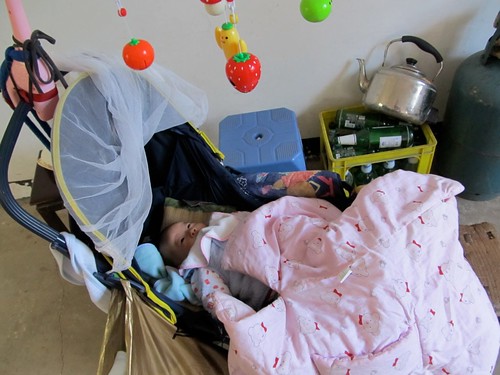
My sister-in-law's baby and the mobile that almost got broke

It’s not polite to tell a guest they shouldn’t do something. I learned this rule only hours after I broke it at my Chinese in-laws’ home.

The next-door neighbor happened to come over, a tiny grandmother with short curly hair and a face that reminded me of Squiggy from the sitcom Laverne and Shirley. As usual, she came in holding her 10-month grandson, a kid nearly one-third her size who looked so big, I wondered why he hadn’t walked in on his own. She stood with her grandson in the foyer of our family home with Laoma (what we call my mother-in-law) and Wenjuan, my sister-in-law.

Most evenings, I wouldn’t notice the guests, but this evening was different. She happened to come during dinner. And this dinner happened to be interrupted by Laoba (what I call my father-in-law) when he told me the pair of flip-flops I sunned outside had dried. I put my chopsticks down to take the flip-flops back to my rooms upstairs, and then returned to the dining room.

That’s when I saw it. Continue reading “How I Broke Chinese Family Etiquette To Save A Baby Mobile”

Things We’ve Learned About Going Meatless in China From Our Chinese Families

Eating dinner at the family table at my Chinese wedding ceremony -- while I dine on the veggies, my husband goes for the pork.

I’m excited to share with you my first-ever collaborative article, which I wrote with Susan Blumberg-Kason. Susan is the author of All the Tea in Chicago and the forthcoming book Good Chinese Wife, a memoir of the five years she spent trying to assimilate into a Chinese family.

This article grew out of stories that Susan and I swapped over the past year about going meatless in China, and especially going meatless in a Chinese family. Hope you enjoy it.

—– Continue reading “Things We’ve Learned About Going Meatless in China From Our Chinese Families”

Ask the Yangxifu: Carolyn J. Phillips On Charming A Chinese Family Through Food

Carolyn J. Phllips
Accomplished Chinese food writer and yangxifu Carolyn J. Phillips talks with me about food and what it takes to charm your Chinese family at the table. (photo from zesterdaily.com)

A few weeks ago, Carolyn Phillips wrote this to me:

Food is such an integral part of Chinese culture that it’s really hard to fit into a Chinese family if one isn’t adept at the cuisine. I suppose this is true to some extent with any country, but the Chinese are probably on par with the French and Italians when it comes to the importance of dining well. 

This is probably doubly important when a yangxifu doesn’t speak Chinese fluently but still hopes to be accepted. Have your readers talked much about this? I truly feel that the old saw about the way to a man’s stomach etc is gospel for us yangxifu.

Carolyn should know — she’s a yangxifu who devoted her adult life to mastering the art of Chinese cooking. She blogs about food at Out to Lunch and tweets about it as @MadameHuang. She’s also working on two forthcoming books on the subject — “Simple Pleasures from a Chinese Kitchen: Authentic Seasonal Recipes from Every Region of China” and “Culinary Goddesses: The Women Who Changed Our Dining Landscape… Recipes Included.” — and is a regular contributor writing about Chinese food for Zester Daily. In addition, she’s even fluent enough in Mandarin to do court interpreting.

In any event, Carolyn has discovered a thing or two about what it takes to woo a Chinese family that truly loves to eat through food. So I sat down with her — from one yangxifu to another — to talk about all things related to food and Chinese family. As Chinese New Year approaches, it’s a topic that will come in handy for lots of readers.

Just be warned, Carolyn mentions a lot of delicious Chinese food with links to her recipes — you may not want to read this one on an empty stomach. 😉 Continue reading “Ask the Yangxifu: Carolyn J. Phillips On Charming A Chinese Family Through Food”