Ask the Yangxifu: On Jiedi Lian, China’s Cougar Love

Barbie Hsu and Vic Zhou, hugging
Jiedi lian (China’s version of Cougar love) is rare — but it can happen, such as when Vic Zhou and Barbie Hsu, stars of Meteor Garden, dated. (photo from www.asianbite.com)

Jie Jie asks:

How much does age difference matter for Chinese people? I’m in my late twenties and I happen to like a Chinese guy who is in his early twenties. He mentioned the term 姐弟恋 the other day. He asked me if I know what that means. I don’t know if I should be worried about his question. Could that mean that he regards me as a craddle-robber or a cougar?

However, he has literally told me that he likes me.

Could age be a barrier between us? Would a couple where the woman is slightly older (in my case, 5 years older) judged negatively? Continue reading “Ask the Yangxifu: On Jiedi Lian, China’s Cougar Love”

10 Extraordinarily Useful Mandarin Chinese Phrases, Pub’d on Matador

fortune cookie message
(photo by Nathan Sudds)

Matador just published my piece on 10 Extraordinarily Useful Mandarin Chinese Phrases, which covers everything from receiving compliments to refusing that extra helping of cai. Here’s a snippet:

You’re just as likely to hear “Ni Hao” as “Hello” in my home. After living in China for five and a half years, I returned to the US with a Chinese husband, the fluency to be a freelance Chinese translator, and a heaping rice bowl of expressions in Mandarin.

If you’re traveling to China and looking to dig your own linguistic chopsticks into Chinese culture, I recommend these 10 extraordinarily useful phrases.

Head on over to Matador to read the entire article. And as always, if you love it, share it. Thanks!

I Love You, Just Not in Chinese

A red kiss mark left on a piece of paper
All these years, my Chinese husband had told me “I love you” in English but could never bring himself to say the same in Mandarin Chinese. (photo by Jenny Rollo)

My husband tells me “I love you” all the time. When I’m dashing out the door to the library. Just before we hang up our phone conversation. As we tell each other goodnight under the covers. There’s nothing really strange about it — except that he’s Chinese, and the Chinese don’t usually express love in words.


For the longest time, I figured he had learned to say “I love you” for me — just as he learned to love so many of my favorite things, from aromatic cups of peppermint herbal tea to vegetarian pizzas with soft, focaccia crust.

But sometimes, it’s not what you say, but the language in which you say it.

“Sweetie, it’s not right to suggest a phrase with ‘ài’ in it, right?” I conferred with him the other day while brainstorming an article about the Chinese language, and realizing that ‘ài’ — the word for love — seemed to pack more punch than necessary. “People don’t really say ‘ai’ in everyday life, as I can remember.”

John nodded. “Definitely not. It’s too strong.”

Suddenly, I thought about how often John said ài in English, to me. “But you tell me ‘I love you’ all the time,” I teased him, nudging his arm. I watched my husband’s face wrinkle into an embarrassed laugh, as he shrunk his his chair.

“I’ll bet it’s because you’re saying ‘I love you’ in English, isn’t it?” I continued, pulling playfully at his shoulder.

John kept giggling until he finally gave me one of those “you’ve got me” looks.

All these years, he had hidden his feelings behind English, a language where saying “I love you” just didn’t seem so forbidden. I still welcome “I love you” in my native tongue. But I have a feeling I’ll be waiting some time for a Wǒ’àinǐ (我爱你) from my sweetheart.

Does your Chinese lover or spouse prefer saying “I love you” in English? Or, if you’re Chinese, do you prefer using a foreign language to express your love?

Ask the Yangxifu: Are Chinese Men with Tattoos Bad?

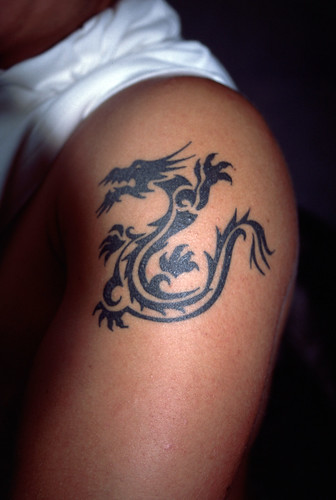
Dragon tattoo on a man's arm
Are Chinese men with tattoos bad people? Should they be branded forever out of your social circle?

D asks:

Hi I have a Chinese classmate and he has always been very friendly with me, and he talks to me and sends me texts almost everyday. When he heard I was interested in learning Chinese, (even though I am still at the beginner stage.) He straight away offered to give me his skype address so that we could practice together online because he is also interested in improving his English pronunciation. He also invited me to go to a bbq at his house so that he could introduce me to his friends. Things seem to be going quite well.

However even though that all sounds great, there is one problem, he has a tattoo on his arm. I know normally this isn’t a big deal in European countries and USA lots of men have a tattoos. When I introduced him to some other Chinese friends of mine. They were shocked and told me don’t get to close to him, this type of man is not normal. Have you had any experience dealing with Chinese men or women with tattoos? Continue reading “Ask the Yangxifu: Are Chinese Men with Tattoos Bad?”

My Chinese Husband Hates Pain Killers

Pills spilled out of a container on a surface
My Chinese husband thinks pain killers are no good. And I think his arguments are just a pain. (photo by Aleksandra P.)
Last Monday night, I tossed and turned half the night from a painful skin infection. By 4:17am, I still hadn’t fallen asleep, and I could feel it throbbing all the way down my thigh. I slipped out of bed and into the living room, knowing exactly what I wanted to do — and why my Chinese husband would be so angry for it the following day. I decided to take a pain killer. 

Sure enough, the pain subsided and I finally fell asleep. But when I told my Chinese husband about it the next day, he looked as red as the inflammation on my body.

“Why did you do that?” he admonished me while hovering over the sink, cleaning up the leftover dishes.

“I just couldn’t get to sleep. It was past 4am,” I explained.

“You’re too impulsive!” he frowned, shaking his head in disgust as he scrubbed a plate. Continue reading “My Chinese Husband Hates Pain Killers”

Lijia, China’s Monthly Break for Women

A wooden chair on a deck, looking into the sunset
From my Chinese husband's perspective, my period meant rest -- even if I felt restless about it! (photo by julian leandro irusta)

Yesterday, I heard that once-monthly command from my Chinese husband. “Think of it as a forced vacation. It’s time for you to xiuxi,” he soothed me, putting a pillow on the couch and coaxing me over to sit down and put my feet up.

“But I have all of these things I haven’t done yet!” I pleaded.

John shook his head. “You need to rest,” he urged me, pointing to the couch.

Eventually, I did go to couch, settling into my usual spot, even as my mind was anything but settled about the idea of resting. You should be writing. You should be answering all of those e-mails. You should be…

If there’s anything I should be, it’s used to this whole routine. John and I have been together through years — and therefore, many, many months of me doing what every woman naturally does once a month. I get the kind of cramps that could drive perfectly normal women to light up their tampons and smoke them, so I should be thinking period equals rest. But right on schedule, just as I begin, so my mind begins the once-monthly protest every time John mentions “rest.”

But what I didn’t understand was, John would have urged me to take a break, even if I didn’t have the cramps. Continue reading “Lijia, China’s Monthly Break for Women”

Shui Tu Bu Fu: A Tale of Two Noses

Tissue box
Tissue anyone? My Chinese husband has sneezing fits in the US, I have them in his family home in China. And our only explanation is shuitu bufu.

Atchoo! Atchoo! Atchoo!

There was my Chinese husband, having a sneezing fit right over our sink. I gave him the usual “bless you” and worried stares of a wife, wondering if this was the harbinger of a bad allergy day for him. And he gave me his usual prognosis on why he had this sneezing problem in the first place.

“In Zhejiang, I never used to sneeze like this,” John lamented, blowing his nose. “I miss the warm, humid air of Jiangnan,” that south of the Yangtze River region, the land of fish, rice and moist air  that included his own beloved province.

It sure didn’t help that, in 2008, we moved to a high desert area in the Mountain West of the United States — what you might term a land of tumbleweeds, dust and dry volcanic mountains. But even when we lived in Cleveland, Ohio, right on Lake Erie, my Chinese husband’s nose seemed to ignore the humidity and moisture, and just sneeze away in defiance. Even worse, his skin became so dry and itchy that he scratched out two pear-sized welts on both of his upper thighs. It took an entire year for those welts to disappear.

The Chinese have a saying for this: shuǐtǔ bùfú (水土不服). Continue reading “Shui Tu Bu Fu: A Tale of Two Noses”

Ask the Yangxifu: Staring in China at Couples of Chinese Men-Western Women

Tom asks:

About several months ago, i asked about how to say “i love u” to a foreign girl.

Thanks to your advice, she has been my girlfriend now. We really have a lot in common and we both think that our relationship can be better — that is to say, she can be my fiance. But,there is a problem between her and i. When we go shopping, go to cinema, or eat out, there always are many, many people looking at us with a strange expression. In fact, i have foreseen that embarrassing thing will happen on me, but i really don’t know that that will be so embarrassing.You know,because of my major, i have to stay in china and it means that i have to tolerate those things constantly.I always do my best to ignore them,but it is really difficult, because u can see them everywhere, even in my family.

I think ur husband has ever met the same situation, too. So, i am wondering if u and ur husband could give me any advice on how to avoid or adapt to this. Hope to hear from you soon.

———-

Tom, sometimes — as my Chinese husband told me — it’s all about perspective.

You see “strange expressions” and feel embarrassment when people gawk at you and your girlfriend on the streets of China. But my Chinese husband John sees something completely different. “They’re amazed that I could get a foreign wife.”

In fact, most people are looking at you in awe, as I wrote last year in my survey of stereotypes about couples of Chinese men and Western women:

To many Chinese, having a foreign girlfriend or wife is the best bling money can’t buy. Like cruising in a BMW or popping open a bottle of Moet (part of the worship of all things foreign in China, chóngyángmèiwài or 崇洋媚外) , we suggest he’s truly “made it.”

With a foreign woman by his side, that Chinese man casts a powerful aura around the world in China. People  crown him as lihai (厉害, awesome), gaping in awe at his good fortune — and his social status soars.

Now, I’m not in any way suggesting you turn your girlfriend into the equivalent of a living, breathing Mercedes Benz to show off to the world. But keep in mind that many of those “strange expressions” hide a quiet envy — that you’re one of the few Chinese men who could pull off this relationship.

Here’s another way to look at it. Chances are, some of these people have never seen or even imagined the possibility of a Chinese man-Western woman couple. In a world where couples of Chinese women and Western men are a mao a dozen, you and your girlfriend are like real-life ambassadors, showing them another, rarer side of the coin.

Now, with family, it’s a slightly different story. You just started dating, so the two of you are still a novelty to everyone. But after almost seven years of marriage, I can tell you the novelty wears off a bit. I still get a look or two from distant relatives, a sudden pride when I walk through their door, or a “wow, she’s beautiful” from someone I’ve never met. But the subject usually changes faster than you can say “have you eaten?” and I have those moments where I’m just family (albeit, family from another country 😉 ). It does get better.

I can’t say the same for being out in public, however. My Chinese husband and I still turn heads whenever we walk the streets in China, even after years of marriage — so I suspect the stares will never go away for you either. And apart from avoiding the streets entirely, or hiding your Western girlfriend’s entire head, there’s nothing to guard against it.

But you always have a choice on something more important: your interpretation. Embarrassment or pride? Strange expressions or awe? None of the above? You decide.

What do you think? What advice do you have for Tom?

———

Do you have a question about life, dating, marriage and family in China/Chinese culture (or Western culture)? Every Friday, I answer questions on my blog. Send me your question today.

On My Chinese Husband’s Time

Retro alarm clock
How was it that my Chinese husband and I seemed to run on entirely different clocks?

We held tickets for a performance at 7pm Wednesday. By 6pm, the table had everything we needed for dinner — fried tofu, spring rolls, stir-fried vegetables. Everything, that is, except for my Chinese husband.

Where is he? I wondered, pacing as I peered out the window, scouring the landscape for any sign of him as the notice on those tickets flashed over and over again in my mind: attendees must be in their seats by 6:45pm, or the unfilled seats will be filled with people in the waiting area.

Suddenly, I spotted someone walking down the street in a rather familiar maroon down jacket, with an even more familiar gait. John. He strolled along with one of his soccer buddies, chatting with all of the leisure of a Sunday afternoon tea time — and not the Wednesday “we have to eat and get the performance ASAP” anxiety coursing through my veins.

Since he stood within shouting distance of our place, I did what any worried wife would do. “Sweetie, it’s dinnertime! Come on!”

When he finally trotted in the door, I gave him the chopsticks and a stern glance. “Where have you been? Did you completely forget about the performance this evening?”

“I was delayed at work. But I figured that 45 minutes is more than enough time for us to head over there.”

I cocked an eyebrow. “You really like to live on the edge, don’t you?”

“It’s not on the edge,” he said, shaking his head. “See, we still have enough time to eat dinner and get over there.”

But I couldn’t help but think about how his timing and my timing didn’t even seem to be in the same row of performance’s theater. Continue reading “On My Chinese Husband’s Time”

Ask the Yangxifu: Getting a Chinese Foreign Student To Notice You

Chinese character
A woman at a Western university has a crush on a Chinese foreign student, and wonders how she can get him to notice her? (Photo by Magda Dlugaj)

Mizu asks:

Well, there is this Chinese guy in my college that I find very attractive but the only thing is that I have no classes with him and I’m not too sure on how to approach him. I think he might be a year or two ahead of me. He’s usually alone with his Mac or with friends that he only talks for minutes and leaves. I’ve tried my best for him to notice me but he doesn’t seem to be interested. He looks very shy and maybe has a little bit of trouble speaking English [he’s usually carrying a portable translator, that I’ve seen] I’ve tried and thought of a way of making small talk, but the only thing that comes to mind is asking him for help in learning Chinese, but I don’t want to offend him in any way or weird him out. I’m a very shy person when it comes to guys that I crush on, I’ve never made a move on a guy with a different ethnicity than mine, so I’m not too sure what are the dos and don’ts in this case or if there’s any. Any suggestions or advice in talking/make him notice me is helpful, thank you.

Side note: I’m not too sure if our ages should matter in this case, I’m 19 not too sure about his; he must around 19-20.

—– Continue reading “Ask the Yangxifu: Getting a Chinese Foreign Student To Notice You”