Don’t Marry in a ‘Widow Year’? On a Chinese New Year Superstition

Did you know that 2019, the Year of the Pig, was a widow year, and it was supposedly “unlucky for marriage?

A “widow year”?

I’ve heard the term “widow”, a woman whose husband has died, used to describe all sorts of things, from the “widow’s peak” on your hairline to, of course, the deadly “black widow spider”. And given the original meaning of “widow”, the term, when paired with a year, struck me as a rather ominous combination.

This piqued my curiosity, which prompted me to do a little research and learn more about this superstition.

Why do people call it a “widow year”? And why is it supposedly bad for marriage?

A “widow year” means any year in the Chinese lunar calendar without lichun or Spring Commences, one of the 24 solar terms that divide up the lunar year. Specifically, lichun or Spring Commences marks the coming of the spring season.

According to the China Daily article Couples Rush to Tie Knot Ahead of “Widow Year” (published Feb 3, 2010), some Chinese people think of lichun or Spring Commences as “a time of Yang (masculine) energy.” To them, a year without lichun or Spring Commences equals a year without Yang energy as well.

The article provides further clarification:

Superstitious people believe women who get married in a year without the “Spring Commences” day will become widows. … Tradition-bound parents also fear consequences like husbands coming to harm, marriages breaking down and children getting bad luck.

Should you postpone your wedding plans during a “widow year”?

If you’re newly engaged, should you put the nuptials on ice or opt for a speedy elopement before the “widow year” begins?

Well, consider what that China Daily article also said:

Regarding the idea of a “widow year”, Guo Hu, director of Beijing’s Bureau of Meteorology, says that on average, there are seven so-called “widow years” every 19 years. But there are also seven years with two “Spring Commences” days in the same 19 years.

“It is totally groundless to say a year without a Spring Commences day is unlucky,” Guo told the Beijing Daily.

In other words, it all depends on your perspective and what you consider auspicious.

After all, imagine all the hundreds of thousands of people who marry in any given “widow year” around the world. Every single one of these couples could not possibly suffer the same marital misfortune. If a “widow year” truly posed a threat to people everywhere, then why didn’t anyone ever pass the warning on to me while in the US?

And, apparently, a growing number of young Chinese people don’t mind flouting this superstition either, as the China Daily article Vowing to be different with the nuptials notes:

Wang Xiaoqiang, a 26-year-old white collar worker in Shanghai, doesn’t really care that the Year of the Snake 2013 is not regarded as a propitious year for weddings.

“I was told Lunar 2013 is not a good year to get married but that is something believed by elderly people,” said Wang.

In other words, when a “widow year” comes, worry less about the superstition — and follow your heart instead.

What do you think about the “widow year” superstition for Chinese New Year? Would you marry in a “widow year”, or would you postpone your wedding?

Correction: Updated original post, which incorrectly named 2020 as a widow year.

Baring it All for Love? The Skinny on ‘Naked Marriage’ in China

When I say my husband and I had a “half-naked marriage”, you’d be wrong to envision the two of us parading down the aisle in, say, a stripper’s version of wedding garb. As titillating as it might sound, the reality looks far more practical (and not nearly as sexy), as reported in the Feb 3, 2010, China Daily article Embracing a ‘naked marriage:

A witty poem on major BBS and SNS websites defines naked marriages as: “No apartment, no car, nor diamond ring; no wedding ceremony, nor honeymoon; each of us pays 4.50 yuan ($0.66), and we get a wedding certificate to start a new life.”

There are two types of naked marriage, the totally nude kind and the half-naked marriage, which means the man should at least provide a ring or something else for his beloved when they get hitched.

Our nuptials fell into the latter, as I described years ago in the post Marriage in China is Home, Car, Money?:

By July 2007, it’s not as if John and I hadn’t wrestled with these issues before. We faced “Money” all the time — hadn’t we survived summer 2006, when some months I never knew when the checks from my new business would come in, and wondered what bills to pay and what to leave aside? Hadn’t we just managed to scrounge the cash together for plane tickets? When it came to “Car,” we were just grateful that our secondhand 1991 Toyota station wagon — teeter-tottering with every bump on its barely-there shocks — still ran after some 170,000-plus miles. And as for “Home,” we felt lucky to manage the rent on our place — owning just wasn’t in the cards for us yet.

Still, we did have a wedding ceremony in 2007 (which included a banquet that welcomed over 150 guests) and enjoyed a simple honeymoon a few years earlier in Bali, firmly placing us in the “half-naked marriage” camp.

But here in China, our choice still remains largely exceptional, as the 2015 CNN article No frills? Chinese say ‘I do’ to creative — and cheaper — weddings stated:

While the public seems to appreciate the philosophy of true love trumping everything else, most respondents in repeated surveys still reject the notion of disavowing all traditional trappings of marriage.

The 2011 China Daily article Money-troubled post-80s find naked wedding as way out provides some examples of those statistics:

An online survey from China’s popular matchmaker’s network, Jiayuan.com, showed 38 percent of women voted in “support” of a naked marriage, while 77 percent of male voters were happy with it.

And so does the 2013 China Daily article Marriage attitudes slowly change:

When asked about “naked marriage”, a recently coined term for getting married without owning a house, car or much other property, 45 percent of those polled said they are not against the idea, but less than 30 percent would “practice a naked marriage” themselves.

While I embraced our half-naked marriage, I don’t believe I represent most foreign women either. In my previous post 5 Fascinating Stereotypes of Western Women in China, I emphasized that many follow the lead of Ember Swift, who blogged about how she valued the financial stability of the Chinese man she later married.

Nevertheless, China will always have its share of couples who dare to eschew all that pricey pomp and circumstance, whether for frugality or simply to make a statement. And while Jun and I most certainly did not have a bare-it-all ceremony, that hasn’t stopped some couples in China from trying out a more literal interpretation of the naked marriage concept — such as saying “I do” in something resembling their birthday suits.

Humanahumana!

What do you think about naked marriage?

P.S.: For those curious, naked marriage in Chinese is 裸婚 (luǒhūn).

Mandarin Love: A Banquet of Chinese Wedding/Marriage Words, With Personal Notes

It’s nearly summer, that intoxicating season of endless love — and, where I’m from, one punctuated by lots of wedding invitations. If you’re planning to tie the knot in China or know someone who will, here’s handy little reference of Chinese wedding/marriage words and expressions, with some of my own personal notes.

Getting Married in Chinese

Qiúhūn, 求婚: Whether you’re getting down on one knee or making a big spectacle, this word means “propose marriage.”

I proposed (marriage) to her.
我向她求婚了.
wŏ xiàng tā qiúhūn le

Note that in recent years, the trend in China is for men to turn wedding proposals into major spectacles — make it memorable and romantic!

Jiéhūn, 结婚: If you’re “getting married” here’s the word for you — as in

We’re getting married!
我们要结婚啦!
Wǒmen yào jiéhūn la!

But keep in mind that there are also different words for a woman marrying a man versus a man marrying a woman. The difference reflects the Chinese perspective that the woman marries into the man’s family.

Qǔ,娶: If you’re a man and you are marrying someone, you use qǔ,娶, which also can mean “take a bride”. For example:

He married a girl from Henan.
他娶了个河南姑娘。
Tā qǔle gè Hénán gūniang.

Jià, 嫁: Women, however, are perceived as marrying out and so you use the word jià, 嫁 instead. For example:

I married (gave myself to) him.
我嫁给他了。
Wǒ jià gěi tā le.

But if you think that’s confusing, so are anniversary dates in China. That’s because most people register their marriages and thus become officially married ahead of the wedding ceremony itself. (If you’re curious, read The Dengji Question: How Marriage in China Gets Confusing.) Which brings me to the next word…

Dēngjì, 登记: While this word means “to register” in general, it’s also a term people use to describe registering a marriage in China (which must be done in a marriage registration bureau and usually happens before an actual wedding ceremony occurs).

We registered (our marriage)!
我们登记了!
Wǒmen dēngjìle!

Hūnlǐ, 婚礼: This is the standard word for “wedding ceremony” and the best term to use when in doubt.

But there are other similar words people often use to talk about wedding ceremonies (which usually just comprise the banquet with guests in China), such as xǐshì, 喜事 (usually taken to mean “wedding”), xǐjiǔ, 喜酒 (meaning “wedding feast”) and of course, hūnyàn, 婚宴 (“wedding banquet”, also the name of the famous film by Ang Lee).

Wedding Attire in Chinese

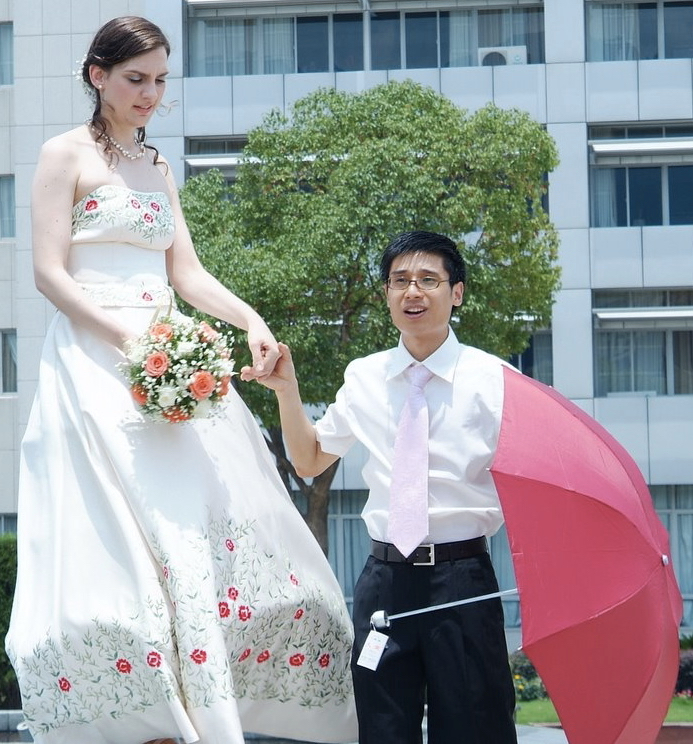
Hūnshā, 婚纱: The white bridal gown, which has become standard for brides in China. At wedding ceremonies/banquets, the bride usually wears her hūnshā first. If you’re purchasing a wedding dress in China, keep in mind there are lots of options for having yours tailor-made, which is what I did years ago in Suzhou (which like a number of cities, has its own “wedding-dress street).

Tóushā, 头纱: The veil for your white bridal gown.

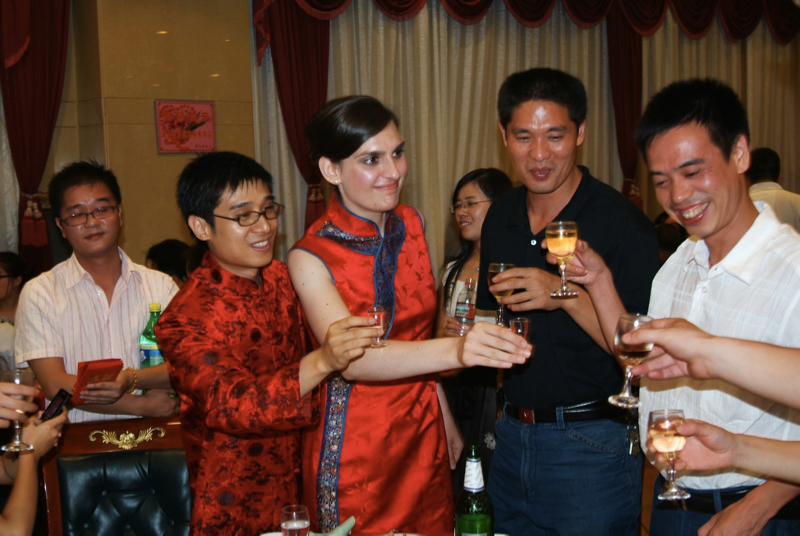
Qípáo, 旗袍: As I wrote before, the qipao or cheongsam is “a high-necked and form-fitting style of dress with slits down the skirt, often on both sides. The dress first appeared in 1920s Shanghai as a modern take on traditional Manchu garb, and has since evolved into a stylish tradition of its own for women in China.” Since most Chinese brides wear several dresses, many opt to have a qipao at their weddings. I actually wore two at mine.

If you’re debating whether or not to have one, see Do You Need to Wear a Cheongsam in Your Chinese Wedding?

Wǎnlǐfú, 晚礼服: The evening gown, another wedding dress option chosen by many Chinese brides.

But let’s not forget the groom…

Yànwěifú, 燕尾服: A tuxedo, one option for the groom.

Tángzhuāng, 唐装: A Tang suit, which mainly consists of a jacket, often made of silk or silk brocade, to match a bride’s qipao. My husband wore a Tang suit at our wedding.

The Wedding Party in Chinese

Xīnniáng, 新娘: The bride. While weddings in the West traditionally have reflected the bride’s style, weddings in China often revolve heavily around the family and guests. In other words, it’s a family affair, much like in Ang Lee’s The Wedding Banquet.

Xīnláng, 新郎: The groom.

Xīnrén, 新人: The newlywed couple.

Bànniáng, 伴娘: The bridesmaid(s)

Bànláng, 伴郎: The groomsman/groomsmen

Traditionally, bridesmaids and groomsmen in Chinese weddings should be unmarried individuals.

Other Wedding Must-Haves in Chinese

Hūnshāzhào, 婚纱照: Pre-wedding photos, one of the most important — and glamorous — steps in getting married. There’s a huge industry in China devoted to turning every young couple into models for a day, complete with multiple outfits, professional makeup and hair designers, and airbrushed photos.

Jiéhūn jièzhǐ, 结婚戒指 (hūn jiè, 婚戒): The wedding ring. While not a traditional part of Chinese weddings, most couples today will exchange rings.

Hūnchē, 婚车: The wedding car, a modern version of the traditional wedding sedan chair (or jiàozi, 轿子). Expect your wedding car, which is almost always a luxury model, to be decorated in elaborate flower arrangements.

Xīnfáng, 新房: While it literally means “bridal chamber” — traditionally, extended families lived together so the new couple only had a chamber within the home — now people use the term to refer to the apartment or home purchased explicitly in preparation for a wedding, usually bought by the groom. (The pressure to buy an apartment in China, where prices have skyrocketed in major metropolitan areas, weighs heavily on the shoulders of young men, especially if their families don’t have much money. See Marriage in China Is Home, Car Money?)

Xǐtáng, 喜糖: Wedding candy. Whenever someone gets married in China, they will pass out wedding candy to all their guests as well as friends and even coworkers who may not have attended the nuptials. There’s a whole industry built around this, with ultra-cute boxes for the candies. (I love chocolate, but soft corn candies shaped like miniature corn cobs are a personal favorite as well.)

Nàodòngfáng, 闹洞房: Roughhousing in the bridal chamber, also known as the most humiliating portion of the wedding for the bride and groom. Their friends will either corner them in the banquet hall or follow them back to the new apartment or a rented hotel room, and tease them with risque practical jokes (including those involving bananas). Traditionally, it was done to ease the new couple into their sex life, long before sex education existed; now it’s just done to amuse the guests and make the couple blush, and then some. Sigh.

Hóngbāo, 红包: Red envelopes stuffed with money. Chinese weddings may be exhausting for the couple, but at least you can count on receiving lots of these from your guests.

Other Helpful Chinese Wedding Expressions

Méndānghùduì, 门当户对: Refers to families of equal status. Traditionally, Chinese marriages happened between families that matched each other in rank and wealth.

Báitóuxiélǎo, 白头偕老: A happy greeting for the newlyweds that means, “May you live together until you’re old and gray.”

Sāndàjiàn, 三大件: The three big items, which refers to three must-haves for married couples. Once upon a time when my in-laws married, it was actually four big items (sìdàjiàn, 四大件). In more recent times, the must-haves are things such as a home, car and money — or even a home, car, money and nice honeymoon.

Jīngpílìjié, 精疲力竭: Completely exhausted, which is how the bride and groom will probably feel after that marathon Chinese wedding. Trust me.

What do you think? What terms would you add/recommend?
Do You Need to Wear a Cheongsam in Your Chinese Wedding?

When you tie the knot across cultural and even international borders, as I have, the whole idea of “I do” suddenly becomes even more complicated. Now you’ve got another culture to consider, with its own set of expectations for the wedding.

If that culture happens to be Chinese, that means there’s another possibility for your wedding dress – the cheongsam. Which leads to this question:

Do you need to wear a cheongsam in your Chinese wedding?

For those of you who don’t know about the cheongsam, also known as the qipao, it’s a high-necked and form-fitting style of dress with slits down the skirt, often on both sides. The dress first appeared in 1920s Shanghai as a modern take on traditional Manchu garb, and has since evolved into a stylish tradition of its own for women in China.

By C.H.Wong Photo Studio.Shanghai.China.中国上海王开摄影有限公司 – http://blog.voc.com.cn/blog.php?do=showone&uid=2785&type=blog&itemid=85453;http://www.kaixin005.com/repaste/3273028_2612066860.html, Public Domain, https://commons.wikimedia.org/w/index.php?curid=8669270

While most women in China don’t wear the dress on a daily basis, it does appear at certain holidays (like Chinese New Year) and special occasions such as weddings. So it’s very common to see brides wearing cheongsam in their pre-wedding photos and at their wedding ceremonies or banquets.

But does that make the dress a must-have in your Chinese wedding?

The short answer is, not necessarily.

I’ve attended a number of Chinese weddings where the brides never even wore a cheongsam. While you’re almost guaranteed to see Chinese brides decked out in a white frothy gown fit for a princess, the cheongsam is generally optional. (Unless, of course, it’s an expectation or wedding tradition of the Chinese side of the family.)

Still, a lot of brides in China will opt to have a cheongsam for a number of reasons. First, you get to wear more than one dress – three is very typical for weddings in China — which means, at least here, you don’t have to choose. And second, the cheongsam is a gorgeous way to add a little Chinese flair to your bridal look.

Many women have rocked the cheongsam in their Chinese weddings, and it’s hard to resist the allure of this sexy dress, which hugs every curve. I ended up wearing two in my own Chinese wedding ceremony (which I’ve shown in the photos I included with this post).

So really, the question shouldn’t be, do you need to wear a cheongsam in your Chinese wedding? Instead, you should ask yourself, do you want one?

P.S.: While you can purchase a cheongsam or qipao online through stores such as Amazon, I highly recommend getting yours tailor-made in Asia. Here’s a list of tailors in Hong Kong, a list of tailors in Shanghai, and a list of tailors and stores in Beijing.

P.P.S.: While the issue of cultural appropriation can come into play whenever non-Asian women are wearing a cheongsam, I like Walking May’s take on this:

I feel the difference between the offensive and non-offensive is crucially ‘how one wears the traditional dress’, so here’s a few ideas to consider:

  • Research that dress! If you would like to wear a Qipao (Cheongsam) respectfully, then do a little research into what looks nice with it and know the name of what it is that you will be wearing. It is probably best not to mix a widely perceived Chinese dress with items from other Asian cultures, to avoid making broad statements about all Asian cultures, or indeed dig out the political through a historical war context that could simmer a stereotypical grudge of some sort. If in doubt, keep it simple.

  • Mere fun-filled costume or true loving appreciation? Your intention matters, and how you choose to wear a traditional garment will allow others to decipher information about you as well as how you feel about the garment. If you love something, then you will simply want to do it justice and appreciated it in the best way that you can.

What do you think?

Why Your Chinese Family Wants You to Have a Wedding Banquet (Even if You Don’t)

When a friend told me she didn’t want to have a big wedding banquet in China, I could totally understand why.

After all, I’m the one who wrote about Why I Don’t Like Going to Wedding Banquets in China. I still have a “just say no” policy when it comes to Chinese wedding invitations. Just the mere suggestion of a wedding in China fills me with dread. The last thing I need is more non-vegan food I can’t eat, a room polluted with noxious secondhand smoke, and a raucous atmosphere that will leave me unsettled for the rest of the night.

In short, a good book at home beats a wedding banquet in China any day for me.

And to be sure, there was a time when I once hoped that my own wedding ceremony in China would have been different. Smaller. More intimate. Vegan food. A strict smoking ban. I envisioned this glorious countryside wedding at the family home, a delightful ceremony closer to nature and tradition than anything I’d seen in the cities.

Well, it didn’t happen that way.

Instead, I got a big, red banquet in a hotel with more than 150 guests in attendance. The only vegan dishes were prepared for me, on the side. And as for that smoking ban, as much as we tried enforcing it, it was kind of laughable when there were free cigarettes at every setting (typical for most wedding banquets in China).

In fairness to the family here, I should be clear about one thing – I was enormously grateful for the wedding banquet for a number of reasons.

Having a wedding in the US was pretty much an impossibility for my husband and me. So if we hadn’t had the ceremony in China, we wouldn’t have had anything at all. Furthermore, they shouldered all the costs of the wedding, which was incredibly generous of them. And in the process of planning the banquet, they allowed me and my husband to make a lot of decisions. We chose the décor for the stage/backdrop. We organized the karaoke afterparty. We decided on the flowers. We specifically requested those candid photos shot during the event. We even planned to let me sing “our song” during the ceremony (which would have happened, had I not lost my voice). In short, we were given a lot of leeway to lend a personal touch to the event.

But yes, if I had planned it all according to my wishes, like brides in America do, I would have had a completely different wedding banquet altogether. (And nobody would have gotten those free cigarettes at the table!)

It was my husband who helped me understand the reality in China – that wedding banquets matter not just to the bride and groom, but to the entire family. As I wrote in Why Your Chinese Wedding Ceremony Will Always Be Big, Fat and Loud:

You can think of Chinese weddings literally as a family affair — a sort of public face that impacts the entire family, beyond you and your groom. And for Chinese families, good face comes from putting on the biggest, fattest, loudest possible affair. Reputation is everything here! After all no one wants guests to remember them as, say, the family who put on that small and pathetic little wedding banquet, or the family who served crappy food or booze. You get the point.

It’s no wonder, then, that often your fiancee’s parents and the rest of the family will have a hand in some, if not most, of the planning of that Chinese wedding ceremony. John’s family sure did.

There’s also another important reason why the wedding banquet must go on – because many families don’t consider you married without it.

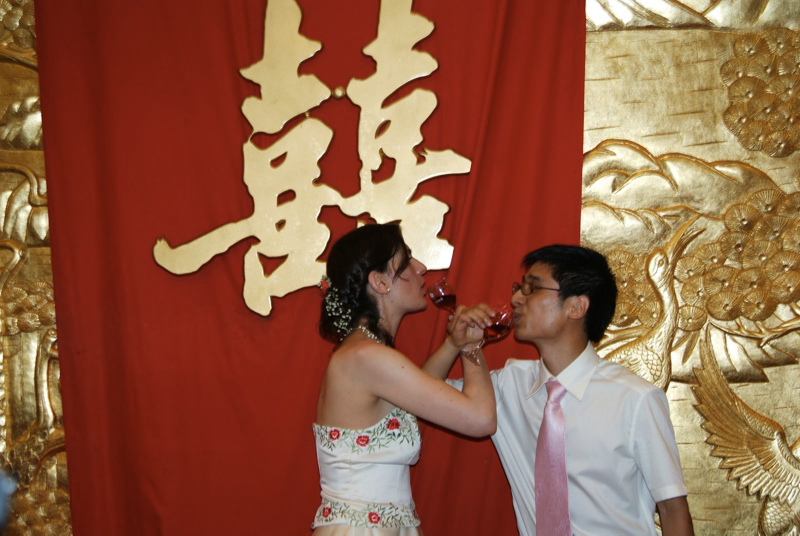
Even though my husband and I registered our marriage years before our wedding banquet, the family didn’t consider us married until we, as the Chinese say, had our “happiness wine”.

So yes, your Chinese family wants and expects a wedding banquet. While there are probably lots of things you can have a say on – from the flowers to the décor to even your photographers – the actual wedding banquet isn’t one of them. Not even close.

But I say, if you’ve got to do it, embrace the experience. And believe me, there are benefits to getting married over here. How about having more than one dress in your ceremony? Or getting your hair and makeup redone several times during the event? Or even having those stunning wedding/engagement photos done? Trust me, there’s lots of potential to enjoy the whole “princess” treatment here.

As for me, I don’t regret the way my wedding banquet turned out. Maybe it wasn’t the “perfect day” I imagined long ago, but that’s OK. After all, my husband and I honeymooned in that magical island of Bali.

Yeah, you can envy me now. 😉

Why I Don’t Like Going to Wedding Banquets in China

In China, there’s nothing that strikes fear into my heart quite like the phrase, “Let’s attend a wedding.”

I should know. A little over a week ago, I was worried when my husband’s old classmate was about to have a wedding banquet – and kept insisting that I simply had to come.

My palms started to sweat and visions of wedding banquets from hell in China flashed through my mind.

(Sadly, almost every wedding banquet I’ve experienced was pretty hellish in one way or another…)

The classmate tried really, really hard to persuade me to come. He offered to take care of everything that worried me about weddings, promising things would be different this time.

As much as I knew he was a nice guy, and as much as my husband trusted him so much he called him a “brother”, I wasn’t exactly buying it.

It’s not that I didn’t believe in his hospitality. It’s just that I know better about weddings in China. I know the drill. I’ve been there and done that. And I never, ever, want to go again if I can help it.

Here are my 3 reasons why I really dislike going to weddings and wedding banquets in China:

#1: I’m a vegetarian, which means I won’t have anything to eat

Wedding banquets in China are renowned for being extravagant feasts, with more dishes than everyone could humanly consume.

In theory, nobody should leave the table hungry.

But I, on the other hand, have left most wedding banquets in various states of hunger. At best, slightly hungry and requiring an additional snack; or at worst, so famished I ended up leaving the banquet hall before the affair was over.

That’s because wedding banquets almost exclusively serve up the finest meat and seafood dishes, while I’m a vegetarian (vegan actually) pining for something that’s not on the menu.

In China, people assume everyone eats meat, seafood and even eggs – and can’t imagine that there are people like me with special dietary needs. It’s such a problem that even dishes that technically ought to be vegetarian – like Chinese kale or tofu – end up being prepared with non-vegetarian ingredients like lard, ground pork or oyster sauce.

It’s bad enough to come for dinner and find there’s nothing for you to eat. But it’s pure torture to watch everyone else at the table blissfully devour their dinner while your stomach grumbles in vain.

Unfortunately, I’ve had this experience a few too many times at weddings in China. It’s enough for me to mentally link the occasion with “starvation” in my mind – and want nothing to do with wedding banquets in China.

Now, my husband’s friend did promise he would have commissioned the kitchen to prepare all the vegetarian dishes my heart desired. That was incredibly generous of him to offer. Still, that wasn’t enough to tempt me, because it’s not just the food that makes weddings in China so aversive to me…

(Photo by MiKi via Flickr.com)

#2: People usually smoke at wedding banquets in China, and I hate secondhand smoke

My husband and I are both fervent nonsmokers. We detest secondhand smoke and don’t want it crapping up the dining table – including when we eat out.

Well, it’s common practice at weddings in China to pass out cigarettes, guaranteeing most of the people there will light up. (And guaranteeing that if I were there, I would be coughing and hacking in agony.)

True to form, they distributed the Zhonghua brand smokes at my husband’s classmate’s wedding. My husband reported that the banquet hall was mired in a noxious cloud of smoke. Yuck!

Jocelyn-John-letdown#3: Weddings in China can be huge, overwhelming events — and I prefer small, quiet affairs

I’m an introverted, quiet kind of gal. I prefer long hikes in the mountains, lazy afternoons writing articles on my own, or reading a fantastic book all morning. I’m not a big party person, but when I do go I usually end up in the most low-key place with a handful of people to talk with – generally the kitchen. Loud noises unsettle me and crowds make me nervous.

In other words, I’m not at all suited for the kind of atmosphere you’ll find at most wedding banquets in China. You know, packed with at least 100 (and often more) people and often so noisy it’s difficult to carry on a conversation at the table.

Indeed, I’ve left more than a few wedding banquets in China wishing I’d just spent that time reading a good book instead.

How do you feel about wedding banquets in China?

6 Surprising Ways Funerals in China Resemble Weddings in China

When John’s Grandpa passed away earlier this year, the last thing I ever expected was to imagine the happiest of all life events. But in many ways, his funeral ended up reminding me of weddings in China.

Coincidence? Maybe not.

The Chinese phrase hongbai xishi (hóngbáixǐshì or 红白喜事, literally “red-white happy events”) links these two drastically different life celebrations in the same breath, with the “red” symbolizing weddings and the “white” funerals. There are even companies in China who exist solely to supply folks with just about everything they need to put on either a wedding or a funeral, advertising themselves as “hongbai xishi” specialists. Who would have thought a wedding planner could be a funeral planner at the same time? But in China, it’s possible.

Well, here are 6 surprising ways that Grandpa’s funeral resembled the weddings I’ve attended in China:

(NOTE: None of the following photos came from the funeral itself. The family specifically asked that we not photograph anything and, as fascinating as it would have been to share those pictures, we obviously needed to respect those wishes.)

IMG_0411

1. Banquets, banquets and more banquets

Anyone who has ever attended a wedding in China or tied the knot themselves knows what the real star attraction is for the event – the sumptuous food. Dish after succulent dish of such incredible delicacies (which, incidentally, have without exception made all of the food I’ve ever dined on at weddings in America look like something out of a high school cafeteria line).

Well, based on my experience at John’s grandpa’s funeral, if you’re attending a funeral in China, prepare to chow down at lots of banquets.

When we arrived at Big Uncle’s home that first evening, we discovered his entire first floor had been converted into a huge makeshift banquet hall, complete with the kind of tacky red plastic table covers I’ve come to associate with weddings in John’s rural hometown. In the four-plus days we spent during the funeral, the vast majority of our participation involved crowding around one of these tables with distant relatives or friends, downing the local dishes while battling with the elders for our sobriety (yes, like weddings the alcohol flows a lot!).

We literally sat down to at least seven banquets that week (and there were at least one or two we even missed because we arrived late and left early).

One thing, though. I don’t know if this is true for every funeral in China, but the food we dined on was definitely NOT the best we’ve ever tasted. But let’s face it – this is a funeral and nobody’s coming just for the food, right?

(photo by ChinaKFC via Flickr.com)

2. Giving money

In China, attending a wedding has its own “entrance fee” if you will. A good guest will always present the happy new couple with one of those infamous hongbao – red envelopes stuffed with an auspicious amount of cash that serve as a wedding gift.

When I caught my father-in-law doing “accounting” one afternoon following a banquet, I soon learned that funerals in China also demanded a little financial support from guests.

That’s right – if you attend a funeral in China, be sure to give the family some cash, just like you would for a wedding.

I’m no expert on how much to give, but I can tell you that guests attending Grandpa’s funeral gave amounts ranging from 200 RMB to 1,000 RMB. By the looks of how many pages were filled in on my father-in-law’s accounting book, I’d say the family did pretty well (except, of course, the fact that no amount of money will ever bring Grandpa back…sigh).

See the floral wreaths in this photo -- they're very similar to those we carried in Grandpa's procession. (photo by 曹鹏 via Flickr.com)
See the floral wreaths in this photo — they’re very similar to those we carried in Grandpa’s procession. (photo by 曹鹏 via Flickr.com)

3. Processions

Traditionally, Chinese weddings always included a lively procession. The bride would be lifted into a dazzling sedan chair decked out in red silk followed by a parade of her dowry items, with the whole thing accompanied by the jubilant sounds of horns, drums and cymbals.

While there was no rejoicing over Grandpa’s funeral, the procession to his tomb in the hills was more striking and vibrant than I ever expected.

For example, white wasn’t the only color on display. Sure, this traditional color of mourning in China figured prominently in the event, with a number of family members wearing white caps on their heads and everyone wearing a white ribbon like a necklace. But there were also brilliant floral wreaths made up of flowers from every color on the rainbow. We carried these eye-catching arrangements on the way to the tomb and it made the procession look quite beautiful.

The sound of drums and cymbals also accompanied us on our short journey to Grandpa’s tomb. John said the instruments struck a mournful tone in comparison to what you’d hear in a wedding procession – but just having them in the background was quite the contrast to the staid and quiet Catholic American funerals I’ve attended back in the US!

IMG_2129

4. Firecrackers

Nowadays, every modern wedding is an explosive experience – literally – with lots of fireworks and firecrackers.

If Grandpa’s funeral is any measure, China clearly wants to send their deceased off with a bang.

Of course, there were the obligatory explosions right near the tomb and before they started the big procession to Grandpa’s tomb, but that’s not all. Big Uncle’s family actually used firecrackers to announce all of the banquets that week. (By the time we were ready to leave, I swore I was almost having this strange Pavlovian reaction to the sound of firecrackers – where that booming noise made me feel hungry!)

143486176_6d0c8c93f9_z
The guests at Grandpa’s funeral dressed a lot like these folks. (photo by Steven Yu via Flickr.com)

5. People dress in surprisingly casual clothing

As I’ve written before, don’t even think about trotting out your best cocktail dress and suit and tie when you’re attending a wedding in China. Well, by the looks of Grandpa’s funeral, I’d say don’t even bother donning the kind of funeral outfits you’re used to in the West.

While most people generally stuck to muted colors as well as black and white, the styles were all over the map. My sister-in-law, for example, spent the entire funeral wearing a jean skort so short and tight I was stunned – a look that seemed more on the corner of Hollywood Boulevard than mourning a relative.

Most people wore shorts and T-shirts, sneakers and old loafers; only a small handful of women had on casual dresses and not a single man in attendance sported a necktie.

(photo by kenji via Flickr.com)

6. The experience will exhaust you

The one thing people never tell you about participating in Chinese weddings – something you only learn through experience – is just how incredibly exhausting it is to be the bride and the groom. You’re on your feet almost the entire celebration, you spend so much time toasting all the guests that you don’t even have time to dig into the amazing food, and then just before it’s all over you have to take part in the embarrassing ritual of roughhousing in the bridal chamber.

Well, if your dearly departed is close family – like Grandpa was for us – get ready for a marathon experience yourself. His funeral lasted from Sunday through Thursday evening, five entire days of remembrances, rituals and banquets.

Just thinking about that makes me feel exhausted all over again.

But the real exhaustion lies in the details – and in particular, a certain ritual called shouling (shǒulíng or 守灵). This tradition requires that a family member keep vigil on the deceased’s coffin at all times, even through the night. Many relatives sacrificed their sleep night after night to fulfill their duty and accompany grandpa – especially Grandpa’s children, like my mother-in-law. Well, she paid a steep price for staying up late several days in a row: it sent her straight to the hospital following the funeral.

While her example is pretty extreme, the whole experience of Grandpa’s funeral left everyone feeling a little fatigued. At times, it seemed like taking care of Grandpa (through the traditions) mattered more than having the family members left behind actually take care of themselves.

Still, the fact that John’s oldest brother complained about the length of the funeral – and the fact that it put his mother in the hospital – tells me that there’s still room for a happy medium that respects the culture and the needs of the attending family members.

What do you think? Have you seen similarities between funerals and weddings in China?