
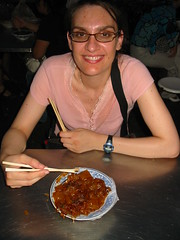
Travel China with the Yangxifu: the Kaifeng Night Market

Travel China with the Yangxifu takes you to the Kaifeng Night Market. Here, I’m trying fried bean-starch, or chao liangpi.

Foreign women are not available at the Kaifeng Night Market — even if there’s a demand.

“Wow, you have a foreign girl — you’re really sharp!” The almond tea vendors, wearing white coats and kufi — the traditional Muslim caps for men — reveled in the fact that my Chinese husband, John, had a foreign wife. But their revelry was more than just a casual curiosity.

“I’d like a foreign wife,” one of the vendors declared in a rough Henan accent. “How do you get one?”

You don’t get one at the Kaifeng Night Market.

But you will find so much more, from fantastic xiaochi (小吃), which means

snacks), to quirky people (including the aforementioned foreign-babe obsessed vendors) and a uniquely boisterous atmosphere. The Kaifeng Night Market is a living relic, a reminder of the forte volume and flavorful delicacies of night markets that once blanketed the country, but are now disappearing because of city beautification or cleanup projects. (Interestingly, my friend Frank G, who works as a judge in Kaifeng, said that the city cannot shut the market down, because they’re afraid the sellers would protest.) But, most of all, it is relaxing, fun and leaves you with none of the touristy aftertaste associated with China’s major attractions.

Continue reading “Travel China with the Yangxifu: the Kaifeng Night Market”

Chapter 6: I’ll be watching you in China

There stood John, my Chinese coworker, in front of our office building, just as he promised moments ago. “I’ll be watching you in the bus.”

Would he really still be there after I boarded the bus downtown, the bus that took me to the gym where I exercised many evenings? It was a thoughtful sentiment, but one I’d never heard before. Was this just another joke, the same jokes I’d heard before when sitting with the translators? I turned the corner before the intersection, and walked north a few meters to the bus station, wondering who I would see before our office building.

But there he was, motionless, and awaiting my safe passage, as if I had just boarded the slow boat for North America. It was as though John had all of the time in the world, as long as it was for me. The John I came to know was not just any Chinese man.

John didn’t just stand up for me — he stood up for his village, as he told me one afternoon. Continue reading “Chapter 6: I’ll be watching you in China”

Chapter 5: Love is Impractical

Frank, my ex-Chinese boyfriend, may never love again, the way we loved. This is what I learn when he and I have dinner one evening in early July, 2002.

Frank and I had began to talk once again in the first week of July, after he sent me a series of text messages in Chinese demystifying some of his feelings:

“I regret what happened between us.”

“I was unfit for relationships.”

“This was a failure of mine.”

Frank’s words released me from the emotional purgatory I suffered in after our breakup — a breakup I had to shoulder silently and painfully each day, because my desk sat next to Frank’s. Soon, we became friendly again, every warm smile a relieving reminder that we were moving towards a friendship.

One night, I was moved to send him a text message in Chinese: “I am so glad to see your smile again.”

“I sincerely appreciate your understanding,” he wrote back. “You are my best friend.” I clutched my chest again because his words brought me back to our courtship. Did Frank really break my heart? I began to wonder if our parting was a mistake.

But now I know better, after that dinner. Continue reading “Chapter 5: Love is Impractical”

Ask the Yangxifu: Sensitive China issues, arguments and your Chinese husband

Ellen asks:

My husband and I had a little argument yesterday regarding the execution of a British citizen in China, you are probably aware of the case. We often have complete opposite opinions on political issues and China’s attitude towards human rights, democracy, and so on… I tend to avoid these subjects because I know they are very sensitive to him and no matter what he will always defend his country. He can be very stubborn, and very annoyed by the fact that the West will only listen to Chinese people when they criticize their country (his words, not mine).

I was wondering: how do these sensitive issues (Tibet, Urumqi, China’s “great firewall”, freedom of speech, human rights and so on and on…) affect your husband? Do you often have discussions about it? Or do you -like me- tend to avoid them (also on this blog maybe?)? And if you have different views, do they influence your communication? Continue reading “Ask the Yangxifu: Sensitive China issues, arguments and your Chinese husband”

Chapter 4: The Embarrassment of Love in China

“That’s too nauseating!” Caroline reproached me the morning after spending the night at her house in Yiwu — for a rather nauseating gesture towards John.

Since I’d overslept that morning, I rushed out the door without putting on sunscreen, and had to do it in front of Caroline and John. Just as I massaged the lotion into my face and arms, John spoke up. “Could you give me some?” I don’t know why, but instead of handing him the container, I applied it directly to his face. That’s when Caroline groans — at this mere insinuation of affection.

The last time I heard anything like “that’s nauseating” about my love life was in high school. But I’m not surprised by Caroline. When I taught freshman college students in Henan Province, girls and boys sat on different sides of the room, and never spoke publicly with the opposite sex, afraid of the mere perception — and, in some cases, stigma — of romance. Their high schools and parents prohibited dating. I’m sure Caroline’s and John’s schools and parents did the same. Yet, Caroline and John are in their early twenties, and, to them, love is still an embarrassing, strange thing. They make me feel embarrassed all over again, as if I am 12 and afraid to hold hands in the school hallway with my so-called boyfriend.

Still, while I flirt fearlessly, I fear the words Caroline spoke to me freely, a week after we return from Yiwu: I think he would make a great husband.

I’ve only begun to know John, and now Caroline wants me to think about him in marital terms. Now I’m the one embarrassed, sitting on the opposite side of the classroom, and afraid to make a move.

But putting lotion on John’s face, and getting ridiculed by Caroline? I think, secretly, I love it. Now, that’s too nauseating.

Have you experienced the embarrassment of love in China? Did your friends laugh at you when you flirted with someone, or held hands, or even tried to kiss?

——

Memoirs of a Yangxifu in China is the story of love, cultural understanding and eventual marriage between one American woman from the city and one Chinese man from the countryside. To read the full series to date, visit the Memoirs of a Yangxifu archives.

Chapter 3: Shortcomings

I had never stood next to John before the day we rode the “green skinned” train to Yiwu. I asked John out for lunch before we rode the train, and, as he stood up from his chair, there he was — more than two inches below me, and many pounds lighter.

I always believed I wasn’t superficial, until now — I felt disappointed, just because John was shorter. Continue reading “Chapter 3: Shortcomings”

Chapter 2: My Chinese Matchmaker, Caroline

Caroline’s mother doesn’t believe me when I say I’m full. She is a typical Chinese hostess, deciding that I am being polite, even as I’m being truthful every time I tell her chibaole — I’ve eaten enough. “Eat, eat, eat” is her mantra as we sit around the dinner table at this home in Yiwu, feasting on eggplant, fried pumpkin, and — for Caroline and John — chicken feet and shrimp.

I think Caroline takes after her mother, because she doesn’t believe me either — about love, that is. You need to be careful who you date. Continue reading “Chapter 2: My Chinese Matchmaker, Caroline”

Chapter 1: My Heart is Shut Away, My Chinese Boyfriend is Gone

Our “green-skinned” train to Yiwu had no air conditioning on this sultry evening of July 13, 2002. My two translator friends, Caroline and John, were with me on the hard-seat section of this train. The three of us sat on the same seat — with upholstery in the same dark green color as the train — across from two soldiers in the People’s Liberation Army. I borrowed Caroline’s plastic fan from time to time, and sometimes caught a breeze through the open window. But mostly, the humidity loitered painfully around us, and we hoped, in vain, that it would go away.

There is a word for this weather in Chinese: 闷热­ or menre, meaning muggy. The first character, men, is made up of the character for heart (心) contained within the character for door (门) — as if to say your heart is shut away or contained.

My heart had been shut away before this trip. I had just broken up with Frank, my first Chinese boyfriend in Hangzhou, my coworker at the Chinese Internet company where I worked. Continue reading “Chapter 1: My Heart is Shut Away, My Chinese Boyfriend is Gone”

January in China: The Holidays aren’t over yet

I wrote this piece five years ago, but it still rings true. If you miss the holiday atmosphere in January, after Christmas and New Year’s Eve, then you should be in China.

—-

It was early afternoon, and the little Luwan Food Store in Shanghai was belching out patrons left and right. We felt the squeeze as we waited in line for the sesame seed/walnut powder. I was taken by one man who bought two large containers, and slipped them into a black valise that seemed more fitting for someone in the secret service. The people behind John and I impatiently nudged us forward.

The ladies behind the counter just beyond that — the one for Chinese tonics and herbs, everything from ginseng to swallow saliva — bustled back and forth, handing the remedies over to customers in the smart, glossy red packages. Even the tea department brewed with energy. Several men hunched over a counter displaying an assortment of dried and cured leaves in a spectrum of greens, browns and black.

When John and I returned to Huaihai Road — the “Fifth Avenue” of Shanghai — we plunged into a odd gallery of late-season holiday decorations in the store windows. Tinsel, Christmas trees and images of Santa Claus all contradicted the reality that Christmas was already over. Even department stores broadcasted Christmas carols in the background.

This is January in China’s big cities: still frosted with holiday flavor, and still a consumer frenzy that would rival the Christmas shopping season. Continue reading “January in China: The Holidays aren’t over yet”

Weathering Cross-Cultural Love in China

This is another classic post from four years ago, when John and I hit some turbulence in our relationship. Stress, personal issues and cultural differences all exploded together just as the weather began to change. Maybe you’ve been there too?

——

In December, a sudden change of weather can really throw you off guard. One day it’s 16 degrees C, and the next day the temperature dives down to 6 degrees C — or less. Of course, the weatherman has a scientific explanation — it’s because of that cold front from the North or something else. Explanation or not, you’re left with the chilling reality that winter is here. And, you wonder when exactly did Autumn make its surreptitious departure?

Like the weather, relationships have their own rapid fluctuations — as I have discovered in this month. Continue reading “Weathering Cross-Cultural Love in China”