
Should you cave to family pressure at Chinese New Year to drink or smoke, even if you’ve never done either, out of politeness to your hosts?
For the author of an article published in Beijing Kids, detailing how she brought her Beijing-born husband to see relatives for one Chinese New Year, the answer was, shockingly, yes:
Now I don’t know whether you’re familiar with Dongbei (Northeastern) hospitality, but it’s intense. If I had to describe it in one word, it would be excess. According to one of my aunts, Dongbei people give their guests the best that they have to offer which, in my family, translated to the most expensive baijiu, extravagant meals breakfast, lunch, and dinner, and non-stop smoking even for my non-smoker husband. According to my husband, it’s impolite to turn down gestures of hospitality, so for a week, he became a smoking baijiu day-drinker.
I understand how sitting around a crowded table at Chinese New Year can function like the social equivalent of a pressure cooker, where people get passed cigarettes or poured baijiu even after multiple refusals. And yes, sadly, many Chinese feel bound by an unhealthy culture, especially in northeastern China, as chronicled by China Daily in the article Learning to Refuse Toasts in the Season of Ganbei, published Jan 26, 2012:
Li Li, 36, from Harbin, Northeast China’s Heilongjiang province, said she often feels pressured at business banquets to drink too much with friends and clients and the problem get worse during the holidays.
“Repeatedly, and I mean repeatedly, clients come to me proposing toasts, and they won’t stop until I’m drunk,” she complained. “Unfortunately, in our culture, you just don’t turn down a toast-people would feel humiliated and consider your rejection a put-down. But it seriously hurts my health.”
And among family, people you’ll end up seeing again and again over the years, drinking or smoking, even when you don’t want to, creates a potentially binding precedent that will haunt you every time you return. Everyone will point out how you raised your glass or lit up last time, and clamor for you to fall in line once again.
But who says you have to say yes?
My husband, who is Chinese, doesn’t smoke or drink, and won’t make an exception for holidays merely because of family pressure. Granted, he hails from Zhejiang province, which perhaps has a more tolerant attitude toward people who pass on the cigarettes or baijiu. But he has also found it helpful to trot out this brilliant excuse, which always works: “I have a foreign wife!”
In fact, pointing to a spouse who wouldn’t approve has actually become a bona fide reason for many Chinese to turn down alcohol, as chronicled among the tips mentioned in the China Daily piece Learning to Refuse Toasts in the Season of Ganbei:
Strategy 1: Drive to parties. Since drunken driving has been classified as a major criminal act, even the most enthusiastic drinker would not force a driver to break the law.
Strategy 2: Bring up your spouse, even if he/she is not present. Tell those urging you to drink that your significant other considers drinking too much absolutely unacceptable.
Strategy 3: For health reasons. If you were told for medical reasons to steer clear of alcohol, telling the group, in your doctor’s words, can get you out of forced drinking.
Strategy 4: Complain about your workload. You need not go into much detail, just tell your friends or clients that you have too much work to do after the dinner.
Most of these strategies could also help you say no to cigarettes too. (And you could even use the “health reason” strategy to craft your own “white lie” of a doctor’s excuse.)
Plus, anyone facing forced drinking might also bring up that time-honored Chinese saying – yĭ chá dài jiŭ (以茶代酒, substitute wine with tea) – which has allowed many a person in China to escape that dreaded baijiu.
And if you feel especially courageous, consider reminding your host of the expensive lessons that could ensue from coercive imbibing, such as the case chronicled in the China Daily article Don’t Force Others to Drink:
A court has ordered a 69-year-old woman in Kai county, Chongqing, to pay a fine of 330,000 yuan ($53,000) to her brother, who fell down and injured himself after being coaxed by her into drinking about 600-ml of homemade liquor at her birthday party. The fine should be a warning to people who are in the habit of forcing others to drink beyond their capacity, says an article in Legal Daily.
If you plan to spend Chinese New Year with your family or that of friends, don’t assume you must succumb to pressure to drink or smoke. You can say no, following one of the many strategies I’ve listed in this piece, and still remain in the good graces of your hosts, while leaving the vices to others.
So when it comes to “cheers”, I hope your Chinese New Year is filled with those of happiness!
What do you think?
Photo credit: https://commons.m.wikimedia.org/wiki/File:Vertreter_der_vier_Baijiu_Kategorien.jpg


 Qixi Festival: Popular Gifts
 Have a romantic candlelit meal together
 Long-distance lovers make contact
 Get matched or even married
 Do a little stargazing
 #1: Be totally antisocial
 #3: Dress in shabby or old clothing


 When Disney taught me about happily ever after, they forgot to add in some additional clauses about cross-cultural relationships. In particular the challenges that accompany a AMWF (Asian Man, White Female relationship). Thus when I fell in love last summer to the sweetest, gentlest man I’d ever met, I never realised that the happy ever after I’d always longed for had inadvertently sent me on a cultural collision course. In fact, despite being in my mid-20’s, I assumed, as my good friends Cinderella and Pocahontas had once taught me, that love could, and would, solve everything.

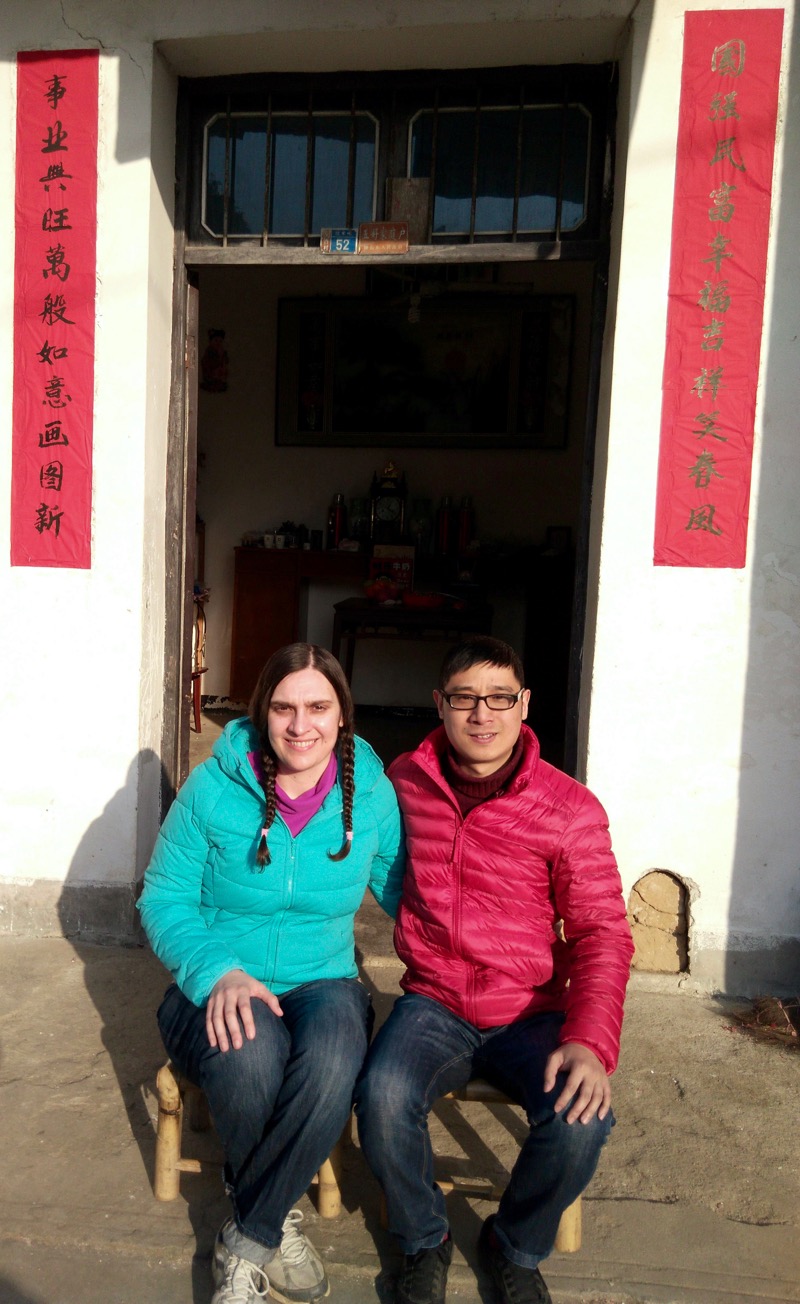
 New year, new picture of John and me in front of the family house. We may be smiling, but we’re beat. With all the fireworks set off all night, I got maybe four or five hours of decent sleep.
 This is our first dinner of the new year at an uncle’s house. There’s lots of toasting, and lots of fantastic food. My husband’s aunt is an extraordinary cook and she happened to dish up a serving of Chinese-style kimchi more delicious than anything I’ve ever had (Must corner her and get the recipe!)
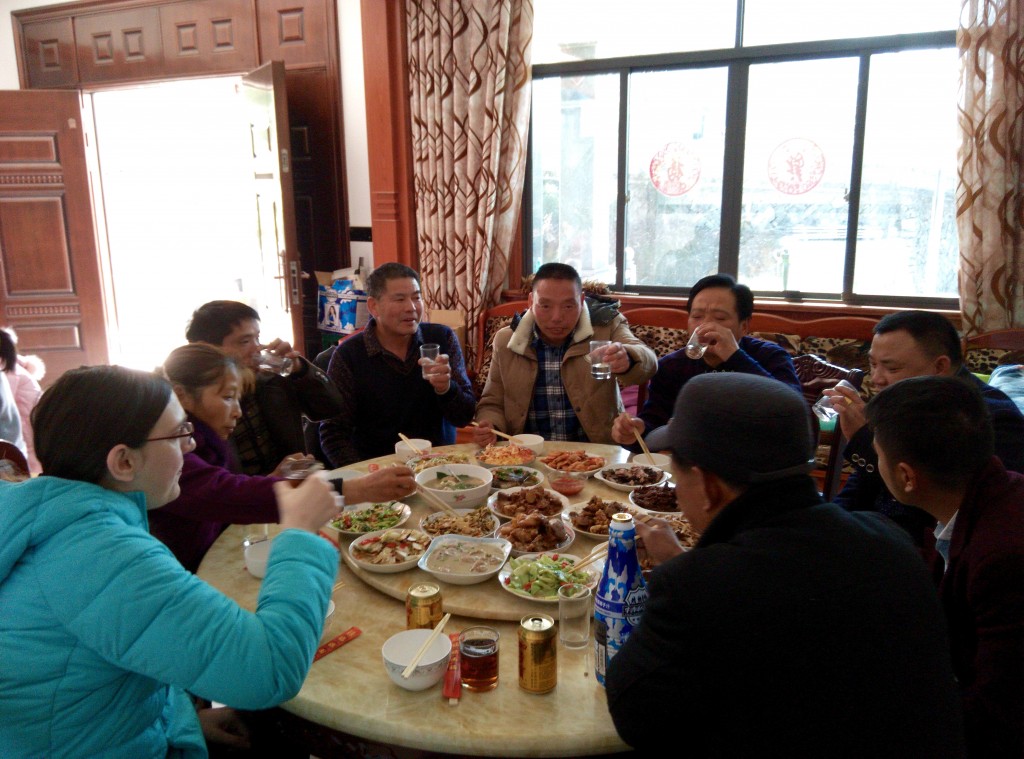 Yeah, I know, eating again. Seriously, that’s the heart of this holiday. Lots and lots of lunches and dinners. As always, we ate…
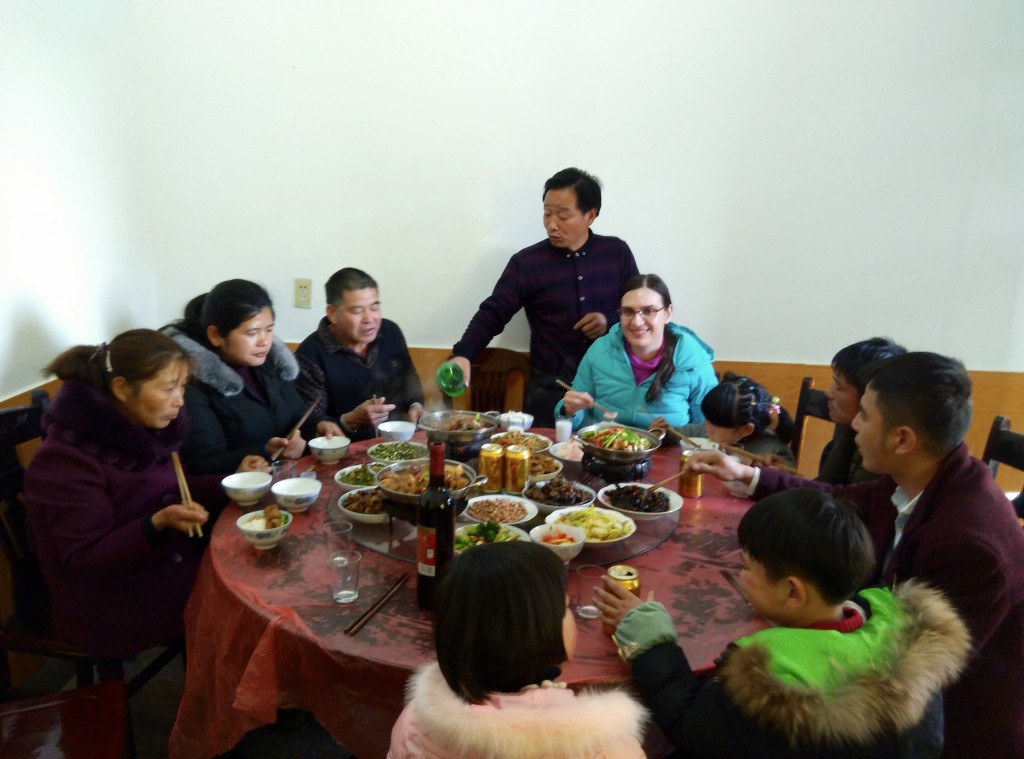 …and ate…
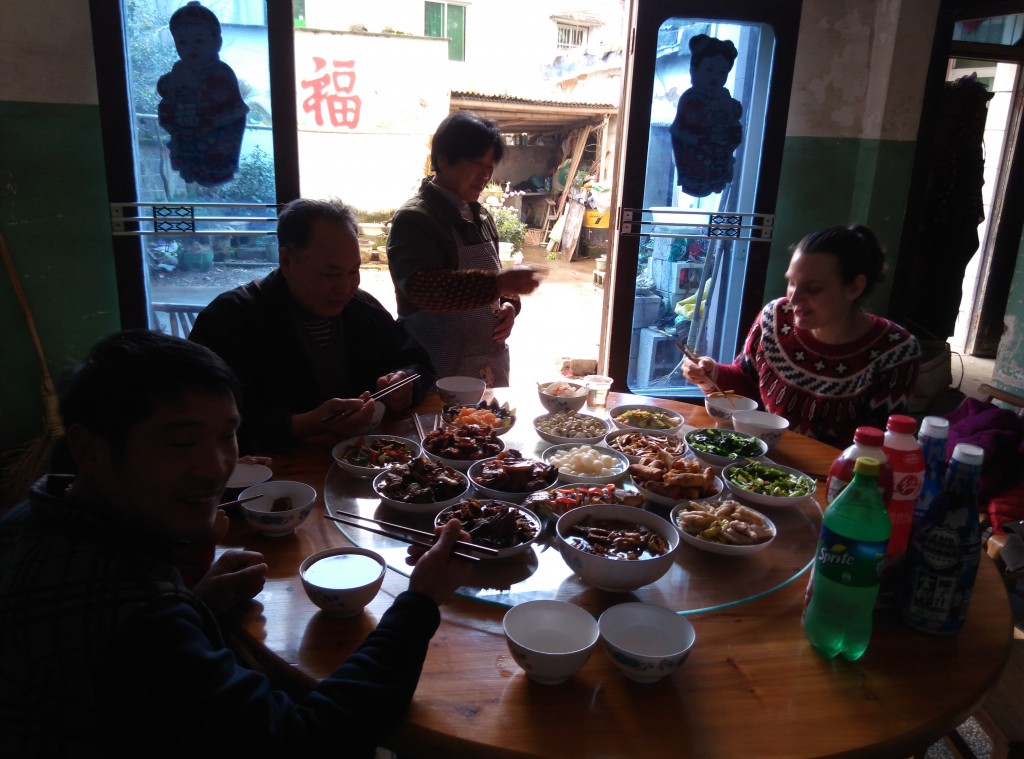 …and ate!
 Even when you’re not having lunch or dinner, people usually offer you lots of food to snack on. Notice the trays of assorted nuts, fruit and candies arranged on the tables before us.
 Here I am at an aunt and uncle’s home, attempting (unsuccessfully) to snack on raw sugar cane. Sweet, but a little too pulpy for my taste. This was day 6. Do you see the fatigue on my face yet?
 This is John and me at the end of the holiday. I’m looking haggard (see the “panda” eyes?) — and longing for a little peace. Fortunately, when we returned from this walk, the village was quiet. Finally, I could rest.