
Featured in Global Times Article: On the Fast Track to Love

Champagne glasses, toasting at the beach
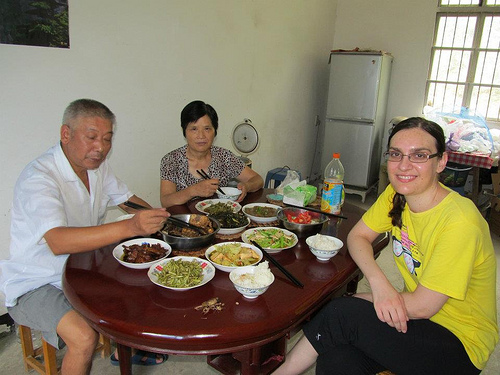
The Global Times featured me in a recent article titled "On the Fast Track to Love." (photo by Roger Kirby)

I’m on the fast track back to the US (I’ll be hopping a plane back there on Tuesday, August 16). That’s why I’m late to tell you about my latest appearance in the news — a Global Times article titled On the Fast Track to Love, a story about cross-cultural speed dating. Here are a few quotes from me in the article:

For some, the attraction comes from an interest in their partner’s culture. “I’ve always felt more comfortable in the company of Chinese men, since their culture is more in tune with who I am,” US born Jocelyn Eikenburg, an English/Chinese translator who married a Chinese man and blogs about intercultural relationships, said, adding that she’s actually “incredibly shy and not so direct with people.”

For many Westerners, saying “I love you” is a big step in a relationship, a sign that you are really serious and invested; while love is usually implied among Chinese couples through actions such as sending you all the way to the door of your apartment, Eikenburg said.

“When Chinese do verbalize their feelings, they tend to use softer terms than what we are used to, such as ‘I like you’ because the word for love packs quite a punch in Chinese,” she added. “Not surprisingly, many Chinese with foreigners actually feel more comfortable saying ‘I love you’ in a foreign language.”

Check out the full article online. And if you love it, share it. Thanks!

Ask the Yangxifu: Opposite-Sex Friendships in China

An American woman wonders, can people of the opposite sex still be friends in China? (photo by Edwin Pijpe)

Eleanor asks:

I’ve recently befriended a Chinese student here in the US. I lived in China for 2 years and speak Chinese more or less fluently, but my grasp of Chinese friendship/dating culture is still pretty basic. He and I have talked about exploring the possibility of being more than friends, but both of us agreed to take more time to get to know each other just as friends for now and not to rush anything. I think there’s an obvious undercurrent of attraction between us, and I’m worried that if we decided we were unsuitable romantically that he would back off friendship-wise as well. In China, I didn’t see many opposite-sex friendships (besides with high school aged kids), and I worry if we don’t end up dating that I would lose him as a friend too. I like and respect this guy a lot, so I hope you can reassure me that our friendship can continue even if one of us finds someone else. Continue reading “Ask the Yangxifu: Opposite-Sex Friendships in China”

Five Things Taiwanese Idol Dramas Say About Love in China

Down With Love Taiwanese Idol Drama promotional poster
What do Taiwanese Idol Dramas -- such as "Down With Love" -- say about love in China? (image from wikimedia commons)

This year, I’ve enjoyed a summer of love — if, by love, you mean the love portrayed in Taiwanese Idol Dramas. I got hooked sometime in June on Down With Love. Before I knew it, I tuned in for parts of Romantic Princess, Sunshine Angel, Miss No Good, They Kiss Again and even Taiwan’s version of Honey and Clover.

The more I watched, the more I realized these shows have something to say about love in China. Here are five things I noticed. Continue reading “Five Things Taiwanese Idol Dramas Say About Love in China”

For My Chinese In-laws, Scolding is Love

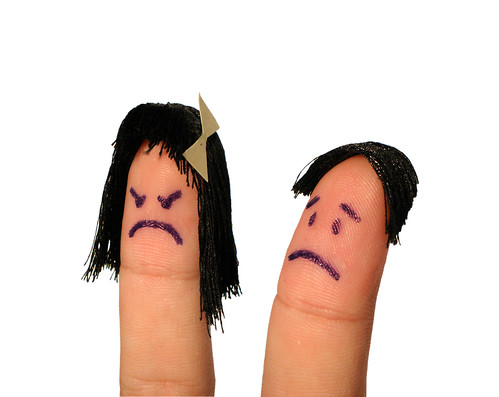
A finger-puppet couple with the wife visibly angry at the husband
I didn't understand why my Chinese mother-in-law always argued with my Chinese father-in-law. But, according to my husband, maybe that's their way of showing love (photo by kamil kantarcıoğlu).

My Chinese father-in-law isn’t just a husband and parent in our home. He’s also a punchline, and a virtual punching bag.

I’ll never forget that day in May when I watched my Chinese mother-in-law storm out into the yard and holler up to my Chinese father-in-law. “You’re just like a Bodhisattva! Always staying up and never coming down!”

I don’t know what he did to deserve that Buddhist curse. But after spending more than two months here – where almost a day wouldn’t pass without my Chinese mother-in-law naming my father-in-law’s stupidity du jour – I can guess why. Continue reading “For My Chinese In-laws, Scolding is Love”

Ask the Yangxifu: Why Does My Chinese Family Refuse My Gifts?

Gift box wrapped in silver paper with purple, blue and green stripes and a magenta bow
An American woman wonders why her Chinese in-laws seem upset every time she gives them a gift. Why do they always refuse what she buys for them? (photo by Irum Shahid)

Sam asks:

Recently, while I was at the grocery store, I saw a lovely bouquet of lilies. I thought they would look lovely in the kitchen, and decided to by them for my Chinese mother-in-law. I brought them home and put them in a vase. But when she came home and I told her they were for her, it seemed to stress her. She first tried to get me to say that they were just for myself, and then insisted that they were for the men in the house since Father’s Day had been the week before. We finally agreed that they were for everyone.

I can’t help but wonder if I did something wrong. My husband didn’t think so, but he’s been in the states for over 20 years now and isn’t always in the loop.

I had a similar experience when I came back from a trip. I had bought her a purse that I found on super-sale and thought she would like it. She kept on insisting that I would need it more than she would and that I should keep it for myself. It wasn’t until I told her I had bought myself something similar that she settled down and accepted it.

It is not uncommon for me to see something that I think a friend will like and buy it for them. Several times I’ve seen clothes that I know would fit my mother in law that would look good on her, but I am afraid I’ll terrify her or something. Do you have any insight? Continue reading “Ask the Yangxifu: Why Does My Chinese Family Refuse My Gifts?”

My Chinese Inlaws’ Not-So-Free Marriage

Clouds against a blue sky forming a heart
My Chinese father-in-law insisted that the new China included free choice in marriages. But it seemed like an illusion when he admitted he didn't freely choose his bride. (photo by miguel ugalde)

The other day, while talking about weddings in China with my Chinese father-in-law, we happened on the idea of parental involvement (or should I say, pressure) since the founding of the People’s Republic of China.

“It seems to me that parents still have a say in marriages today,” I said.

My Chinese father-in-law shook his head. “No, no, that’s the past,” he disagreed, referring to how Chinese parents used to arrange marriages for their children. “Now people have the freedom to marry whoever they want.”

How I longed to shake him and say, what about what you said about John and I? My Chinese father-in-law was the one who cautioned John against having a foreign girlfriend, telling him he could be friends with — but not date — me.

But I bit my tongue. “What I mean is, Chinese parents have ideas about their children’s marriages. The parent will tell the child if they like the person or not. The child has free choice, but may want to be filial and not go against their parents.”

My father-in-law’s eyes widened and he grinned. “Ah, yes, yes!” Then came a surprising confession. “That’s my marriage.” Continue reading “My Chinese Inlaws’ Not-So-Free Marriage”

The Chinese Relatives Name Game

rp_6287663793_de769896c5.jpgMore than a week ago, my Chinese mother-in-law spent a whole day helping someone plant their rice paddy. That “someone” turned out to be a relative.

“She was out helping our Jiujiu plant the fields,” my sister-in-law told me at dinner. Jiujiu is the Chinese word for uncles on the mother’s side. But as far as I knew, we only had two uncles on John’s mother’s side — Da Jiujiu and Xiao Jiujiu. Neither of them needed assistance in the fields, especially Xiao Jiujiu who just became our village secretary. How could she possibly help someone called “Jiujiu?”

“Oh, that’s the godfather’s little brother.” Godfather, as in John’s godfather (John needed a godfather because his Chinese zodiac sign, the horse, conflicted with his father’s, the rat).

Then I remembered that, some time ago, my Chinese mother-in-law told me the godfather was a relative — but I’d forgotten how and asked my sister-in-law. “He’s the Gunainai’s son.”

“Gunainai?” I felt as if I was getting tangled in the branches of this family tree. Continue reading “The Chinese Relatives Name Game”

Ask the Yangxifu: Chinese Boyfriend Never Plans Our Dates

Road sign indicating left or right turn is permissible
Her Chinese boyfriend leaves all of the date-night decisions to her, and she's tired of it. How can she get him to care?

MC asks:

I hate the whole “passive Asian man” stereotype because I don’t think it’s always true. For example, my Chinese boyfriend is a Banquet Captain at a hotel, and sometimes his coworkers will call him to ask where something is or how to set up the banquet hall. The way he takes charge and responds shows that he has a leader in him, and it’s a huge turn on when I see him like that. But then when we hang out, I decide everything, from what we do, to where we eat, and even what we eat sometimes. I don’t mind doing it sometimes, because it basically means he’ll go anywhere I want him to without complaining, yet it gets tiring. I feel like it’s the guy’s role to lead and to decide even just where to eat sometimes. I’ve talked to him about it but his thinking is so different than anyone I’ve ever met (though he doesn’t think so). I can see it from his point of view, but he can’t see mine. And I understand his logic. He honestly does not care what we eat. So even if I tried to make him care, his mind would be a blank. If that’s the case, you’d think it’d be easier for me to just choose a place, right? What should I do? Continue reading “Ask the Yangxifu: Chinese Boyfriend Never Plans Our Dates”

Ruzhui: When Chinese Men “Marry Into” Wife’s Family

A man falling upside down
Ruzhui -- where Chinese men "marry into" the wife's family and have the child take on her name -- turns Chinese marriage tradition upside down. (photo by Charlie Balch)

Before I even entered his apartment with John, my Chinese husband, I knew O’Neil – a close Chinese friend of John’s from middle school – had marital distress. But I never imagined that – among other things — it would have anything to do with a struggle over the next generation’s name. “At first, her parents demanded ruzhui,” he shared late Friday, May 27, as John and I sat side by side on a sofa in his apartment for one on Hangzhou’s West Side.

I raised an eyebrow at this strange Chinese word. “What’s ruzhui?

“You marry into her family, and your children have her name,” explained O’Neil. Unlike O’Neil, who came from the countryside, his wife was the only child of a proud Hangzhou family – a family that didn’t want their name extinguished in the next generation, just because they happened to have a daughter. It turned Chinese tradition — the woman marrying into her husband’s family and giving her child his name — upside down.

O’Neil documented far greater transgressions in their marriage (the parents bought them a car, but only gave their daughter a key; on an apartment deed, where they were required by law to write their son-in-law’s name and give him a share in the real estate, the parents gave him only one percent of the value). If anything, the suggestion to ruzhui was almost understandable in a Chinese sense – except that the parents hadn’t discussed it with him before the marriage. Continue reading “Ruzhui: When Chinese Men “Marry Into” Wife’s Family”

Ask the Yangxifu: Chinese Boyfriend Seems Too Chinese To Western Girlfriend

A worried Chinese man
When a Western woman tells her Chinese boyfriend he's "too Chinese," he wonders -- is "too Chinese" unattractive to Western women?

Seborga asks;

my fiance has been together with me for 4 years. she always mentioning that it won’t be possible for her to be together with me if I were too Chinese. Since I have been overseas for 13 years since I was 16, she thinks I have the same wave length of thinking as her. I had few western gfs, and most of them taking “Chineseness” as something very negative. So does that mean thinking and behaving as a total chinese is very unatttractive in the eyes of mainstream western women? Continue reading “Ask the Yangxifu: Chinese Boyfriend Seems Too Chinese To Western Girlfriend”