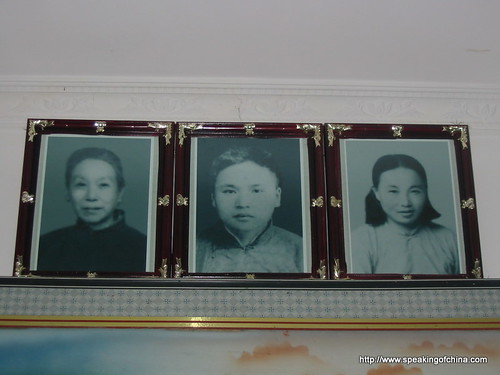
The fact that my Chinese husband worshipped his ancestors inspired me to worship my own.
“I feel so hopeless.”
In the ebb and flow of my own moods, I had hit another low tide this past Friday. I didn’t want to feel this way, but the week had swept me under for a lot of reasons – from hormones to the fact that my Chinese husband John had a really bad week (for reasons I can’t get into right now). So there I was, sitting at the kitchen table and letting myself get pulled into a whirlpool of negativity.
Then I thought of it – or, rather, her, my deceased mother. And just like that, I sprang from my chair and my mental abyss, as if pricked by some invisible pin. “I know what we need!” I exclaimed to John as I started opening a little box in the corner of our living room. “A little help from our American ancestors.” Continue reading “With A Little Help From Our Ancestors”
Kim Lee's bruises put a new face on her cross-cultural marriage to the founder of "Crazy English," Li Yang.
Just last month, I discovered a new celebrity couple in the cross-cultural community of Chinese men and Western women — Li Yang, the founder of Crazy English, and Kim Lee, his American wife. If only it weren’t because of revelations that Li Yang beat and battered Kim for many years.
If there was a “model Yangxifu” award, Kim Lee deserves it. She courageously shared her private turmoil with the public, starting a national conversation on domestic violence and spurring the Chinese government to reconsider dormant domestic violence legislation.
But Kim’s relationship with Li Yang could easily play into some of the worst cross-cultural marriage nightmares — and, I might add, negative stereotypes of Chinese men.
Of course, I don’t fault Kim for anything. She did the right thing. Still, a celebrity couple in the community of Chinese men and Western women in love makes the headlines… and, unfortunately, it’s for domestic violence. I couldn’t help but wonder — will some people come away with the wrong kind of message? Continue reading “On the Kim Lee and Li Yang Domestic Violence Story”
What would it be like if my Chinese husband were an only child? (photo by Joseph Hoban)
“How is it your husband has two brothers? What about the One-Child Policy?”
The question came out this afternoon while sharing stories from my summer in China at a party — and, more specifically, photos showing my husband actually has two older brothers. One of the women at the party suddenly blurted the question out, because the idea of siblings just didn’t mesh with the narrative she’d heard all along about China.
I told them he was born in 1978, the first year the One-Child Policy began, and he happened to be the youngest in the family. “But most of the men younger than him don’t have brothers or sisters.”
In marriage, is love really destiny? (photo by Scott Snyder)
“I think love is destiny.” My Chinese sister-in-law Wenjuan blushed as said these words, her own definition of love in marriage.
But even though I understood her every word, I still didn’t get it. “What do you mean by that?”
She glanced down at the table and then met my eyes with an almost virginal shyness, as if she were yet to understand everything about love. “If a couple has destiny, then they have love. Love is a part of destiny.”
Love is destiny. I thought about her words long after we left the table — especially when I pondered something my Chinese father-in-law once said at my wedding ceremony:
There’s always someone out there who really understands you, they are destined to cross a thousand miles to meet. The same idea will bring two people together.
He never spoke of love between John and I; just that we had this destiny that bound us forever in marriage. I heard the same when I attended Lao Da’s wedding earlier this summer. When the bride’s mother praised their union, she called it “destiny” over and over again, never once coming out and using the big “L” word.
In China, how many times had I heard “destiny” invoked in the success or failure of a relationship? Before Lao Da found a wife, he used to shrug off the dates gone wrong and the girlfriends that never happened with this phrase: “We didn’t have a destiny to be together.” At the same time, so many Chinese friends praised the “destiny” between my husband and I — to the point that even I embraced “destiny” as the reason he and I came together.
If love really is destiny, then maybe that Beatles song could go another way — “all you need is destiny.” 😉
Have you ever heard “love is destiny”? What do you think?
A Western woman wonders, how should I tell my Chinese boyfriend about my dark secret -- Asperger's Syndrome? (photo by Zsuzsanna Kilian)
Alhana asks:
I feel embarrassed asking this but since you mentioned your husband is PhD, and since he is a psychology major, I’m positive that he is familiar with Aspergers, otherwise known as high functioning autism. In May a psychologist diagnosed me with Aspergers, and around the same time I did some research and found out that Aspergers is genetic, which means if I have a child then there is a high chance of them having Aspergers. Also, ironically, I’m in kind of a long distance relationship with a Chinese guy. (I haven’t told him.) If he and I should ever get together and if he proposes to me, I feel that I must tell him about it because I know that there’s a possibility it will bite me back in the future and will create resentment. The thing is I don’t know how to go about it. I doubt that he has heard of it or is familiar with it. How can I make it seem normal or casual without making me seem like a freak or whatnot?Continue reading “Ask the Yangxifu: Should I Tell Chinese Boyfriend I Have Asperger’s?”
"Won't you graduate already?" That's the pressure my Chinese husband felt from family and friends, wondering why he was over thirty, with no career or children. (photo by shno)
My Chinese husband John shot me his weary, it’s-way-too-late-on-Sunday look. I expected him to vent about his PhD studies the way he always did when he appeared tired — the homework, the papers, the feeling that you’re always, despite your best efforts, just a little behind. Behind it all, though, I always felt his passion, his love for the path he’d chosen — to become a clinical psychologist.
But not tonight. “I’m tired of being a student,” he sighed.
I dashed into the living room, as if his words signaled some emergency, that his lifelong passion needed life support. “What do you mean?” I asked, staring into his eyes for signs of something, anything, that could tell me what was wrong.
He hid himself behind a generic smile, the kind that doesn’t really mean he’s happy. “My cousin is my age. He is settled down and has a family.”
“So? Your cousin also will never be able to do what you can do after graduating.”
Sara Jaaksola offers insight from her own relationship with a Chinese man on what to do when language barriers get in the way of your love.
Over a month ago, Jin Feng asked me if I could share some advice on a special kind of relationship between Chinese men and Western women — where language poses a problem.
I said “sure, I’ll do it.” But then faced a problem of my own. How could I write about this? After all, the closest I came to this happened in my relationship with Frank — but even then, I spoke decent enough Chinese that communication didn’t really get in the way.
When her Chinese boyfriend gets very critical with her, a Western woman wonders, is this normal, and what should I do? (photo by Rob Rosenhamer)
Anna asks:
I came to China about six months ago with the intention of staying for four years to study at University. Three months ago, I met my current boyfriend — Chinese, 24, owns his own hair salon — although we’ve only been “officially together” for roughly two weeks.
He’s from Henan, and his parents are very poor farmers, so he was never able to get a good education and some of our outlooks on life are very different (although we value that about each other). He’s very bright and intelligent, though, and he’s always been the sweetest person to me. He’ll even accompany my classmates and I to the bars and clubs on weekends, and doesn’t mind hanging around the international dorms even though he can’t speak any English. Point is, he’s a great guy.
I’m a digital artist, and a few days ago I showed him some of my artwork. He said he really liked it, and asked if I could do a digital portrait of him. Of course I said okay, and went straight to work that night. I worked really hard, and it turned out really well. I was so excited to show it to him! But… when I did… all he could say was, “You made me look too old. I look 53. I don’t really like it… did you make any others?”
My Chinese is just intermediate, so for a minute I thought he was just joking around and trying to be humorous. But then I realized he was dead serious. Now… I don’t really mind so much that he didn’t like the picture… everyone has their own tastes… and although, to me, he doesn’t look 53 but in fact looks younger, I understand that he might have a different perspective.
What I DON’T understand is why he was so critical about it right off the bat! He often offers me those scolding-words-of-encouragement that I’ve come to appreciate… but he’s never been so directly negative before, especially about a gift. He really hurt my feelings. Is it normal/cultural for Chinese boys to be so harsh about these sort of things? Did we cross into the super-critical-is-okay boundary when we declared ourselves official? He really hurt my feelings… but I don’t want to make a big fuss if it’s jut something normal. The last thing I want is to seem petty to him. What should I think? What should I do? Has anyone else had a similar experience?Continue reading “Ask the Yangxifu: My Chinese Boyfriend is Too Critical”
The way my Chinese in-laws said goodbye to John and I, it could have been any other morning. But it wasn't -- we were leaving for the US, for another two years. (photo by Alexandre Caliman)
It looked like every other morning when I’d left my Chinese in-laws’ home this summer. My Chinese mother-in-law grumbled about how large our bags were, but then proceeded to push more honey pears and mooncakes into our backpacks. As usual, my Chinese father-in-law paced around the first floor like an expectant father – and only stopped when we climbed into my oldest brother-in-law’s car. Through the window, they appeared with the same calm and content face I remembered every morning, pushing heaping plates of breakfast my way (on this day, I had vegetarian dumplings stuffed with tofu and pickled vegetables and sweet fried rice pancakes) while asking why I’d risen so late from bed.
But this was not just any morning. John and I left his home for the US – which meant we wouldn’t see his family for another two years. When I waved at my Chinese mother-in-law and father-in-law through the window, that was the closest to a “goodbye” that we had.
This website uses cookies to improve your experience. We'll assume you're ok with this, but you can opt-out if you wish.AcceptRejectRead More
Privacy & Cookies Policy
Privacy Overview
This website uses cookies to improve your experience while you navigate through the website. Out of these cookies, the cookies that are categorized as necessary are stored on your browser as they are essential for the working of basic functionalities of the website. We also use third-party cookies that help us analyze and understand how you use this website. These cookies will be stored in your browser only with your consent. You also have the option to opt-out of these cookies. But opting out of some of these cookies may have an effect on your browsing experience.
Necessary cookies are absolutely essential for the website to function properly. This category only includes cookies that ensures basic functionalities and security features of the website. These cookies do not store any personal information.
Any cookies that may not be particularly necessary for the website to function and is used specifically to collect user personal data via analytics, ads, other embedded contents are termed as non-necessary cookies. It is mandatory to procure user consent prior to running these cookies on your website.