Double Happiness: A Journey Towards China And Love

Red Chinese lanterns at nighttime
(photo by miguel ugalde)

This is the longest story I’ve ever published in my Double Happiness series. But Mayte’s unexpected journey towards China and love really touched me, and I’m really excited to share her story of two different, surprising and beautiful relationships with Chinese men.

——

I came to China to enjoy my dream trip. But before I arrived, I met and fell in love with a Chinese man who was by far the most amazing person I had ever met.

It began as a language exchange so that I could improve my Chinese enough to get through a backpacking trip I had planned in China. I wasn’t looking for any relationship at the time but as I prepared for the trip, it made sense to start working on learning Mandarin if I was going off on my own for the latter half. I met C.J. when he responded to a post asking for a language exchange. We talked briefly by phone before meeting and the day I met him, I thought he seemed sweet. When we talked, it was like talking to your best friend after not seeing them for years. We laughed a lot and shared lots of stories. He told me about China and I told him about life in the States, among other things. We closed down a cafe and a bar while we talked that night.

When I went home, I remember thinking that this was the kind of guy I could marry. I think that’s when everything changed for me. Continue reading “Double Happiness: A Journey Towards China And Love”
The Fuqi Xiang Fallacy

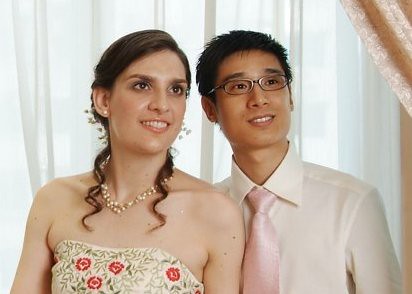
John and I standing side by side
John and I have fūqī xiàng? How could anyone think we look that much alike?

You two really have fūqī xiàng (夫妻相).

I can’t tell you how many times I’ve heard this from Chinese friends. As much as I love when people suggest my husband and I are a lucky match, a couple destined to stay together forever, fūqī xiàng leaves me puzzled. How could anyone think we look that much alike?

I could imagine why such a saying came from China, a country dominated by the Han people, who share the same black hair and eyes, and similar skin tones. With that background, it wouldn’t take much for any couple to look alike. At a minimum, they’d need the same nose and the same shaped eyes; maybe the same shaped face, if you were a stickler. But even so, the odds are good you’d find many couples with their match reflected in their faces.

Not with John and I. Maybe we have the same nose — maybe. But one nose in common does not a fūqī xiàng make. Continue reading “The Fuqi Xiang Fallacy”

I Stand By My Man, And Yes, He’s Chinese

Two rings on a wooden surface
(photo by Johanna Ljungblom)

When you’re facing hard times as a couple, people say all kinds of things. “Hope it gets better.” “Stay strong.” “You’ll be okay.”

And then, there’s what my so-call friend told me back in December, after I told her about the discrimination against John, and how I supported him.

“So you’re standing by him? Wow, you’re so loyal.”

You’re so rude, I wanted to tell her. I also wanted to slap her across the table, but it was a holiday party and that sort of thing doesn’t go well with gingerbread and hot apple cider.

“Why wouldn’t I be? He’s my husband and I love him,” I finally said as I glowered at her.

From her perspective, “for better or for worse” just didn’t apply to us. She might as well have said, “You should have married a white man,” because that’s exactly what I heard hidden within her words — that when a white woman chooses to marry someone outside her race, in my case a Chinese man, she should throw in the towel when she faces something she’d never face with a white husband.

Please. Continue reading “I Stand By My Man, And Yes, He’s Chinese”

Getting Personal When Buying Condoms at Watson’s China

At Watson’s in China, a little personal shopping got too personal when I decided to stock up on condoms. (photo by Calvin Teo from wikimedia.org)

“Your Personal Store.” That’s the tagline for Watson’s, the most popular pharmacy/drugstore shop in Asia and my go-to in China for so many health and beauty items I need. But after my experience this summer, I began to wonder if Watson’s wasn’t becoming “Your A Little Too Personal Store.”

Last summer, I lived mostly with my in-laws and visited Hangzhou or Shanghai only a few times. For me, that meant no Watson’s conveniently just around the corner or a short bus, subway or taxi ride away. So when I saw a Watson’s, I would sometimes kick into “storage mode.” That meant buying some extra peppermint hand wipes, another bottle of Johnson’s Baby Wash (for my sensitive skin), and, say, some more Durex condoms.

I’m a married woman, and yes, I wanted to replenish my condom stash. I sure couldn’t do it in my Chinese husband’s rural village, which probably sold those dodgy ones with what always looked like adult movie stills printed on the package. On this day in question, I still stayed with him in his rented room in Shanghai for a few more days, we’d have a few weeks or so together at the end of the summer before returning to the US, and what we didn’t use, we could always take home. Yes, condoms would definitely come in handy.

But I’d have to go alone on this one. “It’s easier for you,” John said. “They expect foreigners to buy these things.”

I couldn’t deny the truth in what he said — that many Chinese believed foreigners, especially foreign women, were so much more “open” about sex. Sure, I liked sleeping with my husband, and wasn’t afraid to say so. But that didn’t make me some foreign Jezebel ready to screw on the spot. Besides, I couldn’t hide in China — people noticed me everywhere as a foreigner, and that meant they might even notice my purchase even more.

“But people will stare at me, it will be so embarrassing,” I said.

He flashed me one of those “go-get-’em” smiles, and said, “You have self-efficacy, you can do this.” Then he patted me on the shoulder. That was all his way of saying, there’s no way in hell I will buy the condoms. Continue reading “Getting Personal When Buying Condoms at Watson’s China”

Double Happiness: Once You Go Black, You Never Go Back

When I published a story several weeks ago for Double Happiness, one comment caught my attention:

…I feel compelled to mention how disappointed I am that “foreign” girls are always white girls…. I live in China, and I’m quite attracted to Chinese guys, but my dark skin and less than European features seems to mean that I’m destined to be forever alone. It’s quite sad that no one’s aware of this growing problem, the plight of the forever forsaken non-white girl…. There are many of us out here, and every once in a while, we’d like some love, too.

After reading these words, I immediately thought of Chenyin Pan. He and I struck up a conversation this past summer at the Shanghai reading for Rachel DeWoskin’s latest book, and he happened to mention he once dated some non-white women as a university student in the US. In previous e-mails, he even mentioned the striking words of a Korean friend (who wrote them with respect to dating non-white women): “The world is getting smaller and we should try new things.”

Well, Chenyin definitely has, and I’m really thrilled he agreed to share. While I normally don’t run Double Happiness columns consecutively, I wanted to put this one out there as soon as I could — if nothing else, to give some non-white women out there a little love. 🙂 Continue reading “Double Happiness: Once You Go Black, You Never Go Back”

On Discrimination and Marriage to a Chinese Man

A white woman crying in the corner
Discrimination. I never realized just how intimately I would come to know this word and what it really means after marrying a Chinese man. (photo by ayleene de monn)

Discrimination. I never realized just how intimately I would come to know this word and what it really means after marrying a Chinese man.

I’ve thought about this word often in the past few days because of something that happened. I can’t write about it in any meaningful way, though I desperately want to. Like so many things, I feel condemned to carry this pain around with me in silence. I guess that’s why I needed to write this entry — to at least come forward and acknowledge what has happened, if only in a general sense.

When I married my husband, I never really thought much about the prospect of discrimination that would come with our decision to return to the US. I guess I suspected some people wouldn’t agree with our relationship or would have difficulty accepting John. But I always assumed the discrimination would remain obvious, like the one time when a White supremacist group linked to this website during a forum discussion about a “Chinese takeover.” Continue reading “On Discrimination and Marriage to a Chinese Man”

One Vegan, Making Chinese Red-Braised Pork For Love

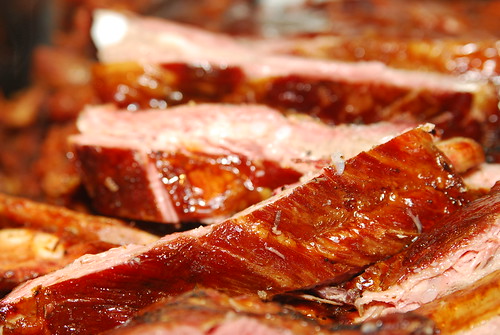
Close-up of BBQ pork ribs
As a vegan, I never though I’d end up making pork — and more — for my husband, all for love. (photo by Charles Thompson)

I can’t tell you how many times I’ve made red-braised chicken wings, legs or thighs for my husband. They’re the chicken equivalent of his favorite dish, red-braised pork (or, to be even more specific, Chairman Mao’s Red-Braised Pork, which I’m sure appeals to his patriotic side). I’ve adapted the sauce to become a marinade, and turned the whole recipe into something I can bake neatly in the oven for 50 minutes at 400 degrees Fahrenheit. I have to admit that there’s even this small part of me that beams with domestic pride when I watch John devour the chicken fresh out of the oven in blissful silence (in my home, when John simply eats, instead of talking, it’s the equivalent of giving the chef his highest compliments).

But for anyone who knows me well, this whole scenario feels rife with dietary dissonance and makes them go “hmmm” (or, in some cases, “what?!?”). That’s because I’m a vegan, married to a Chinese man who can’t live without his meat and fish. Continue reading “One Vegan, Making Chinese Red-Braised Pork For Love”

Ask the Yangxifu: Six Western Women of the Past who Married Chinese Men

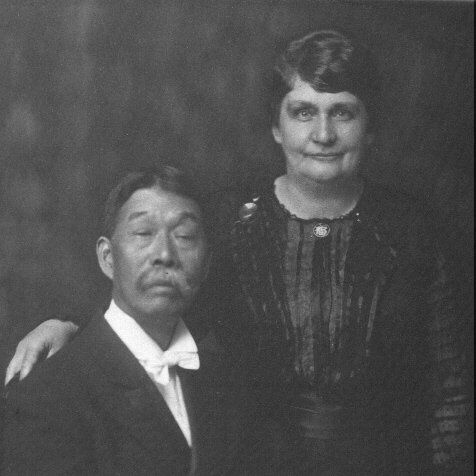
Louise Van Arnam Huie, with husband Huie Kin
Louise Van Arnam Huie, with husband Huie Kin (photo from http://www.huiekin.org)

mali asks:

I just came across this book Grace an American in China with a foreign woman marrying a Chinese man in the 1930s and going to China. I thought it was pretty cool that they had their relationship then…wow that must have been so hard!! So I wondered if you knew about other actual women like her that married Chinese in the past?

I sure do. You might call them our “yangxifu grandmothers,” the Western women who paved the way for the rest of us to love and marry Chinese men (and often at great cost to their own lives). Here’s a list of six prominent women I know of — including Grace: Continue reading “Ask the Yangxifu: Six Western Women of the Past who Married Chinese Men”

My Chinese Husband’s Cousin, Looking For a Western Wife to Brag About

Wang, my Chinese husband’s cousin, seemed to have it all. A lucrative job as a real estate developer. Two new BMWs. Expensive suits. Nothing about him suggested his countryside roots — the same mountain village as my husband, where people still planted their own rice paddies, used wood-burning stoves, and had free-range chickens scurrying in and out of their houses.

But when he volunteered his silver BMW sedan as our wedding car in 2007 (of course, he couldn’t help but boast “oh, if you had mentioned this sooner, I could have prepared my bigger and better BMW.”), he discovered he was missing the ultimate accessory of all — a Western wife.

“He told me he wanted to find a yangxifu,” my husband recalled. “He asked if we could introduce him to some Western women.”

But we didn’t. Sure, we didn’t know any single Western women in China, since by then we lived in the US for nearly two years. But even if we did, introducing them to Wang had the kind of cheap, mail-order-bride feel to it that no friend would get their friend into. After all, he didn’t really care who she was, so long as she was foreign.

It’s just like I read over a year ago in a study about What Western Women Think of Chinese Men:

Those [Chinese] men with Western girlfriends or wives will brag about them, as if these women were a BMW.

Wang already had two BMWs to show off, but no such Western wife — never thinking, of course, that a wife, any wife, should never become a man’s bling.

“People who think this way have no suzhi,” my husband said as he frowned, using the word that Chinese often use to refer to the quality of people — which, in this case, was not much at all. “They turn their wives into objects, and  try to show they are better than others in such a low way.”

Still, Wang could have gone much lower, as we learned two years ago while visiting the Kaifeng Night Market. After we bought almond tea from a stall run by lanky twentysomething wearing a white kufi — the hat worn by the Muslim Hui minority in China — he nudged my husband. “Hey, do you think you could get me a foreign wife? I could buy her a house and a car.”

John grinned as he shook his head. “It’s not that simple. Western women have different expectations.”

Then the lanky guy leaned over and whispered something in my husband’s ear — which John told me about later. “He said his penis is very strong.”

What do you think about this?

The Relationship Between Language and Falling in Love

Over dinner two weeks ago in Beijing, Melanie Gao — a fellow yangxifu and blogger — asked an interesting question. “What language do you have a better relationship in with your Chinese husband?”

I didn’t know what to say because John and I had always floated between English and Mandarin, as if the two languages together somehow became our hybrid “husband-wife” language. “Hmmmmm, I don’t know. It’s hard to decide between English and Chinese. Maybe our relationship is slightly better in English these days.”

But I never would have guessed Melanie’s answer. “My husband and I have a better relationship in Japanese.” Japanese? If John had been here, he (and the remnants of his anti-Japanese ideas) would have fallen over. “I think it’s because it’s another language for us. We both have to try hard to understand one another.”

Still, I remembered reading how Melanie met her husband in Chiba, Japan when they were foreign students there — and came to know him in Japanese. Which made me wonder about another explanation. “Maybe that’s because Japanese is the language you fell in love in.”

Does it matter in what language you fall in love with someone? The question followed me long after that dinner, as I recalled my different loves in China. Continue reading “The Relationship Between Language and Falling in Love”