Ask foreigners in China what they do for a living, and chances are you’ll hear a common answer – teaching English.
I’ve done it before. Most of my friends here have too. In fact, it’s such a prevalent gig for foreigners in China that you might even call it a rite of passage.
But anyone who has taught English in China also knows there’s a dark side to the profession.
During my first year teaching in China, this one white American guy who had signed on to work for our program never showed up and placed us all in jeopardy. (I later discovered he was a hard-core alcoholic.)
Later in Hangzhou, I bumped into a white American guy on a Hangzhou bus who confessed his secret for getting English teaching jobs – lying about his credentials. He smirked about how he had hoodwinked schools in China into believing he actually had a college degree, even though he was only a high school graduate.
Egads.
It’s hard to believe that I could actually inhabit the same profession as those two guys. But it happens, more than we’d like to talk about.
For writer Quincy Carroll, this is the stuff of a great novel. In this case, his new novel Up to the Mountains and Down to the Countryside.
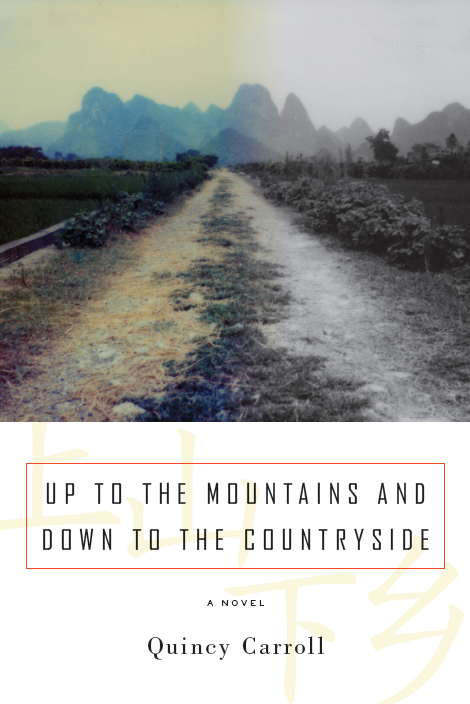 Set in the rural town of Ningyuan, Hunan Province (where Carroll himself actually taught English as a volunteer), the story centers on the clash between two white Americans — deadbeat Thomas Guillard and the idealistic Daniel – and the young Chinese student who gets caught between them. Up to the Mountains and Down to the Countryside is a thoughtful look into the experience of being a foreigner in China, as well as the good, bad and the ugly of teaching English.
It’s my great pleasure to introduce you to Quincy Carroll and his new novel Up to the Mountains and Down to the Countryside through this interview.
 Here’s Quincy’s bio from Goodreads:
Quincy Carroll is a writer from Boston, Massachusetts. After graduating from Yale in 2007, he lived in China for three years, where he taught English and worked as a copywriter. He currently teaches Mandarin in Oakland, California. His debut novel, Up to the Mountains and Down to the Countryside, was published in November 2015 by Inkshares.
You can learn more about Quincy and his new novel at his website. Up to the Mountains and Down to the Countryside is available on Amazon.com, where your purchase helps support this site.
As a bonus, Quincy has an original song from the novel that you can hear at Soundcloud. (It’s the song Daniel performs in Chapter 12 for his students at the English competition in the school gymnasium.)
—–
What drove you to write this novel?
I arrived in China with quite a bit of uncertainty; I’d just quit my job in finance, and I was looking for direction. I didn’t know how to define myself. One of the first things I noticed was that there were a lot of other expats in the same boat—people of all backgrounds and ages, looking for some type of purpose. What I found most interesting, however, were the different ways in which people handled said uncertainty. For the most part, the volunteers in my cohort (I served through a program named WorldTeach) were gracious and curious when it came to interacting with people from another culture, but there was another group of foreigners (Westerners, especially) that seemed to view everything in China as beneath them.
That was really what spurred me to begin brainstorming a plot for the novel. I understand that Up to the Mountains and Down to the Countryside is far from the first story to examine the questionable influence of Westerners in Asia, but given the massive influx of foreigners in China over the past several decades, I believe it’s a timely, important tale worth retelling.
How did you conceive of Guillard?
Again, I was astounded by the number of “arrogant, lewd and racist” people I met when I touched down in China. Similarly to other characters in the book, Guillard is an amalgam of numerous expats I had encounters with over the course of my time abroad. I have been surprised since the novel’s release by how many readers have written to ask if I based the character on so-and-so from such-and-such a province, most of whom I’ve never met and most of which places I’ve never even been to before. Just goes to show how prevalent the archetype is.
I’ve also had many people ask me whether all Westerners in China are “that bad.” I’d like to state that I met some of the most thoughtful, kind people while abroad. I hope the story avoids coming off as an indictment—it’s more of a critique.
How did you conceive of Daniel?
I’ll just say it to get it out of the way: Daniel is the most autobiographical character in the book, although I’m sure that surprises no one. His struggles with questions of identity and purpose were written as a form of catharsis, but I took inspiration from additional sources as well (both literary and personal). I like to think that there is a bit of John Grady Cole in him, but that’s probably an overestimation of my writing. Fellow volunteers from the WT China program will probably be able to pick out aspects of Daniel’s personality that were drawn from their own or those of others we knew. In the end, a writer’s primary source of inspiration is almost always direct experience—what’s fun is that you get to play with the details you’re given and turn disorder into art.
One example of this in Up to the Mountains and Down to the Countryside is Daniel’s appearance: long, dyed hair, sleeve tattoos and gauged ears. Now, as far as I can remember, I didn’t meet anyone who looked like that in China, but just like Guillard’s deformities, I chose to give him these characteristics to add an external layer to his personality: in this case, a young man who has gone off the beaten path and is desperately trying to stand out. Another reason I think this worked is that, as a foreigner in China, you’re constantly under the attention of others. I was trying to capture some of this in Daniel’s outlandish physical appearance, but maybe it was just hyperbole, more than anything else.
What are some of the greatest challenges of teaching English in China?
I held two very different positions when I was in China that I believe are common among expats. Both are touched upon in Up to the Mountains and Down to the Countryside. As I’ve already mentioned, I volunteered in the Chinese countryside for two years via a Western NGO. Resources were scant, enthusiasm among our students was mixed, and aside from a modest stipend we received each month, payment was non-existent. For me, one of the biggest challenges was maintaining a sense of commitment throughout the year when it felt like we were there more because we were foreigners than because we were dedicated teachers. I certainly took the job seriously, but at times I wondered if anybody—my students, the administration, fellow teachers—cared about what I was doing. I collected grades my first semester in town, for example, only to find out that they were never included on my students’ report cards.
When I lived in Changsha, the provincial capital, several years later, I tutored high-school students from affluent families who were willing to pay through the roof for an American teacher. Since I had graduated from Yale, rates were even higher than expected, and even though I came prepared to each lesson, it was hard not feeling at least a little extortionary. Once again, my status as a foreigner made me uncomfortable, but I was in need of money and trying to support myself as a writer, so I didn’t say anything.
During the second half of that year, I started working for a local consumer tech company, and in addition to my copywriting duties, I ran a class in Business English every Monday. That was undoubtedly the most satisfying teaching experience I had in the country, as my colleagues genuinely wanted to learn. Most of them were in customer service, so they had to use the language every day.
What do you want people to come away with after reading the book?
More than anything, I hope that readers come away from the novel with a greater sense of humility and the ability to see themselves as part of a larger, globalized world. In addition to that, I hope the story makes them feel somewhat uncertain of who they are. I know that probably sounds a bit strange, but I’m a staunch believer that many of the greatest evils in our world result from one thing: an overinflated sense of self-importance. As the U.S. and China continue to challenge each other on the world stage, I hope that stories like Up to the Mountains and Down to the Countryside continue to remind us that we’re all lost in this together.
—–
Thanks so much to Quincy Carroll for this interview! You can learn more about Quincy and his new novel at his website. Up to the Mountains and Down to the Countryside is available on Amazon.com, where your purchase helps support this site.
As a bonus, Quincy has an original song from the novel that you can hear at Soundcloud. (It’s the song Daniel performs in Chapter 12 for his students at the English competition in the school gymnasium.)





 I never expected that my China-obsessed self would fall so hard for a Korean man. But as long as you’re following your heart, there’s no such thing as a “wrong” relationship.
 (or, more likely,
  ).
).
