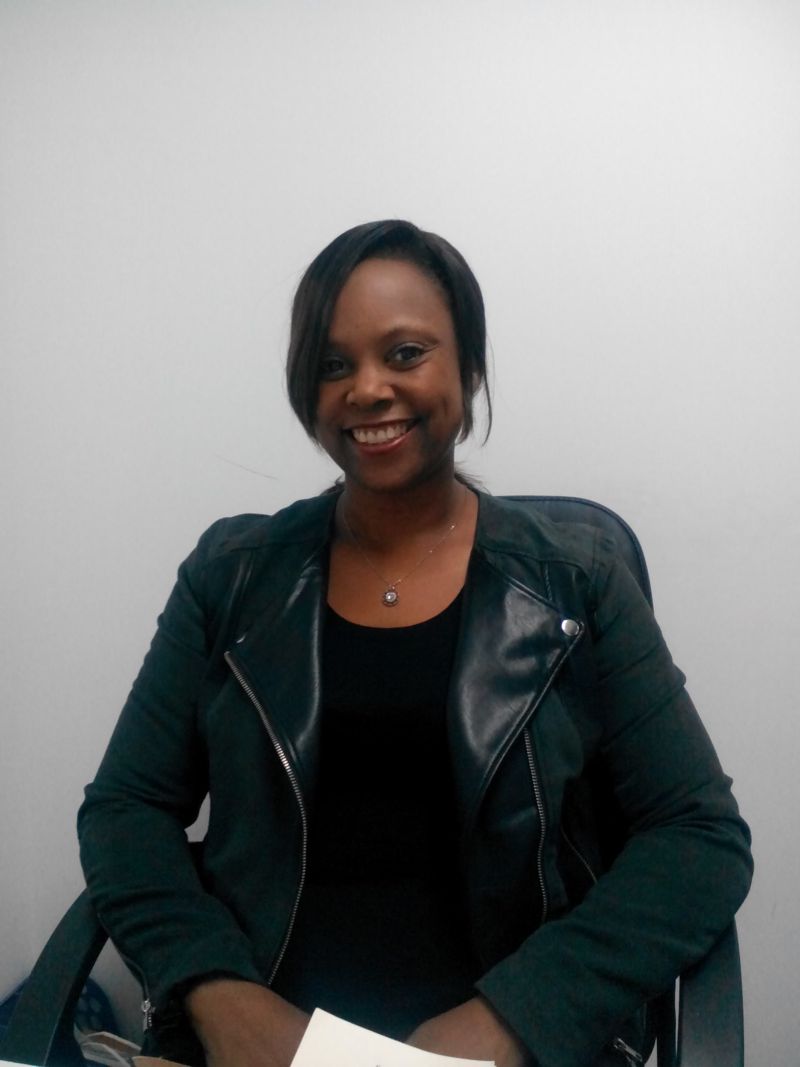
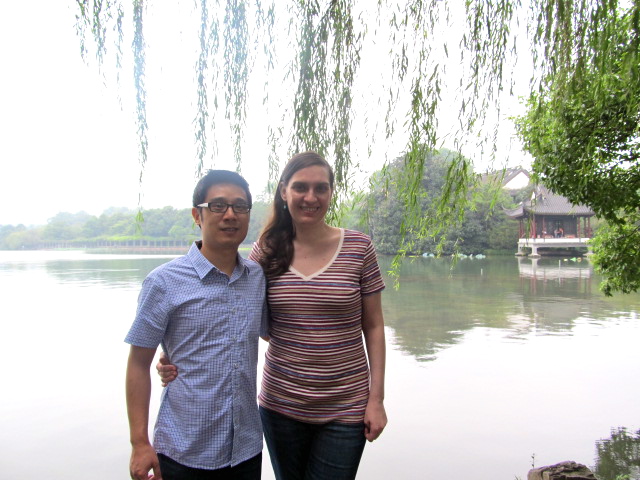
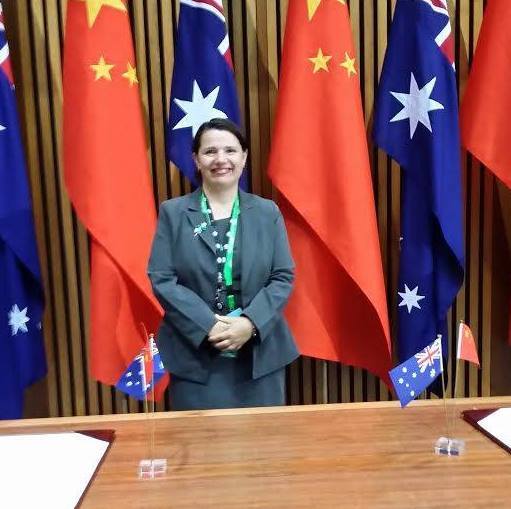
But it’s not always easy to transition to a new country. After all, as Linda writes, “Before I met Jeongsu, the only thing I knew about Korea was that its capital is Seoul. I hadn’t even tried Korean food.” I asked Linda to share some of her tips for a smooth transition to life in South Korea – read on!
Do you have some advice, a story or other guest post you’d like to see featured on Speaking of China? Check out the submit a post page to learn more about what I like to publish and then submit yours today.
—–
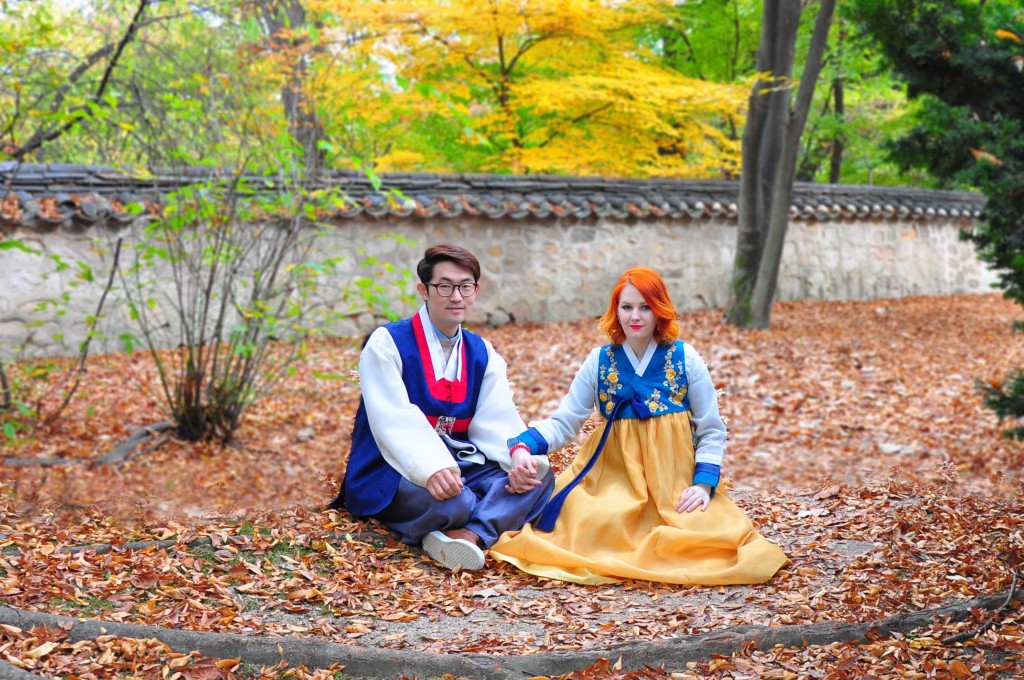
I’ve always been interested in Asia and its different cultures and nations. China had especially caught my eye and I decided to study Mandarin and even move to China – which I did and it was awesome. Then, I went to California to get my bachelor’s degree, with a plan in mind to move back to China – maybe even for good.
However, something, and I like to argue it were higher powers, had completely changed my path. Actually it wasn’t something but much rather someone. While studying in San Diego, I met a handsome Korean exchange student who instantly caught my eye. We quickly started dating and he is now my fiancé.
After graduating, I did, in fact, move back to China, were I stayed for a year in Hunan’s capital of Changsha. I got to travel the country and experience the local culture to a great extent. However, I wasn’t fully happy there. Being in a long distance relationship was hard and after 1 year in China, I decided to make the big move to South Korea.
Before I met Jeongsu, the only thing I knew about Korea was that its capital is Seoul. I hadn’t even tried Korean food. However, all of this quickly changed and is now a big part of my life. I would like to share some of the strategies that helped ease my transition into living in South Korea.
#1: Learn the Language
Soon after I met Jeongsu, I started learning Korean. I’m by far not fluent but the basics help me fit in the daily life here and make it a lot easier to live here. I signed up at the local YMCA and took a Korean course with other foreigners. The good thing was that I met other foreigners – some of which also have Korean partners.
#2: Eat local food
Food is a key part of every culture. It seems like Korea even takes it to a new level, having a certain set of side dishes for every meal. I remember the first time I saw “kimchi” (the most popular Korean side dish) in Jeongsu’s fridge back in San Diego. “I’m never going to eat that!” I screamed because of the foul smell. Now, I love it and eat it with almost every meal.
#3: Do as the Koreans Do
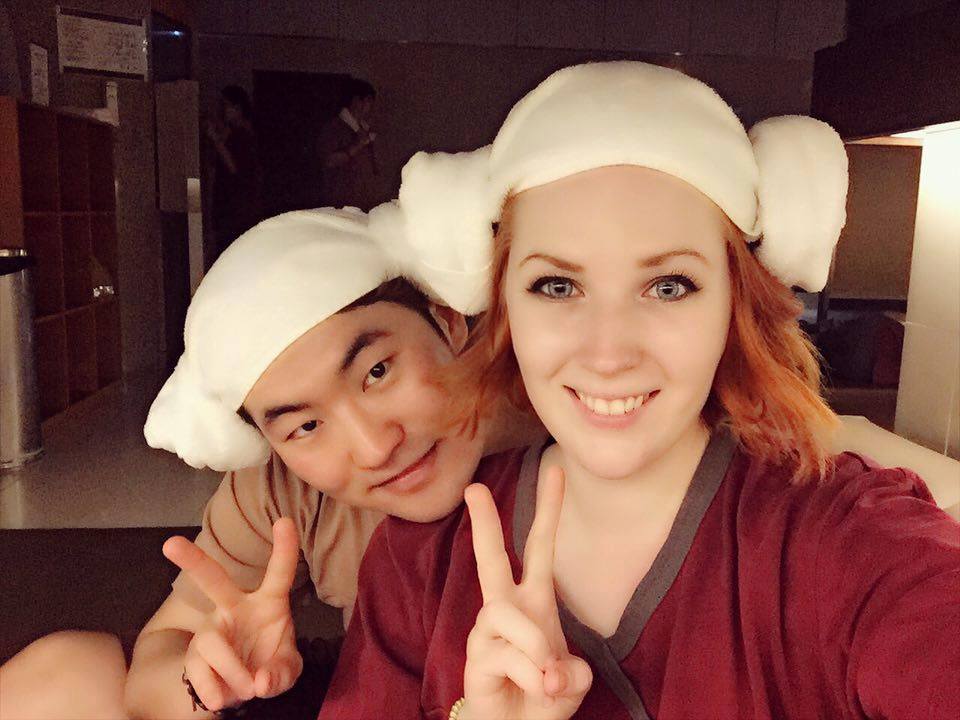
Koreans work a lot, but also take their free time seriously and love hanging out with friends. Drinking, karaoke or even Korean traditional sauna include only few of the dozens of things Korean take on in their free time. You should also be aware of the strict hierarchy here in Korea. When you treat people older than you in a polite way, you’re going to be much more successful living here.
#4: Make local Friends
Obviously, the reason why I moved to Korea was to be with Jeongsu. Having him here helps me a lot since he can support me when I have problems of communication and he explains cultural differences to me. However, even if you move to Korea alone, you should definitely make Korean friends. You’re Korea experience is going to be so much deeper when you have a chance to see how locals really live.
What are you waiting for?
If you are thinking about moving to South Korea, don’t hesitate too long! It’s a wonderful country to fall in love with. I didn’t know a lot about Korea before moving here but now I am astounded by the country’s vast history and culture. Korean BBQ, KPOP, awesome skincare products and loads of themed cafes are waiting for you here!
Linda writes about life in Korea, her AMWF relationship with a Korean man, traveling around Asia and studying Asian languages at www.lindagoeseast.com . She is also very active on social media, especially Facebook, Twitter and Instagram.
Cross-cultural misunderstandings are a huge pitfall in dating abroad, including here in China.
Just imagine what it must have felt like for Ava Ming, the English blogger behind My Oriental Life, when she heard these words from her date for the evening, a Chinese guy she met in Shenzhen: “I really want to kiss you, Ava, but I’m scared that I might get AIDS because all Africans have AIDS.”
Whoa!
Read on to learn the whole story of how things fell apart between her and Larry.
Do you have a shocking tale of cross-cultural misunderstandings or other guest post you’d like to see featured here on Speaking of China? Visit the submit a post page to learn more about becoming a guest poster for this blog.
—–
Shenzhen, China (photo by Ramon Boersbroek via Flickr.com)
I’ve often considered telling the story of my first Chinese date. But usually I’ve declined, thinking it was too personal, perhaps too upsetting and might also give the impression that I dislike Chinese men, which is really not the case at all.
But the event occurred a while ago now back in 2013. After reading about others who’ve braved their souls on Jocelyn Eikenburg’s fabulous blog, I’ve decided to share. Besides, who knows, maybe someone else could have or has had a similar experience?
I met Larry at the terminal subway station. There were very few commuters around. I was curious as to why he came so close, sitting right next to me on an empty train, leaving a small space between us.
I noticed his glances in my direction, wondering if he was trying to work up the courage to ask if he could practice his English with me. Pretty soon he introduced himself and asked me where I was from, which led to a conversation.
He told me that he was a professional who’d travelled to various European cities but never England. He was 37, unmarried and feeling the pressure from his parents to change his single status. I enjoyed our talk during the long ride but initially didn’t read anything into it. Around that time I seemed to be making a lot of new Chinese friends while on various subway rides. I guess I must have exuded an approachable air!
As we approached his stop he told me that he thought I was pretty. He couldn’t believe no other Chinese guy had made me his girlfriend. Then he asked for my number and if we could go to dinner.
Have to admit I was pretty surprised. Until then I’d been under the impression that Chinese guys would never be so forward due to a natural or cultural shyness. I said I wasn’t sure about a date but we could talk from time to time.
Over the next fortnight he sent regular messages via text and email usually beginning with ‘hello, my angel.’ Yes, Larry was a charmer but the messages did make me smile.
Eventually we set up a date and met on a hot and sticky Friday evening. By now I knew that I wasn’t romantically attracted to him, but I did like his personality and I was interested in meeting more people and expanding my circle of Chinese friends. I also assumed that he didn’t have intentions of getting serious with me either. His parents probably weren’t expecting him to marry a foreign girl.
The date was nothing special. The best word to describe it would probably be ‘nice,’ well up to a point anyway. We ate rice in a Japanese restaurant and then went for a walk in the park. He kept guiding me towards secluded places, which I thought was a bit strange. But then he’d comment on the sculpture, or lotus flower pond, or round leafy bush we’d stumbled upon.
I still wasn’t feeling any chemistry towards him. But he had a gentle humour and I thought perhaps we could be friends in the future.
Ava Ming
Approaching 10pm I wanted to leave, having made plans to go dancing, but Larry wasn’t ready. He insisted on ‘just ten more minutes’ and took me to a bench by the side of the river, again another secluded place. When we sat down he made a confession.
“I really want to kiss you, Ava, but I’m scared that I might get AIDS because all Africans have AIDS.”
I was literally struck dumb at his ignorance. Then I became so angry I actually felt tears welling up. Angry tears have a whole different feeling to ones of sadness or joy.
We’d already discussed my family history, him being impressed that my parents were from Jamaica and that I was born in England. But regardless of place of birth, how could he be so naive? In addition, was there no filter in his brain to tell him exactly when to shut-up?
I told him that AIDS didn’t originate from Africa, but was initially a disease among gay white men in New York. I pointed out that he should really think before he speaks and that he shouldn’t believe so strongly in stereotypes. On top of this, why on earth had he asked me out if he’d thought I was ‘unclean?’
Seeing my distress he insisted that I’d misunderstood when we both knew that I hadn’t. To make matters worse, he then pulled me close and tried to kiss me! Saying; “look, see, I know you don’t really have AIDS!”
I wanted to storm off in a huff, but it’s kind of difficult when you don’t know where you are, so we caught the bus back together. He begged me not to tell anyone because he didn’t want to lose face. I made no such promise. If he’d just ended the date at 10pm before his confession maybe we would have become friends, although then I would never have known what he was really thinking.
For a long time I dismissed the idea of dating another Chinese guy. If this was the common school of thought then what would be the point?
A short while later I discussed his theory with my Chinese friends, many of whom also believed that AIDS originated in Africa, but none of whom believed that all Africans have it.
As for Larry, he called and emailed several times to apologise for upsetting me. I accepted his apology but declined his offers to go for a drink. Making someone cry on a first date, even if they were tears of frustration, is really not an auspicious beginning!
As I mentioned this was a while ago and I have since relaxed my guard, becoming more open to Chinese men who just want to talk. But as for dating? Not sure. For that I think I’ll need a little more time.
I’m Ava Ming, born in England to Jamaican parents and currently living in Shenzhen, Guangdong Province, China where I write and teach English.
—–
A few years back, I wrote an article titled The Chinese Relatives Name Game, reflecting on the challenges of trying to remember all of the names for relatives here in China. It’s funny that I’ve been married to my husband for over 10 years and I still can’t keep them straight! (In the post, I even wondered if it might take me a lifetime to get the names right… 😉 )
Of course, with Chinese New Year coming up, it’s as if I’m facing the yearly final exam on this subject – one that I’m not entirely sure I’m going to pass. (Ah well, at least my blunders might provide a bit of comic relief during the holidays?)
That’s why I’m grateful Yiwen Yang has graciously provided this article. It’s an introduction to some of the basics every Western woman who marries a Chinese man should know when it comes to what to call your Chinese family members.
Do you have a guest post that you think ought to be featured on Speaking of China? Check out the submit a post page to learn more about writing for this blog.
—–
The other day we were reading Jocelyn’s article The Chinese Relatives Name Game again, and thought about how confusing understanding all about Chinese family members can be!
Whilst we’re sure it’s not a new topic for many foreigners who are learning Mandarin Chinese, it’s definitely still a big challenge—especially if you are new to your Chinese family, and them to you.
As Chinese New Year is once again looming, why not refresh some of your Chinese language skills in advance so that you can impress your Chinese family—or maybe give them surprise at how fluent you have become in the language.
So, today, we are going to help you out!
As many of you know, Chinese family trees can be talked about forever. To actually remember the names and titles of people in Chinese family trees takes time; indeed, it’s also challenging for many native Chinese.
As Jocelyn from Speaking of China is more focused on AMWF (Asian male/Western female) love, let’s get started by looking at terms for Western women married to Chinese men.
Here’s an easy one if you are married to a Chinese man:
Husband: 老公,丈夫,先生 (lǎogōng, zhàngfu, xiānsheng)
What will your husband call you? (wife): 老婆,妻子,夫人 (lǎopó, qīzi, fūrén)
Note: 老公 (lǎogōng)/老婆 (lǎopó) are the most popular names which you can use in basically every situation, whilst 丈夫 (zhàngfu)/妻子 (qīzi),先生 (xiānsheng)/夫人 (fūrén) are a bit more formal and used to introduce a couple to other people.
For example, 这是我的先生 (Zhè shì wǒ de xiānsheng):This is my husband
In-laws:
Father in-law (your husband’s father): 公公 (gōnggong)
Mother in-law (your husband’s mother): 婆婆 (pópo)
公公 (gōnggong) and 婆婆 (pópo) are the most common words in use although, in many cases, people just use the same words as their husband use, which are father(爸,bà)or mother(妈,mā).
Also, when you have a child, some people will follow the words the child speaks, namely: grandfather(爷爷,yéye),grandmother (奶奶,nǎinai) 。
So what will your in-laws call you? 媳妇 (xífù)/儿媳 (érxí):(daughter in-law)
Note: in many cases, if they are talking to you, they will just say your name naturally.
Other useful names you might use:
Your husband’s older brother: 大伯(dàbó)
Your husband’s older sister: 大姑子(dàgūzi)
Your husband’s younger brother: 小叔子(xiǎoshūzi)
Your husband’s younger sister: 小姑子(xiǎogūzi)
Sounds complicated already?
Well, here are some great tips for you to follow:
For the older generation/seniors, if you forget the correct way to speak to them, just to follow your husband is fine. (Eg. it’s okay to call your parents in-law just “father” or “mother”.)
For the younger generation/seniors, you can either follow your husband or just say their name directly. (Eg. Your husband’s younger sister. If her name is 筱钧(xiǎojūn),you can just say her name directly.)
You may not need to use all of the above every day but, don’t worry, you’ll soon get used to the best/correct ways of addressing family members.
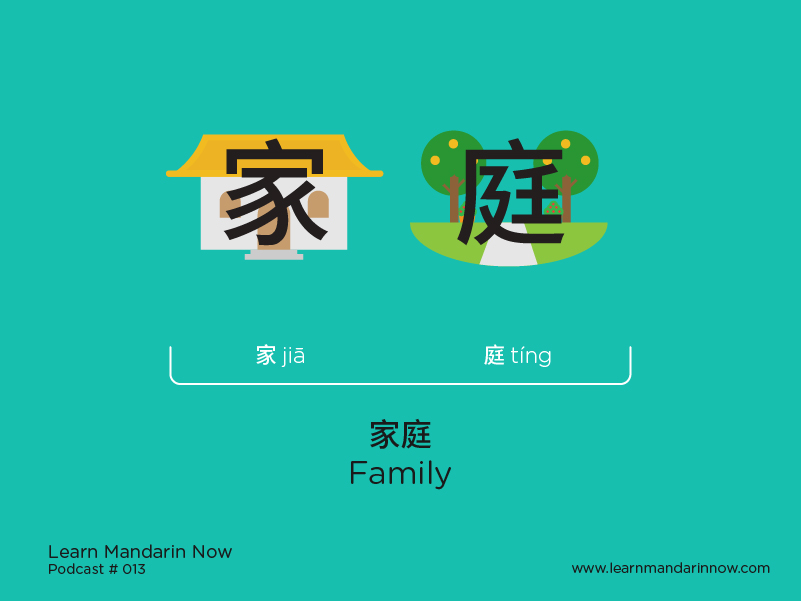
Actually, on our site Learn Mandarin Now, we recently published two Podcasts about Chinese family members:
direct family members: http://www.learnmandarinnow.com/podcast13
extended family members: http://www.learnmandarinnow.com/podcast19
We are now publishing our exciting Podcasts every day from Monday-Friday, covering a variety of interesting topics to help you learn Mandarin Chinese more effectively. They are totally free for everyone to view and listen to but, if you can kindly leave your honest opinion and ratings in i-Tunes or just simply tell us what kind of topics you like us to talk about in the near future, we’d greatly appreciate this. In any event, we’d love hear from you.
Wang Jia, who blogs about culture, race and relationships at WhyAMWF.wordpress.com, has just uploaded his TEDx Erasmus talk titled “Western Women, Eastern Men” online and asked me to share it with you. Here’s the scoop:
—–
Originally from Beijing, Wang Jia has lived in The Netherlands and Germany for 15 years. He always wondered why it is rare to see AMWF couples. Only a year ago, he started to look into this topic seriously. He holds a Ph.D in chemical engineering from TU Delft, the Netherlands. (That probably helped him in structuring his thoughts and research.) As he has a passion for public speaking and communicating ideas that will influence people’s lives, becoming a TEDx speaker became one of his dreams. [FYI for people new to TEDx:]
What is TEDx?
The TEDx Program is designed to help communities, organizations and individuals to spark conversation and connection through local TED-like experiences.
At TEDx events, a screening of TED Talks videos — or a combination of live presenters and TED Talks videos — sparks deep conversation and connections at the local level. TEDx events are planned and coordinated independently, under a free license granted by TED.
Those 11 minutes were a fantastic experience for Wang Jia. He never felt so good under the spotlight.
In the speech, WangJia drew on his personal experience to explain the reasons behind the West-East relationship imbalance. It’s a lighthearted speech that will leave you with a smile. For anyone who is struggling with the West-East relationship barriers, don’t miss it.
So what happened with Wang‘s dating life? It’s a surprise and not a disappointment.
WangJia finally formed his own AMWF relationship and still lives in the Netherlands. If you’d like to learn more about his insights into culture, race and relationships, visit his blog: whyamwf.wordpress.com
Unless you’re like my husband (who lucked out and ended up marrying his one and only girlfriend), chances are you’ve had your share of relationships or crushes that didn’t work out — perhaps even ones you might regret. I know I have.
Which is why, when Holly of From My World To Your World decided to share the tale of what happened between her and Chun, I was nodding my head the entire time I read it…and thinking of that one guy I never should have fell for, but did.
Do you have a story about love gone wrong or other guest post you’d like to see featured here on Speaking of China? Check out the submit a post page to learn how to get your work published on this blog.
—–
(Photo via http://ent.cnwest.com)
It is really hard for me to write about this only because this is something that happened recently with someone I thought was going to be a big part of my life. But, he stopped contact with me. A small part of me wanted to know why he decided to stop talking and the other part just doesn’t care anymore. For this, it’s almost a long story, which goes back last year.
I’ll start in the beginning on how we met.
Chun was someone I never thought I would meet. I always believed people were destined to meet and I thought this was the right moment. But once again, I was wrong. Last year we met at a time in my life when I still was a very emotional person and still searching for a relationship. I really thought everything was perfect when I met him.
Late September, last year
It was a good Monday evening when I was asked by a friend if I wanted to go eat dinner. Let’s call her Ying. So when I arrived to the restaurant, Ying introduced me to the other two guys that were sitting and eating dinner with us. The three of them are Chinese and were speaking Chinese. I could understand as much as I could at the time. But, there was something about Chun that I was attracted to. He was tall, had a broad chest, black hair, funny, and just kind of my type… a bad boy. And I was really physically attracted to him.
Chun was the type of guy who didn’t finish high school. He dropped out of school and never even bothered getting his GED. He and his parents worked at a Chinese buffet or restaurant somewhere in my city.
After dinner, Chun said he almost forgot it was his birthday the next day. So we decided to all go for hookah that night. On the way there, Ying and I were in her car. I asked her if he was single. She said she thinks he might be. That night I got to know him a little bit more, still very much curious about this guy.
The following day he wanted to go bowling, but no one wanted to go. At the last minute I decided to go. He picked me up at my house since at this time, I didn’t know how to drive. When we were bowling, we had this deep discussion about life, love, happiness and more. There were some things I told him that I thought I wouldn’t tell anyone. We talked about the tattoos on his body, the scars he received on his arm, why school wasn’t for him. I was nothing but comfortable with him since meeting him even though he had this bad boy mentality.
October, last year
Just that coming weekend, it was my birthday. In fact it was my twenty-first birthday. The day after, on Saturday, he took me out downtown to a bar and bought me a few drinks. I had gotten a little drunk, but I remember most of that night. I remember dancing with him and then him telling me he doesn’t like to dance. I remember gulping down three or four glasses of water before walking downtown and then discussing a potential relationship.
I told him I was starting to fall for him a bit and that I liked him. He replied that he liked me too, but wanted to get to know me more before pursuing a relationship with me. At the time, I thought this was the right moment to tell him my deepest secret: being autistic. When I told him, his arm was still around me, holding me as we walked. He said to me, “Don’t worry, everyone is different.”
After he dropped me off home late that night, I had liquid courage. I reached up and kissed him. It wasn’t a deep kiss. Mostly it was light kissing. I said bye to him and parted ways.
Who would’ve thought that after that night that everything would go downhill?
A few days later I met with Ying and told her what happened. She told me she talked to him and asked if we had fun that night. His excuse was, “I don’t remember much.”
My heart sank. Was this really true? Did he not remember? How could he not? He barely drank that night, or at least I thought.
The week after my birthday, I invited a lot of my friends out since I had to work on my twenty-first. I invited him out as well. He came a little later and immediately headed to the bar. I went up to him and asked him if he remembered what happened. He said he didn’t remember at all. This made me angry. Just after he had a few drinks, he suggested we all go to a different bar. We agreed to try to bar hop some. I still was upset with him and slowly that night I became devastated. How could he be so cold and barely talk to me that night?
After my party I tried to message him a few times, but he wouldn’t reply as much.
Every time I saw Ying, I felt so bad because all I would do is talk about him.
November came and I saw continued sadness in my life, I was so upset that he wasn’t replying when I tried to contact him. December came quicker than I expected. This was when I decided to call him and ask why he stopped talking to me. But, I was going to have to wait until after finals.
When finals were done, I decided that it was time to call him.
No answer.
I left a voicemail, even though I knew he wouldn’t listen. After this voicemail, I messaged him on WeChat. I said to him, “I called because I wanted to ask you something. But I guess it is pointless now. I tried hard enough. And you haven’t bothered replying. I don’t know what’s going on in your life right now, but you’re ignoring me for some reason…it hurts me. It’s been a long time since we last talked.”
Finally after a few months of no responses, I got a reply. He told me that he didn’t want to talk to anyone because he was planning on moving to a different State. I decided that this was it, which I didn’t care anymore…or at least I thought. Deep down I still cared.
The next day while driving with Ying to go downtown to bar hop, we were talking about something and brought up Chun. This was when she told me something I never knew.
She said to me, “He’s so stupid, I didn’t tell you this because I didn’t want to make things worse. But I wanted to tell you that he had this girlfriend.”
I looked at her, so confused, “What do you mean?”
She replied, “This girl, I know her, she is kind of crazy, She’s a Chinese girl. She doesn’t really care much about anything. They were on and off dating, just kind of like friends with benefits, but whatever.”
I wondered if this is what stopped him from talking to me?
“When did he meet this girl? Was it around the same time I met him?”
“Yeah, I believe so, but they were just friends before it happened. Sorry I didn’t tell you before.”
I stopped for a moment, letting this sink in. It made sense…another girl was in his life so that’s why he probably stopped talking to me.
I told Ying I was grateful and smiled, realizing that Chun was not supposed to be in my life…or so I thought.
About 7 months later, late July, this year
Out of the blue, I received a message from him on WeChat. I never bothered to really remove him from my life anyway so I decided to just keep him on social media. Just a few months before I saw that he was back in my city for the summer. Chun asked me what’s up. I told him that I was going to the mall. He said that he could meet me there. This was strange since I barely talked to him since December. And I was wondering if I was prepared to meet with him.
I told him what time I would be there and he met me. The entire time I barely wanted to look at him, still remembering about what happened in the past. My main destination was Victoria’s Secret. He followed me into that store. The entire time I felt like I was teasing him. We got into a small argument what my actual bra size is. I told him teasingly, “Why? Do you want to see me in these bras then?”
His response, “Yes, I actually do.”
Throughout that day at the mall and spending time with him, I never thought I would get some closure. He offered to drive me home. On the way I was talking about how we first met. I unexpectedly got an answer I was looking for.
“How come you don’t remember that time we went bowling?”
“Well, to be honest, I was high a lot. I was smoking weed before I saw you or anyone else. That, or drunk. Or both.”
I was a little relieved in some way. Because telling him I was autistic was one of my biggest worries and I was so scared that this is what made him stop talking to me.
“I also heard you were with this girl too?”
“Yeah, that’s true as well, but she was crazy. And she lied to me. I felt badly about it later. But I took her virginity. She never told me before. I thought she wasn’t a virgin and was angry she didn’t tell me.”
I really didn’t care about that. I just finally was able to know some of the truth.
“You really upset me at the time. I hate to blame, but a part of the reason I am like this is because of you.”
I think these words did make him see that he truly screwed up. And I luckily got an apology.
When we sat in the driveway for a few moments, he asked if I wanted to go somewhere else with him. I agreed and then we were off to play mini-golf and ride go-karts. Next thing I knew, it was around nine at night.
“It’s getting late and I’m kind of hungry.”
“What do you want to eat?” he asked.
“Uhm, I’m not sure, I’m not picky.”
Chun decided that we could just go to the grocery store and then cook back at his place. I said sure. But, I didn’t realize his place was farther from mine, about a twenty minute drive or so. When we got to his place, he told me his situation. Chun was living in the living room since there were only two bedrooms and his parents have a friend staying with them. So his parents and little brother occupied one room while their friend had the other. I told him not to worry. Ten minutes later, his family arrived. His parents mainly ignored him the entire time I was there.
Time was going by slow and it was already ten-thirty at night when we started to eat dinner. He suggested that I just stay the night. I asked if that was okay with his parents and he said they didn’t care.
So I spent the night. And things happened.
At the time I was so happy. Everything was perfect. We talked a lot that night. I told him that I am happy how things worked out this way. Mentioning of course that I don’t want a relationship at all.
He said he was happy too and that he wanted me in the same way I wanted him. We talked almost that entire night. About how he was in trouble with the law and how his parents didn’t recognize him as their son now because he said he has disappointed them. Part of me was feeling really bad for him.
But after that night I didn’t see him for a while. He got busy with work and so did I.
A few weeks after seeing him, I managed to convince him to come over. However, he messaged me and told me not to think anything of us and that we are just paoyou (炮友), or friends with benefits. Why would you send that when we already defined the relationship between us two? I snuck him into my house that night, but my brother came home to sleep that night. My older brother was barely home at this time as well. So, overall the mood was ruined.
This was when I asked him quietly, “Why did you have to remind me that we’re just paoyou?”
Chun wasn’t happy I brought it up, “Because I wanted to remind you.”
“No, seriously, please tell me why.”
He paused for a few seconds, totally not expecting this response.
“I feel like I’m not good enough for you.”
I looked at him, “Why do you think this?”
“When I see you, I see myself. I see how I used to be and I how much I changed. You deserve better. Now, enough of that. But promise me something.”
“Hmm?” I inquired.
“If I disappear from your life again, don’t get sad.”
Still a little confused, “Why do you say that? I already had you gone from my life once, I’m sure I can get through it again.”
I snuck him back out after this big conversation of ours. That last kiss, that last hug…I never thought it would’ve been the last of it all.
Early September, this year
School started for me and I was really happy to be back at school. One day after I was finished with classes for the week, I texted him. The message wasn’t sending on WeChat and it was saying I had to add him as a friend. Confused, I looked him up on Facebook. Chun also removed me from there as well.
I was furious. So I messaged him on Facebook telling him, “We’re better than this. I don’t know what’s going on but it would be nice for you to talk to me instead of just removing me from your life. Please call me when you get the chance.”
No phone call.
No response.
No text messages.
Silence.
I talked to Ying just a few weeks after it happened. She told me that one of her friends went to hang with him and they got stuck on the highway. This friend of hers said that Chun was agitated because this one girl wouldn’t stop talking to him. And also that he didn’t really want to talk with her a lot and it was becoming annoying.
Immediately I knew that was me. I wasn’t really talking to him every day, I made sure of it. But, when I heard all this, I sighed some relief.
I began to not care about this situation because this wasn’t my problem. Deep down I knew that this was possibly going to happen again. I knew that he was going to stop contact with me again.
Somedays I have some regrets about letting him back into my life. I wish I had been wiser about things. But we learn from our mistakes and learn to accept them. This is just another life lesson that was learned the hard way. I’ve accepted what happened and even though I want to regret, I cannot. This situation shaped me into who I am today and helped make me stronger.
When North Korea sent some 357 men over to the former East Germany in the 1950s to train them, the two countries also unexpectedly set in motion some of the most dramatic and bittersweet stories of forbidden love that I’ve ever encountered.
Renate returned to Germany on Tuesday after a 12-day reunion with her long-lost husband in North Korea – a highly unusual episode given the Communist government’s policy of keeping most of its people without mail or telephone links to the rest of the world, not to mention the Internet.
Traveling with Renate were their two sons. Peter Hyon Zol was 10 months old, and Renate was pregnant with Uwe, when the family broke up in the vortex of the Cold War.
Renate Kleinle and Hong Ok Geun met in 1955, when they attended the same freshman chemistry class at Friedrich Schiller University in Jena, East Germany. Hong was a humorous exchange student from North Korea, then East Germany’s Communist ally.
They fell in love. Because both governments frowned on marriages between North Korean students and East Germans, the couple married in 1960 in a rural town where the local authorities were unaware of the national government’s policy. There were no guests.
The couple’s happy time lasted only one year, however. In 1961, the Pyongyang government recalled all 350 of its students in East Germany, a measure believed prompted by a few North Korean students’ defections to the West. Hong was given 48 hours to pack.
Holding 10-month-old Peter, Renate bid a tearful farewell to Hong at the Jena train station.
I’m tearing up just imagining that scene for myself.
Well, German filmmaker Sung-Hyung Cho stumbled upon Renate’s love story and it inspired her to discover more of these couples, ultimately leading to a new documentary film released in June 2015 titled “Verliebt, Verlobt, Verloren” (“Loved, Engaged, Lost”). Here’s the trailer on Youtube for the documentary film, presented in German (folks in China, you’ll need a VPN to view it):
Sung-Hyung Cho: The story of Renate Hong was very popular in South Korea. In 2006, her story became the talk of the town after a South Korean historian – who had conducted some research in Jena about the relationship between North Korea and East Germany – met Renate Hong by chance.
She narrated her story, and he propagated it on the Internet. The response was overwhelming. The Koreans were blown away by the sad but beautiful love story.
Most Koreans, myself included, know the story. Moreover, I was greatly interested in knowing and better understanding former East Germany. I also wanted to know more about North Korea, even if only indirectly.
Have you ever heard about this fascinating chapter of AMWF history between Germany and North Korea? And, for those of you who have seen the film, what did you think of it?
P.S.: Thanks to Ruth of the wonderful blog China Elevator Stories for tipping me off to this!
As I was reading her article, I suddenly realized that I too had a pre-China backstory worth sharing – one of relationships that never came to be, and what ifs that point to my own prejudices. So here goes:
—–
In coming to China, the last thing I expected was to end up dating a local guy, let alone marrying one (as I ended up doing with John, pictured here with me). Why?
“You don’t have to worry about the students falling in love with you.”
Before I embarked on my first trip to China, where I would teach English at a college, I met up with one of the former teachers several times for dinner or drinks. And when the subject of student crushes came up – something he had been forced to navigate very delicately – he negated the possibility of anything similar happening to me.
Of course I didn’t question his words. Hadn’t I already envisioned my year-long assignment much like a vow of chastity? I spoke to friends of my interest in studying Tai Chi over there and visiting some local temples, as if I were about to spend my months as a nun instead of an English teacher. It was an opportunity to travel to a new country, a way to postpone my post-graduate dilemma regarding career decisions, and nothing more than that.
Or so I thought.
Then I moved to Zhengzhou, China – and found myself with a crush on one of the first guys I met there, a former student from the program I would teach for. Over a month later, he introduced me to his friend, a guy who was also a former student – and would become so much more to me in the weeks that followed:
Yao came into my life, in all of his sleek, sexy and sullen James Dean perfection, dressed in a black leather jacket as dark as his mysterious melancholy. When my heart raced after our first dinner together, I thought it was just another adolescent crush. Embarrassed, I wanted to just box my feelings away like all of the Barbie Dolls and little girl hairclips of my past.
Then he took me to that teahouse one Sunday afternoon. Over two Taiwanese bubble teas, the truth bubbled through to the surface of my own heart — I loved him with an uncontrollable depth that plunged far beyond the bottom of my tea cup. And, I began to realize, so did he, because he overflowed with confessionals that he had never before poured over with anyone else.
Not long after, our our passions percolated over into romance — a real boyfriend/girlfriend love that translated into steamy weekends at his apartment, hand-in-hand walks around the gardens of Zhengzhou University, and the occasional afternoon out at the Taiwanese teahouse, his favorite in the city. Bubble tea never tasted so sweet.
In his arms, it was so easy for me to forget that I had once secretly declared this year a lonely one without a single chance for dating. And it was also very easy for me to turn a disdainful eye to my female coworkers at the school, all Americans who had no interest in the local men.
I couldn’t help but wonder, why did I assume that I would be single in China? Why did I think I would never date Chinese men? Was it merely that I grew up in an incredibly white middle-class suburb (I could count on one hand the Asian men I knew from kindergarten to high school graduation)? Was it the overwhelming absence of positive images of Asian men in the whitewashed world of American popular culture?
I think back to my college years, a time when I met many foreign Asian men – including Japanese and Cambodian. I called many of them close friends, yet why did I never let them get any closer to me? Why did I always immediately relegate them to the “friend zone” and nothing more? Why did my white girlfriends and I only giggle over white celebrity heartthrobs in high school, like Tom Cruise?
It’s just not right.
All I know is this — in China, I found the sexiest and most amazing men that I had ever known. I ended up marrying one and I’m still crazy in love with him. (Thank you, John!) It took crossing an entire ocean and time zones to realize that my assumptions about dating in China were a lie.
Why did I assume I’d never find a man to date in China? It’s a question that haunted white American Rosalie Zhao (who blogs at Rosie in BJ), surprised to find the love of her life in the Middle Kingdom (she shared her unforgettable love story here in the post “Enter Zhao Ming…China’s Answer to Arnold Schwarzenegger”). She writes, “With rising tensions and deepening talks surrounding issues of race in the US, I’ve been doing a lot of reflecting on my own prejudices.”
It’s been a couple years since my first guest post on Speaking of China. I wrote of how, against my initial expectations, I found love with a local man in China. Since that post, there’s been a rise of AMWF relationships in the media as well as a growing number of Asian men (and the western women who love them) speaking up and speaking out. With rising tensions and deepening talks surrounding issues of race in the US, I’ve been doing a lot of reflecting on my own prejudices. I’ve also given some thought as to why I assumed I’d never find a man to date in China, an assumption that many western women living in Asia seem to make. Then, the reason finally came to me—a man that was such a small part of my past but who I’ve come to realize had a seemingly profound impact on how I viewed Asian men and perhaps even how I saw myself.
It was freshman year of college and I was in a dating slump. The good news was that I got along fabulously with the other girls I lived with in my dormitory suite. There were five of us in total; I was the only one without a boyfriend. The two girls in the room next door, Laura and Erin, each were dating guys who attended a university on the other side of our state, which meant they were away most weekends visiting their beaus. I don’t know whose idea it was, theirs or mine, but somehow we came up with the idea of me having a blind date with one of their boyfriends’ friends. They quickly ran through their mental rolladexes (this was, of course, pre-Facebook). Who among these friends would be a good match? Laura looked up suddenly. “We should set you up with Johnny!” she exclaimed. “Yeah, he’s really cute!” Erin assured me. They shuffled through all the junk in their dorm room, eventually scrounging up a photo. Laura showed me his picture.
For a second, I was taken aback. I assumed he would be white, but he was in fact East Asian. I quickly admonished myself—what did it matter? He looked fairly cute from the photo and they eagerly sang his other praises: he was kind, smart, and 21 (old enough to buy us beer!). I decided to throw caution to the wind and join them on their next road trip across state, in hopes Johnny might be the man of my dreams. Or maybe someone fun to make-out with for the weekend. Whatever. When you’re 19 and in college, it hardly matters.
As fate would have it, Johnny was neither my future husband or make-out partner. The second I laid eyes on him I knew it wasn’t going to happen. I’m short. This guy? He was barely taller than me. He also weighed about 30 pounds less than me. The chemistry wasn’t there. I wanted a man who eclipsed me in size and strength, a man who would wrap me up into his arms and protect me from all danger. If Johnny was a little bigger and I a little smaller, maybe something could be there, I thought. Johnny, however, didn’t share my sentiments. He seemed very much into the idea of us becoming an item. He was smart enough to read my signals and not push me too hard, but he subtly pursued me that weekend and later, online.
I felt bad initially and even worse as time wore on. Johnny and I became closer friends while talking on MSN messenger and it became clear to me that he was suffering from a far worse dating slump than I was. He had been rejected over and over, to the point where he felt his efforts were futile. He was never going to find a girlfriend. I wanted to assure him that the right girl was out there, but I didn’t know how to do that without returning to an awkward conversation in which he asked why I didn’t like him. Eventually, our chats online became less frequent and I guiltily sighed with relief.
After that, I fell for my own perception bias. I viewed all Asian men as being smaller than me and therefore undatable. I assumed I could never again be attracted to them because I’d feel like an ogre in their presence. But then I came to China and discovered that Asian men come in all sizes and shapes. I also realized something else—a man’s true strength isn’t determined by his height in inches or weight in pounds; in the years since coming to China, I have found men attractive who had physiques similar to that of Johnny’s. And I have also realized that my own self-worth cannot be calculated by how small my jean size is. I don’t have to be thin for a man to find me beautiful.
I see now that I never gave Johnny a fair chance. Perhaps a romance could have blossomed and chemistry forged if I had had an open mind. Was I racist? Sizist? Self-loathing? I don’t know. But I don’t want to judge my 19-year-old self too harshly. I’m just glad that in time I was able to open myself up to the possibilities of dating cross-culturally and the idea of dating in China. I’m not sure where in the world I’d be today if I hadn’t.
Rosalie Zhao resides with her family in Hebei, China, where she writes a blog called Rosie in BJ.
When July rolls around, I’m guaranteed two things – plenty of sultry summer weather (especially here in Hangzhou, considered one of China’s “furnace” cities) and the yearly round of congratulations from American friends and family on another wedding anniversary with Jun. Nowadays it comes virtually through e-mails and Facebook messages; when we used to live in the US, it would arrive via greeting cards with silver-embossed print and sentimental prose neatly tucked into pale pink envelopes.
As a child and adolescent, I watched my parents mark their yearly wedding anniversaries with the appropriate festivities – fancy dinners out, weekend getaways, and of course gifts like jewelry. I also grew up in a culture so invested in the idea of celebrating wedding anniversaries that there’s an entire etiquette surrounding the appropriate gifts to mark wedding anniversaries. (Did you know, for example, that you’re supposed to give silverware on your fifth wedding anniversary?)
So it might surprise you to learn that whenever someone congratulations me on our wedding anniversary, sometimes it feels strange.
Why would something I was raised on now seem foreign to me? Well, there’s a personal reason for that – namely, my Chinese husband John. He doesn’t celebrate wedding anniversaries, which is how people are in China. And after years of being married to him, the idea that wedding anniversaries demand celebrations has fallen off my radar.
Why is it that people here don’t celebrate wedding anniversaries? Well, given that people in China hardly celebrate their own birthdays (or, for that matter, birthdays of family/friends), is it any shock that wedding anniversaries don’t count as a significant event? I wonder if it has to do with attitudes towards love and marriage here. In China, love is something implied, inherent in any marital relationship. It doesn’t need to be restated again and again (the way Americans and other Westerners can’t stop saying “I love you” to their spouses or partners). By that rationale, maybe it doesn’t need to be celebrated in some obvious, Hallmark kind of way either.
The thing is, as blasphemous as it might sound, I like the simplicity of this all. I like the fact that a wedding anniversary doesn’t require the cards, dinners out, getaways or gifts. I like knowing that, here in China, my anniversary isn’t something in the spotlight. It’s something that’s private and personal. Something that John and I can celebrate however we want to.
John and I may never mark our anniversary the same way my parents used to – and that’s okay in my book. The most important thing is that we’re still together as a couple, still married for over 11 years (yes!) and still crazy in love.
When an intercultural relationship ends – a relationship that deeply impacted who you are – what does it mean for your identity?
Serina Huang (a fantastic writer, blogger, mother and frugalista many of us know as the Taiwanxifu) writes, “Now that I am no longer with my Taiwanese husband, I am beginning to rediscover and question who I am. Will I keep my Asian surname? Am I Asian? Am I Western?”
Do you have a story you’d like to share on Speaking of China? Have a look at the submit a post page to learn more about how to become a guest poster.
—–
“Is he Australian?” my friend Rose asked.
I knew what she meant, but still the question surprised me. I paused for a minute, before replying, “no, actually, he’s English.”
Her eyebrows went up slightly, and she gave a slight giggle. “Oh, Serina!”
For seventeen years I had shared my life with a Taiwanese man, with whom I bore two dual-cultural children. We were introduced while I was studying Mandarin Chinese at University: he had been my language partner, and – quite unexpectedly to all concerned, myself included – morphed into my partner with whom I hoped I would spend my life.
I have spent over twenty years being immersed in Chinese (and Taiwanese) culture. This isn’t something faddish, but rather something was essential in my role as a Taiwanese xifu or daughter-in-law. Before we were married, my Taiwanese mother-in-law told me that once I became a xifu I must become Taiwanese rather than a foreigner. (She also made it clear she expected to live with us and for me to care for her in her old age.) I laughed a little about this as it seemed absurd not to live like an Australian in my own country.
But somehow, bit by bit, I changed. I became an egg: outwardly white, yet inwardly Asian yellow. I would go to work and act out my work existence, but somehow felt different and apart, unsure about how to behave in the oddly open Australian office environment. I didn’t spend my evenings and weekends the way that other people seemed to; I rarely went out for after work drinks, rarely went to the movies, hardly ever watched commercial TV.
Instead I went home to cook for a house full of Asian people – for six years we had home-stay students and invariably they were Chinese, broken up occasionally by Japanese or Korean students. I bought rice in 10kg bags (only ever high-grade Japonica rice, which I cooked in a special Ta-tung electric cooker we had imported from Taiwan). I only purchased the proper brand of naturally brewed soy sauce. I learned through trial and error to cook meals that tasted the way a Chinese mother would have made them. I still remember the night my husband nodded with appreciation because I had stir-fried a simple meal of Hokkien chicken noodles just right “That tastes like it was cooked by someone Chinese, not like a lao wai,” he said, scooping up mouthfuls of the noodles with relish in his shiny metal chopsticks.
We were always saving money to invest in properties that would help build a better future for us and for the children I eventually produced. One of my work colleagues laughed at this and told me I was ‘so boring and so Chinese.’ Unlike him, I didn’t have cool or expensive hobbies, and we rarely travelled. When we were invited to noisy dinner gatherings with Chinese friends, invariably the discussion would drift to money and investing in property. Even people who were not working had investments. We were held up as models of the successful Taiwanese immigrant life. My husband was an investment guru and financial star and held court dispensing advice for those looking to emulate our experience.
We rarely dined out and instead spent evenings sitting on the sofa watching Japanese soap-operas with Chinese subtitles. My favourite mega-series, which I have watched at least four times, is called ‘Diamond Girl’. Kind of like a Japanese version of Legally Blonde, it follows the journey of a privileged and spoiled young woman (with her endless wardrobe of brand name clothing) who worked as a secretary in law firm in an impossible quest to win back her fiancé. In the beginning of the series she studies (or rather socializes) in Sydney, and I loved seeing my own country through the eyes of a Japanese fashion princess. I so wanted to be Diamond Girl: she was cute and sassy, and I aspired to wear her bright and sexy clothes.
Later, I became madly addicted to a Taiwanese soap Inborn Pair. It is an odd title, and a better translation is Love Looking for Trouble. I lusted over the clean-cut Burberry overcoat clad actor who played the lead in the series, Chris Wang. I discovered that he spent his early years studying/working in Australia, and I used to daydream about meeting him and casually asking about his experiences Downunder. I imagined him as a younger and more romantic version of my husband. In my dreams I was transported back to an idealized vision of when we first met, before xifu responsibilities and cross-cultural misunderstandings got in the way.
Of course these were hardly tales that you could talk about in the kitchenette at work while filling up my thermos to make a cup of Taiwanese gaoshan high mountain green tea.
“You know, last night I cooked Chinese kongxincai greens with fermented beancurd, stewed fatty pork belly with star anise and hard boiled eggs, and served it over perfectly steamed rice. And then I watched Diamond Girl pretend to be a hostess in a bar in order to win back a client whom she accidentally insulted at the law firm she worked at. Oh, and her boss really likes the tea that she makes for him – you can tell because he grunted.” This wasn’t something most ‘Aussies’ could relate to.
Now that I am no longer with my Taiwanese husband, I am beginning to rediscover and question who I am. Will I keep my Asian surname? Am I Asian? Am I Western? What does the ‘West’ even mean? What bits of my ‘egg’ identity to I want to keep? Are there bits that I want to separate out, like a yolk being separated from the whites?
Above all, how to explain to New Man, whom I started dating in a strange yuan fen coincidence of destiny that only Chinese people could fully understand, that I might look like outwardly a plump middle-aged Anglo-Saxon mother, but my head and my heart operate quite differently.
Some things are easy: I tell him my favourite band is the Taiwanese rock group Mayday (aka wu yue tian), and I love singing karaoke classics by Teresa Teng and Ah-mei, and more recent songs by the lovely Della Ting and breathless Jia Jia. He nods but I know that Mando-pop will probably never appeal. At least my Taiwanese-Australian girlfriend gets it; over Easter we spend an afternoon belting out karaoke classics on my computer while my kids are with their father. She introduces me to Leehom and Kimberly; I fall in love with Leehom youtube videos and he becomes my new Asian pin-up model.
I talk about my student days in Beijing, with toilets that stank so much I could smell them from my room down the hallway. About my first frightened night in student accommodation and the drunken Kazakhstanis who kick-boxed down the door opposite mine in a quest for beer from the xiaomaibu store. Surviving that to spend a year partying and flirting with abandon. Naively backpacking through China. About living in Taiwan, about the dumplings, vegetarian buffets with fake meat and vegetables grown in the mountains, hidden hipster cafes in the back laneways and how sad I was to say goodbye to the royal blue LED-lit tiers of Taipei 101 as our chauffeured car swung past it in the light winter rain. I joke about travelling back to Taiwan with my mother-in-law on my honeymoon, and (having left her in Taipei) reminisce about clutching my new husband on a scooter while we travelled along the fiercely beautiful coastal region near Taitung. I tell New Man that Taiwan is a clean, green city in Asia, that the subways (jieyun) and High Speed Rail (gaotie) are amazing. I get excited about the emerging art scene in Taiwan, the way that ancient and modern cultures are converging to form a new identity.
He has been to Hong Kong but never really travelled through Asia; Asia to him is a night at a Thai restaurant eating laksa. (That prompted a whole explanation of Singapore’s nyonya cuisine, and regional differences in Chinese cuisines, which I think again went over his head.)
I tell him I can speak Mandarin. “You clever thing,” he says. He starts sending me sexy messages on Facebook messenger with the help of Google Translate. They make me laugh.
But it is difficult to explain that my brain doesn’t just translate from English into Mandarin, like a tap that I can turn on and off. I might not be a native speaker, but I think, I live, I dream in Chinese. I am often at my happiest prattling on in imperfect Mandarin, so happy to meet Taiwanese Mums on a playdate and to bitch light-heartedly about the frustrations of navigating the Australian dream – many are married to Australian men and experience what I did in reverse. My children’s English is littered with Chinglish phrases. “Mummy, bao bao,” my toddler pleads when he wants a cuddle. My preschooler, who seems to perpetually have his hands in his undies, refers to his genitalia as ‘xiao niaoniao’ and this seems an easier term to use when chiding him about it in public.
In the early days of dating, I had to stop myself from speaking to New Man in Chinese. “Ni xian shuo ba! – you speak first,” I have nearly said on the phone countless times. Chinese was the secret language of courtship and intimacy with my husband, a language I intuitively retreat to when thinking emotively. “Talking about love – tan lian ai’ , is how they refer to this stage of dating someone in Chinese.
I argue best in Chinese. It is only in Mandarin that I feel that I can truly express my anger, my indignation about things, especially injustices right or wrong in my marriage. When I get truly worked up, I make my point more shrilly and cruelly than in English. Perhaps it is best that I am not able to tap into this, as it would probably tear New Man’s soft vulnerability to shreds.
I explain to New Man that I feel uncomfortable when people split bills. (Thankfully that has never come up on a date.) I talk a bit about the importance of face (mianzi), and gloss over the importance of cultivating networks or guanxi. I explain about how I plan to help my kids maintain their Chinese language skills. We take our children out together to a Chinese lantern festival. He likes the lion dance and tells me it is fun but that he doesn’t like yum cha (yuk cha, he calls it).
How to explain the deep yearning within me to return to Asia, how I constantly miss living in Taiwan? How a part of me feels this quest to explore, to discover, to connect with Chinese culture as if I was born into it in a past life? That despite my Caucasian appearance, that I feel a sense of belonging and normalcy when I glance out the taxi window and read glaring neon signs in Chinese? That sometimes I feel lost and lonely just being normal in suburban Canberra? How I am a temple junkie, and pray with unadvisable regularity to Guanyin for relationships, Matsu for safe passage, Guan Gong for courage and wisdom, Cai Shen for money and Wen Chang for a promotion in my public service career? What it truly means to express gan en – appreciation – when you receive your hearts desire? How feng shui matters to my life and defines where and how I live? How my children’s Chinese names were chosen by a fortune teller, and mine has layers of meaning that takes five minutes to explain?
“But you are not even Chinese,” I tell New Man on a picnic date shortly after meeting him, as we discuss how inexplicable that it was that we should have hooked up.
With his blond hair and blue eyes, this is fairly obvious. Nor do I wish he was anything other than what he is. The attraction took me by surprise, powerful and unexpected, making me as giddy as a teenager. He is unaware how very English he is. I went to Beijing rather than do the usual pulling a beer in a pub gap year that many Aussies do and so I know nothing about England, nothing about his culture or the landscape that shaped him. To me, being with him is the new foreign, the new exotic.
And through it I am inventing my new life as a mixed-up scrambled egg, choosing how I want to flavour my omelette.
Serina Huang is a writer, blogger, mother and frugalista. She blogs about Taiwanese culture and food at www.taiwanxifu.com, and about parenting and being frugal at www.weekendparent.co. She is currently working on a book about her experiences of doing Chinese postpartum confinement (zuo yuezi).
—– Speaking of China is always on the lookout for outstanding guest posts! If you have something you’d like us to feature, visit the submit a post page for details — and then submit yours today.
This website uses cookies to improve your experience. We'll assume you're ok with this, but you can opt-out if you wish.AcceptRejectRead More
Privacy & Cookies Policy
Privacy Overview
This website uses cookies to improve your experience while you navigate through the website. Out of these cookies, the cookies that are categorized as necessary are stored on your browser as they are essential for the working of basic functionalities of the website. We also use third-party cookies that help us analyze and understand how you use this website. These cookies will be stored in your browser only with your consent. You also have the option to opt-out of these cookies. But opting out of some of these cookies may have an effect on your browsing experience.
Necessary cookies are absolutely essential for the website to function properly. This category only includes cookies that ensures basic functionalities and security features of the website. These cookies do not store any personal information.
Any cookies that may not be particularly necessary for the website to function and is used specifically to collect user personal data via analytics, ads, other embedded contents are termed as non-necessary cookies. It is mandatory to procure user consent prior to running these cookies on your website.
 I’ve always been interested in Asia and its different cultures and nations. China had especially caught my eye and I decided to study Mandarin and even move to China – which I did and it was awesome. Then, I went to California to get my bachelor’s degree, with a plan in mind to move back to China – maybe even for good.
 #3: Do as the Koreans Do
 Linda writes about life in Korea, her AMWF relationship with a Korean man, traveling around Asia and studying Asian languages at www.lindagoeseast.com . She is also very active on social media, especially Facebook, Twitter and Instagram.