Finnish Woman in Guangzhou Spreads Love for City w/ Heartwarming Campaign

The coronavirus has not only ravaged countries around the world with an alarming death toll and economic hardship, but also through heightening anxieties and igniting hatred and discrimination. These are dark times for us.

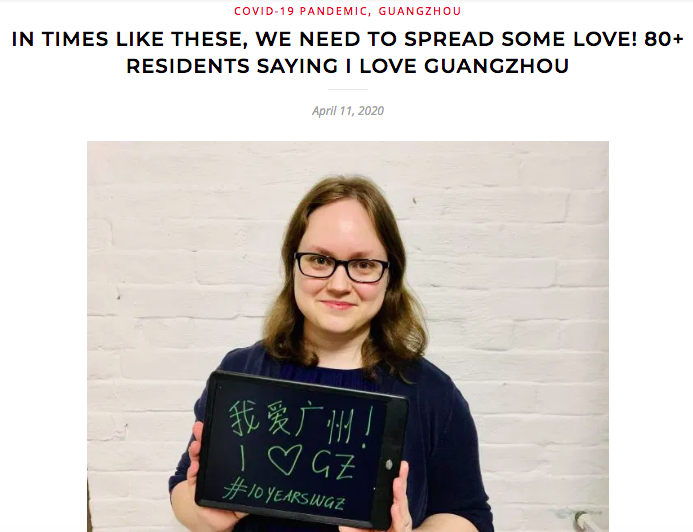
But some have responded by lighting the way forward to spread a little more love and understanding, like Sara Jaaksola, a Finnish woman in Guangzhou who runs a Chinese language teaching business and is married to a local man. Here’s what she said:

I’ve been living in Guangzhou for 10 years, probably will stay here for the next 10 years as well. I feel this is my city, this is the place where I feel like home. So when fear and hate spreads faster than the virus, I feel responsible for doing something about it.

So she created a social media campaign, sharing her love for Guangzhou and asking others to do the same. And she got 80 other residents to join in, posting their own uplifting photos declaring their affection for the city. She shared the backstory behind it all:

To share a little personal story. My local sister-in-law sent a message in our family WeChat group: “Check out this news and be careful when being in touch with foreigners”. I felt my heart broke.

All my years in Guangzhou I’ve been trying to work as a bridge between the Chinese and foreigners. I moved here because I love the language and the culture. I’ve been married to my local husband for 6 years and our daughter is 4.

After all of this, she sent me this message. Not just a stranger on the street, but my family member. Telling me I should be careful when seeing my students and friends. That other should be careful when seeing me and my daughter.

I decided then, that I can’t stop when I feel hurt or sad, that is exactly the time to show everyone that we all can live together in Guangzhou. That we don’t need to be afraid of each other, instead we should learn to understand each other.

Head on over to Sara’s blog to read the whole story and also view all of the touching personal photos from other Guangzhou residents. She proves that, while fear may be contagious, so is love. Pass it on.


No Longer ‘Sleepless in Beijing’ After Sharing My Epidemic Experience – Pub’d on China Daily

China Daily just published my latest column titled No longer ‘Sleepless in Beijing’ after sharing my epidemic experience. Here’s an excerpt:

If my life in March were a movie, you might call it “Sleepless in Beijing”, as I spent much of the month worrying about the health and well-being of family and friends in my home country of the US, where the coronavirus epidemic was getting worse.

Only a month or so earlier, I had been the one they were concerned about, as they inquired about my situation in China and wondered if I was safe. But the tables had swiftly turned as the epicenter of the pandemic had shifted to Europe and experts predicted the US would be next. So there I was, dashing off anxious text messages to make sure nobody in the family had coronavirus symptoms, and even pleading with loved ones, sometimes in tears, to cancel meetings and other social gatherings.

At the height of my fears, I woke up one morning and decided to send out an email to my closest family and friends in the US, detailing my own personal experiences in Beijing with epidemic prevention and control over the past few months. I thought they might better understand the importance of the measures we had already lived – such as going out less, avoiding contact with other people, and not gathering together – if they heard it from someone they knew and cared about.

I hit the send button, crossed my fingers, and prayed at least one of them would actually read my words and heed the warnings.

You can read the full column here. And if you like it, share it. Wishing everyone out there safety and good health.

Just How Contagious Is Coronavirus? <1 Minute of Close Contact Got People in China Infected

The reopening of the Badaling Great Wall in Beijing this past week with restrictions (health checks, no more than 30 percent of normal crowds) reflects just how much the epidemic situation has improved in China’s capital city, where I live. But it’s still a cautious approach – and caution does reign for many of us in how we live our lives.

For example, I still continue to distance myself from anyone I meet on the street, and sometimes six feet even feels too close to me. I’m not the only one who would rather stay farther away, as an article from the local Cleveland, Ohio news site attested to (I’ve closely followed the news in Ohio since much of my family lives there):

Linsey Marr, an aerosol virus transmission expert at Virginia Tech University, told cleveland.com in an email that any viruses released outdoors “will be quickly diluted such that there’s a much lower chance for someone to breathe in many viruses than if they are indoors.” She recommends that people stay 10 feet apart — the farther the better.

So while it’s perfectly OK to go outside for a walk or run, still it might be a good idea to cross the street if you see someone coming on the sidewalk, or keep your distance as you wait for them to pass.

This advice makes sense because the coronavirus is highly contagious. And shocking news reports of how people contracted the virus here in China have really emphasized this reality for me.

Consider this Chinese language news story, which in its headline highlights two cautionary tales: infected in 15 seconds while buying vegetables, infected in 50 seconds while picking up medicine (买菜15秒被感染,取药50秒被感染) [Note: I’ve included the original text along with my translation]:

杭州和宁波于2月5日和2月6日发布的两则确诊病例显示:一人出门买菜,和另一确诊者在同一个摊位有过共同驻留,事后被确诊感染;另一人去药房取药,和另一确诊者在吧台有过共同驻留,事后被确诊感染。这两起病例,共同驻留的时间连一分钟都不到,共同点是两起案例涉及的4个人,都没有戴口罩。

Two confirmed coronavirus cases respectively reported by the cities of Hangzhou and Ningbo on Feb 5 and Feb 6 showed: One person who went out to buy vegetables had stayed at the same vegetable stand with a person confirmed with the virus and was later diagnosed with an infection; another person who went to the pharmacy to get medicine and stayed with another person confirmed with the virus at the counter was later diagnosed with an infection afterwards.

In both cases, the time these people spent together was less than a minute. What these stories have in common is that the four people involved in the two cases did not wear masks.

根据宁波市江北区公安部门2月5日公共视频比对发现,1月23日早上7:47,该患者在双东坊菜场买菜时与路人(江北区确诊患者2:女,61岁,家住文教街道翠柏西巷,1月19日应约参加祈福活动)在同一摊位有过短暂(约15秒)的近距离共同驻留,且两人均未佩戴口罩。

According to a public video comparison of the public security department of Jiangbei district, Ningbo city on Feb 5, it was found that at 7:47 am on Jan 23, the man was shopping at the Shuangdongfang Vegetable Market with a passerby (the 2nd patient diagnosed in Jiangbei district: female, 61 years old, living in Cuibai West Lane of Wenjiao Jie and was invited to participate in a blessing event on Jan 19). The two had a short stay (approximately 15 seconds) at the same booth, staying together at a short distance, and neither of them wore a mask.

根据杭州当地公安部门2月5日公共视频比对发现,1月22日14时21分,徐某某从该医馆的药房门口处进入医馆,与杨某某(1月22日发病的确诊病例)正面相遇,当时徐某某在一楼吧台处取药,杨某某在外侧吧台处停留,有过约50秒的近距离共同驻留,期间两人均未佩戴口罩。1月25日、1月27日徐某某、王某某相继发病,2月5日确诊。

According to a public video comparison on Feb 5 by the local public security department in Hangzhou, at 14:21 on Jan 22, Xu Moumou entered the medical hall from the pharmacy entrance of the medical hall, and Yang Moumou (onset of illness on Jan 22, a confirmed coronavirus case) encountered each other head-on. At that time, Xu Moumou got medicine at the counter on the first floor, while Yang Moumou stayed at the outer side of the counter. The two people stayed together at a short distance for about 50 seconds. During the period, neither of them wore a mask. On Jan 25 and Jan 27, Xu Moumou and Wang Moumou [wife of Xu Moumou] developed symptoms one after another, and their diagnosis [of COVID-19] was confirmed on Feb 5.

Note that in both cases the people got infected in indoor settings, which underlines just how risky it is to be in close contact with anyone in an indoor space.

Wherever you are in the world, please stay safe – and keep a distance, especially indoors.

What do you think?

Coronavirus ‘Signs’ of the Times: Public Service Posters Seen in Beijing

First came the novel coronavirus, or COVID-19, epidemic, followed by a flurry of public service announcements and posters. These posters in particular have become an ubiquitous part of the daily landscape I pass through between the office (just a 10-minute walk away) and home.

Previously, I shared with you my 11 tips for preparing for a coronavirus outbreak in your neighborhood.

Some of you might also be wondering, what kinds of things are the authorities recommending here to the public? I’m sharing a number of the public service posters I’ve encountered during my walk to the office and home, which give you a visual look at some of the advice we’ve received.

(Note: The advice below does recommend wearing masks, something we are all required to do here whenever we go out; however the WHO does not encourage everyone to wear masks.)

This poster, on the door to my building of residence, outlines six major things people should do to help prevent infections of the novel coronavirus. Clockwise, from top left, they are: Wash your hands regularly, eat cooked foods, wear a mask, don’t go to crowded places, drink more water, do regular ventilation.

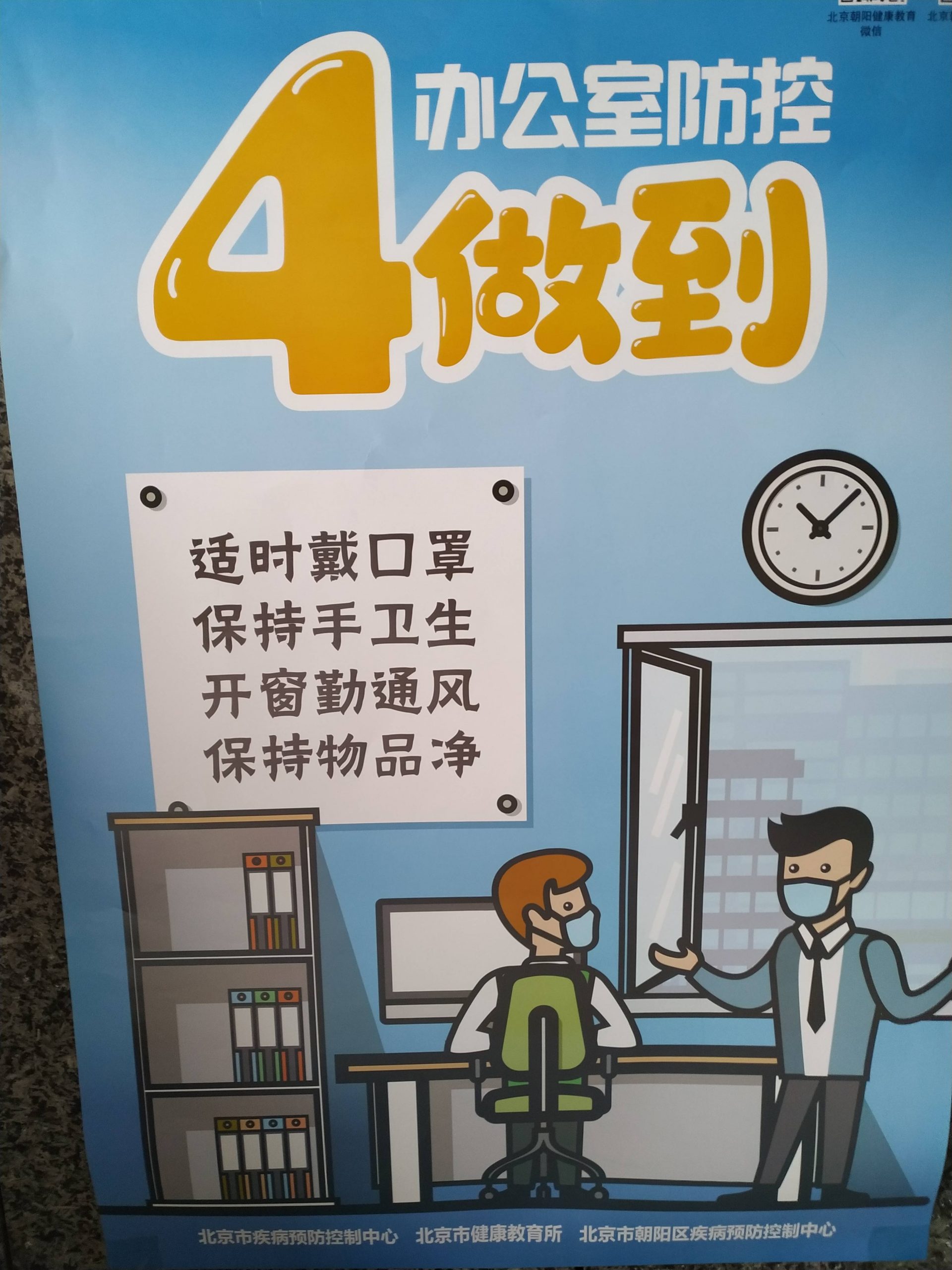
This poster outlines four things offices can do to prevent the novel coronavirus, or COVID-19, listed on the little white square in the poster. They are, from top: Wear masks, maintain good hand hygiene, regularly open windows for ventilation, keep objects clean.

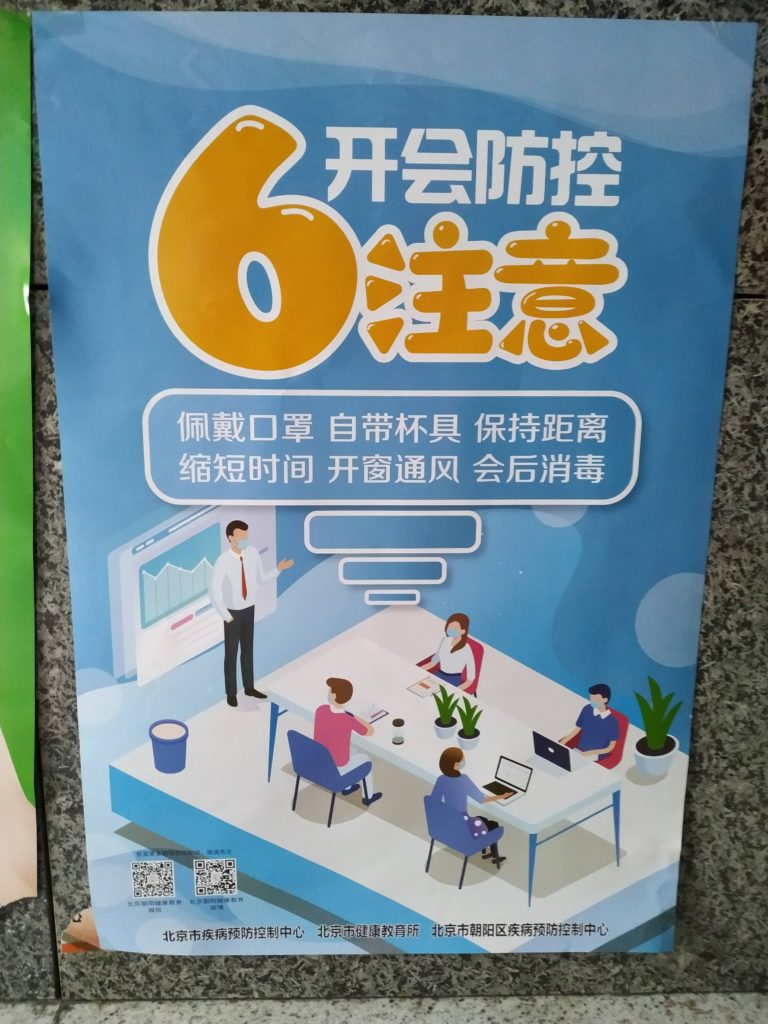
This poster focuses on six things to be aware of during office meetings, listed in the small rectangular area in white characters. Clockwise from top left, they are: wear masks, bring your own cups, maintain distance, shorten the time, open windows for ventilation, disinfect after the meeting.

This poster introduces five principles for prevention of the novel coronavirus in elevators:

  1. Wear a mask during the entire ride
  2. Reduce touching or contact as much as possible
  3. Using the stairs is recommended for those on a lower floor
  4. When more people are present, they should ride the elevator in turns
  5. Stand a meter apart while waiting to ride the elevator

What guidance have you seen or heard in your area regarding coronavirus outbreaks?

I Loved Hair Salons in China, but Now I’m the Home Barber, Thanks to the Virus – Pub’d on WWAM BAM

The group blog WWAM BAM just published my post I Loved Hair Salons in China, but Now I’m the Home Barber, Thanks to the Virus. Here’s an excerpt:

For years I have lauded barber shops in China as one of the greatest things about living in this country. I’ve praised their service in so many ways, from the nice scalp massages that come along with the wash and rinse to the fact that they actually know how to cut my husband’s hair (you would not believe how many US hair salons I’ve seen bungle Asian hair, but that’s another story…).

So about a week ago, I did something I never would have imagined myself doing in China — I cut my husband Jun’s hair. Yes, yours truly became the family barber, wielding our newly bought Flyco electric clipper set. And it’s all thanks to the coronavirus.

Read the full post on WWAM BAM. And if you like it, share it!

In Old Frontiersman’s Lost Horse, We Find Encouragement – Pub’d on China Daily

China Daily just published my most recent column In old frontiersman’s lost horse, we find encouragement. Here is an excerpt:

Long before I ever uttered my first word in Mandarin Chinese, I encountered a story that has helped me redefine how I approach the good and the bad in life-the tale of the old frontiersman’s lost horse, or sai weng shi ma.

According to the tale, an old man living near the border happened to lose his horse when it ran away. People came to comfort him, but he responded by saying, “Why couldn’t this be something fortunate?” After a few months, the horse returned to the old man, bringing along with it a number of fine steeds from the frontier. People came to offer congratulations, but the old man said, “Why couldn’t this be a calamity?” The old man now had many horses at his home, and his son loved to ride. But one day, while on horseback, the son fell off and broke his leg. People came to console the old man, who instead told them, “Why couldn’t this be a good thing?” A year later, barbarians carried out a large-scale invasion on the frontier, and every able-bodied young man took up arms to go to war. The vast majority of the people living at the frontier died. But the son was saved from going to battle because of his lame leg, allowing him and his father to survive in safety.

Ever since I’ve first read this story as a high school student, I’ve returned to it again and again whenever the world yields more sorrows than sweetness. The idea that, perhaps, things that seemed bad might actually prove to have a silver lining, one we might not discern at first, has provided a certain reassurance I depend on amid the vicissitudes of life. And indeed, sometimes what seems apparently unfortunate can still yield blessings after all.

Read the full column here, and if you like it, share it!

Coronavirus: Loved Ones Once Worried About Me in China, Now I Worry About Them

Are you OK? Is everything all right there in Beijing?

In late January and early February of this year, the messages from family and friends, though brief, packed a great emotional wallop. I sensed the care and concern behind them, and I could understand why.

I had followed much of the Western news coverage of the novel coronavirus epidemic, and it painted a rather bleak picture in China, often characterizing the pathogen as “deadly”. In fact, it seemed that every story about the outbreak in China had to use the phrase “the deadly coronavirus” multiple times.

Except, my reality in Beijing was a lot safer than what these media reports portrayed.

Was the virus something we had to take seriously? Of course. But I live in a small and isolated community (which checks our temperatures when we come in and doesn’t allow outsiders to enter). And my office is a 10-minute walk away so I never needed to take the public transportation. There were hardly any people on the street, so I didn’t need to worry about catching something from a stranger; besides I was exercising social distancing on the street, keeping at least six feet away from anybody. And I was ultra-cautious in following the recommendations to stay at home, avoid crowds and crowded places, and just in general not socialize or go out if not needed.

On top of it, my husband could work from home easily and we were even able to go a record 12 days without buying any groceries. And when we did finally order some, we did so through an online service which drastically reduced the chances of any contact with another person.

Sometimes it wasn’t easy to convey all of this to folks not here in China. But I attempted to as best I could. I hoped they understood that I was in an ideal situation for avoiding any possible infections.

I also took much comfort from the fact that I lived in a country that adopted an aggressive approach to control and contain the coronavirus.

I never thought that, all of a sudden, the tables would flip and I would find myself fearing for family and friends overseas, as their countries are forced to grapple with the coronavirus pandemic.

The other day, family texted a slew of photos from local grocery stores, filled with the empty shelves that have made headlines. I couldn’t help worrying, were they able to buy enough to eat, so they can stay indoors? Do they have enough supplies to manage?

When I look at how other countries have responded to this pandemic, I actually feel safer here in China. How I wish they all had this sense of safety I had.

What I found solace in during the hardest of times was this — we were not alone in our situation in China. Everyone was staying more at home, avoiding crowds and the like. We were one unified front.

I hope they too will find that same sense of commitment and solidarity in their response to the coronavirus.

Whether or not you believe it, we are at war, albeit with an invisible enemy. And in wartime, I think of my loved ones a little more, and hope they will see themselves safely through this dark period.

Are you thinking of loved ones more during the coronavirus pandemic? How is your family managing?

P.S.: You can read more coronavirus-related posts here, including my tips for preparation.

Coronavirus: My Bread Flour Shortage Points to Curious Trend in China

Toilet paper shortages? Seriously?

I was stunned when I read news of how this bathroom essential was flying off shelves — and leaving them bare — around the world, all due to fears about the coronavirus.

I found it rather bizarre because here in China, we never saw toilet paper selling out in our supermarket. And apparently I’m not the only one puzzled, since news articles have surfaced on this subject, such as Why are people stockpiling toilet paper?

Still, the coronavirus has led to some unusual pressure on supplies that I never had to virtually elbow my fellow shoppers over.

Witness, for example, how in the past couple of weeks my favorite brand of bread flour, Xinliang, the best-seller in the online supermarket, has consistently been out of stock. I’ve been purchasing it for over a year and this is the first time this has happened.

And we’re not talking about just one type of Xinliang bread flour. Every single darned variety — white flour for bread, whole wheat flour, cake flour — in every single size — from 5 kilograms right down to 500 grams — is unavailable.

The online flagship store for Xinliang on Alibaba’s Tmall provided even less reassurance. While they were selling all my must-have varieties of bread flour, they came with a rather painful asterisk — that the store could ship them out as late as early April. Early April!

Now, granted, the online supermarket has other brands of bread flour on sale — but I’m stubborn. I really, really like Xinliang, right down to the adorable English words “Pure bread flour” printed on the front of its white bread flour packages.

Why has Xinliang been selling like hot jiaozi dumplings? Well, some recent coronavirus-inspired trends might offer some clues.

Last month, I wrote about how spending more time at home inspired me to get more creative in the kitchen, as I prepared more foods from scratch — including home-baked bread (thank you, bread machine!) — and expanded my repertoire, even creating my own homemade hummus.

The problem? Everyone else was steaming up their own kitchen cooking for themselves — and lots of them wanted bread too, by the looks of news reports. Consider this detail in the article Sales of cooking goods soar on online platforms (emphasis mine):

Sales of yeast, a necessity for making bread and pastries, soared by nearly 40 times while dumpling wrappers were sold seven times more than before. Seasonings were a hot item, with over 3.93 million onions, pieces of ginger and heads of garlic sold.

Data from Tmall International also showed that a UK multifunctional boiler, a Japanese sandwich maker as well as bread makers saw their sales soar 400 percent in its platform during the past one month.

So if more shoppers have been snapping up yeast and bread makers, then it’s no wonder my precious Xinliang bread flour has been missing in action in the online supermarket.

I keep waiting and hoping for it to reappear on the virtual shelves, checking every single week for signs of its re-emergence. But so far, no luck.

Meanwhile, I’ve observed shoppers moving on to a new brand of bread flour, touting how everyone in those Tik-Tok cooking videos uses it and posting their photos of bread hot out of the machine. It offered some reassurance, at least, that shifting to a new brand wouldn’t somehow lead to lackluster loaves.

But since I still have at least 3 kilograms of Xinliang bread flour left over — and a perhaps somewhat irrational attachment to the brand — I’m willing to wait a little longer.

However, if you’re one of the poor souls facing toilet paper shortages, waiting a little longer, depending on how many rolls you have left, might literally bite you in the bum.

Have you been seeing any unusual shortages in your area because of the coronavirus? Sound off in the comments.

P.S.: If this post inspired you to bake some more bread, consider heading over to When West Dates East for a delectable recipe for Shaker bread. And please, do your other fellow bakers a favor and leave some bread flour for the next person!

SARS vs COVID-19: Comparing My Experiences in China

COVID-19, the novel coronavirus, is not my first experience of living through an epidemic in China.

Back in 2003, a little over a month after I moved to Shanghai to start a new position with a multinational media organization, news of a deadly new pathogen that had apparently first emerged in southern China and since spread to Beijing, alarmed the public. It was called severe acute respiratory syndrome, or SARS.

As COVID-19 has exploded into our lives this year, I’ve often found myself reflecting back on my experiences during SARS in China, comparing and contrasting. Here are some of the similarities and differences I’ve noted since the novel coronavirus outbreak began here in China.

SARS never affected lives across China as COVID-19 has

Shanghai, where I lived at the time, only saw a small handful of SARS cases in 2003. And while I did wear a mask as a precaution and paid plenty of attention to hygiene, I still lived my life much as I had before the news of SARS surfaced. I commuted to work by bus every day, ate out at restaurants on the weekends, and went out shopping to buy goods and groceries.

Other areas more hard hit by SARS did see more stringent measures, such as school closures in Beijing, but it didn’t constitute a nationwide response. Nevertheless, for many people, SARS hadn’t penetrated that close to home.

However, COVID-19, the novel coronavirus, has truly became a nationwide – and of course, now global – crisis, more so than SARS ever was. It has touched every single province or region of China, the worst of course in the epidemic center of Hubei province and particular its capital Wuhan. And that has meant that everyone in this country has felt the effects of the novel coronavirus on their lives in some ways, such as the following:

  • Spending time holed up at home indoors, in some cases for weeks
  • Residential communities closed to outsiders who don’t live there
  • School closures or delays in opening
  • Shifts to working from home where possible
  • Bus transportation between provinces halted for periods
  • Online delivery services, much in demand for people staying indoors, saw enormous pressure at the height of the outbreak, with many finding it tough to order groceries through their favorite apps (including us)
  • Businesses being slow to open after Chinese New Year and suffering losses due to the epidemic

In essence, the entire nation of China found itself in hardship together during the novel coronavirus outbreak, making sacrifices and adjusting to this new kind of normal.

Temperature checks less common during SARS, ubiquitous in COVID-19

Back in Shanghai during SARS, I only recall one place within my regular sphere of life that did temperature checks – the office building next door to mine that housed a Subway sandwich shop. Whenever I wanted to pick up a sandwich for lunch, I had to get scanned by this guard holding a large testing device that reminded me of a ray gun from a science-fiction movie.

I never imagined that this isolated experience would become an ubiquitous reality in COVID-19. As I wrote recently, every place that matters in my life here in Beijing – office and community – requires me to pass a temperature check for entry (leading me to dub my temperature as a kind of “passport”). And the devices nowadays are much more compact, and probably more accurate, than what they used at that office during SARS.

And if you want to get around your city, you will have to pass through plenty of temperature checks nowadays, including if you choose to take public transport.

Holidays were canceled during SARS, but extended in COVID-19

SARS shook up the world, and particularly China, in mid-to-late-April, especially when the numbers of cases in Beijing surged. This all happened close to one of China’s major annual holidays, Labor Day. Back then, we were set to get an entire week off. But due to SARS, the government decided to cancel the holiday in order to discourage travel.

However, during the COVID-19, or novel coronavirus, outbreak, China instead extended holidays in an effort to encourage people to stay at home and not return to work too early. Across the nation, the Chinese New Year holiday, which should have ended Friday Jan 31, stretched until Sunday Feb 2. And even then, certain areas further delayed the end of the holiday, such as to Feb 9 in Shanghai.

Mask shortages more severe under COVID-19

After Jun and I learned of those handful of cases of SARS in Shanghai, we visited a supermarket that weekend to purchase some masks I could wear during my commute between the office and home. We found plenty of options and weren’t concerned about panic buying (though even during that time, there were some initial shortages of masks among medical personnel).

But with COVID-19, now that masks remain largely mandatory for anyone who wants to step outside of their community in China, a lot of mask hoarding has ensued.

Many people have struggled to purchase them as areas of China, including Hubei, saw shortages in medical supplies including masks. It created this nationwide mask crisis. In the early days of the outbreak, a story crossed my desk about all the stores in central Beijing that sold out of masks.

Fortunately, China has now reported producing more than enough masks to meet demand. Still, the novel coronavirus has migrated to other countries around the world, triggering similar runs on masks and shortages among medical centers of this vital form of medical protective gear. (It’s important to note that the WHO says only certain people need to wear a mask — and if you don’t count among them, consider not buying masks to reduce pressure on supplies.)

Disinfectant sells out for both SARS, COVID-19

When I wanted to buy alcohol at the local pharmacy during SARS, the staff told me they had sold out — a sign of just how widespread the panic already was in Shanghai.

In that respect, much hasn’t changed with COVID-19, as I’ve seen any kind of disinfecting product in short supply or not in stock. I’m fortunate I bought the bleach and other antibacterial cleansers I like to use a long time ago, because whenever I check on them online, they’re not available to buy.

Still, for much of the outbreak, I couldn’t even purchase my favorite brand of antibacterial hand soap and only just recently saw it available in my online supermarket. (I had to settle for an alternative, but that’s OK because any soap can effectively kill viruses.)

In both SARS, COVID-19, hope for an end

One thing that remains universal both during SARS and now with the novel coronavirus, or COVID-19, epidemic — we all wish for an end as quickly as possible. Every day, I continue to pray for all those affected by the virus, from infected patients to medics on the front line and everyone else concerned about its spread across the world.

Let’s hope the end to the COVID-19 epidemic comes soon.

What do you think? If you have experienced SARS and COVID-19, what are your thoughts?

Love Amid Coronavirus: Separated Lovers, Veggie Bouquets, Brave Medic Couples

As China and the rest of the world fights the coronavirus, for many people love lights the way through this dark time. Sometimes it takes a crisis for our true hearts and souls to emerge, and when they do, it can make for both beautiful and unexpected gestures.

When a nation like China calls for quarantines and lockdowns, which have left many bound to their apartments, love has to find new ways to thrive, as the China Daily story Love wins out despite lockdowns, quarantine describes, particularly in this touching scene:

Chen Ying, who was born in the 1990s, is a nurse at a hospital in Zhejiang province. Her boyfriend, Huang Qianrui, visited Chen at the hospital after seeing a photo of the red marks left on her face by the tight protective mask she wore at work.

Chen cried as Huang Qiangru showed her that he had brought her favorite crucian carp soup and snacks. Standing on different sides of the ICU’s glass door, they cried and spoke via their cellphones.

The scene touched Chen’s colleagues, who shot a video.

“Are you feeling better?” Huang Qiangru asked Chen, referring to the marks made by the mask.

Chen: “Much better.”

Huang Qiangru: “I want to give you a hug.”

Chen: “I want to hug you, too.”

Huang Qiangru: “How? We can’t.”

Meanwhile, how about saying “I love you” with a bouquet of veggies? That’s a new kind of romantic gesture gaining traction in the time of the coronavirus, as chronicled in the story Masks, goggles and alcohol wipes become hot Valentine’s Day gifts:

At a Shanghai grocery store operated by Suning, people can online order a 258-yuan ($36) bouquet made of fresh produce, including broccoli, carrots, chili peppers and corn. Customers can pick up the bouquet or have it delivered to their sweethearts’ homes, so that their loved ones don’t need to go outside to buy groceries and risk catching the virus.

This unorthodox gift was surprisingly popular, and the store has sold over 50 batches since Tuesday, the store owner told local media. A female costumer surnamed Liu said her husband is tackling the epidemic in Shanghai, but he still prepared her a “surprise”.

“At first, I thought I was going to a store to pick up some rice or oil, I didn’t expect a hilarious bouquet of vegetables,” she said. “Now I believe sending roses and flowers are super lame. Sending your loved one produce, now that is true love.”

Meanwhile, stories of couples fighting the coronavirus together have emerged, including a duo that didn’t even realize they were working on the same floor of the hospital, as detailed in Couples stand together to fight the disease:

“I saw a familiar figure wearing a protective gown in the quarantine area. The name written on the gown was ‘Yu Chen’. When she turned around, I saw her eyes behind her goggles. I was shocked to find her on the same floor,” Ke said.

Yu said it was only when Ke called her name in a voice full of doubt that she confirmed they were working on the same floor.

After a moment of slight shock, they went back to their posts to continue their busy tasks.

“I can’t say I wasn’t afraid, but knowing he was around eased my worries. We encouraged each other through eye contact,” Yu said.

Although they had worked at the hospital before the outbreak, Ke suddenly saw Yu in a different light: “In this battlefield, I saw the power and courage in her small body, like a totally different person. In the middle of the battle against the virus our relationship was not just love, but a combination of family ties and wartime friendship. I don’t think anyone or anything will be able to sway it in the future.”

What unusual stories of love in the time of the coronavirus have you heard about? Share them in the comments.