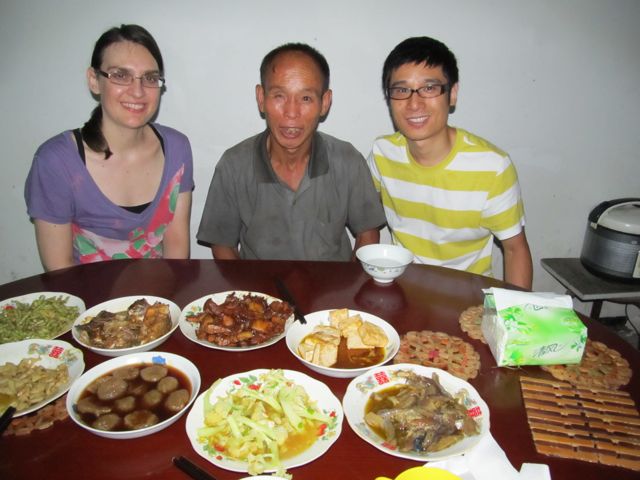
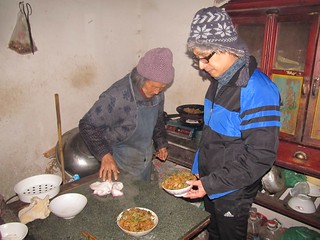
The other day, John’s grandma invited the two us over all of a sudden for dinner at her house. When I say “all of a sudden”, I mean that she interrupted us in the midst of preparing handmade dumplings and told John and me we were dining on fried rice noodles instead.
As much as I love fried rice noodles, her invitation arrived on an evening when I had been craving the very handmade dumplings we were preparing with John’s father. But what could we do? Here was grandma, who had been hospitalized for two months in fall of 2013, standing at the door and asking us to dine on the noodles she had already finished preparing. It was the kind of situation with “just go with it” written all over it. Besides, my mother-in-law said we only had to eat a little, just to be polite. So I hid my dumpling disappointment behind a smile, hooked my arm in grandma’s arm, and strolled out the door with John beside us.
Once at grandma’s home, she immediately plunked heaping bowls of rice noodles in front of us — each bowl easily three times larger than her own. When she said dinner, boy did she mean it.
“Aiya, too much!” John said in protest, which I repeated in turn. What happened to just eat a “little bit”, like my mother-in-law said?
“Not too much!” Grandma said in a gruff voice, followed by nagging us to “Eat, eat!” as if we had to finish our bowls of rice…or else.
So we tucked into the rice noodles with our chopsticks and discovered that, if this was indeed a “responsibility”, it was the most delicious kind. I couldn’t help savoring the baby bok choy perfectly seasoned with garlic and dark aged soy sauce. It wasn’t too salty or overdone, and arguably it was the finest rice noodles she had ever fried up for us. So as I cleared the last of the noodles in my bowl, I couldn’t help but tell her, “So delicious!”
For grandma, that wasn’t praise but rather a cue to provide seconds. Before we could utter “bu yao!” grandma was on her feet, trying to shovel more rice noodles into our bowls. We each shielded the bowls with our hands, pleading to her not to add more. And when that failed, we simply rose from our stools and headed for the door itself.
Grandma chased after us with mandarin oranges, trying to press the fruits into our hands with far more strength than you might expect from a recently hospitalized woman over 80. But we pushed them back into her hands and then trotted outside, saying “Save them for next visit!”
Grandma, interrupting our “regularly scheduled” dumplings for a spot of fried rice noodles at her place.
“You know, she shouldn’t have made us those rice noodles,” I said to John on the way back home, shaking my head. “She’s still recovering from her heart condition.”
John shrugged and smiled. “That’s how she shows her love for us.” His words echoed what my mother-in-law would say after we returned home: “She shouldn’t do it, but she wants to do it because she likes you.” You could say the same about the black striped polyester pants I never asked her to buy for me (and which I could barely squeeze into) or the hulking bag of puffed rice sweets she delivered to us one afternoon.
Grandma has never hugged or kissed me, nor told me she loves me. But these days — and especially after this impromptu dinner — I’ve never felt closer to her.
Canadian Alex calls it destiny. She went to China in June 2010 as an exchange student, never realizing she would leave her heart in Qingdao — and end up becoming a wedding planner together with her husband, Fei.
Our hometowns share an ocean, but are on different continents. We both celebrate a new year, but at a different time. We both have parents, but only one of us has siblings.
I can tell the story of how Fei and I met in two languages. This type of meeting is called 缘分 (yuanfen) which depicts that by fate or destiny two people come together.
Like most foreigners here I began my journey as an exchange student in June 2010. At the same time Fei agreed to help his friend by teaching a class on Business in China. Fei studied and lived in Dublin, Ireland for nine years. When we met it was not in Canada, it was not in Ireland, nor was it in Fei’s hometown Qingdao (青岛). We met in a small suburb outside the city, in an old classroom on the 6th floor.
In class we exchanged cards and arranged to meet later on. We went with several friends for a dinner of roast duck, which led to night market shopping, and further an intimate pot of blue mountain coffee shared between the two of us. After coffee I followed like a puppy to watch a football match in a pub even though I had never been a fan.
Fei
The next day I left to Xi’an. It was painful leaving but the Terracotta warriors, Yangzte River, and Wuhan Dam all distracted me for a little while. As I traveled throughout China we kept in contact every day via text message. Through these short but meaningful first messages we subtly developed our relationship.
We met in a classroom, bonded over coffee, and spent only one week together in Qingdao, China before I had to fly home to Canada. Over the distance our relationship grew closer and commitment solidified.
Today we work side-by-side creating weddings and events here in Qingdao. Everyday we share a cup of coffee together, we make jokes and laugh in both languages, and when I am not at home working we are often crazily texting each other about some little wedding detail or color combination.
Alex, doing a floral arrangement for a wedding.
It feels surreal to think that my small exchange student opportunity has opened up this entire new world. I am fluent in Chinese, married to a wonderful husband, and we are both building our careers and future together everyday.
It’s quite complicated how we came to be in the wedding industry. After we were engaged we of course began to think about how to arrange and coordinate an international wedding party. We also went to check out a few of the local wedding planners (婚庆公司). At first I saw their weddings and just didn’t really understand how there was such a huge T-shaped stage, many different colored lights, and aisle decorations that were nearly touching the ceiling? I thought to myself this isn’t the wedding that I imagined and just doesn’t feel right.
So after some trials and tribulations and meeting the right people, in May 2011 we had our first wedding client (a friend of a friend of course). Our first wedding was an amazing (and frustrating) learning experience about the different between Western and Chinese style weddings. I learned very quickly that creating hand-made seating arrangements for 300+ people just do not work!
One year later I had the chance to design and create our own wedding. I wanted to give my Chinese family and friends the experience of what a western style wedding is like. We were married by the sea, in the yard of a 100 year old building, we ate delicious steak and drank wine, we danced, we ate cake, and we drank some more. It was the best day of my life and Fei agrees it was his too.
Our company is growing, we are learning so much everyday and being challenged in every way possible. I feel honored that I can help other brides and grooms create the same wonderful memories that we had after our wedding day.
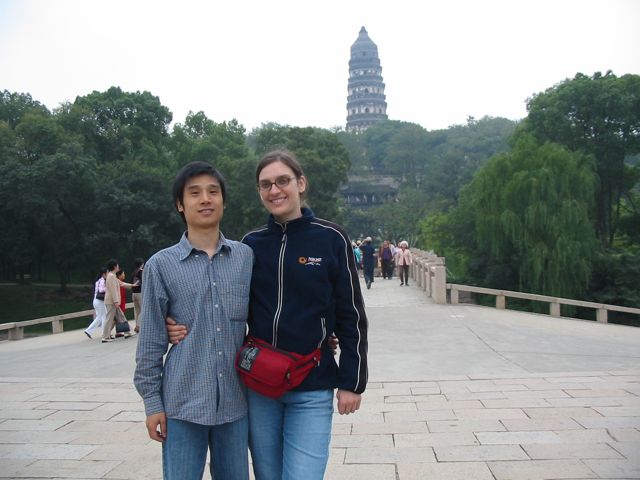
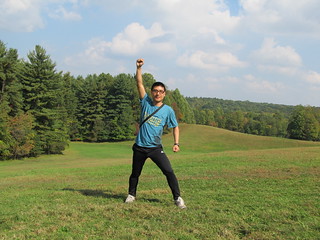
The thought crossed my mind as I scrolled through the photos of John and me in the US. In one, I crouched before the cream-colored house in the suburbs we once called home. In another, he posed like a triumphant warrior before the rolling hills of Ohio we hiked every evening.
Some two weeks ago, I slept under the roof of that cream-colored house in Ohio and meandered through the trails in those hills. But now that I sleep under the roof of a white-washed home in rural Zhejiang and hike through mountains filled with bamboo and pines, my former life in the US feels like a fantasy — as if someone photoshopped me and John into those photos.
And oddly enough, it’s not the first time I felt this way. Whenever I’ve traveled between China and the US, my life in the country I left behind always seemed more like a long, extended dream to me. Not even artifacts of that previous life — such as those photos — could completely dispel this feeling that it was all just a hallucination.
Maybe that’s what happens when you’re in an international, cross-cultural relationship — where you straddle two different worlds. It’s not just geography that separates China and the US; different cultures and languages only serve to reinforce the separation. Meanwhile, I’m surrounded by people here in China who couldn’t really understand what it was like for John and me to live in the US — while in the US, most people I know don’t understand life in China. Sometimes, I feel as if these two separate worlds of mine will always remain strangers in a sense — where never the two shall meet.
Perhaps that’s also the power of living in foreign countries. Suddenly, you realize that the reality you knew growing up isn’t universal…that reality changes when you cross borders and oceans.
In the meantime, I’m enjoying my new reality in China. And someday, when I return to the US for a visit, perhaps this will all feel like a dream all over again.
When I usually share stories about couples of Chinese men and Western women, they usually fall into two camps: the “happily-ever-after” couples and the couples that once were.
And then there’s the story I’m about to share — about a couple fighting for their marriage. Petya reached out to me recently to ask that I publish her tale on my blog, hoping that readers could also weigh in with advice on how to save her marriage and family. So please, don’t be shy in the comments! If you have any ideas, Petya would love to hear them.
Petya, thanks so much for your courage to share this publicly.
—–
I’m Bulgarian. My childhood passed under Communism in the Eastern Block. When I went to study in Western Europe, I got on very well with my Chinese colleagues. There was something deeply similar in the education and behavior that made contact very easy.
Years later I went to study Japanese in Tokyo. The second time I went to Japan, in my class I met a Chinese man who was interested in me. He was working in a big multinational Japanese company and they took him in Japan and payed for his Japanese lessons because they were preparing him to become their Marketing Director for China. I didn’t return his interest, even though we were getting along well. I knew we lived in different worlds — I would go back to Europe and he had brilliant career prospects in Asia.
But one day, we had a debate in class about love and he said in front of everybody that the perfect person to be his girlfriend exists and it was me. Of course it was very flattering for me, but most importantly, I found this very brave and I decided this guy is exactly like me — a fighter — so I gave him a chance.
We started a beautiful relationship. I had to go back to Europe to work. As I have a flexible and well paying job, I was traveling every month to Japan for approximately 10 days to be with him. We got engaged and continued like this. He came two or three times to Europe. We also went to China and he introduced me to his family. His mother passed away a long time ago, and his father is remarried. He has an elder brother who is married with one child.
This situation could have continued for years. He had business trips everywhere in Asia and if I could, I joined him in exotic destinations. Then the big earthquake and the tsunami hit Japan. He was in Tokyo and I was deadly worried. Then Fukushima happened too. It was horrible to be so far away. And suddenly, even though I always said I didn’t want to hurry to have children, I changed. I thought life is so short and we are so vulnerable. I could lose the love of my life and will have nothing left except some beautiful memories. Then I decided I’m ready for a family. We married one month later. A few months later I got pregnant. The big surprise was I was pregnant with twins. We decided it’s better for me to stay and give birth in Europe, because of the radiation in Tokyo. So we did. Meanwhile he moved back to China for the new position. I travelled two times during my pregnancy to China The twins were born in Europe, but he couldn’t be here to see their birth.
My life changed completely. Before I knew I was pregnant with twins, I was still planning to travel. I overestimated myself. With the two newborns and no family to help me, only a full-time nanny, I was crazy tired here. And I had to resume working on the third month after the birth, because we went through all our savings. It was impossible to travel. I thought going to Shanghai to live there, but my husband’s job, even as Marketing Director didn’t pay well enough to allow him to support our big family. I had to take care of the two babies. And I don’t speak Chinese. How could I bring the babies to a doctor without speaking the language if my husband is on business trip? I couldn’t even order a taxi. He said he would send the babies to his family, but I doubted his step-mother would take care of the babies of somebody else’s son. I went to visit him with the babies and the nanny, a long and difficult flight from Brussels to Shanghai. His father didn’t even come to see the boys in Shanghai. Only the wife of his brother came and she helped me a lot.
If we move to Shanghai, we don’t have enough money to live normally, I don’t speak Chinese, and the only solution is we hire an English-Chinese speaking nanny and I still have to travel to Europe to work for at least one or two weeks every month in order to contribute to the family budget and eventually pay my loan for the apartment I’ve bought in Brussels.
If I quit completely my job, I have to sell the flat in Brussels, abandon everything, and become a housewife and somehow live there. I’m not the housewife type. I’m conference interpreter, working for Heads of States and Governments, the European Commission and Parliament. But my main language, Bulgarian, is too small to be interesting for somebody in China.
The third solution was for him to abandon everything, but I didn’t want this. I know how difficult is to make a career from a scratch because I did it too. I could not destroy his career. And as a Bulgarian from the former Soviet Block, I know what discrimination means in Western Europe. I lived as a second category citizen in France during all my studies there, even if I had more diplomas and better notes than most of the French people. I know what humiliation means. I didn’t want him to experience the same as a Chinese.
I was getting more and more tired, depressed, and even crazy. I had also some health problems resulting from complications of giving birth, so I had surgery.
I started asking him to come. We fought, we argued. Then I asked for a divorce. He realized it was serious and quit his job. He came here. Was I happy? No, I was crying over his destroyed career. I was feeling guilty. He came here broken. I think unconsciously he was hating me because I destroyed his career. He hated also to be dependent on me. I tried to find him something to do while we were searching for a job. I registered him to study French and to go to driving school. He refused to finish the classes. He said he will decide when to go to classes and what to do. We argued about how could I help him. He said my job-hunting assistance wasn’t helpful and he doesn’t need my help.
I was nervous, often crying and shouting. He said he hated this kind of woman and if he knew I was like this, he would never marry me. He accused me of using the boys as a tool to make him come here. We fought for half a year. Although I found him a job as a shipment manager, and not a bad one, he wasn’t satisfied and hated it. The atmosphere in the company was bad, he said. Because of the family reunion law, he couldn’t leave the country for 6 months. He felt even worse – like my hostage.
And one day he saw me completely broken, crying and telling him that I made a mistake to ask him come here, that all I did was stupid and I’m ready to quit my job and Europe and go to China. The colleague who replaced him as Marketing director in China had left, so his position was free and he could have gone back. He refused.
So this is our story until now. We stopped arguing and I don’t ask anything from him. I just try to stay calm and he also seemed to calm down recently. But I don’t know what will happen.
What do you think? What advice do you have for Petya?
“My parents miss us,” said John, who beamed like a Mid-Autumn moon. “They want us to be back at home. They like it better when it’s renao,” or lively.
While working on to-dos for our trip back to China, my thoughts turned to living in the family home once again. And just like that, John reminded me of the warm welcome we’ll enjoy when we move back into the same two-story building his parents call home.
I felt that same welcome from John’s parents during the summer of 2009. On the phone, my father-in-law spoke of home renovations they planned to complete before our arrival. “Why are they wasting their money on that?” I once asked John. Turns out, the renovations were a whole new addition to the family home — including a two-bedroom and bathroom suite that my father-in-law would later dub our xinfang, that new home every newly married couple should have. “This is your home,” my father-in-law said to me once, after I claimed John and I didn’t have a home of our own.
In the US, this reads more like a fairytale — or even a myth. While your parents might kick in some cash for your wedding, they’re sure not likely to leave a “vacancy” sign on for you and your spouse to move in and call it home. And as for the married child, well, moving back home with your spouse is an utter embarrassment — or even life failure.
But John’s parents wanted us living with them so much they made room for us — literally.
And, strange as it may seem, I want nothing more than to live with them too. I love the way his father gets excited about the flowers in the garden and Chinese poetry and writing about the history of his ancient village. I love how his mother keeps me stuffed with the most sumptuous home-cooked vegetarian dishes, and won’t let me do my laundry, and teaches me how to cook with her fire-powered wok.
Maybe most Americans can’t understand why I’m excited about moving in with my in-laws. And that’s okay. The more time I’ve spent with John, the more I’ve realized that not everything about the white US culture I grew up in makes sense either. Sometimes, it’s not about what makes sense to the world or to others, but what makes sense to you.
All I can say is, I’m already missing my mother-in-law and father-in-law and can’t wait to be home with them.
Just before John and I went to the US together, I too was once starstruck with the idea of living here.
“Everything is so great here in the US!” said this young woman from Jiangsu. She gushed like a girl talking about her first crush, right down to the blush on her cheeks and the glimmer in her eyes. And in a way, maybe it was a crush to her — a “business-trip-to-the-US” crush.
We met her while waiting for a changing room to open up at an Adidas outlet. Even though the conditions in the store seemed like hell — only three changing rooms and endless customers streaming in through the doors — the conditions outside bordered on heavenly. An azure sky, sunshine, the trees dressed in their finest autumn scarlet and gold and orange, and throngs of happy shoppers. In the beauty of that day, I even began to forget the sadness of the past 24 hours.
But when I heard her praise the US, a part of me shuddered. After all of the hardship that John and I experienced in this country, I just could never endorse the idea that everything was just fabulous here. And given the recent government shutdown — which has locked up the local national park where I once found solace and comfort in daily hikes — I wasn’t alone in my feelings.
Yet, before I brought John to the US, wasn’t I — in a sense — as starstruck as this young Chinese woman? Once upon a time, I spun my own personal fairytale version of a happily ever after with John in the US. The fact that John was once denied a tourist visa to come over to the US only strengthened my conviction that, somehow, if I could just bring him over here, everything would be better. But things unravelled as the years in this country passed and the disappointments piled up — until I had not a single thread of that fairytale left.
What I had left was a lot of guilt. I remembered how John’s father told me, “When you’re far away from us in the US, you’ll have to take care of him.” Even though it was completely and utterly irrational, I felt responsible for every terrible thing that happened to John.
Sometimes life lets you down. But it doesn’t mean that I’m down or John is down. And it also doesn’t mean that I have to bring someone else down because of it.
So when she gushed about the US, I just smiled and nodded. “I’m glad you’re having a good time.”
Who knows if she’ll feel the same way days or even years later? And who knows if I’ll feel the same? But I do know this — her happiness somehow touched me, and reminded me that perhaps my happiness will eventually come in time.
Sometimes, when I come across a memento of my pre-China life, I can’t believe that now I think of a foreign country as home. I imagine that girl, the one who longed to break free of the suburbs, who dreamed of the world beyond the Cleveland, Ohio area she’d always known. Who’d have thought those dreams would take me across the Pacific, to a whole different country?
I even think back to my first steps in China, imagining the whole experience would turn into nothing more than some “gap year” between my graduation and eventual career back in the US. It’s funny how a small decision like teaching English in China can change your life forever. Soon, one year turned into several years, where I found my calling as a writer and eventually met my husband John, a native of the Hangzhou region.
But while John and I moved together to the US, our attention — and plans for the future — shifted back towards the Pacific shores. Maybe that seems counterintuitive — honestly, even I wondered that sometimes. After all, most of the other yangxifu I know who met their husbands in China invariably packed up their lives, left China and never returned. But after a while we couldn’t imagine living forever in the US; it never felt like home and never fully ignited our dreams and our potential.
Of course, there’s another factor in China’s favor — that we actually have our own home there, awaiting our return. John’s parents added a new suite to their family house just for John and me. They called it our “xinfang” or new home in Chinese. There, the delicious aroma of my mother-in-law’s stir-fried specialties — from smoked tofu with spicy peppers to fresh bamboo with soy sauce — fills the entire household, and delights us at every meal. There, my father-in-law spins stories of life in his ancient village and shares his latest artwork and calligraphy with me. There, my niece bounces through the household with the exuberance of a toddler while my sister-in-law just grins. There, the relatives come over almost every day to visit, or invite us over for dinner, or share some of the freshest fruit in season with us.
When I think of this home in China, anticipating our arrival, I am filled with enormous gratitude. Maybe it’s not a coincidence, then, that our departure date just happens to be November 28 — Thanksgiving Day in the US.
The other night, when the evening sunset made the horizon blush, I thought about the vastness of the universe. “Just imagine,” I said to John, “Our sun is one of 400 billion stars in the Milky Way Galaxy.”
“Four hundred billion…that’s sìqiān yì.”
“Four thousand yì equals 400 billion?” I asked.
“One billion is shí yì.”
Of course one billion was 10 yì! I wanted to slap my forehead in what was arguably a huge “doh!” moment. Hadn’t I learned Chinese so many years ago — including numbers and their equivalents? But yet it took me a few extra seconds to remember the difference between billion and yì.
I shook my head. “It always seems like I can’t keep the numbers straight. I had the same problem when I went to Spain and was speaking Spanish. But maybe it’s even harder in Chinese. You have yì, we have billion and they don’t equal each other. And of course I like billion — because that’s what I grew up with.”
“I like yì,” said John.
It’s funny that we can stare at the same setting sun, imagining the exact same number of potential stars, and express it in a completely different way — all because of cultural and linguistic preferences.
Is it better to say 4,000 yì or 400 billion? Who knows? But whatever your choice of number, there’s nothing like gazing at the night sky — or a sunset — and wondering about all of the unanswerable “whys” in the universe.
If you know Unsavory Elements— the anthology published earlier this year which includes my essay, “Red Couplets” — chances are you know Tom Carter as well. He edited the anthology and contributed his own essay.
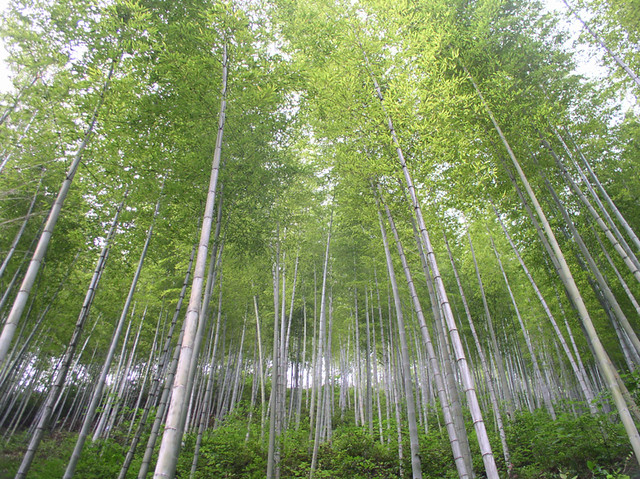
But prior to his “unsavory” endeavors, he became known for his book CHINA: Portrait of a People. This collection of photographs from all 33 provinces in China offers the most comprehensive view of China in book form. Tom spent two years backpacking around the country to capture these photos, which amazes me.
In this interview, Tom talks about CHINA: Portrait of a People — and shares some of his favorite photographs as well.
—–
(photo by Tom Carter)
It’s clear that you have a great passion for China. Could you talk about how the experience of photographing your journey around the country changed your own perspective on the country?
To be completely candid, prior to coming to China my estimation of the Chinese was not very high. As a San Francisco City native growing up in North America’s largest Chinese community, I found Chinese immigrants to be rather aloof and unapproachable. They didn’t seem to “mix” well in our Great American Melting Pot, which in turn validated the Caucasian community’s prejudices towards them; a kind of self-perpetuating vicious cycle.
I eventually came to China (in 2004) not out of any affinity for Chinese culture but simply because I wanted to travel and see the world, but once I got here it didn’t take long to fall in love with the place and its people. Having immersed myself in its society, my appreciation and passion for Chinese culture far outweighed any occasional lapse in tolerance I still might have been guilty of.
(photo by Tom Carter)
Could you tell us about the most romantic place you photographed?
(photo by Tom Carter)
Gosh, I’m not sure that’s answerable; the notion of romanticism is relative to the person you are at that time. I’ve watched my own ideas of romance and love mature over the past ten years here in China, from a swinging single American male just looking for a good time, to eventually meeting the woman who I have no doubt is my soulmate.
We were married in a rural village in the Jiangsu countryside and she recently gave birth to our son there as well, at a small public People’s hospital. So for me, that little farming village is one of the most special places in my life. Romantic? Depends on how you feel about peasants and pitchforks and livestock and rice fields and bamboo groves…
(photo by Tom Carter)
You brought your wife along with you during your trip. What was it like traveling together as a couple?
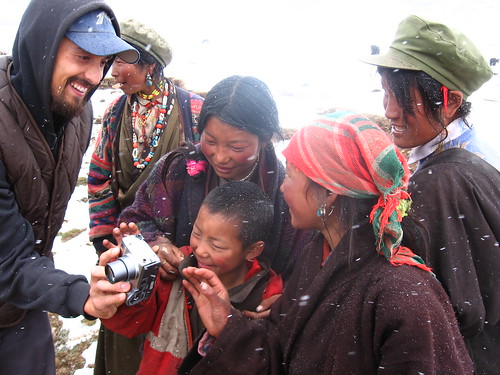
Tom Carter showing his camera to some new friends in China. (photo courtesy of Tom Carter)
We met in Beijing in 2005 while I was working there, but then the following year I departed to go backpacking across the entire country alone, which had been a dream of mine since I first arrived. We stayed in touch – she even bailed me out of not a few hard situations via phone and rendezvoused at her home village over October holiday so that I could meet the parents (and like 50 other random relatives). When I finally returned to Beijing the following year and landed my book deal (to publish CHINA: Portrait of a People) I decided to go back out on the road for another year to obtain more photos, but this time I invited her to come with me. She quit her job, bought a backpack, and we re-traced my steps through the 33 provinces and also discovered new places together that I never would have found without her.
I think spending that much time with someone is a true test of any relationship, but for us the balance of bliss and hardship that comes with budget backpacking in a developing country seemed to bring us closer together. We did a similar trip across all of India in 2009, a rough, brutal journey that she seemed to handle far easier than me (she’s publishing her own book about India next year). She’s small in stature but even more of a bad-ass than this 6’4” American! By the end of that trip there was no question in my mind that she was the woman I intended to marry.
Tell us about another fascinating couple you photographed during your travels.
(photo by Tom Carter)
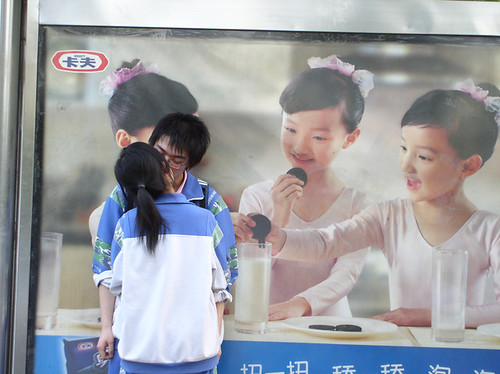
In spite of China’s rapid modernization (and westernization), public displays of affection are still not very common in this country, so I was sure to steal a snapshot on the rare occasion that I spotted one, such as the uniformed highschool students sneaking a kiss behind a bus-stop billboard.
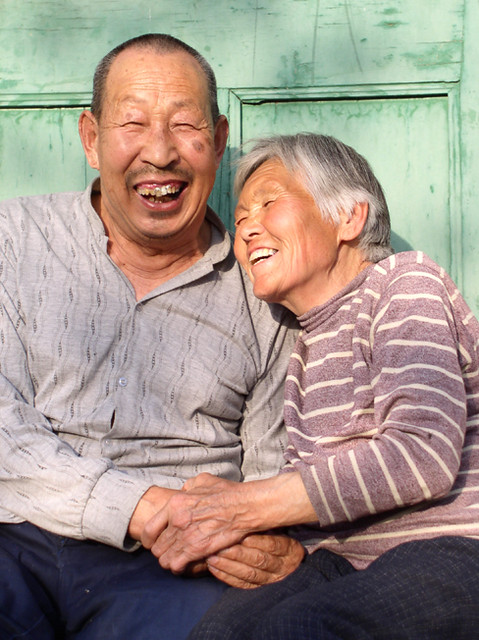
But for me the most special and personal photograph is of the elderly couple in Beijing celebrating their 55th anniversary. I feel so blessed to have captured their embrace in that photograph – it’s not something you often see any couples let alone old folks in China do. About a half-decade after taking that photo, that elderly couple became my in-laws (they are my wife’s grandparents) but the following year Laolao passed away, followed quickly by Laoye, whom we can presume died of a broken heart. But they have been immortalized in the pages of this book for future generations of our family.
(photo by Tom Carter)
What message do you hope people come away with when they read your book?
(photo by Tom Carter)
I think each photograph in this book conveys its own personal message about life and humanity in China: deep-rooted traditions, the importance of family, a dwindling yet proud agrarian class, rich indigenous culture, and dire widening economic and regional disparity. But I try to let the photos speak for themselves without shoving a message down anyone’s throat, which is why I decided against narrating my journey or being too heavy-handed in the book’s captions (which some readers have actually complained about on Amazon).
But mostly I just hope the book inspires people to get out there and explore some of “real” China beyond the touristic sites and the glistening steel-and-glass skylines of its major metropolises. It’s a big, beautiful country, and the regions that aren’t getting any attention are the places that are, in my opinion, the most deserving of it.
Charlotte and Santiago (photo courtesy of Charlotte)
This is the story of how Charlotte, “a shy, Midwestern American girl” who is also a writer, mom and blogger at Chinese Potpourri, ended up marrying a Chinese guy — with no traditional proposal, and even no huge wedding banquets. Theirs is a subtle and surprising romance, which includes perhaps one of the most unusual ways I’ve ever heard a man express his true love for someone: “I want to be your slave for the rest of my life.”
And ultimately, Charlotte also shares a universal truth based on her experience: “I’ve realized that even though our story is unconventional and unexciting, it’s special because it’s ours.” Well said.
This website uses cookies to improve your experience. We'll assume you're ok with this, but you can opt-out if you wish.AcceptRejectRead More
Privacy & Cookies Policy
Privacy Overview
This website uses cookies to improve your experience while you navigate through the website. Out of these cookies, the cookies that are categorized as necessary are stored on your browser as they are essential for the working of basic functionalities of the website. We also use third-party cookies that help us analyze and understand how you use this website. These cookies will be stored in your browser only with your consent. You also have the option to opt-out of these cookies. But opting out of some of these cookies may have an effect on your browsing experience.
Necessary cookies are absolutely essential for the website to function properly. This category only includes cookies that ensures basic functionalities and security features of the website. These cookies do not store any personal information.
Any cookies that may not be particularly necessary for the website to function and is used specifically to collect user personal data via analytics, ads, other embedded contents are termed as non-necessary cookies. It is mandatory to procure user consent prior to running these cookies on your website.
 The other day, John’s grandma invited the two us over all of a sudden for dinner at her house. When I say “all of a sudden”, I mean that she interrupted us in the midst of preparing handmade dumplings and told John and me we were dining on fried rice noodles instead.
 “Not too much!” Grandma said in a gruff voice, followed by nagging us to “Eat, eat!” as if we had to finish our bowls of rice…or else.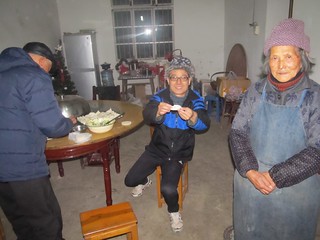


 Was that really me? Were we really there?

 “My parents miss us,” said John, who beamed like a Mid-Autumn moon. “They want us to be back at home. They like it better when it’s renao,” or lively.