I was stunned when I read news of how this bathroom essential was flying off shelves — and leaving them bare — around the world, all due to fears about the coronavirus.
I found it rather bizarre because here in China, we never saw toilet paper selling out in our supermarket. And apparently I’m not the only one puzzled, since news articles have surfaced on this subject, such as Why are people stockpiling toilet paper?
Still, the coronavirus has led to some unusual pressure on supplies that I never had to virtually elbow my fellow shoppers over.
Witness, for example, how in the past couple of weeks my favorite brand of bread flour, Xinliang, the best-seller in the online supermarket, has consistently been out of stock. I’ve been purchasing it for over a year and this is the first time this has happened.
And we’re not talking about just one type of Xinliang bread flour. Every single darned variety — white flour for bread, whole wheat flour, cake flour — in every single size — from 5 kilograms right down to 500 grams — is unavailable.
The online flagship store for Xinliang on Alibaba’s Tmall provided even less reassurance. While they were selling all my must-have varieties of bread flour, they came with a rather painful asterisk — that the store could ship them out as late as early April. Early April!
Now, granted, the online supermarket has other brands of bread flour on sale — but I’m stubborn. I really, really like Xinliang, right down to the adorable English words “Pure bread flour” printed on the front of its white bread flour packages.
Why has Xinliang been selling like hot jiaozi dumplings? Well, some recent coronavirus-inspired trends might offer some clues.
The problem? Everyone else was steaming up their own kitchen cooking for themselves — and lots of them wanted bread too, by the looks of news reports. Consider this detail in the article Sales of cooking goods soar on online platforms (emphasis mine):
Sales of yeast, a necessity for making bread and pastries, soared by nearly 40 times while dumpling wrappers were sold seven times more than before. Seasonings were a hot item, with over 3.93 million onions, pieces of ginger and heads of garlic sold.
Data from Tmall International also showed that a UK multifunctional boiler, a Japanese sandwich maker as well as bread makers saw their sales soar 400 percent in its platform during the past one month.
So if more shoppers have been snapping up yeast and bread makers, then it’s no wonder my precious Xinliang bread flour has been missing in action in the online supermarket.
I keep waiting and hoping for it to reappear on the virtual shelves, checking every single week for signs of its re-emergence. But so far, no luck.
Meanwhile, I’ve observed shoppers moving on to a new brand of bread flour, touting how everyone in those Tik-Tok cooking videos uses it and posting their photos of bread hot out of the machine. It offered some reassurance, at least, that shifting to a new brand wouldn’t somehow lead to lackluster loaves.
But since I still have at least 3 kilograms of Xinliang bread flour left over — and a perhaps somewhat irrational attachment to the brand — I’m willing to wait a little longer.
However, if you’re one of the poor souls facing toilet paper shortages, waiting a little longer, depending on how many rolls you have left, might literally bite you in the bum.
Have you been seeing any unusual shortages in your area because of the coronavirus? Sound off in the comments.
COVID-19, the novel coronavirus, is not my first experience of living through an epidemic in China.
Back in 2003, a little over a month after I moved to Shanghai to start a new position with a multinational media organization, news of a deadly new pathogen that had apparently first emerged in southern China and since spread to Beijing, alarmed the public. It was called severe acute respiratory syndrome, or SARS.
As COVID-19 has exploded into our lives this year, I’ve often found myself reflecting back on my experiences during SARS in China, comparing and contrasting. Here are some of the similarities and differences I’ve noted since the novel coronavirus outbreak began here in China.
SARS never affected lives across China as COVID-19 has
Shanghai, where I lived at the time, only saw a small handful of SARS cases in 2003. And while I did wear a mask as a precaution and paid plenty of attention to hygiene, I still lived my life much as I had before the news of SARS surfaced. I commuted to work by bus every day, ate out at restaurants on the weekends, and went out shopping to buy goods and groceries.
Other areas more hard hit by SARS did see more stringent measures, such as school closures in Beijing, but it didn’t constitute a nationwide response. Nevertheless, for many people, SARS hadn’t penetrated that close to home.
However, COVID-19, the novel coronavirus, has truly became a nationwide – and of course, now global – crisis, more so than SARS ever was. It has touched every single province or region of China, the worst of course in the epidemic center of Hubei province and particular its capital Wuhan. And that has meant that everyone in this country has felt the effects of the novel coronavirus on their lives in some ways, such as the following:
Spending time holed up at home indoors, in some cases for weeks
Residential communities closed to outsiders who don’t live there
School closures or delays in opening
Shifts to working from home where possible
Bus transportation between provinces halted for periods
Online delivery services, much in demand for people staying indoors, saw enormous pressure at the height of the outbreak, with many finding it tough to order groceries through their favorite apps (including us)
Businesses being slow to open after Chinese New Year and suffering losses due to the epidemic
In essence, the entire nation of China found itself in hardship together during the novel coronavirus outbreak, making sacrifices and adjusting to this new kind of normal.
Temperature checks less common during SARS, ubiquitous in COVID-19
Back in Shanghai during SARS, I only recall one place within my regular sphere of life that did temperature checks – the office building next door to mine that housed a Subway sandwich shop. Whenever I wanted to pick up a sandwich for lunch, I had to get scanned by this guard holding a large testing device that reminded me of a ray gun from a science-fiction movie.
I never imagined that this isolated experience would become an ubiquitous reality in COVID-19. As I wrote recently, every place that matters in my life here in Beijing – office and community – requires me to pass a temperature check for entry (leading me to dub my temperature as a kind of “passport”). And the devices nowadays are much more compact, and probably more accurate, than what they used at that office during SARS.
And if you want to get around your city, you will have to pass through plenty of temperature checks nowadays, including if you choose to take public transport.
Holidays were canceled during SARS, but extended in COVID-19
SARS shook up the world, and particularly China, in mid-to-late-April, especially when the numbers of cases in Beijing surged. This all happened close to one of China’s major annual holidays, Labor Day. Back then, we were set to get an entire week off. But due to SARS, the government decided to cancel the holiday in order to discourage travel.
However, during the COVID-19, or novel coronavirus, outbreak, China instead extended holidays in an effort to encourage people to stay at home and not return to work too early. Across the nation, the Chinese New Year holiday, which should have ended Friday Jan 31, stretched until Sunday Feb 2. And even then, certain areas further delayed the end of the holiday, such as to Feb 9 in Shanghai.
Mask shortages more severe under COVID-19
After Jun and I learned of those handful of cases of SARS in Shanghai, we visited a supermarket that weekend to purchase some masks I could wear during my commute between the office and home. We found plenty of options and weren’t concerned about panic buying (though even during that time, there were some initial shortages of masks among medical personnel).
But with COVID-19, now that masks remain largely mandatory for anyone who wants to step outside of their community in China, a lot of mask hoarding has ensued.
Many people have struggled to purchase them as areas of China, including Hubei, saw shortages in medical supplies including masks. It created this nationwide mask crisis. In the early days of the outbreak, a story crossed my desk about all the stores in central Beijing that sold out of masks.
Fortunately, China has now reported producing more than enough masks to meet demand. Still, the novel coronavirus has migrated to other countries around the world, triggering similar runs on masks and shortages among medical centers of this vital form of medical protective gear. (It’s important to note that the WHO says only certain people need to wear a mask — and if you don’t count among them, consider not buying masks to reduce pressure on supplies.)
Disinfectant sells out for both SARS, COVID-19
When I wanted to buy alcohol at the local pharmacy during SARS, the staff told me they had sold out — a sign of just how widespread the panic already was in Shanghai.
In that respect, much hasn’t changed with COVID-19, as I’ve seen any kind of disinfecting product in short supply or not in stock. I’m fortunate I bought the bleach and other antibacterial cleansers I like to use a long time ago, because whenever I check on them online, they’re not available to buy.
Still, for much of the outbreak, I couldn’t even purchase my favorite brand of antibacterial hand soap and only just recently saw it available in my online supermarket. (I had to settle for an alternative, but that’s OK because any soap can effectively kill viruses.)
In both SARS, COVID-19, hope for an end
One thing that remains universal both during SARS and now with the novel coronavirus, or COVID-19, epidemic — we all wish for an end as quickly as possible. Every day, I continue to pray for all those affected by the virus, from infected patients to medics on the front line and everyone else concerned about its spread across the world.
Let’s hope the end to the COVID-19 epidemic comes soon.
What do you think? If you have experienced SARS and COVID-19, what are your thoughts?
As China and the rest of the world fights the coronavirus, for many people love lights the way through this dark time. Sometimes it takes a crisis for our true hearts and souls to emerge, and when they do, it can make for both beautiful and unexpected gestures.
When a nation like China calls for quarantines and lockdowns, which have left many bound to their apartments, love has to find new ways to thrive, as the China Daily story Love wins out despite lockdowns, quarantine describes, particularly in this touching scene:
Chen Ying, who was born in the 1990s, is a nurse at a hospital in Zhejiang province. Her boyfriend, Huang Qianrui, visited Chen at the hospital after seeing a photo of the red marks left on her face by the tight protective mask she wore at work.
Chen cried as Huang Qiangru showed her that he had brought her favorite crucian carp soup and snacks. Standing on different sides of the ICU’s glass door, they cried and spoke via their cellphones.
The scene touched Chen’s colleagues, who shot a video.
“Are you feeling better?” Huang Qiangru asked Chen, referring to the marks made by the mask.
At a Shanghai grocery store operated by Suning, people can online order a 258-yuan ($36) bouquet made of fresh produce, including broccoli, carrots, chili peppers and corn. Customers can pick up the bouquet or have it delivered to their sweethearts’ homes, so that their loved ones don’t need to go outside to buy groceries and risk catching the virus.
This unorthodox gift was surprisingly popular, and the store has sold over 50 batches since Tuesday, the store owner told local media. A female costumer surnamed Liu said her husband is tackling the epidemic in Shanghai, but he still prepared her a “surprise”.
“At first, I thought I was going to a store to pick up some rice or oil, I didn’t expect a hilarious bouquet of vegetables,” she said. “Now I believe sending roses and flowers are super lame. Sending your loved one produce, now that is true love.”
Meanwhile, stories of couples fighting the coronavirus together have emerged, including a duo that didn’t even realize they were working on the same floor of the hospital, as detailed in Couples stand together to fight the disease:
“I saw a familiar figure wearing a protective gown in the quarantine area. The name written on the gown was ‘Yu Chen’. When she turned around, I saw her eyes behind her goggles. I was shocked to find her on the same floor,” Ke said.
Yu said it was only when Ke called her name in a voice full of doubt that she confirmed they were working on the same floor.
After a moment of slight shock, they went back to their posts to continue their busy tasks.
“I can’t say I wasn’t afraid, but knowing he was around eased my worries. We encouraged each other through eye contact,” Yu said.
Although they had worked at the hospital before the outbreak, Ke suddenly saw Yu in a different light: “In this battlefield, I saw the power and courage in her small body, like a totally different person. In the middle of the battle against the virus our relationship was not just love, but a combination of family ties and wartime friendship. I don’t think anyone or anything will be able to sway it in the future.”
What unusual stories of love in the time of the coronavirus have you heard about? Share them in the comments.
Back in late January, when the novel coronavirus outbreak first exploded in China, readers from outside the country worried about my husband and me.
But as the virus has spread to more nations around the world, more people have worried about themselves – and what they need to do to get ready.
First things first – please don’t panic! If you haven’t yet, I encourage you to educate yourself on the basics about this virus. While there’s still much to be learned, as this is a new pathogen, knowing more can help you understand the risks and how to manage them in your daily life.
The WHO has an entire page devoted to the novel coronavirus, or COVID-19. In particular, you should look at their Q&A section, which can answer pretty much every major question you might have about the novel coronavirus. Their advice for the public is especially helpful.
Additionally, make sure to visit the center for disease control and prevention in your country and also follow the national and local news to stay updated on the latest novel coronavirus reports closer to your home.
Here are some steps you should consider in preparation for a potential novel coronavirus outbreak in your community, based on authoritative sources as well as what I’ve learned and experienced.
(Note that throughout this article, I’ve linked to Amazon, where I’m an affiliate – if you are an Amazon shopper and find my advice helpful, shopping through these links is a great way to say thank you and support this blog, at no additional cost to you.)
#1: Prepare enough food and other supplies to stay at home for 2 weeks
Staying indoors here in China has become a nationwide phenomenon, as many of us have had to become homebound for a variety of reasons due to the novel coronavirus, particularly self-quarantine requirements.
Even if you don’t have to undergo a mandatory quarantine, you might still need to stay indoors for at least two weeks or more, as an NPR article on readiness for the coronavirus explains:
Basically, you want to avoid crowds to minimize your risk of catching the disease. If COVID-19 is spreading in your community, the last place you want to be is in line at a crowded grocery store or drugstore.
The NPR piece recommends stocking up on enough medicine and nonperishable foods to get you through two weeks – and reminds you not to forget your favorite foods for when you get sick (in case you do come down with a mild case of COVID-19 and end up housebound).
Note too, the same NPR post reminds us all that “most household cleansers — such as bleach wipes or alcohol — will kill [the virus]” and “even wiping down surfaces with soap and water should do the trick”, so no need to stock up on special cleaners. If you have soap on hand, you’re ready.
(Note: As you’re doing your shopping, consider buying your products online with home delivery, if you can, especially if your neighborhood has a potential coronavirus outbreak. This serves as another way to reduce contact and avoid getting infected. Amazon, for example, offers home delivery on groceries.)
#2: Have a thermometer on hand
Fever remains among one of the more salient symptoms of the novel coronavirus, and you may need to monitor your temperature, especially if you happen to be at risk for an infection due to travel or developments in your community. If you don’t already have one, pick up a thermometer.
#3: You may not need medical masks
Medical masks have become a must-have in China, where everyone is required to cover their face when going out due to the novel coronavirus epidemic. But this requirement has, in part, lead to shortages and pressure on medical mask supplies. (Cue the hilarious photos of people wearing masks made of instant noodle bowls, T-shirts, plastic water jugs and, yes, even a thong.)
(Or, if you want to give the public some laughs, strap a thong over your face.) 😉
#4: Rearrange your home entrance to help keep the coronavirus out
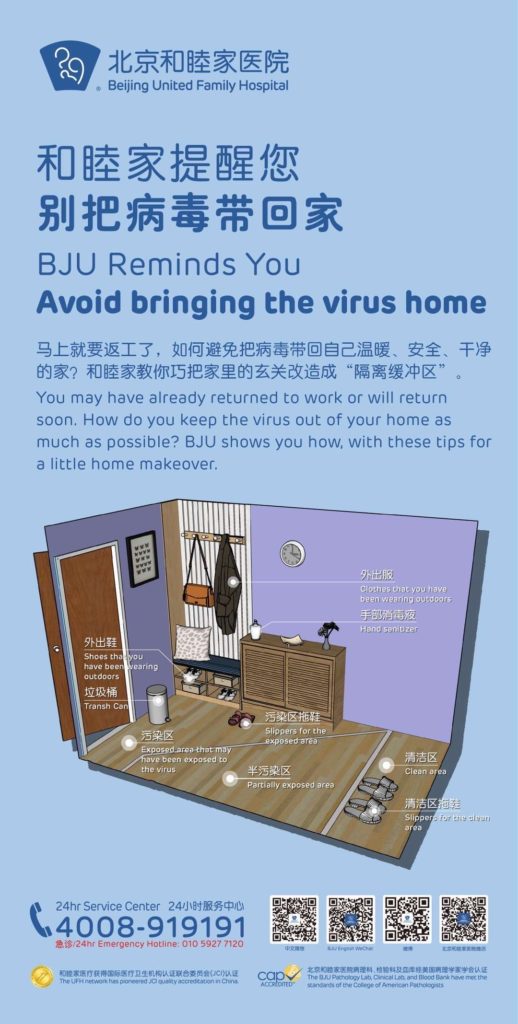
When the outbreak first started, I found this illustration from Beijing United Family Hospital as a very helpful guide to how you can rethink your home entrance, so you’re not bringing the virus into the rest of your home.
See if you can rearrange your home entrance, much like this suggestion, to further safeguard your own home.
(And if you want more inspiration for your home, see this post, which includes another diagram from Beijing United for how you might clean your bathroom with coronavirus prevention in mind.)
#5: Ask your employer about working from home
Several cases of infections originated at offices, which is why the government in Beijing has requested that employers, where possible, institute flexible work options such as working online from home. And in the event where people do need to go to work, employers here have also been encouraged to promote off-peak shifts, so people can avoid the crowding typical of rush hours.
If you can accomplish your work from home, not going to the office would serve as another excellent way you can reduce the possibility of getting infected. Ask your employer ahead of time about whether remote work or other home working options are a possibility. It may help prompt a companywide conversation about how to respond to the epidemic and also protect everyone who works there.
#6: Prepare for possibility of schools closing or home schooling
Schools have continued to remain closed here in China because they’re prime areas for crowding, which is a huge risk factor for the spread of the novel coronavirus. And here in Beijing, the authorities have set some very stringent standards for schools to reopen, whenever that takes place. In the meantime, schools have moved forward with online and remote learning for kids (including having some lessons broadcast on TV).
If you have kids, contact their school to find out what plans, if any, they have to deal with an epidemic. Would they close their doors and offer online learning?
Also, if you’re not satisfied with the response from your local school, is home schooling an option for your kid?
With schools closing or home learning, that would also require having someone at home to monitor and guide the kids. Also, make sure you have a plan for a parent, guardian or other caregiver to remain at home in the event school is closed.
—
Now, don’t forget the basics – good hygiene and other simple practices can go a long way toward keeping you healthy:
#7: Wash your hands first thing when you come home
Washing my hands after coming home has always been a part of my routine, but now even more so, given the WHO advice for the public has stated:
Wash your hands frequently
Regularly and thoroughly clean your hands with an alcohol-based hand rub or wash them with soap and water.
Why? Washing your hands with soap and water or using alcohol-based hand rub kills viruses that may be on your hands.
You’re probably already washing your hands after using the toilet and before having dinner. But also, wash your hands first thing after you arrive home, which helps to ensure you’re not bringing any viruses from outside or surfaces you may have touched into your home.
(Also, as a side note, if you are washing your hands a lot more, pay attention to hand creams and moisturizers, because washing will take a toll, especially during these colder months!)
#8: Avoid touching your face with your hands when you’re out
Since the outbreak started here, one of the things I’ve tried really hard not to do is something that most of us engage in all the time and never notice – something the WHO says in its advice for the public:
Avoid touching eyes, nose and mouth
Why? Hands touch many surfaces and can pick up viruses. Once contaminated, hands can transfer the virus to your eyes, nose or mouth. From there, the virus can enter your body and can make you sick.
Your hands will inevitably come into contact with lots of surfaces when you’re out and about, and you don’t know who touched that place before or whether anyone has cleaned it in a long time.
One thing I do when I feel like I must touch my face outside – pull out a tissue first and put it on my hand, so there’s no direct contact.
#9: Keep at least 1 meter away from people in public
Out on the streets of Beijing, we all steer clear of other pedestrians. And even in the office, I keep a distance from fellow coworkers. That’s because close contact with others is one of the primary transmission modes of the virus.
Now, the WHO advises: “Maintain at least 1 metre (3 feet) distance between yourself and anyone who is coughing or sneezing.”
I would add, if you really want to be cautious, keep that same 1-meter distance from anyone you encounter in public. After all, there have been reports of people who were asymptomatic yet still tested positive for the novel coronavirus.
#10: Avoid crowded places or gatherings
One of the earliest pieces of advice we heard in China was to avoid crowds and gatherings. At the same time, the country moved to close down any possible places or events with the potential to pack in a lot of people together, to prevent the spread of the coronavirus. Even my community has asked us not to invite people over.
While it might put a major dent on your social life, avoiding crowded places or gatherings greatly reduces your risk of infection, and it’s especially important advice for more vulnerable individuals, as the WHO director said in recent remarks:
…if you are over 60 years old, or if you have an underlying condition like cardiovascular disease, a respiratory condition or diabetes, you have a higher risk of developing severe disease. You may wish to take extra precautions to avoid crowded areas, or places where you might interact with people who are sick.
#11: Keep spaces, objects you regularly touch clean
Here in China, the major broadcaster constantly airs lots of public service announcements about the novel coronavirus. In a portion of one of my favorite segments (I like it in part because it is spoken by a health expert with what I consider a really cute southern Chinese accent) stresses that elevator buttons and door handles are a concern during the epidemic because these are items with a high frequency of contact.
This is the expert in a screenshot from the segment.
Every time I hear this, I’m reminded of the importance of cleaning the spaces and objects that are frequently touched – from door handles to keyboards to, especially, my smartphone (note that a recent report said the coronavirus could live on a phone screen for up to 96 hours).
Every day I aim to clean and disinfect these spaces and items as much as possible. This is particularly important for anything you carry around outside when you’re shopping or at work or otherwise, like a smartphone.
Think about those items you frequently touch and get into the habit of giving them a daily wipe with your preferred cleaning solution.
What other advice would you recommend to prepare for a novel coronavirus outbreak?
This morning, the building managers decided to start asking us to physically write down our temperature every day we enter the premises, on a log sheet. It’s yet another change to get used to during this novel coronavirus outbreak, among the many changes I’ve already detailed. But it got me thinking of a certain idea – that these days amid the epidemic here in China, my temperature truly is my passport for getting around in this new world.
If you’ve seen or heard about the 1990s film Sneakers, then you might remember the quote from that high-tech comedy which inspired me: “My voice is my passport – verify me.”
Here, however, we only gain access to our communities, office buildings and, yes, even major public transportation through our temperature – a normal temperature of course (set at any reading less than 37.3 degrees Celsius).
That is the one thing that allows us to pass freely. That is how we get verified.
(Now if you registered a fever of 37.3 or more, you wouldn’t hear sirens and alarms go off, like trying to get past security in the movies – but you would be directed to the nearest hospital fever clinic!)
We’ve been living this for about a month already and it has become so ingrained into our lives that I think I would feel strange if the guards in front of our main building didn’t take out that temperature monitor and check me.
While some might make comparisons to dystopian worlds, in reality temperature checks just make sense, given that fever stands out one of the major symptoms of the novel coronavirus, and the new devices allow people to monitor this symptom with ease.
It also subtly reminds us all that health really does matter right now, amid the epidemic (which has made me care more about my health and, in turn, feel really great these days).
But let’s face it – this is a “passport” we all hope will eventually go defunct. So I look forward to the day when I have to remind myself not to log in or stop before the guard for a reading.
Healthier during an epidemic? As strange as this might sound, I’ve enjoyed one of the healthiest winter months of recent in the past 30 days or so, since the novel coronavirus epidemic started.
Of course, such an outbreak creates an inevitable motivation. As I detailed earlier in the post How the Novel Coronavirus Outbreak Has Changed My Daily Life Here in China, we’ve experienced a lot of life changes that have made our health an important issue. We must pass temperature checks to enter the community and enter the main building. We have to report our health condition daily to HR as well.
And COVID-19, the novel coronavirus, has symptoms that are very similar to the common cold. Which means, if you’re unfortunate enough to come down with a common cold, you might actually end up at the hospital anyhow for a check and confirmation you don’t have the novel coronavirus.
So staying as healthy as possible has really become my No. 1 focus over the past month. And that has meant things like more care with hygiene, avoiding going out or crowds, eating well, getting enough rest and just not pushing myself too hard on a daily basis. If I feel exhausted after coming home from work (which isn’t unusual, given that we’ve seen an avalanche of stories pass our desks because of the epidemic), I’ll just indulge in a relaxing foot bath and maybe watch my favorite nature series or finish off my latest book. I would rather rest more than risk overdoing it, which could lower my immunity and make me more susceptible to getting ill.
In fact, none of this is really earth shattering or worthy of headlines. It’s just good common sense that your mom or grandma probably told you about a long time ago. And as low tech as it all sounds, it truly does work.
While we’ve seen a decline in new cases here in China, including a number of provinces and regions such as Beijing that have reported no new cases over a few days, the outbreak still hasn’t ended yet. The recent news of surging cases from other countries, such as South Korea and Italy, stands as a reminder that we all need to remain vigilant.
And authorities in Beijing have reminded the public here recently not to get complacent, despite the drop in new cases or reports of no cases. We still must avoid crowds in public, wear masks outside, and not pack too many people into the office, as many companies used to.
Which means health will continue to remain my priority, until the whole world finally wins the war on this novel coronavirus epidemic.
When this outbreak first hit, it created a sudden tsunami of changes (and deluge of news stories – I’ve never been so busy here at the office during a holiday). With all of these different adjustments to life here in Beijing, at first I really didn’t know what to say because I was still kind of digesting everything, trying to understand the situation and how it was affecting me and my husband.
The major TV news broadcaster reports all outbreak related stories under the banner of The War on the Epidemic (战疫情). Now the use of the term “war” might sound scary, but in many ways, it does feel like China is indeed at war with an enemy (albeit a microscopic one), marshaling so many resources to support the fight in Wuhan and Hubei province, the epicenter of the outbreak. And during a war, the whole country has to make some sacrifices to ensure victory.
For those of us on the ground, it means having to adjust to a new kind of normal. Not necessarily a frightening normal – but a temporary one with changes aimed at curbing the spread of this virus.
But it’s not always easy to get used to a new normal.
It felt odd at times having to cover my face whenever I stepped out, and to see other people’s faces concealed. The streets still appear largely quiet with only a handful of people out, in contrast to the frenetic pace of life that used to buzz around the block, as residents heed the recommendation to avoid going out. And I never thought I would get accustomed to getting a temperature check to enter the community, but I have.
I’ve found it helpful to remember that these changes have a positive aim, even if they might bring some disruptions to what we were once used to.
I don’t know exactly when I started to find myself falling into a more comfortable routine, but it happened at some point during this week. I think I’m fortunate, as I largely still do most of the same things I used to before the epidemic – going to the office (where I always wave hello at the guards), cooking and baking, reading books, doing our “walking program” at home, enjoying warm foot baths, and of course, watching movies (including those sappy romantic comedies I can’t resist).
And that’s the key to adjusting — when you discover that, underneath it all, your life still remains much the same. How grateful I feel that this is true for me.
In the meantime, I will continue to rise each day, go to work, and stay safe as much as possible. And I will pray for Wuhan, for Hubei province, for all those on the front line and the patients, and everyone else affected by this epidemic.
Because as much as I’ve adjusted, I look forward to the day when can adjust to another reality — that we’ve won the war on this epidemic.
As the novel coronavirus epidemic has gripped China, it has led to a cascade of life changes for everyone still here in the country, especially those living in Hubei or the city of Wuhan, the epicenter of the outbreak.
I reside in Beijing, which hasn’t been as hard hit as Wuhan or Hubei province or other regions. Nevertheless the ongoing epidemic has still touched my life in a variety of ways, and it has meant adapting to a new, albeit temporary, existence in the name of doing our small part to prevent and control this new virus.
For those of you outside of China wondering what it might be like to be here right now, as an average person, I wanted to share some of my own experiences as someone residing in Beijing.
I’ve been at work during most of the Spring Festival holiday – the news doesn’t take a vacation — which allowed me to see it all unfold.
First things first — why I’m staying put
As many foreigners living in China have engaged in the “do I stay or do I go” debate, I’ve never once entertained the thought. For me, it was never even a question – of course I would stay. My life and work are here, my husband is here, and this country has long been a second home to me. No matter the headwinds, Jun and I will soldier on together in China.
Furthermore, people (such as Michael Wester in a piece for the Beijinger) have noted that travel poses a far greater risk for exposure to the novel coronavirus — on the train, bus or taxi to the airport, in the airport itself and even on the plane. And some asymptomatic cases have emerged, which means someone who appears perfectly healthy could in fact carry and transmit the virus.
CDC estimates that influenza has resulted in between 9 million – 45 million illnesses, between 140,000 – 810,000 hospitalizations and between 12,000 – 61,000 deaths annually since 2010.
CDC estimates that influenza was associated with more than 35.5 million illnesses, more than 16.5 million medical visits, 490,600 hospitalizations, and 34,200 deaths during the 2018–2019 influenza season.
In any event, I am here to stay in Beijing. And remaining here means making a contribution, however insignificant, to support efforts to manage the outbreak, which involves complying with the many changes and measures now in place because of the epidemic.
Avoid going out, crowded places or unnecessary gatherings
News reports and public service announcements constantly remind us to not meet up or go to crowded places, and to generally avoid going out unless you absolutely have to. Because of this advice, I actually canceled a get-together at my apartment that I had planned with an old friend.
Many people in China have had to do the same, and it’s tough at this time of year, because visiting family and friends is a holiday tradition in Chinese culture known as bainian – but TV spots have suggested doing any such meetups online, such as a video chat.
Most cities have made the choice relatively easy – for example, Beijing canceled all of its temple fairs during the holiday, closed up nearly every major tourist attraction, and shuttered theaters to stage performances and screen movies.
Games in China national soccer and basketball leagues have halted.
Even my Catholic diocese here in Beijing has suspended all masses until further notice. Some people in a local faith community chat post the week’s readings for church and other suggestions for worship in lieu of going to church.
At the same time, recently local governments have encouraged people to work from home, and have delayed the start of school until later in February or even until March.
For me, abiding by the recommendation to avoid going out, crowds and gatherings means that I only spend time in the office and at home. Since I live just around the corner from the office, getting to work is still very easy and involves little chance for coming into contact with lots of people. As it is, I generally encounter only a handful of folks on the streets when I make the short walk between my apartment and the office.
I don’t mind having to stay in and avoid going out or meeting up with people. We all must make some small sacrifices to do our part to support the fight against the epidemic. And besides, I’m quite the homebody, loving an excuse to enjoy a movie night at home, read a book, write or cook up something delicious in the kitchen (like vegan carrot cake….mmmm!).
Temperature checks to enter main work building, community
During this outbreak, everyone must have their temperature checked in order to enter the main work building or our community. The checks help to detect one of the major symptoms of the virus – fever. Nobody with a temperature of 37.3 degrees Celsius or higher can come in.
If you register a fever, you would have to visit one of the designated clinics in the city that receives patients with fever and/or other potential symptoms. One of those clinics sits just a 10- to 15-minute walk down the street, so if I ever actually had to go, I could easily make it there on foot.
But of course, nobody really wants to get that kind of “firsthand hospital experience”. I don’t really fear for my life since I’m healthy — but I also don’t relish the idea of ending up isolated in a hospital for any period of time!
That’s why I have stepped up my vigilance to ensure I don’t get sick and end up developing a suspicious fever or other symptoms. Mostly, that means doing things like washing hands as much as possible, not touching my face, and paying more attention to hygiene in general.
I still continue my trusty “walking program” indoors, together with Jun, thanks to an exercise video.
Also, as l still work these days, I try to take it easy as much as possible and rest more in every way possible. (It’s a great excuse for me to indulge in some herbal additional foot baths for relaxation and well-being!)
Health reports to work unit
Human resources has asked us to also report our health and situation to them every sday starting late last week. We need to tell who we’re living with, where we are, whether we’ve had any connection to Hubei province (the epicenter of the virus), whether we have a normal temperature, and how we’re feeling. This appears to be common practice at other work units and even schools, based on what other people in chat groups have reported.
As odd as it might feel at times, I understand the measures – it’s a way for an organization to ensure early detection and quarantine, if necessary.
No more delivery guys allowed inside community
Before, delivery guys would bring any packages straight to our apartment door. But in an effort to prevent the spread of the virus, anyone in the community receiving a delivery must pick it up at the gate. Again, it’s understandable, even if it creates some inconvenience – and could mean making two trips just to bring your order back.
In some cases, I’ve read that other communities in places in China have required no contact between people for any deliveries (in other words, the delivery guy must leave the goods at the gate and not hand them directly to you — after the person leaves, then you can retrieve your order). And some areas of China with more severe outbreaks have chosen to temporarily suspend deliveries altogether.
We feel very grateful deliveries to still receive deliveries here in our community in Beijing – including groceries and vegetables. We did our most recent produce shopping via delivery and this allowed us to get groceries without having to go to a market, which again helps to reduce person-to-person contact, an important way to prevent the novel coronavirus.
Face masks in short supply, making do with what you have
Once Wuhan and other cities in Hubei went into quarantine, it set off a wave of panic shopping on masks, leaving many – including me – with few to wear.
The official guidance suggests wearing a mask when you go out and many have been recommending disposable masks. But if you don’t have many, you can’t afford to throw them out. And if you have just a few, you don’t want to wear a potentially dirty face mask multiple times. Besides, a recent WHO report said:
Wearing a medical mask is one of the prevention measures to limit spread of certain respiratory diseases, including 2019-nCoV, in affected areas. However, the use of a mask alone is insufficient to provide the adequate level of protection and other equally relevant measures should be adopted.
I figure, having something to cover my face outside, as a courtesy and to abide by the official guidance, will do for now.
I tie a large winter scarf around my head to cover my nose and mouth area. It works perfectly and, as a bonus, I can regularly wash it for good hygiene.
At the same time, the shortage in China has resulted in a lot of ingenious face mask alternatives emerging, some with hilarious results – masks made from instant noodle containers, plastic water jugs, plastic bags, pomelo/grapefruit rinds, T-shirts and, yes, even a thong.
A very empty office
At the office, we have easily at least 30 or 40 people on our floor, if not more. But these days, I can generally count on one hand everyone I’ve seen here.
Why are most of my colleagues not here? Besides heeding the advice to avoid crowding in offices, the company has, as an extra precaution, also asked everyone who left Beijing during the holiday to quarantine themselves in their homes for 14 days before coming to work. Given that most of my colleagues are either not from Beijing or like to travel during the holidays, that has forced the vast majority of them into this self-quarantine situation.
Still, I see a silver lining — at least I don’t have to queue up at the women’s bathroom in the office right now.
—
Don’t worry about me and Jun — we are doing fine here in Beijing, as I reported earlier this week, and have adjusted well to the new situation.
In the meantime, until things change, I will continue to work, stay positive and pray for the people on the front line as well as the patients and everyone else directly affected by the virus. Stay strong, Wuhan!
Are you living in China right now and experiencing the epidemic? Or do you know someone who currently is? Share those experiences in the comments.
Posting a quick update here, as the novel coronavirus outbreak here in China has made headlines around the world, leading some family and friends to express concern over me and Jun here in Beijing.
I just wanted to let everyone know we are safe and well in the capital city. My office is just around the corner from my apartment, and our residence has put in place reasonable measures to reduce the possibility of transmission, including temperature checks for everyone.
Demand for news coverage on the novel coronavirus has kept us extremely busy at the office. I’ve been working through most of the holiday, which has also left me with a lot less time and energy to quickly post an update here. In any event, I will update you with more soon.
If anyone had ever told me as a child growing up in the United States that a flower could flourish in the coldest days of winter, a flower that bloomed straight from the bare branches of a tree, I would have thought they had a vivid imagination or a penchant for spinning tall tales.
Yet years ago in late February, while strolling the eastern shores of the West Lake in Hangzhou, Zhejiang province, with my husband, Jun, I encountered a spray of brilliant pink petals cascading over tree branches, which looked as artfully windswept as a bonsai. That striking shade, more typical of spring and summer flowers, seemed utterly defiant against the melancholy gray of the overcast sky and the mournful silhouettes of other trees, their leafless limbs stretched upward as if praying for an end to the chill of the season.
I almost didn’t believe my eyes at first. Surely flowers couldn’t bloom like that, direct from the branch, without the usual green leaves? And how could they thrive in this weather, where temperatures that hovered just above freezing had led us to don our warmest down jackets and even hats?
After my astonishment, I felt a certain appreciation for this ethereal beauty before me, painting the otherwise dreary February landscape into such a gloriously hopeful hue, promising better times just around the corner.
That is the power of the plum blossom, one of the most distinctive and cherished flowers in China.
This website uses cookies to improve your experience. We'll assume you're ok with this, but you can opt-out if you wish.AcceptRejectRead More
Privacy & Cookies Policy
Privacy Overview
This website uses cookies to improve your experience while you navigate through the website. Out of these cookies, the cookies that are categorized as necessary are stored on your browser as they are essential for the working of basic functionalities of the website. We also use third-party cookies that help us analyze and understand how you use this website. These cookies will be stored in your browser only with your consent. You also have the option to opt-out of these cookies. But opting out of some of these cookies may have an effect on your browsing experience.
Necessary cookies are absolutely essential for the website to function properly. This category only includes cookies that ensures basic functionalities and security features of the website. These cookies do not store any personal information.
Any cookies that may not be particularly necessary for the website to function and is used specifically to collect user personal data via analytics, ads, other embedded contents are termed as non-necessary cookies. It is mandatory to procure user consent prior to running these cookies on your website.