The Chinese Relatives Name Game

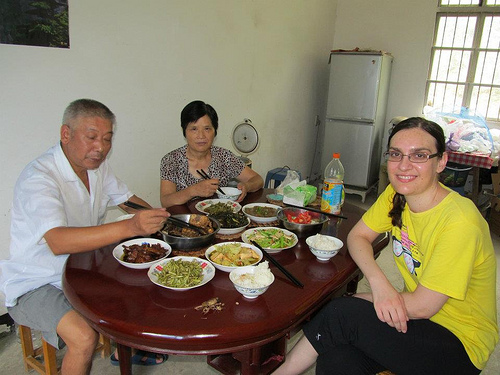
rp_6287663793_de769896c5.jpgMore than a week ago, my Chinese mother-in-law spent a whole day helping someone plant their rice paddy. That “someone” turned out to be a relative.

“She was out helping our Jiujiu plant the fields,” my sister-in-law told me at dinner. Jiujiu is the Chinese word for uncles on the mother’s side. But as far as I knew, we only had two uncles on John’s mother’s side — Da Jiujiu and Xiao Jiujiu. Neither of them needed assistance in the fields, especially Xiao Jiujiu who just became our village secretary. How could she possibly help someone called “Jiujiu?”

“Oh, that’s the godfather’s little brother.” Godfather, as in John’s godfather (John needed a godfather because his Chinese zodiac sign, the horse, conflicted with his father’s, the rat).

Then I remembered that, some time ago, my Chinese mother-in-law told me the godfather was a relative — but I’d forgotten how and asked my sister-in-law. “He’s the Gunainai’s son.”

“Gunainai?” I felt as if I was getting tangled in the branches of this family tree. Continue reading “The Chinese Relatives Name Game”

Ruzhui: When Chinese Men “Marry Into” Wife’s Family

A man falling upside down
Ruzhui -- where Chinese men "marry into" the wife's family and have the child take on her name -- turns Chinese marriage tradition upside down. (photo by Charlie Balch)

Before I even entered his apartment with John, my Chinese husband, I knew O’Neil – a close Chinese friend of John’s from middle school – had marital distress. But I never imagined that – among other things — it would have anything to do with a struggle over the next generation’s name. “At first, her parents demanded ruzhui,” he shared late Friday, May 27, as John and I sat side by side on a sofa in his apartment for one on Hangzhou’s West Side.

I raised an eyebrow at this strange Chinese word. “What’s ruzhui?

“You marry into her family, and your children have her name,” explained O’Neil. Unlike O’Neil, who came from the countryside, his wife was the only child of a proud Hangzhou family – a family that didn’t want their name extinguished in the next generation, just because they happened to have a daughter. It turned Chinese tradition — the woman marrying into her husband’s family and giving her child his name — upside down.

O’Neil documented far greater transgressions in their marriage (the parents bought them a car, but only gave their daughter a key; on an apartment deed, where they were required by law to write their son-in-law’s name and give him a share in the real estate, the parents gave him only one percent of the value). If anything, the suggestion to ruzhui was almost understandable in a Chinese sense – except that the parents hadn’t discussed it with him before the marriage. Continue reading “Ruzhui: When Chinese Men “Marry Into” Wife’s Family”

Ask the Yangxifu: British Woman with Chinese Husband Lonely in Marriage

The silhouette of a woman sitting on a stool, crying
A British woman, living with her Chinese husband in his isolated village, feels as if she's missing some emotional support and more. (photo by Glenda Otero)

Hainangirl asks:

Im from england and im 25 i have been married for about a year and a half to a chinese guy who is a year older than me.  I love him very very much and i trust him with all my heart but i can sometimes feel so frustrated with the way he shows his love. I know its a culture difference and his upbringing as he is from a very small village , and has lived a bit of a sheltered life.  Like i read in some of your articles about sex and love i had to teach him. the lack of eduction is also an issue when making big decisions or planning for the future.  I hate to feel like im unsatisfied with him but sometimes i need reassurance and comfort.  I have found the biggest problem can be him recognising my feelings.  He doesnt speak english but im fluent in chinese and i make it very clear how i feel and i try not to critise him as i dont want to affect his confidence.  It probably sounds so horrible that im moaning about him. We are very happy together and he compliments me perfectly but sometimes i feel uneasy.  I am alone in china and not only am I committing my life to him, but also his family and this island and if you have ever been here you will know that the people here are not used to foreigners and you feel a bit like an alien.  I feel i need more emotional support and comfort and reassurance about our future and our plans for a family.  How do i get that??? i also wants to know that he is happy with me, he very rarely talks about how he feels and this can sometimes make me insecure?  do you have any suggestions that could open him up a little. Continue reading “Ask the Yangxifu: British Woman with Chinese Husband Lonely in Marriage”

My Chinese Mother-in-law and the Ring of Compliments

Ring on a finger
When I complimented my Chinese mother-in-law's ring, I ended up with a ring of compliments -- to wear.

“I really like your ring, it’s beautiful.”

I couldn’t believe I had missed this lovely glint of silver on the left ring finger of my Chinese mother-in-law, etched in a black with a flower that seemed to burst with all the brilliance of the star of Bethlehem. That’s why I told her I liked it. I don’t believe in keeping a good compliment to myself.

She smiled, wrinkling the corners of her lips as she took her left hand out of the dishwater in the wok to show it to me up close. “Somebody made it in our village.”

She then told me about this metalworking place in town, where silversmiths can fashion such a ring from raw silver. “Do you want one? I can make one for you.”

Is a compliment really just a compliment to her? I wondered. Continue reading “My Chinese Mother-in-law and the Ring of Compliments”

One Chinese Woman Fears Marriage

Silhouette of a woman waking up from a nightmare
"I just had a nightmare -- I got married." (photo by Cathy Kaplan)

It’s no secret that women in China worry about getting married. Sometimes it’s because she’s approaching 30 – China’s unofficial expiration date for single women. Sometimes it has to do with parents and relatives raining that “why don’t you have a boyfriend?” question on her over and over again like neverending debris from Chinese New Year fireworks. And sometimes, in the case of my 22-year-old cousin Mei, the problem isn’t age or being a chronic singleton, but marriage itself.

“I don’t really want to get married. I’m afraid!”

Moments before Mei confessed her fear of an institution as integral to Chinese life as chopsticks and rice, I had told her she looked beautiful. Her navy-striped ruffle-trimmed blouse and khaki mini shorts accentuated her lovely Pippi Longstocking freckles, and she had long, creamy legs that could have stopped even high speed trains, perched atop patent leather high heels. If she had told me she had a boyfriend, I would have started teasing her about some imaginary hot date she didn’t have that evening. But she had no boyfriend, and no desire to find one either.

“Everyone around me is getting divorced,” she sighed.

“Who is getting divorced?” Continue reading “One Chinese Woman Fears Marriage”

Shui Tu Bu Fu: A Tale of Two Noses

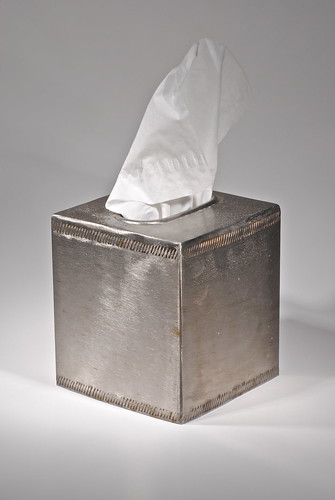
Tissue box
Tissue anyone? My Chinese husband has sneezing fits in the US, I have them in his family home in China. And our only explanation is shuitu bufu.

Atchoo! Atchoo! Atchoo!

There was my Chinese husband, having a sneezing fit right over our sink. I gave him the usual “bless you” and worried stares of a wife, wondering if this was the harbinger of a bad allergy day for him. And he gave me his usual prognosis on why he had this sneezing problem in the first place.

“In Zhejiang, I never used to sneeze like this,” John lamented, blowing his nose. “I miss the warm, humid air of Jiangnan,” that south of the Yangtze River region, the land of fish, rice and moist air  that included his own beloved province.

It sure didn’t help that, in 2008, we moved to a high desert area in the Mountain West of the United States — what you might term a land of tumbleweeds, dust and dry volcanic mountains. But even when we lived in Cleveland, Ohio, right on Lake Erie, my Chinese husband’s nose seemed to ignore the humidity and moisture, and just sneeze away in defiance. Even worse, his skin became so dry and itchy that he scratched out two pear-sized welts on both of his upper thighs. It took an entire year for those welts to disappear.

The Chinese have a saying for this: shuǐtǔ bùfú (水土不服). Continue reading “Shui Tu Bu Fu: A Tale of Two Noses”

My Chinese Husband, Almost Switched at Birth

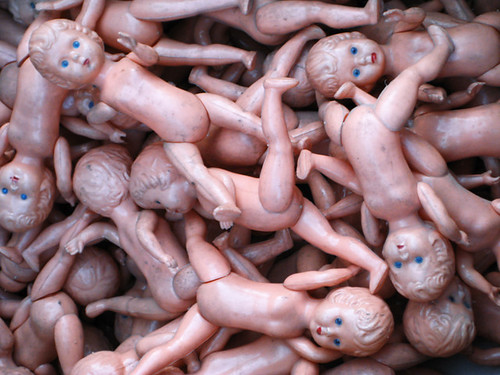
Some old dolls packed together
When my Chinese husband was born, the neighbors wanted to swap him for their baby daughter (photo by Onclebob)

When someone gives birth to a baby boy, you wouldn’t say “can we switch babies?” Unless, of course, you happened to be neighbors to my Chinese husband’s family.

As the third son in the family, John dashed his mother’s hopes of finally giving birth to a girl. Their neighbors had the opposite problem — they had just birthed another girl, the third in their family. So the neighbors came to John’s parents, with a different kind of indecent proposal.

The way my mother-in-law and father-in-law tell it, there was no question what they would do. “He’s our son, we could never give him away,” my mother-in-law declared emphatically at lunch one day, as my father-in-law nodded his head, adding how the neighbors “had a crazy idea.”

But what about the neighbors themselves? Continue reading “My Chinese Husband, Almost Switched at Birth”

Travel China with the Yangxifu: Mao Zedong’s Childhood House, Shaoshan, Hunan

Mao Zedong's Childhood Home, Shaoshan, Hunan Province
Chairman Mao's Childhood Home in Shaoshan, Hunan is a delightful pastoral retreat from the city.

Nestled in the sun-kissed hills of central Hunan, there’s an ordinary yellow mud-brick peasant house with a not-so-ordinary neighbor — a permanent People’s Liberation Army guard station.

That humble — and now fortified — abode was laojia (老家, home) to one of China’s most commanding (and controversial) figures of the 20th century: Mao Zedong.

In a China hell-bent on modernization and the the whole idea of “out with the old, and in with the new” (旧的不去,新的不来), Mao’s home offers a delightful respite from the usual concrete-block urban depression. Yes, delightful — even if you’ve sworn off the Chairman for personal reasons, or after reading Wild Swans (or, more likely, Mao: The Unknown Story).

That might be hard to believe when you’re touring his home. People’s Liberation Army soldiers had us bustle through in a neverending line of tourists, leaving no more than a moment or two to admire the wooden canopy beds, or imagine the fiery aroma of local Hunan dishes being cooked over the old-style hearth. (At the very least, the privilege of gazing upon the humble home of Chairman Mao comes gratis, in a China where, nowadays, there’s a price on everything.)

But then John and I rambled up a dusty trail above Mao’s home, between the terraced ponds and the fringe of forest beside us. Continue reading “Travel China with the Yangxifu: Mao Zedong’s Childhood House, Shaoshan, Hunan”

Ask the Yangxifu: Too Many Concessions for a Chinese Family?

Giving hands, turned towards the sky
Are we always the ones to concede a culture greater than ours, such as China?

Michael asks:

Jocelyn, I think its great you were brave and went ahead and appeased the cultural divide by participating in such a wedding [as described in the post A Big, Fat, Traditional Chinese Wedding?]. I’m sure your husband was appreciative. I would have been scared too. This type of thing always makes me wonder though about cultural traditions. Do we not have any in the U.S? Seems like we are always the ones conforming to appease a tradition that must be greater than our own? Is it because we just don’t value tradition as much?

I’m not saying its bad, I still commend you but when I read the answer and they said its not about you, it’s about the family I know a lot of girls who would of said GTH. It’s my day. hmm
Continue reading “Ask the Yangxifu: Too Many Concessions for a Chinese Family?”

The Dog Days of My China Summer

My husband John, petting Xigou, a miniature German Shepherd dog
My husband John gave Xigou one last pet before we parted last summer, never knowing it would be his last.

When John and I returned to his home in the countryside, we had a new voice — or should I say, sound — marking our arrival: a dog’s barking.

To be sure, this wasn’t exactly a welcome. The dog, who looked like a miniature German Shepherd, growled and bared its teeth, until my mother-in-law admonished him and shooed him away, to let us in the door. Well, he was only doing his job, as my mother-in-law put it: “He’s a guard dog.”

How could John and I have known then that the dog, affectionately known as Xigou, would become one of our favorite companions during the summer? We whiled away many a blissful moment just rubbing his belly or chasing him playfully around the yard. Even when we left John’s family home, we took pictures with Xigou and gave him one last belly rub, which caused the little guy to roll over excitedly many times.

But, for Xigou, it wasn’t all wanton pleasure, all the time — especially when John’s godfather, who had given the dog to John’s family, came over to see the dog. I once peered out a bedroom window, where I saw Xigou recoil timorously before the godfather, who then whipped him a couple of times — not for any obvious transgression by Xigou, but almost as if to remind Xigou of his subservience in the grand scheme of life there. Xigou yelped desperately, perhaps hoping someone like me or John would protect him from the pain. Continue reading “The Dog Days of My China Summer”