Chapter 83: Salad, But Not Safe

Salad with lettuce
When John, my Chinese boyfriend, refused to eat my salad, that moment was a window into one major difference between our culinary cultures.

One Saturday evening in Shanghai, I holed up in the kitchen with some long lost culinary acquaintances — angel hair pasta, ripe red tomatoes, and mesculin mix, with flavors that ranged from the bitter, toothy mizuna to the sweet baby lettuces. I wasn’t even close to being purebred Italian, yet for years, an Italian meal on the weekends was as important a ritual as evening mass at the Catholic church. It just wasn’t a week without our spaghetti and salad.

Well, in China, I had spent many a week without spaghetti or salad. And after discovering the foreign foods market just blocks away — the tawny olive oils, the deep balsamic vinegars, pasta, and even salad greens in a rainbow of colors and shapes — I schemed to dazzle my Chinese boyfriend with a taste of my childhood, and feed my thirst for something beyond the usual Chinese fare. Continue reading “Chapter 83: Salad, But Not Safe”

Chapter 64: Living in the Face of SARS

Doctor in a surgical mask
As a friend goes into quarantine, and the virus closes in on John's hometown in the countryside, I had to learn how to live with the threat of SARS, everyday.

I could have been quarantined.

One of the employees at Alibaba — the Internet company I interviewed at in Hangzhou — contracted SARS while attending the Canton Fair. On her second visit to the hospital, she discovered her illness was no typical flu. And just like that, everyone who worked in Alibaba — and other companies sharing the office building — was put under quarantine in early May, 2003, including John’s high school classmate, Douglas.

I wanted so much to stay in Hangzhou only months before, and work for Alibaba. Weeks after I moved to Shanghai and began work for the global media company, Alibaba even called to offer me the job — which of course I turned down. I came so close to this company. I could have been another casualty of SARS.

As SARS continued to spread, before long it began to touch the people you know and care about. Continue reading “Chapter 64: Living in the Face of SARS”

Chapter 49: Winter Showers and Different Living Standards

John warming himself in the living room of his family home in China's countryside
Living at John's home was different than what I'd known -- from showers to even the living room. But as I pondered the excesses of American life, I wondered -- whose standard is right?

Sitting on a stool in the bathroom, with warm water in a basin poured over my body, is the closest thing I’d ever get to a shower in John’s family home.

I’d been there for two days, and soon yearned for the familiar after-shower freshness — but didn’t know how to get it. “I desperately need a shower,” I confessed to John, my Chinese boyfriend. Not long after, he escorted me to the bathroom with a large, plastic red basin, filled with warm water, and a wooden, toddler-sized homemade stool. He placed the stool on the floor, where I crouched carefully to sit after removing my clothes. He ladled the water over me to wash away shampoo and soap — a fleeting burst of warmth to counteract the near-freezing air that surrounded us, even in the bathroom. Taking a shower never seemed so risky, and impractical. Continue reading “Chapter 49: Winter Showers and Different Living Standards”

Chapter 48: The Pressures of an Unmarried Chinese man in the Countryside

Chinese man holding a little baby
I wondered why Er Ge, John's second oldest brother, was so painfully quiet. Learning his story was like a window into the pressures of young unmarried Chinese in the countryside.

John’s second oldest brother, Er Ge, was like the wallflower of Chinese New Year at the family home in China’s countryside. He usually lingered in the corners with a slight hunchback and frightened, delicate eyes, like a fragile little sparrow hoping to escape the marauding glance of humans. There was a quiet, impenetrable sadness that clouded his personality, and somehow, I couldn’t get past a Ni Hao to really know the man within.

Only 26 years old, he was the only brother who still lived at the family home. He didn’t care much for study, only finishing Junior High and then going on to become an itinerant worker in the countryside, doing odd jobs for relatives and friends. But none of this seemed to explain why Er Ge withdrew from the world.

So I asked John one evening, as we sat around the hot coals and watched Chinese television. Continue reading “Chapter 48: The Pressures of an Unmarried Chinese man in the Countryside”

Chapter 47: A Picture of My Chinese Boyfriend’s Family

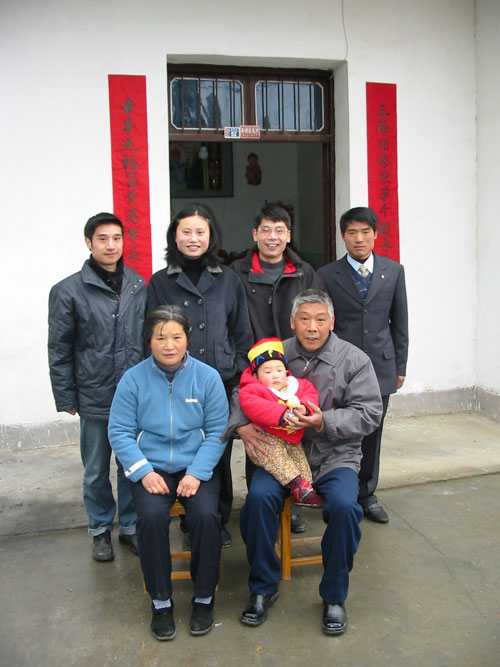
My Chinese boyfriend's family, at their countryside home
Even as I shot a photo of John's family, I still didn't see have the entire picture of his family -- until I showed them pictures of my own.

In China, they call a family picture 全家福 (quanjiafu), which literally means happiness for the entire family.

It is happiness if you can have the entire family together to take a photo. And, in John’s family, this happy day usually comes during Chinese New Year, when the whole family returns home to celebrate.

The whitewashed facade of John’s family home reflected the filtered sunshine that afternoon of Chinese New Year’s day, brightening the yard like backdrop lighting in a photography studio. It was a perfect spot for the family photo, where John’s father and mother sat in front, holding baby Kaiqi, with the three brothers and sister-in-law standing behind. I stood before them all, digital camera in hand, as I framed the family through the lens for the perfect photo. I snapped several shots, including one of just Da Ge, his wife and baby Kaiqi.

Even as I finished taking the photos, I still didn’t have a clear picture of John’s family. No photo is complete without the stories behind it. I didn’t know the real stories from John’s family, because we hadn’t truly connected since my arrival. Instead, my time there, up until that afternoon, was like an unnarrated slideshow, where the outside observer could only guess what was happening.

But, sometimes, to get the full picture, you have to give a full picture in return. Continue reading “Chapter 47: A Picture of My Chinese Boyfriend’s Family”

Chapter 46: Cold Nights in the Chinese Countryside

Western woman in Chinese countryside, during Chinese New Year
I never felt such a bitter cold until I went to my Chinese boyfriend's hometown in the countryside -- because I was too embarrassed to say I needed more warmth at night.

“The worst cold I ever knew was winter in Hong Kong.” I didn’t understand those words, spoken by a woman who taught English there before China opened up. She shared her experience in China with me as I prepared for a year of teaching English in Zhengzhou. But as I smiled and nodded, the idea nagged me — how could Hong Kong, on China’s Southern coast, be so cold?

The thing is, any place can feel bitterly cold in China — if there’s no warmth in the home.

John’s family home in the winter was fast becoming the worst cold I had known. The house, with most of its doors and windows cracked or wide open to the elements, had no central or room heaters. We spent our hours huddling around giant woks filled with hot coals to fight off the nip of near-freezing temperatures, which felt even more frigid because of the moisture-laden air of this humid climate, South of the Yangtze River. I wrapped myself my long down jacket all day — indoors and outdoors — just like everyone else, as I remembered how, back in the US, people would have thought me strange or even impolite not to take my jacket off, as a guest.

But, most of all, those parental misgivings of months before seemed to chill my heart: “It’s okay to be friends with a foreign girl, but not to date her.” No matter how many warm vegetarian dishes they placed before me, or how much money they stuffed into my hongbao, I remembered the reality — John defied them in bringing me here. And if I complained or troubled them too much, I might just be left out in the cold, never to be John’s girlfriend, and never to return. Continue reading “Chapter 46: Cold Nights in the Chinese Countryside”

Chapter 45: Paying Respects and Pondering Family

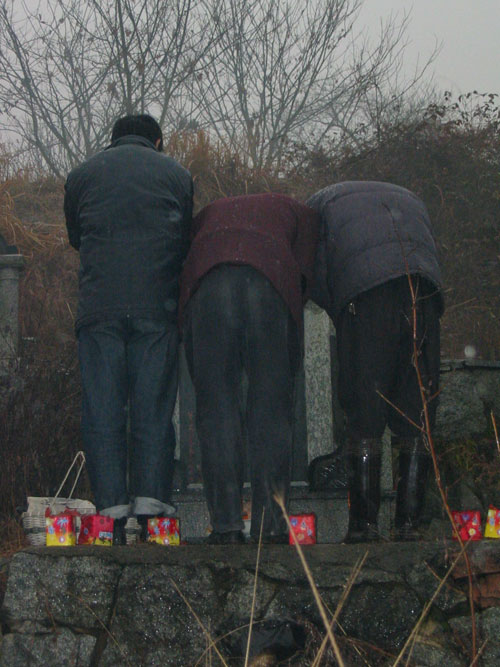
paying respects to Chinese ancestor, at their grave
I followed John, my Chinese boyfriend, and his two older brothers as they paid respects at their ancestor's grave. As I stood aside and took pictures, I wondered just how close -- or how far -- I was from their family.

The afternoon after I arrived at the family home of John, my Chinese boyfriend, for Chinese New Year, we needed to visit his grandmother. John and his two older brothers — Da Ge and Er Ge — prepared a basket with three fried dishes, rice, bottled water and fruit, as well as a little money, firecrackers, candles and incense. I followed them along with my camera and curiosity — because this grandmother was dead.

John’s family continued a Chinese tradition perhaps as old as the Chinese themselves — to show reverence for their ancestors, especially during major holidays. Even the entranceway to John’s home told the story of ancestors. Three framed black-and-white portraits — John’s paternal grandfather, paternal grandmother, and paternal great aunt — hung solemnly above a day-glow painting of Huangshan, where John’s ancestors are from.

As the rain fell like the tears of graveyard mourners, John, his two older brothers and I hiked through muddy terraced fields, up into the hill where his grandmother’s grave was. It looked like a tiny marble throne, with flourishes on the top and sides, and the grandmother’s name, date of birth and death, and a listing of all the generations that followed her. Continue reading “Chapter 45: Paying Respects and Pondering Family”

Chapter 44: Finding Comfort In a Strange Chinese Countryside

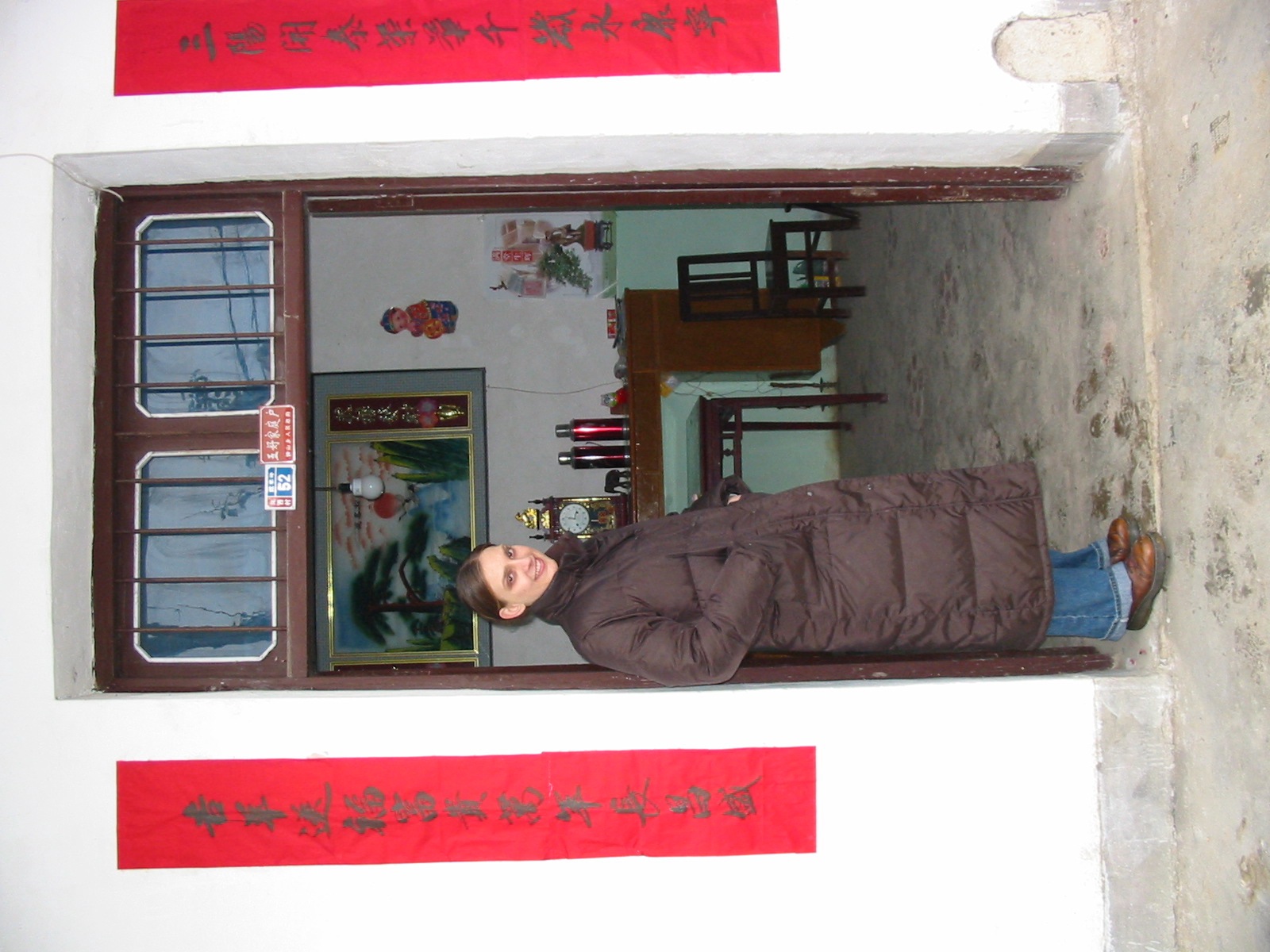
Standing in front of my Chinese boyfriend's countryside home, with his mother
I felt like an anachronism visiting my Chinese boyfriend's countryside home for the first time, with everything so strange to me. (Pictured: me in front of the home, with his mother)

By the end of January, 2003, I had lived in China for more than two and a half years, spoke fluent Mandarin Chinese, and had John, my Chinese boyfriend. It’s easy to believe you know China, that it feels familiar and comfortable when you settle in one place, and have close loved ones by your side.

But the Chinese know better. Lin Yutang once wrote that the happiest thing for a Chinese is to return to his hometown, and speak in his local dialect. Outside of their home region, even a Chinese could feel like a foreigner, lost in a world where no one speaks their home dialect, or eats the local delicacies they loved as a child. Sometimes, you only have a cross a mountain or two in China to find yourself in a completely different world.

John and I crossed many a mountain to reach his village in the countryside of Tonglu, and I couldn’t have felt more strange. I was already a stranger to his parents. But I also faced a home and village that was like nothing I’d known before — even in China. Continue reading “Chapter 44: Finding Comfort In a Strange Chinese Countryside”

Chapter 43: Going to John’s China Hometown

Mountains in the countryside of Zhejiang Province
John's ancestors come from the area near Huangshan -- one of China's most impressive mountains. But his family lives in a countryside ravaged by economic development, worlds away from what his ancestors knew. (pictured: me before the fields opposite John's home, Chinese New Year 2003)

“五岳归来不看山,黄山归来不看岳” — After China’s Five Sacred Mountains, you needn’t see another mountain; after Huangshan, you needn’t see China’s Five Sacred Mountains.

John loves this expression, and has told it to me many times in our relationship. There is truth to it. Huangshan is an impressive mountain, and has a greater scale than China’s Five Sacred Mountains — Songshan, Hengshan, Hengshan, Huashan, and Taishan. But many would argue that the Five Sacred Mountains have their own beauty, and a beauty worth seeing, even if you have visited Huangshan. I don’t mention this to John, because I know his words say more about him than Huangshan. He loves Huangshan, because his relatives lived in the shadow of its enormous spires. His people are mountain people, and come from a mountain that claims to overshadow the rest.

Though he didn’t grow up at the feet of Huangshan, he was born and raised in the mountains just southeast of Huangshan. On the top level of a double-decker bus, on a sultry summer evening in 2002, he turns to me and speaks of the beauty of the mountains in his hometown. “My hometown is a tourist destination,” he says proudly. He tells me it is Tonglu, but I have never heard of it. “We have mountains, rivers, and caves,” he says. And then he smiles gently and adds this: “You’re welcome to visit anytime.”

I don’t visit his village until six months after that — during Chinese New Year, 2003. Continue reading “Chapter 43: Going to John’s China Hometown”

Chapter 42: New Clothes for Chinese New Year

Chinese tangzhuang silk jacket
I wanted a new beginning in Chinese New Year. So, I made an outfit to make a good impression on John's parents, and, later, a new job.

In Chinese New Year, wearing new clothes means a new beginning. Before Chinese New Year in 2003, I desperately needed a new beginning — because I’d lost my job at the Chinese Internet Company, and I was about to meet John’s parents.

After the remark from John’s father — that foreign women make good friends, not girlfriends — I needed something to make a fresh start with his family. That’s what I told Caroline, my Chinese friend, days before John and I would travel to his countryside home. We had just had dinner together that evening, and on our post-meal stroll, came across the tiny, brightly-lit store of a tailor I knew all too well.

My eyes twinkled like a child before the tantalizing toys in a Christmas store window display. “She’s the one who made my qipao.” The same qipao I wore for my birthday celebration the summer John and I fell in love. “Let’s go inside and take a look.” Continue reading “Chapter 42: New Clothes for Chinese New Year”