

Chapter 15: Climbing Back Into Love With John

John brought me to Tonglu, his hometown in the Chinese countryside, to climb Daqi Mountain. If only I knew I’d have to do more than just climb the mountain — I’d have to climb out of the mess I created this morning.

John didn’t see the best of me on that bus, complaining about the indirect, circuitous route, the precipitous driving, the secondhand smoke, the unpredictable pickups and drop-offs. It was only a couple of hours — why did I say anything at all? After my display of intolerance and impatience with China, did John wonder if the girl he fell in love with — the girl who opened herself to China, who wanted to understand — was still there?

As we sat down at one of Tonglu’s restaurants, dining on a feast of vegetarian delicacies for lunch, I laid myself out — with all of my flaws — like the dishes before us. “I’m so sorry about this morning. I don’t know what I was thinking. I may have been here in China for two years, but I don’t understand everything. I should have been more understanding.” I exposed myself for what I behaved like: a foreigner who only saw the shadows of China. But all I seemed to eat during lunch was shame, and the deep, persistent feeling that I was pushing John away. Continue reading “Chapter 15: Climbing Back Into Love With John”
Chapter 14: The China Road of Misunderstanding

I really want to be on the new highway leading to Tonglu, John’s hometown in the Chinese countryside. The smooth concrete is perfect, unblemished by potholes or cracks. Each side of the highway has a new guardrail, with newly transplanted trees beside it, propped up by four wooden supports and rope tied around the trunk. And on the highway, a bus cannot stop to pick up new passengers — it must go nonstop to its destination, so the passengers know when it will arrive. It is China’s future, right next to me.

I, however, am currently in the present on this Sunday in early September, 2002

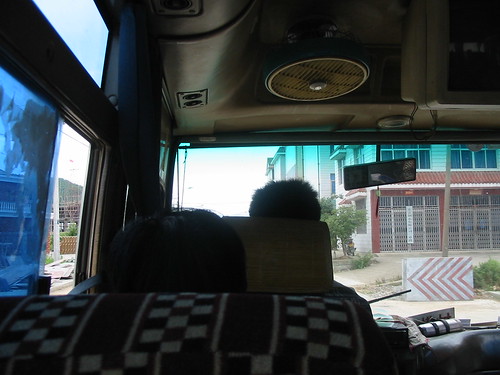
The present is a rickety minibus on road etched with cracks and potholes — as the minibus hits them, the feeling becomes amplified through the floor and seats like a cacophonous sound in an auditorium. Everything on the bus, from the exterior to the furniture, is stained by a brown veneer, like the patina of a dirty teacup.

The bus rambles along this road next to the highway — stopping every now and then to pick up a passenger, or drop someone off — and with each passing moment, my patience rambles along towards anger. Continue reading “Chapter 14: The China Road of Misunderstanding”

Chapter 12: What is Buried Beneath Our Hearts, and Lakes, in China

Chinese poets once praised the Xin’an River in Zhejiang Province as a mirror, so clean and clear you could see the bottom. But the Xin’an River is no more. It was dammed in 1958 to create 1,000 Island Lake, where John takes me in August 2002 to visit the country of his ancestors.

His ancestors, and all of the beauty that inspired the poets, are buried beneath 1,000 Island Lake. But we are interested in one ancestor in particular — John’s grandfather, who died in 1948, the same year John’s father was born. This grandfather never saw Communist China or 1,000 Island Lake, only knowing the clarity, the lucidity that was Xin’an River. Maybe he is lucky for that.

“I once tried to find my grandfather’s grave,” John confessed. “I rowed all around this one area, the area where he supposedly was buried. But I never found it.” Today, we hope to find his grandfather’s grave, because John, like many Chinese, still believes in ancestor worship, in the importance of the connection to his past. We only hope it isn’t lost for good.

But we are lost on the lake. Continue reading “Chapter 12: What is Buried Beneath Our Hearts, and Lakes, in China”

Chapter 6: I’ll be watching you in China

There stood John, my Chinese coworker, in front of our office building, just as he promised moments ago. “I’ll be watching you in the bus.”
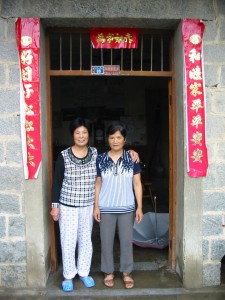
Would he really still be there after I boarded the bus downtown, the bus that took me to the gym where I exercised many evenings? It was a thoughtful sentiment, but one I’d never heard before. Was this just another joke, the same jokes I’d heard before when sitting with the translators? I turned the corner before the intersection, and walked north a few meters to the bus station, wondering who I would see before our office building.

But there he was, motionless, and awaiting my safe passage, as if I had just boarded the slow boat for North America. It was as though John had all of the time in the world, as long as it was for me. The John I came to know was not just any Chinese man.

John didn’t just stand up for me — he stood up for his village, as he told me one afternoon. Continue reading “Chapter 6: I’ll be watching you in China”

Of China’s Countryside Bachelors, and One Chinese Man’s Divorce

Er Ge in Yaolin Cave in Zhejiang Province, less than a year after his wife abandoned him.

Er Ge, my second-oldest brother-in-law, wanted to marry for life.

His bride in 2005 was a lovely, lithe girl of 18 from Guizhou who worked in a local sewing factory, often evenings. I never forgot her almost ubiquitous smile in my presence. It was inscrutable, a smile that remained far too long to be just about happiness.

Mysterious smile or not, she must have made Er Ge happy, or at least relieved.
For years, his mother had fretted over finding him a wife — not easy, given the distorted sex ratio, especially in the countryside. Er Ge’s own personality added challenges. He was always the wallflower of the family, parsimonious with his own words, as if they were a precious currency. It took years before I even held a bona-fide conversation with him. But Er Ge’s mother didn’t want him to take years before he understood romance. So, following in a long tradition of mothers who arranged marital affairs for their sons, she made inquiries in town, and eventually found him a bride. He would be the last of the three brothers to be matched.

Er Ge is a peasant, and still resides in his family home, so they held the celebration at home too. He donned a black polyester suit and tie; she dressed in a white Western-style tulle wedding gown with roses in her flowing black hair.

She may have looked like a fairytale bride, but there is no fairytale ending here. Continue reading “Of China’s Countryside Bachelors, and One Chinese Man’s Divorce”

For Many of China’s Rural Residents, Health Insurance is Not Enough

This is the first in a four-part series of articles providing a snapshot of modern life in China ahead of October 1, 2009, the 60th anniversary of the founding of the People’s Republic of China. It was published September 20, 2009 in the Insight section of the Idaho State Journal.

————

Peng Qiulan and Jin Genxiu, like most residents in China's countryside, have rural health insurance policies that only cover a fraction of their medical costs

Zhongshan, Tonglu County, Zhejiang, China — In a old wooden home hidden behind Zhongshan’s main street is a place where Ye Xianna, my husband’s 76-year-old grandmother, is quietly putting her trust in Jesus — to protect her against illness.

After sitting with for nearly four hours in the rows of turquoise-colored pews that felt like tiny park benches — witnessing speaking in tongues, singing hymns in Chinese, and preaching on the virtues of Christianity — it was one of the congregation who spoke the most important reason why Ye, like many others in the church, was present that morning.

A senior man in a tan-striped polo shirt and oversized brown pants, with squinty eyes, stubble and a mostly toothless smile, stepped behind the turquoise podium with a blood-red plastic cross attached to it, and began addressing the room.

He was speaking in the local dialect of Tonglu — one of the thousands of dialects in China that sounds different from the country’s official Mandarin Chinese — so I couldn’t understand his words, at first. “What is he saying?” I asked Ye, sitting next to me in the pew in a flowered blouse and pants, with her wiry, shoulder-length gray hair tied into two pigtails.

Ye, whose local dialect is better than her Mandarin Chinese, explained it to me as simply as she could: “His arm used to hurt. Then he believed in Jesus, and it stopped hurting.”

Her simple words spoke a powerful idea: that Jesus heals, literally.

And for many churchgoing senior citizens in China’s countryside, like Ye, it’s the one thing they can count on in the face of a rural healthcare system that is still far from ideal. Continue reading “For Many of China’s Rural Residents, Health Insurance is Not Enough”

How my Chinese mother-in-law cured a mentally ill chicken

At my inlaws’ home, I didn’t take much notice of the chicken habitually roosting in the corner of the room next to the kitchen. Chickens have free run of the first floor of the house (which means we have to watch where we walk) and even have their own sleeping corner.

But my Chinese mother-in-law did notice that chicken, and she didn’t like it one bit.

“It keeps sitting there in the corner, but it won’t lay eggs!” she exclaimed in her booming voice — a voice that is pretty normal out here in the countryside, but would border on argumentative if she were speaking in English.

A few days later, I discovered the cure. Continue reading “How my Chinese mother-in-law cured a mentally ill chicken”