John never looked more upset the moment I lifted our artificial Christmas tree — up and out of the living room.
“What are you doing? Don’t move that,” he said.
“But it’s embarrassing,” I said, not glancing back at him as I carried it into our bedroom. “Just think if our guest saw it.”
“Nobody cares, just leave it out.”
“Look, this isn’t just another Chinese New Year decoration you just hang up all year long.” I glared at him as I said it, the kind of glare that says, “Don’t even try winning this argument.”
Outside, the sun’s rays turned the field across from our place into a shimmering green, where the crack of baseball bats and the barking of dogs trailed by owners in shorts and T-shirts reminded me the holidays had long gone. But you wouldn’t know it by the Christmas tree, stockings and string of holiday lights in our home — decorations that, to my Chinese husband, deserved a place in our home the entire year, just like the red couplets or “Good Fortune” characters decorating the homes of most Chinese. Continue reading “From Chinese New Year To Christmas in July?”
Ah, wedding rings. Whenever I see an ad for them on TV, I immediately shout out “Hūnjiè,” (婚戒), the Chinese word for this most intimate of all jewelry, and then shoot my husband a grin. He usually laughs and nods at what’s become our husband-wife running joke — that I still have no wedding ring, and John still “owes” me.
This isn’t some post-wedding inner Bridezilla of mine coming out, as if I enjoyed putting my husband on a guilt trip for all the ways our wedding never lived up to expectations. No, as weddings go, I’m pretty happy over how we tied the knot and wouldn’t change a thing. I’ve never even pressured him about buying things; if anything, I’m the one usually clamping down on our family budget, and he’s the one encouraging me to “reward myself” with something I really wanted. Still, behind this running joke of ours remains a real promise — that, someday, he hopes to buy me the perfect wedding ring. Continue reading “How My Husband Embraced My Wedding Ring Tradition”
Sometime in April, I watched in horror as my husband pulled his shirt up. Sure enough, the rash had migrated across his chest up into his armpits, and even his shoulder.
“Oh, Sweetie,” I said to him. “I’m so sorry to see you this way.” I rubbed lotion all over the rash to soothe it, though I knew that as long as the pressure remained, the rash would only move once again.
In Chinese, he always called his condition shénjīngxìngpíyán (神经性皮炎), sensory neurodermatitis. Over the years, I came to know this — along with those sudden stomach aches John would get before a challenging day at school, and even his allergies — as a sure sign of my husband’s stress or anxiety.
I can count on one hand the times I’ve seen John cry, an emotional response that I pull out at least once a month — and sometimes, in the past months as we faced pressure from the discrimination, at least once a week. The strongest emotion I’ve seen from John would be what I might call frustration, but even that’s nothing compared to the anger I’ve flashed before him in the past. Instead, I read how John really feels through things like his spreading rash, or his stomach aches — things he referred to as somatization, the channeling of emotions into physical symptoms. Continue reading “Somatized”
…some of the most successful love stories in China touch on similar themes, catering to “Chinese audiences’ psychology of a normal male hungering for the touch from a ‘fairy.’
The theory behind the film’s draw stands in stark contrast to urban China’s increasingly money-driven marriage culture, in which many men complain that without a house and a car they have little chance of attracting a woman’s affections, or her parents’ approval.
When I read this, I had to wonder — was the attraction of Western women to Chinese men also a sort of reverse-Cinderella tale, in a sense? Maybe most Chinese men with dreams of a yangxifu aren’t as poor as penniless Jack Dawson who rode in the third-class section of Titanic. But perhaps the cache of having a Western wife, of a woman who could open up opportunities to him (such as study or work abroad, or more), could work like a reverse-Cinderella story to some men? Continue reading “Titanic’s Reverse-Cinderella Story and the Appeal of Western Women to Chinese Men”
I’m sure I heard that sound this past Friday, after a phone call closed one of the best options for my husband’s internship. The person in question echoed much of the same discrimination we’ve known from the past. It sent me reeling for much of the evening, and well into Saturday.
Maybe it hurt me harder because I considered this person’s very emergence a miracle. That kind of “hey, someone else actually believes in my husband too” sort of feeling. But the person turned out to be nothing more than a mirage, and so were the opportunities.
Still, even if they’re not real, mirages can sting. I should know, because I came this close to just giving in, just saying, “To hell with it, maybe they were right all along.”
But yesterday, I donned my Red Army cap, the very one I bought years ago on a trip to Chairman Mao’s hometown of Shaoshan, Hunan, and headed outside with my husband to kick around a soccer ball in an empty soccer field nearby. Continue reading “The Miracle of the “Long March Spirit””
Some of the best creative works about Chinese men and Western women in love came from Western women who never once had a Chinese husband. I’d like to salute five of these women, who in my opinion will always be honorary yangxifu (foreign wives of Chinese men).
Pearl S. Buck
Pearl Buck didn’t just make her mark in the literary world with her novels about life in China — she also was one of the first to write about love between Chinese men and Western women in East Wind: West Wind. Pearl married twice, both white American men, but some allege she was a secret lover of the famous Chinese poet Xu Chimo. Maybe her supposed affair inspired some of those on-the-page Chinese man-Western woman romances? Who knows, but she’ll always be the ultimate honorary yangxifu in my book. Continue reading “Yangxifu Pride: 5 Creative Women Who Should Be Honorary Yangxifu”
I want to be the kind of yangxifu who can shove it all aside and find the strength to churn out another Ask the Yangxifu, Yangxifu Pride or even Mandarin Love. But I can’t right now. To be honest, I’ve spent most of this week oscillating between a kind of “don’t worry, everything will be okay” mindset to outright fear, terror and the tears that come along with it all. Most days I’ve cried, some more than others. And just when I find a small patch of hope — something that gives me a sense that maybe, just maybe, this will turn out all right — it gets stamped out by another goon. Continue reading “The Discrimination Continues, But I Need A Break (Today)”
You might call it “lust in translation.” This Chinese-English online quiz, one I agreed to do complete well before I met John, turned into a perfect excuse to visit John a little more often at work. I translated the English words into Chinese, and then brought my work over to him for proofreading. Sure, in between our “how do you say”s and “zenme shuo”s, we flirted a little. But we also learned something too, more than just the right way to say rainjacket or maozi. We made a pretty awesome translation team.
Nearly eight years later, we still help one another with language and translations. John’s my go-to guy for Chinese when I’m stuck on translating a word, and I’m the one he calls on to give his English writing a final check. One week, he tells me about a new Chinese idiom; the next, I’m explaining a new saying in English. You might say we’ve re-written that old cliche — now, the couple that wordplays together, stays together. Continue reading “The Couple That Wordplays Together, Stays Together?”
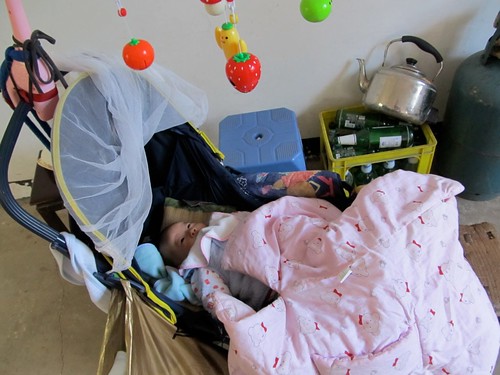
My sister-in-law's baby and the mobile that almost got broke
It’s not polite to tell a guest they shouldn’t do something. I learned this rule only hours after I broke it at my Chinese in-laws’ home.
The next-door neighbor happened to come over, a tiny grandmother with short curly hair and a face that reminded me of Squiggy from the sitcom Laverne and Shirley. As usual, she came in holding her 10-month grandson, a kid nearly one-third her size who looked so big, I wondered why he hadn’t walked in on his own. She stood with her grandson in the foyer of our family home with Laoma (what we call my mother-in-law) and Wenjuan, my sister-in-law.
Most evenings, I wouldn’t notice the guests, but this evening was different. She happened to come during dinner. And this dinner happened to be interrupted by Laoba (what I call my father-in-law) when he told me the pair of flip-flops I sunned outside had dried. I put my chopsticks down to take the flip-flops back to my rooms upstairs, and then returned to the dining room.
This website uses cookies to improve your experience. We'll assume you're ok with this, but you can opt-out if you wish.AcceptRejectRead More
Privacy & Cookies Policy
Privacy Overview
This website uses cookies to improve your experience while you navigate through the website. Out of these cookies, the cookies that are categorized as necessary are stored on your browser as they are essential for the working of basic functionalities of the website. We also use third-party cookies that help us analyze and understand how you use this website. These cookies will be stored in your browser only with your consent. You also have the option to opt-out of these cookies. But opting out of some of these cookies may have an effect on your browsing experience.
Necessary cookies are absolutely essential for the website to function properly. This category only includes cookies that ensures basic functionalities and security features of the website. These cookies do not store any personal information.
Any cookies that may not be particularly necessary for the website to function and is used specifically to collect user personal data via analytics, ads, other embedded contents are termed as non-necessary cookies. It is mandatory to procure user consent prior to running these cookies on your website.

 John never looked more upset the moment I lifted our artificial Christmas tree — up and out of the living room.



 . Pearl married twice, both white American men, but some allege she was a secret lover of the famous Chinese poet Xu Chimo. Maybe her supposed affair inspired some of those on-the-page Chinese man-Western woman romances? Who knows, but she’ll always be the ultimate honorary yangxifu in my book.