Chapter 27: I Don’t Need Your Mianzi

Character for good fortune
I didn't need mianzi from the family of the famous calligrapher, Tang.

Tang, the famous calligrapher and painter, and his wife, Zhang — my next door neighbors — lived a world as intentional as the eccentric style of Tang’s calligraphy scrolls that decorated the walls of their apartment. Tang painted and wrote calligraphy, often for dignitaries, officials, the elite — and they reciprocated lavishly. How did I know? Because Zhang told me, whenever I saw her in the hallway between our doors.

Renjia songde — a gift from others,” she would tell me, her lips pursed smugly as she held up the latest swag — from Amway vitamins to the expensive, first harvest green teas, all from the endless stream of guests that the couple entertained most weekends. Sometimes she would blather on about a free trip somewhere, such as an upcoming visit to Huangshan that included a river cruise.

Personally, I didn’t need Zhang — or even Tang — to talk about all of their gifts or free trips or extra apartments in the city. I already respected Tang as an artist. He was the one who memorialized my first date with John at the West Lake, in a painting. But I suspected Zhang couldn’t help it — as the wife of a famous artist, his fame and glory was all that she had, and all that she could feel proud of. There was a sad, lonely woman behind the swag. So I would stand there, smile and nod, as if I was a parent who knew better, listening to a child.

But I could do more than listen. Continue reading “Chapter 27: I Don’t Need Your Mianzi”

Chapter 26: Hello, Foreigner – and Goodbye, Generosity

Western woman hiding behind a mooncake box
Sometimes, you misunderstand China, or China misunderstands you. And all you can say is, I'm sorry.

As October 2002 went on, I fell deeper in love with my Chinese boyfriend, John, and found a new sense of belonging through lunches with Zhang Bin.

Yet, was I just fooling myself, to think I could masquerade as a local? I am a foreign woman. My face, hair and larger, curvier body made me a curiosity, no matter how standard my Mandarin pronunciation was.

I wasn’t a curiosity to Jason, an old college classmate of John’s that we met during the National Day holiday, on the way to our favorite restaurant near my apartment. I had met John’s xiongdi — “brothers,” or close friends — once before. Ever since then, I loved knowing anyone with a connection to John, and Jason seemed nice enough. We exchanged phone numbers, with the suggestion we might meet for lunch sometime. “I could practice my Chinese with him,” I whispered to John, as we walked in the other direction down the street, after meeting Jason. Continue reading “Chapter 26: Hello, Foreigner – and Goodbye, Generosity”

Chapter 25: No Chinese, No American, Just Lunch

Stir-fried chinese vegetables
John, my Chinese boyfriend, wasn't the only one who could make me feel less foreign in China.

When you have a Chinese boyfriend, you have a strange sensation, perhaps the first since your arrival to China — that maybe you’re not so foreign, or so different. The way John spoke to me, and cared for me, made me feel — if only for a moment here and there — that we were equals.

Yet after he left, I began to see that it wasn’t just John who had the capacity to see past my foreign face.

“We shouldn’t see each other as a Chinese and an American.” Those were the words of Zhang Bin, a friend who lived across the street from our office — and who agreed to make lunch with me during the weekdays.

Lunch had been a headache for me ever since I entered the company. The boxed lunches delivered daily to the office were too greasy, and had few vegetables to satisfy a vegan, driving me to find lunch alternatives outside the building. I found them in a variety of restaurants — from a local Zhejiang specialty restaurant to a Japanese noodle house — but usually had to enjoy lunch alone. Continue reading “Chapter 25: No Chinese, No American, Just Lunch”

Chapter 24: Tied in Chinese Knots over John

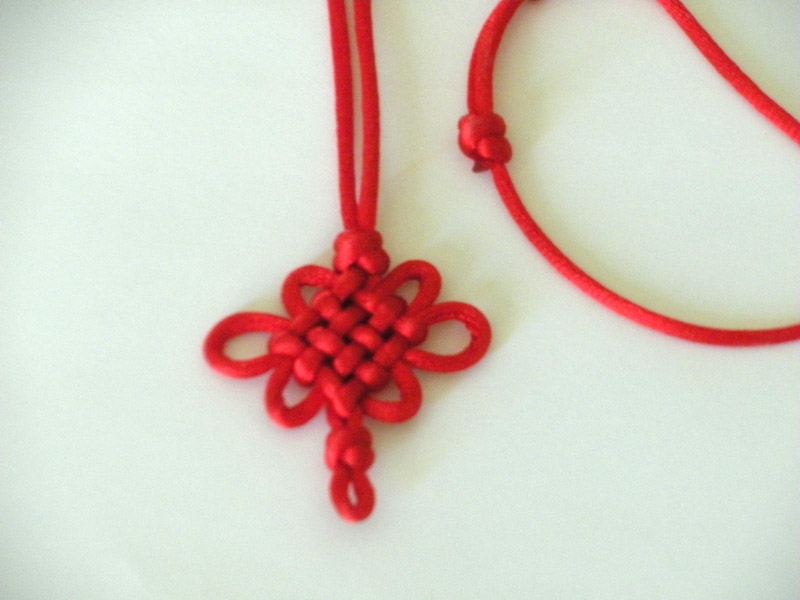
Red Chinese Knot
I was getting tied up in knots over my relationship with my Chinese boyfriend, John, when I never needed to. (Photo from Wikimedia, shot by Ucla90024)

As John, my Chinese boyfriend, and I spent more time together, it was as if we were creating a Chinese knot of our own, promising forever — a forever I had never known with anyone else. And I was tying myself up in knots, because in the world I had known before — where love came and went as effortlessly as the rain across the West Lake in Hangzhou — forever seemed so hard to find, and so hard to believe.

I found solace in my Chinese friend Swallow, one of the translators, a “spicy Sichuan girl” who knew John too. She gave me one of her easy smiles when I told her of my worries, and the experience I had with him during National Day. It was as if she had to laugh at all of the ridiculous mental knots I had created. Continue reading “Chapter 24: Tied in Chinese Knots over John”

Chapter 23: The Sound of Silence in Love

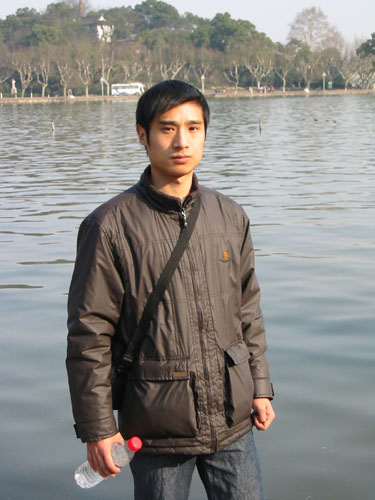
My Chinese boyfriend, John, by the West Lake in Hangzhou
My Chinese boyfriend, John, became increasingly quiet, and I wanted more words, instead of more silence.

In Chinese, you can say so much, with so little. Four-character idioms could say what a sentence or two in English might. One character could even do the work of a short sentence or sentiment.

But sometimes simplicity invites questions — when one character could mean so many different things. Think about the character 到 (dao). Depending on how you use it, it could say: arrive or reach; to go to; up until, or up to; or thoughtful.

After spending several days touring Beijing with John, our conversations went from so much to so little, where silence filled more of our moments, as if our relationship, like one character, could say more than so many words.

Yet, despite our understanding, I longed for words. I found strength and security in John — in us as a real, lasting couple — through words. Without them, questions began to fill in my mind as we passed National Day together. Continue reading “Chapter 23: The Sound of Silence in Love”

Chapter 19: Only Mandarin-Speaking Foreigners Belong in China?

Western woman sitting with Chinese graduates.
Are Mandarin-speaking foreigners the only ones who can integrate into China? Or will foreigners always be foreigners no matter what (and stand apart from the crowd)?

Even in a city as large as Hangzhou — with over 6 million people — it’s hard to escape your past. My ex-Chinese boyfriend Frank still sat next to me at work in the Chinese Internet company. And far across the West Lake sat remnants of my ex-life in Hangzhou, when, in 2001, I endured four months in an international NGO struggling to be a technical writer.

I wanted to leave that place behind, because, like Frank, it left me with painful memories. A dictatorial Chinese director who blocked me from doing the writing I was hired to do. A European roommate who harassed and humiliated me, in an effort to drive me away from our coworkers. Poor facilities, from the broken washing machine to the dank, windowless basement kitchen filled with crickets. The only thing I could be proud of was that I managed to survive for four months.

So when Camille — a new European volunteer at the NGO — got in touch with me, it was like getting a call from an ex that I wasn’t even sure I wanted to talk to again. Continue reading “Chapter 19: Only Mandarin-Speaking Foreigners Belong in China?”

Chapter 18: The Parts of My Chinese Boyfriend Left Behind

Picture of Chinese boyfriend
Even though my Chinese boyfriend, John, was going to Shanghai for graduate school, what he left behind warmed my heart.

More than a month ago, John’s duffel bag mysteriously appeared in my apartment — as he moved in with me. Now that blue duffel bag had turned into a maroon wheeled suitcase we bought at the corner supermarket, and that suitcase would be leaving with John for Shanghai. There was no mystery in it — John was going into a master’s program in psychology at a university in Shanghai.

We had our official sending-off dinner at the formal dining room in Hangzhou’s Town God’s Temple, perched on a hill just above Wushan Square. As we walked up the winding trail to the restaurant, weaving in and out of the shadows of pine and oriental plane trees, I sang “Rainbow” by Yuquan, a song that had become ours ever since John gave me the CD with it on my birthday. Yuquan was John’s favorite Chinese rock group, and now I was using the music he romanced me with to romance him back.

But, even as I sang to John — in the music John loved best — he wore a salmon, Italian-style buttoned shirt and slacks, one of the many outfits I had bought after discovering that, in fact, John had only two decent T-shirts, a worn pair of jeans and polyester pants with frayed hems that fluttered in the wind.

So much of our recent lives had been lived together, and influenced in subtle ways by our shared presence. Continue reading “Chapter 18: The Parts of My Chinese Boyfriend Left Behind”

Chapter 17: A Dream Of Life Without My Chinese Boyfriend

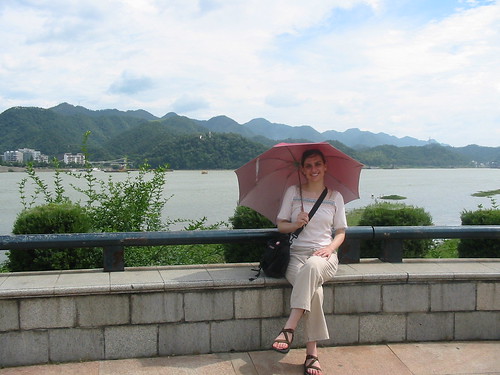
Foreign woman sitting next to a pagoda by the West Lake in China
On an afternoon alone, as I read through "A Dream of Red Mansions," and lost power in my apartment, I wondered what would happen in my life without John, who was leaving Hangzhou for graduate school in Shanghai.

Sometimes love isn’t enough, as A Dream of Red Mansions — the classic Chinese novel of the demise of a powerful family during the Ming Dynasty — tells it. It’s not enough that Lin Daiyu and Jia Baoyu love each other — love is not theirs to choose, but chosen by their parents instead. And the weepy, sensitive, and critical Lin Daiyu just can’t win hearts like the well-behaved, more presentable Xue Baochai. Xue Baochai and Jia Baoyu are married, and Lin Daiyu dies not long afterward.

As I read A Dream of Red Mansions on the afternoon of September 14, 2002, I am reminded that life is not always ours to choose — that sometimes, things happen. Sometimes, things just die…like the power.

I was all by myself that rainy afternoon, while John went to spend the day saying goodbye to his close male friends from high school and college, his “brothers” — in just five days, he would go to Shanghai to start graduate school. I spent the afternoon with the love triangle in A Dream of Red Mansions — Lin Daiyu and Jia Baoyu and, yes, even Xue Baochai. But as I turned the pages, approaching Lin Daiyu’s inevitable demise, the power suddenly went out. Not long after that, so did Lin Daiyu, on the pages of my book.

With no John, no power, and no Lin Daiyu, my world — from the pages to the present — felt so dark and lonely. If John was saying goodbye to his “brothers,” I seemed to be saying hello to what it would be like without him by my side. I wonder if that alone could have sent Lin Daiyu — who was ill even as a baby — to the sickbed. Continue reading “Chapter 17: A Dream Of Life Without My Chinese Boyfriend”

Chapter 16: Foreign Girlfriend or Fascinating Moonlight Tale?

(photo from Stuart Williams’ Flickr)

In China, the Autumn is a time of separation, like the solitary confinement of Chang’e, the woman of the moon. Early Autumn is when we celebrate the Mid-Autumn festival, gazing at the moon and paying homage to Chang’e. Chang’e once had a loving husband, Houyi, who saved the earth by shooting down the nine other suns that were scorching its crust. It wasn’t enough for her to have a husband who was hers; she wanted more. She wanted his immortality pill, the one he received from the heavens themselves. After she stole the pill, the immortals banished her to the moon, forever apart from her dear Houyi.

On September 2, 2002, after we visited Daqi Mountain, John sent me back to Hangzhou on a bus, and returned to his village in the countryside for most of the week. His trip made me wonder — was I asking too much out of him, to have a foreign girlfriend? Continue reading “Chapter 16: Foreign Girlfriend or Fascinating Moonlight Tale?”

Chapter 15: Climbing Back Into Love With John

John brought me to Tonglu, his hometown in the Chinese countryside, to climb Daqi Mountain. If only I knew I’d have to do more than just climb the mountain — I’d have to climb out of the mess I created this morning.

John didn’t see the best of me on that bus, complaining about the indirect, circuitous route, the precipitous driving, the secondhand smoke, the unpredictable pickups and drop-offs. It was only a couple of hours — why did I say anything at all? After my display of intolerance and impatience with China, did John wonder if the girl he fell in love with — the girl who opened herself to China, who wanted to understand — was still there?

As we sat down at one of Tonglu’s restaurants, dining on a feast of vegetarian delicacies for lunch, I laid myself out — with all of my flaws — like the dishes before us. “I’m so sorry about this morning. I don’t know what I was thinking. I may have been here in China for two years, but I don’t understand everything. I should have been more understanding.” I exposed myself for what I behaved like: a foreigner who only saw the shadows of China. But all I seemed to eat during lunch was shame, and the deep, persistent feeling that I was pushing John away. Continue reading “Chapter 15: Climbing Back Into Love With John”