Marriage Reform Empowers People to Follow Their Hearts – Pub’d on China Daily

China Daily just published my latest column, a version of the speech I delivered a few weeks ago, titled Marriage reform empowers people to follow their hearts. Here’s an excerpt from that piece:

On a summer day in 2004, a young Chinese man and a young woman from the United States walked up to a stage draped in burgundy velvet curtains, before the red national flag and the red-and-gold national seal of China at an office in Shanghai. They stood to the side as a government representative-a 30-something woman with a floppy ponytail-asked them to remain faithful and respectful to one another, to care for their parents, to support each other, and to maintain harmony in the family. Then they signed two small red books on the podium, and held those books up beside their smiling faces, as photographers snapped away and the young government representative beamed. By the powers granted her by the People’s Republic of China, the couple became legally married.

That was the day my husband Jun and I registered our marriage, a moment we had envisioned ever since January of that same year, when he had proposed to me over the phone. But none of this-the proposal, and the subsequent marriage registration-would have happened in 2004 without a very significant change that took place in China on Oct 1, 2003.

On that date, a reform of China’s Marriage Law took effect, abolishing a previous requirement: approval by your employer or work unit to register your marriage. In Shanghai, this change applied to students too, like Jun, who was in a graduate program at the time. The prior regulation had barred us from even considering marriage for a simple reason-universities would not permit it.

Thanks to this reform of the Marriage Law, we could move forward to register our marriage without concern over any impact on Jun’s graduate studies.

The only approval that mattered in the process was our own.

We weren’t the only ones that year who took advantage of the change. According to data from the National Bureau of Statistics, 2004 stood out as a boom year for marriage registrations across the country, with 8.67 million couples tying the knot, a rise of nearly 7 percent over 2003. At the time, it represented the largest year-on-year increase in marriage registrations in China since 1986.


You can read the full piece here online. And if you like it, share it!

P.S.: Yes, that photo above was taken the day my husband and I registered our marriage!

Christmas Tree a Symbol of Love, Acceptance Across Cultures – Pub’d on China Daily

Recently, China Daily published my holiday-themed column Christmas tree a symbol of love, acceptance across cultures. Here’s an excerpt:

My old Christmas tree-the very one I bought years ago at a Hangzhou supermarket-was the last thing I expected to find in my in-laws’ storage room in their rural Zhejiang home.

My husband Jun and I had just moved back to China after spending years in the United States, my home country. We had decided to stay at the family home during our transition back to life in China, which just happened to overlap with the start of the Christmas season.

While I recognized we probably couldn’t “deck the halls” with the same flair as my family had done in the US, I still longed for that one holiday necessity-a Christmas tree.

The last time we had owned an artificial tree in China, we lived in a small apartment in Shanghai, where it always occupied a place of importance in our living room every Christmas. But before moving to the US, we had left the tree behind with Jun’s family, like many other possessions we could never have packed because of the limited space in our luggage.

I knew his parents, frugal by nature, cherished the many practical household items we had passed on to them. Yet, if there was one thing I felt certain they had already jettisoned from our Shanghai days, it was the old Christmas tree. After all, they hadn’t grown up celebrating the holiday, and I had never glimpsed a single Christmas decoration in their rural home.

Why would they hold onto something that ostensibly had no obvious place or purpose in their rural Chinese lives?

So after moving back to China, when I brought up with my husband the idea of having a Christmas tree, I had assumed it would lead to talk of taking the bus to the largest supermarket in the county, sure to have a corner dressed in tinsel, filled with everything from rosy-cheeked plastic Santas to artificial evergreens of all sizes covered in shiny baubles and twinkling lights.

Instead, hours later, my husband poked his head into the bedroom, to bring great news of a package he and his parents had pulled out of one of the storage rooms: my old Christmas tree.

You can read the full piece here — and if you like it, share it! 

Wherever you are, here’s wishing you a very Merry Christmas and a Happy New Year!

A photo of the Christmas tree we used during our Shanghai days.

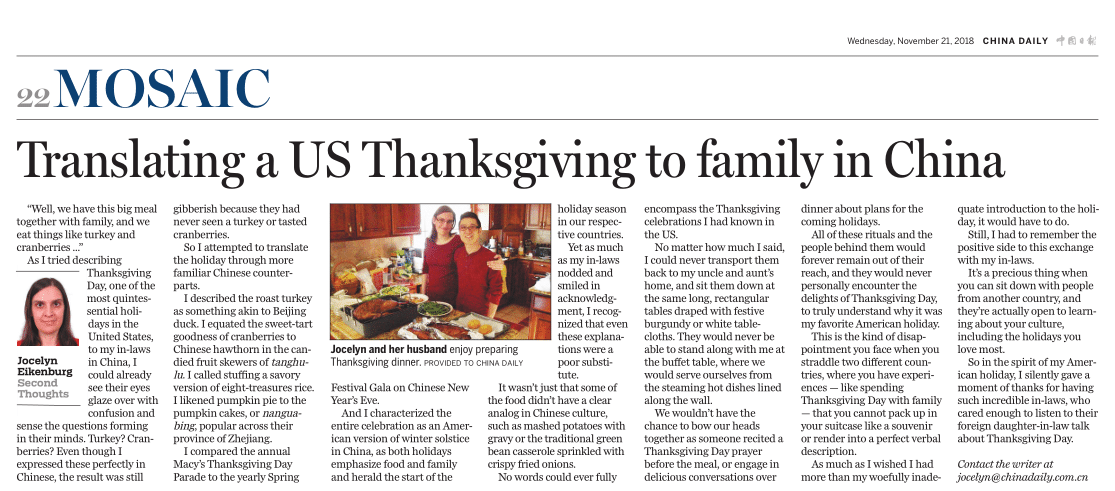
Translating a US Thanksgiving to Family in China – Pub’d in China Daily

China Daily published my column titled Translating a US Thanksgiving to family in China, where I share my memories of trying to explain this favorite American holiday of mine to my Chinese in-laws. Here’s an excerpt:

“Well, we have this big meal together with family, and we eat things like turkey and cranberries …”

As I tried describing Thanksgiving Day, one of the most quintessential holidays in the United States, to my in-laws in China, I could already see their eyes glaze over with confusion and sense the questions forming in their minds. Turkey? Cranberries? Even though I expressed these perfectly in Chinese, the result was still gibberish because they had never seen a turkey or tasted cranberries.

So I attempted to translate the holiday through more familiar Chinese counterparts.

I described the roast turkey as something akin to Beijing duck. I equated the sweet-tart goodness of cranberries to Chinese hawthorn in the candied fruit skewers of tanghulu. I called stuffing a savory version of eight-treasures rice. I likened pumpkin pie to the pumpkin cakes, or nanguabing, popular across their province of Zhejiang.

I compared the annual Macy’s Thanksgiving Day Parade to the yearly Spring Festival Gala on Chinese New Year’s Eve.

And I characterized the entire celebration as an American version of winter solstice in China, as both holidays emphasize food and family and herald the start of the holiday season in our respective countries.

Yet as much as my in-laws nodded and smiled in acknowledgment, I recognized that even these explanations were a poor substitute.

It wasn’t just that some of the food didn’t have a clear analog in Chinese culture, such as mashed potatoes with gravy or the traditional green bean casserole sprinkled with crispy fried onions.

No words could ever fully encompass the Thanksgiving celebrations I had known in the US.

You can read the full column here — and if you like it, share it. And for those of you who do celebrate it, wishing you a Happy Thanksgiving holiday!

Finding the Faith to Move Forward in the Darkness – Pub’d in China Daily

China Daily just published my latest monthly column, titled Finding the faith to move forward in the darkness, on their official WeChat account. It’s about this one time several years ago when my husband and I found ourselves lost in the dark on mountain, with no clear trail. Here’s an excerpt:

When the mountain trail you thought would take you downhill suddenly ends in a great snarl of thorny bushes, and it’s nearly dusk, you know there’s trouble ahead.

That’s the situation my husband Jun and I faced years ago when we decided to summit the mountain at the center of his rural village in Zhejiang. And I never imagined that, in getting lost there, I would find something far more important.

While we had always wanted to reach the top, which drove us to hike there in the afternoon, we hadn’t planned for such a precarious descent. But our experience hiking around the village and its hidden network of unofficial trails should have prepared us for this possibility. 

How many times had we followed a well-trodden dirt path, only to have it stop in a thicket of weedy grass or a maze of bamboo? In fact, the very trail we used to climb the mountain had also disappeared into the woods, forcing us to improvise a way through a dense cluster of bushes and trees. 

However, the summit appeared deceptively neat, with a clearing and what seemed to be a far easier trail winding down the other slope of the mountain. We thought it would be a fast, straightforward trip back, until the trail petered out and left us stranded in the remnants of abandoned fields swallowed up by layers of weeds and crawling thorns, stretching down the mountain as far as we could see. 

If we wanted to make it back home, we would have to blaze our own way out of there, in the dark. 

As a lifelong hiking enthusiast, I had logged hundreds of miles on trails in parks across the US, my home country, but never at night. And yet there we were, trapped on the side of a mountain in near darkness with no established trail at all. 

I felt scared, beyond just the fact that walking ahead meant facing a prickly field of thorns. I worried we might take the wrong step and tumble down, or fall into something even worse than those thorns, since we couldn’t see the ground. How could we possibly move forward?

“Just take one step at a time,” my husband told me. “Don’t worry.” It was his way of encouraging me to have faith.

Faith is something I’ve struggled with in life, and being on that mountain was a test for me. It took all of my resolve to lift my foot up and place it among those thorns. 

You can read the rest of the column right here. And if you like it, share it! Also, if you would like to hear me read the article, check it out on the China Daily official WeChat account.

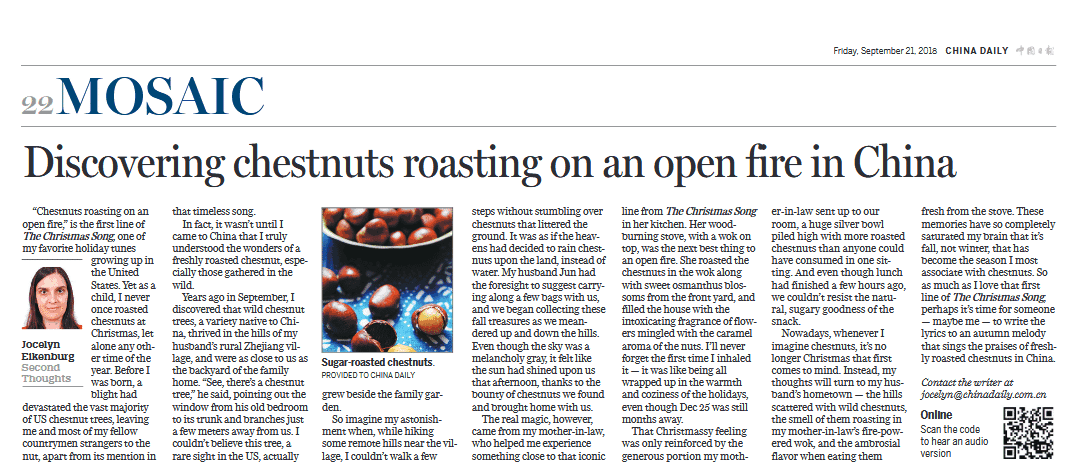
Discovering Chestnuts Roasting on an Open Fire in China – My China Daily Sept Column

Last Friday, China Daily published my column for the month of September: Discovering chestnuts roasting on an open fire in China. Here’s an excerpt:

“Chestnuts roasting on an open fire,” is the first line of The Christmas Song, one of my favorite holiday tunes growing up in the United States. Yet as a child, I never once roasted chestnuts at Christmas, let alone any other time of the year. Before I was born, a blight had devastated the vast majority of US chestnut trees, leaving me and most of my fellow countrymen strangers to the nut, apart from its mention in that timeless song.

In fact, it wasn’t until I came to China that I truly understood the wonders of a freshly roasted chestnut, especially those gathered in the wild.

Years ago in September, I discovered that wild chestnut trees, a variety native to China, thrived in the hills of my husband’s rural Zhejiang village, and were as close to us as the backyard of the family home. “See, there’s a chestnut tree,” he said, pointing out the window from his old bedroom to its trunk and branches just a few meters away from us. I couldn’t believe this tree, a rare sight in the US, actually grew beside the family garden.

So imagine my astonishment when, while hiking some remote hills near the village, I couldn’t walk a few steps without stumbling over chestnuts that littered the ground. It was as if the heavens had decided to rain chestnuts upon the land, instead of water. My husband Jun had the foresight to suggest carrying along a few bags with us, and we began collecting these fall treasures as we meandered up and down the hills. Even though the sky was a melancholy gray, it felt like the sun had shined upon us that afternoon, thanks to the bounty of chestnuts we found and brought home with us.

Read the full piece here online. And if you like it, share it!

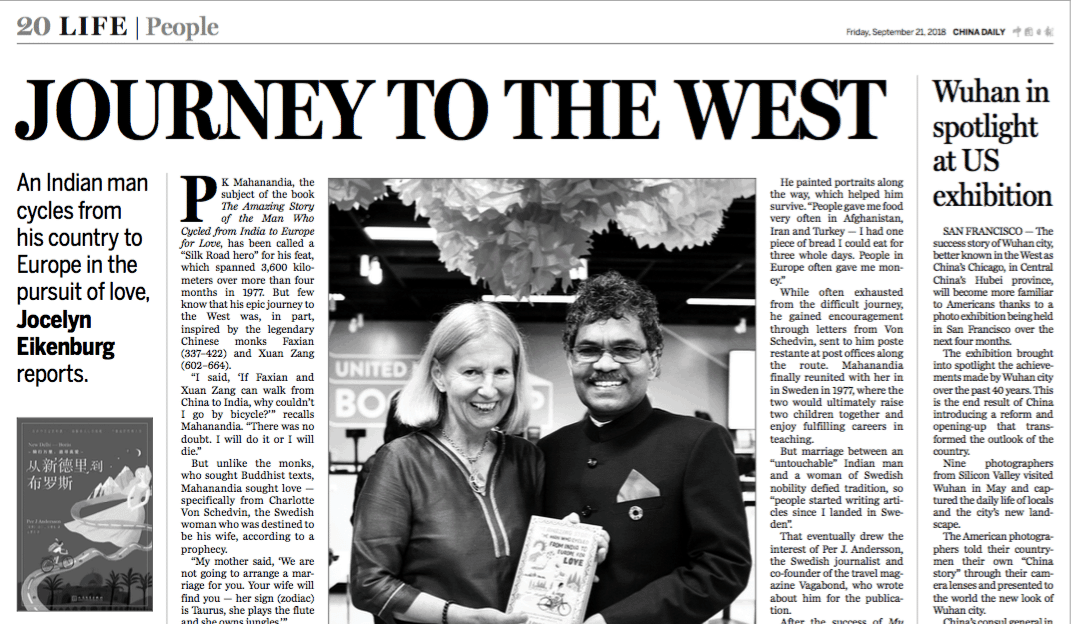
Journey to the West: An Indian Man Cycles From His Country to Europe in the Pursuit of Love (Pub’d in China Daily)

China Daily just published my feature story, titled Journey to the West, about PK Mahanandia and his extraordinary journey from India to Sweden by bicycle for love (which I blogged about earlier this year). Here’s an excerpt from the piece:

PK Mahanandia, the subject of the book The Amazing Story of the Man Who Cycled from India to Europe for Love, has been called a “Silk Road hero” for his feat, which spanned 3,600 kilo­meters over more than four months in 1977. But few know that his epic journey to the West was, in part, inspired by the legendary Chinese monks Faxian (337–422) and Xuan Zang (602–664).

“I said, ‘If Faxian and Xuan Zang can walk from China to India, why couldn’t I go by bicycle?’” recalls Mahanandia. “There was no doubt. I will do it or I will die.”

But unlike the monks, who sought Buddhist texts, Mahanandia sought love — specifically from Charlotte Von Schedvin, the Swedish woman who was destined to be his wife, according to a prophecy.

“My mother said, ‘We are not going to arrange a mar­riage for you. Your wife will find you — her sign (zodiac) is Taurus, she plays the flute and she owns jungles.’”

He and Von Schedvin met in New Delhi in 1975, at a time when Mahanandia was an impoverished art student from the “untouchable” caste who drew portraits in the popular shopping district of Connaught Place.

“When I started doing her portrait, I felt a strange feel­ ing in my body. I was breath­less.”

She returned, and after asking her questions, he learned she was a flute player born in May, whose family owned forests.

“Then I knew that we are destined to meet. I said, ‘You will be my wife, it is decided in the heavens.’”

You can read the full article online. And if you like it, share it!

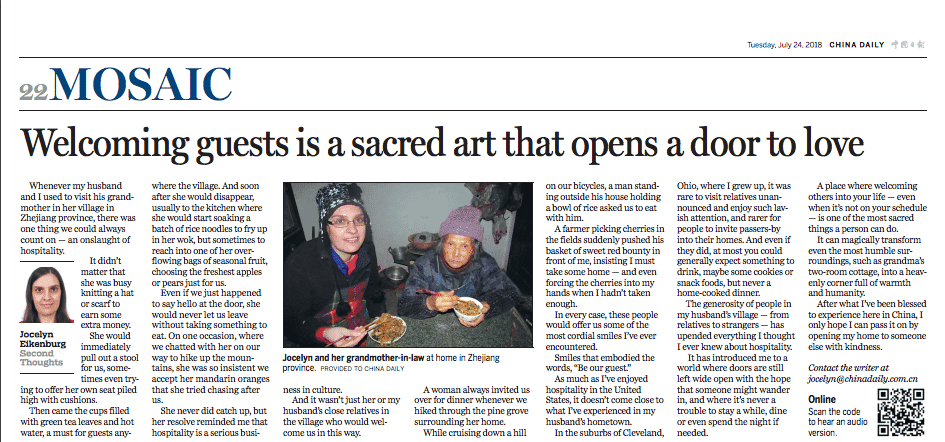
Welcoming Guests Is a Sacred Art That Opens a Door to Love – Pub’d on China Daily

I’ve been so busy in the past few weeks that I’m late in sharing my latest column for China Daily (which is also — drum roll — now in full color, with a photo)! It’s titled Welcoming Guests Is a Sacred Art That Opens a Door to Love, inspired by the hospitality I’ve enjoyed in my husband’s hometown. Here’s an excerpt:

Whenever my husband and I used to visit his grandmother in her village in Zhejiang province, there was one thing we could always count on — an onslaught of hospitality.

It didn’t matter that she was busy knitting a hat or scarf to earn some extra money. She would immediately pull out a stool for us, sometimes even trying to offer her own seat piled high with cushions. Then came the cups filled with green tea leaves and hot water, a must for guests anywhere the village. And soon after she would disappear, usually to the kitchen where she would start soaking a batch of rice noodles to fry up in her wok, but sometimes to reach into one of her overflowing bags of seasonal fruit, choosing the freshest apples or pears just for us.

Even if we just happened to say hello at the door, she would never let us leave without taking something to eat. On one occasion, where we chatted with her on our way to hike up the mountains, she was so insistent we accept her mandarin oranges that she tried chasing after us.

She never did catch up, but her resolve reminded me that hospitality is a serious business in culture.

You can read the full piece here online — and if you like it, share it!

Local Dialect Is Language From the Heart – Pub’d on China Daily

China Daily just published another one of my columns in the paper and on their WeChat official account. It’s titled Local dialect is language from the heart, and here’s an excerpt from the piece:

My husband’s late grandmother, who had lived her entire life in the family’s rural Zhejiang village, was known for her feisty sense of humor, her nimble hands that could knit beautiful hats and scarves, and her homemade fried rice noodles, which were so delicious you could forgive her for adding a little too much salt.

But for years, I struggled to know her because she only spoke the local language.

Anyone familiar with this region of East China knows it is a land rich in dialects, which can differ greatly among neighboring counties.

The most notable example in Zhejiang province is Wenzhounese, considered the least comprehensible Chinese dialect, which is why China used it for communications during World War II.

While grandma’s local dialect wasn’t nearly that divergent from the Mandarin Chinese I had learned, the distinctions were enough to make understanding her a challenge.

Despite that, for years I had shrugged off the possibility of learning the dialect.

You can read the full column online — and if you like it, share it!

Additionally, if you’re fascinated by this topic, take a look at the blog post that inspired the column: To learn dialect or not? When your Chinese family doesn’t speak Mandarin Chinese

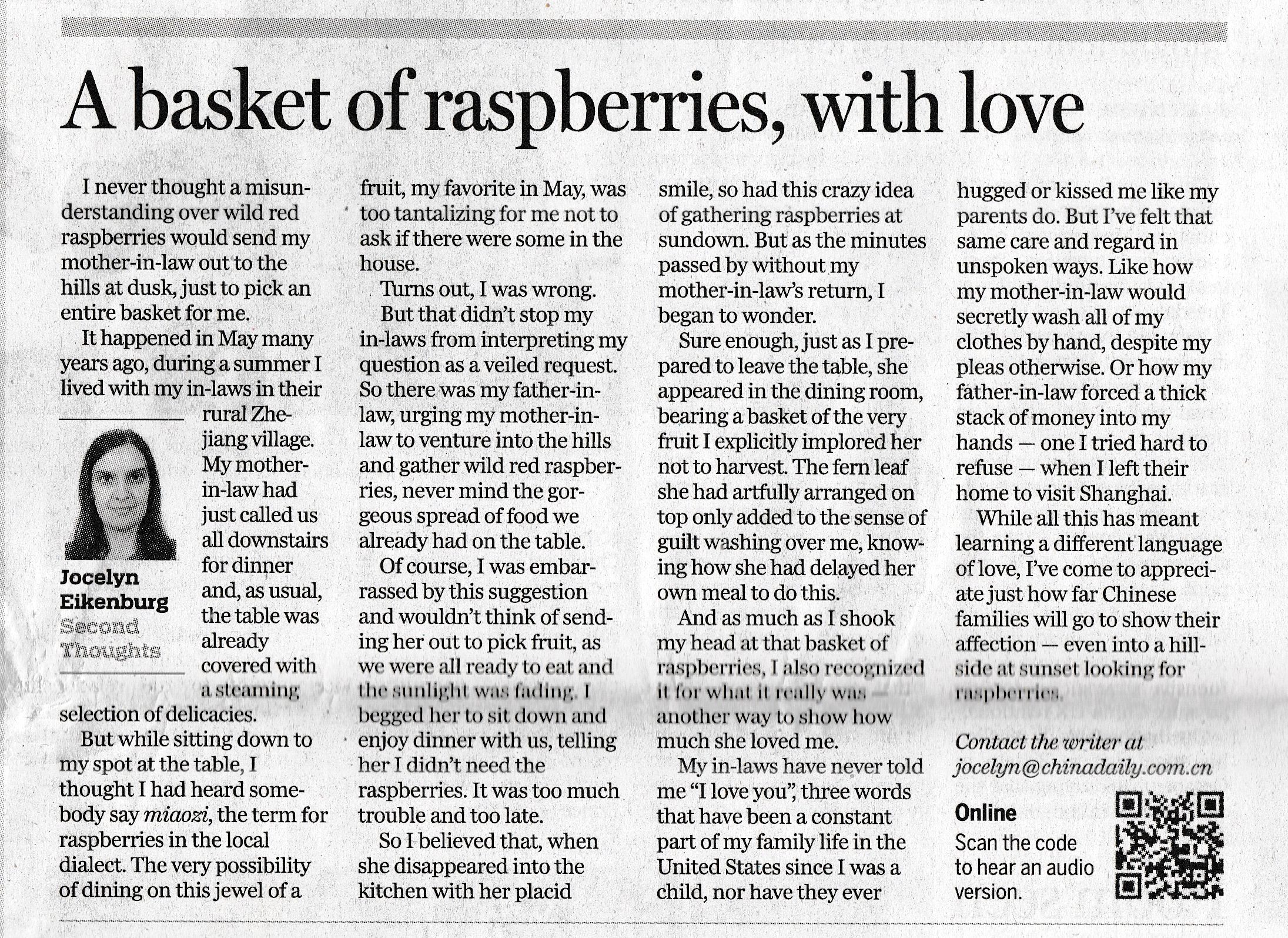
Pub’d on China Daily: A Basket of Raspberries, With Love

Earlier this month my column appeared in the China Daily — both in the paper and its WeChat account. It’s titled A basket of raspberries, with love and recounts a touching gesture from my mother-in-law when I lived at the family home one summer. Here’s an excerpt:

I never thought a misunderstanding over wild red raspberries would send my mother-in-law out to the hills at dusk, just to pick an entire basket for me.

It happened in May many years ago, during a summer I lived with my in-laws in their rural Zhejiang village. My mother-in-law had just called us all downstairs for dinner and, as usual, the table was already covered with a steaming selection of delicacies.

But while sitting down to my spot at the table, I thought I had heard somebody say miaozi, the term for raspberries in the local dialect. The very possibility of dining on this jewel of a fruit, my favorite in May, was too tantalizing for me not to ask if there were some in the house.

Turns out, I was wrong.

But that didn’t stop my Chinese in-laws from interpreting my question as a veiled request.

You can read the full piece here online. And if you love it, share it!

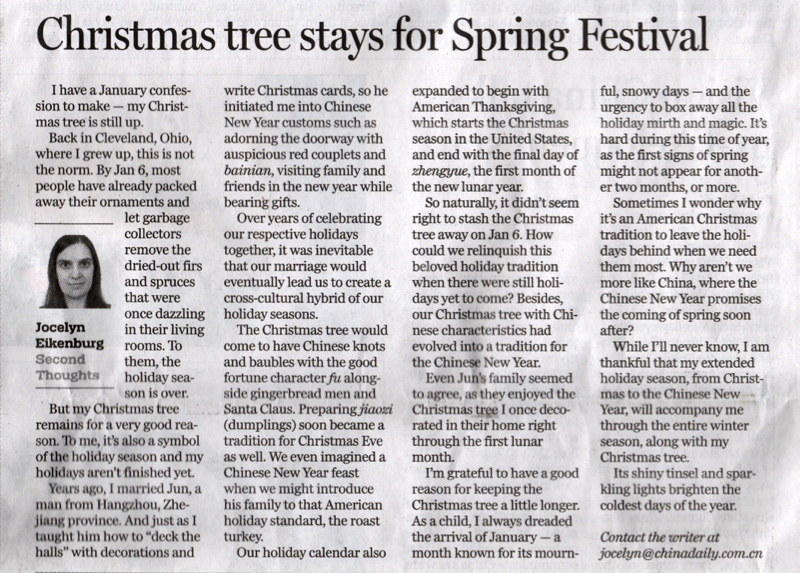
Pub’d on China Daily: Christmas tree stays for Spring Festival

China Daily just published another one of my columns in their newspaper today — it’s titled Christmas tree stays for Spring Festival. Here’s an excerpt:

I have a January confession to make – my Christmas tree is still up.

Back in Cleveland, Ohio, where I grew up, this is not the norm. By Jan 6, most people have already packed away their ornaments and let garbage collectors remove the dried-out firs and spruces that were once dazzling in their living rooms. To them, the holiday season is over.

But my Christmas tree remains for a very good reason. To me, it’s also a symbol of the holiday season and my holidays aren’t finished yet.

You can read the full piece here. And if you like it, share it!