

Sometimes love isn’t enough, as A Dream of Red Mansions — the classic Chinese novel of the demise of a powerful family during the Ming Dynasty — tells it. It’s not enough that Lin Daiyu and Jia Baoyu love each other — love is not theirs to choose, but chosen by their parents instead. And the weepy, sensitive, and critical Lin Daiyu just can’t win hearts like the well-behaved, more presentable Xue Baochai. Xue Baochai and Jia Baoyu are married, and Lin Daiyu dies not long afterward.
As I read A Dream of Red Mansions on the afternoon of September 14, 2002, I am reminded that life is not always ours to choose — that sometimes, things happen. Sometimes, things just die…like the power.
I was all by myself that rainy afternoon, while John went to spend the day saying goodbye to his close male friends from high school and college, his “brothers” — in just five days, he would go to Shanghai to start graduate school. I spent the afternoon with the love triangle in A Dream of Red Mansions — Lin Daiyu and Jia Baoyu and, yes, even Xue Baochai. But as I turned the pages, approaching Lin Daiyu’s inevitable demise, the power suddenly went out. Not long after that, so did Lin Daiyu, on the pages of my book.
With no John, no power, and no Lin Daiyu, my world — from the pages to the present — felt so dark and lonely. If John was saying goodbye to his “brothers,” I seemed to be saying hello to what it would be like without him by my side. I wonder if that alone could have sent Lin Daiyu — who was ill even as a baby — to the sickbed. Continue reading “Chapter 17: A Dream Of Life Without My Chinese Boyfriend”
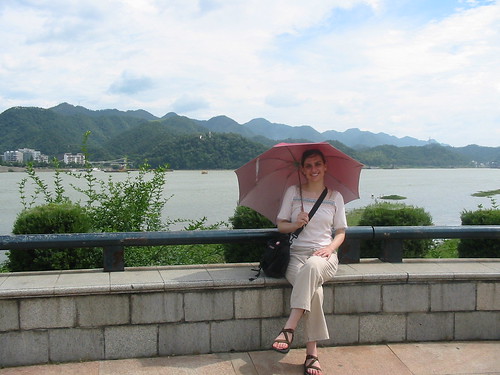 John brought me to Tonglu, his hometown in the Chinese countryside, to climb Daqi Mountain. If only I knew I’d have to do more than just climb the mountain — I’d have to climb out of the mess I created this morning.
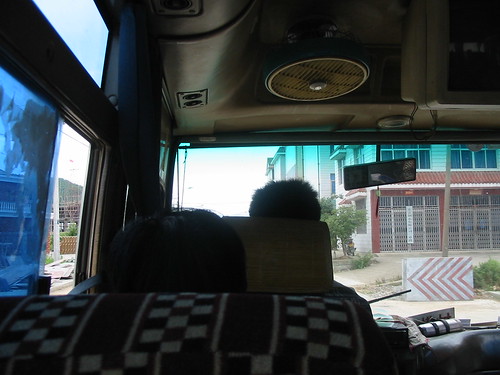 I really want to be on the new highway leading to Tonglu, John’s hometown in the Chinese countryside. The smooth concrete is perfect, unblemished by potholes or cracks. Each side of the highway has a new guardrail, with newly transplanted trees beside it, propped up by four wooden supports and rope tied around the trunk. And on the highway, a bus cannot stop to pick up new passengers — it must go nonstop to its destination, so the passengers know when it will arrive. It is China’s future, right next to me.
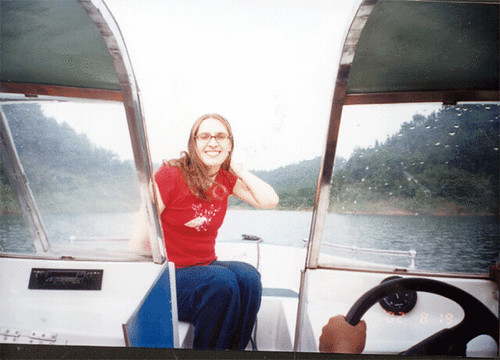 Chinese poets once praised the Xin’an River in Zhejiang Province as a mirror, so clean and clear you could see the bottom. But the Xin’an River is no more. It was dammed in 1958 to create 1,000 Island Lake, where John takes me in August 2002 to visit the country of his ancestors.
 “Do you realize how you hurt Frank?” Xiao Yu, one of my coworkers and friends from the Internet company, confronted me one afternoon, nearly a week after
  There it was, a tiny blue duffel bag on the floor of the guest room. I found it Tuesday evening, after returning home from work.
 “Everyone in this entire teahouse is staring at you,” giggled my Chinese tutor Mandy, as she clutched my arm on the way to the restroom.
 The West Lake, framed by a glittering night sky and the willow tendrils hanging over our bench, could probably turn any young couple into lovers on such an evening. Especially this Western woman and Chinese man sitting beside its taciturn waters, watching the bats dip and sway to catch mosquitoes to the tune of the humming cicadas in the trees and bushes.