Conversations Reveal Power of People-to-People Exchanges – Pub’d on China Daily

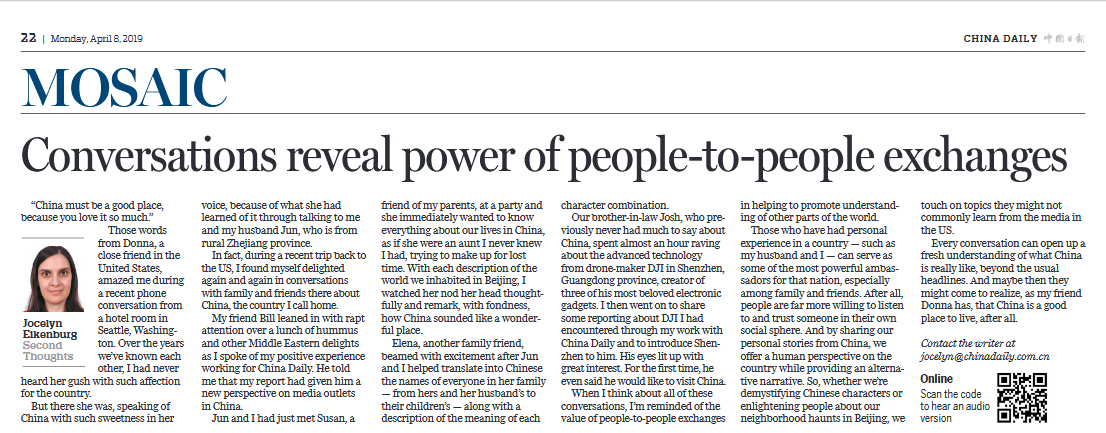
China Daily just published my latest monthly column, titled Conversations reveal power of people-to-people exchanges. Here’s an excerpt from the piece:

“China must be a good place, because you love it so much.”

Those words from Donna, a close friend in the United States, amazed me during a recent phone conversation from a hotel room in Seattle, Washington.

Over the years we’ve known each other, I had never heard her gush with such affection for the country.

But there she was, speaking of China with such sweetness in her voice, because of what she had learned of it through talking to me and my husband Jun, who is from rural Zhejiang province.

In fact, during a recent trip back to the US, I found myself delighted again and again in conversations with family and friends there about China, the country I call home.

My friend Bill leaned in with rapt attention over a lunch of hummus and other Middle Eastern delights as I spoke of my positive experience working for China Daily. He told me that my report had given him a new perspective on media outlets in China.

Jun and I had just met Susan, a friend of my parents, at a party and she immediately wanted to know everything about our lives in China, as if she were an aunt I never knew I had, trying to make up for lost time. With each description of the world we inhabited in Beijing, I watched her nod her head thoughtfully and remark, with fondness, how China sounded like a wonderful place.

Elena, another family friend, beamed with excitement after Jun and I helped translate into Chinese the names of everyone in her family-from hers and her husband’s to their children’s-along with a description of the meaning of each character combination.

You can read the full article here. And if you like it, share it!

‘African Jasmine Flower’: Ruth Njeri Finds Success, Love on Chinese Stage

Among the many talented foreign women who happened to marry Chinese men, there’s Kenyan Ruth Njeri, who rose to fame – and found love – on the stage in China.

Njeri is also known in China as “非洲茉莉花“ (fēizhōu mòlìhuā, the “African jasmine flower”), a nickname she received from the country’s former president Hu Jintao after meeting him and singing together with him the Chinese folk song “茉莉花” (Jasmine Flower) in Nairobi, Kenya, in 2006, which landed her in the national TV news in China. As China Daily reported in an April 7, 2013, story titled Chinese Tones:

Njeri’s patience and persistence in learning Mandarin paid off in April 2006 when Hu Jintao, then China’s president, visited Kenya. Because of her progress in Chinese, she was selected from the Confucius Institute to meet him.

“I was quite nervous meeting him, and I heard my voice trembling while talking to him. He is actually a nice person who is very approachable and likes to chat with young people.”

Njeri completed her studies at Nairobi’s Confucius Institute in June that year and moved to China to pursue a degree in language and literature at Tianjin Normal University a month later.

She also received a scholarship for her studies, thanks to winning the Chinese Bridge Competition in Kenya.

In the next several years, she went on to appear numerous times in TV shows on networks all across China, including the country’s prominent China Central Television, or CCTV, which named her one of the most influential foreigners of 2007.

But her greatest moment – the one that changed her life and love forever – came with her high-profile singing performance in the 2011 Spring Festival Gala, or Chunwan, China’s annual Chinese New Year’s Eve show broadcast across the country on CCTV on the most important night of the year. That year, she shared the stage with Ya Xing, a Chinese man she first met in a Shanghai:

Ya, 40, hails from Luoyang, an industrial city in Central China’s Henan province. He met Njeri, 34, from Nairobi, Kenya in a restaurant in Shanghai while she was studying on a Chinese government scholarship. At the time, they were both participating in the World Expo and met again a month later in Shanghai just before sharing a stage during the CCTV Spring Festival Gala in Beijing in 2011.

“It was fate, Yuánfèn“, Ya said.

The two of them would go on to perform together on TV many times.

Njeri also sang for the 2013 Spring Festival Gala as well (a year that saw Celine Dion perform for the event).

And as for Njeri and Ya:

Three years ago, Ya Xing married Ruth Njeri before his friends and family in China. He is considered brave among his peers for starting a new life in Kenya but the ebullient entrepreneur, once a TV host, does not think so.

“I am in love,” he said. “It might look complicated to marry into a new culture, but I think people think too much of it.”

Read the full story — and see a photo of the delightful couple — at China Daily.

Bilibili has a more recent video about Ruth Njeri’s life in Kenya, including highlights from her performances.

For people in China, here are links to Ruth Njeri’s performances on CCTV, including this CCTV performance of Ruth and Xing, and this other CCTV performance by the couple

You can learn more about Ruth Njeri at Baidu Baike (written in Chinese).

What do you think of Ruth Njeri?

Rapeseed Blooms Bring Beauty and Lessons of Resilience – Pub’d on China Daily

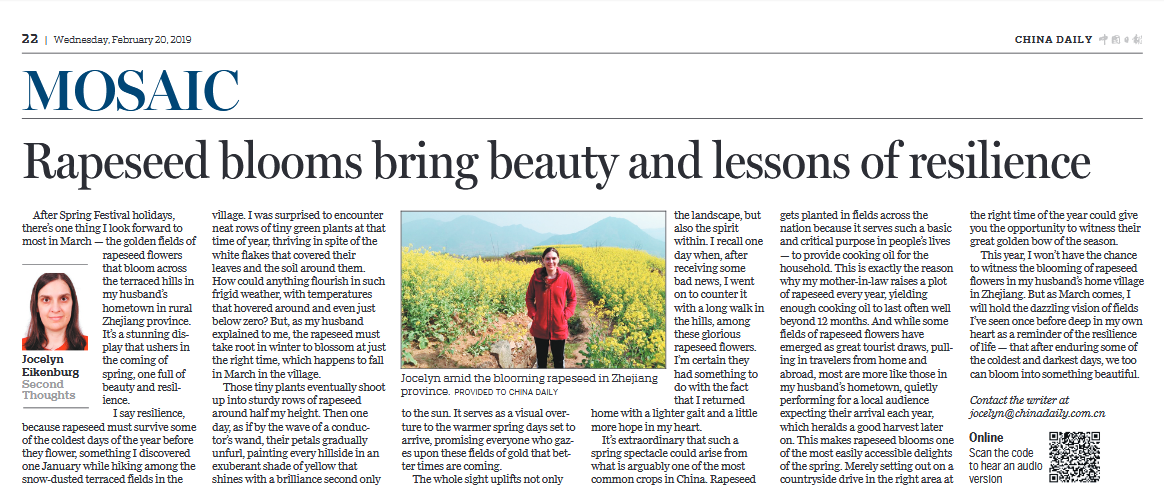
China Daily published my latest column titled Rapeseed blooms bring beauty and lessons of resilience. Here’s an excerpt:

After Spring Festival holidays, there’s one thing I look forward to most in March-the golden fields of rapeseed flowers that bloom across the terraced hills in my husband’s hometown in rural Zhejiang province. It’s a stunning display that ushers in the coming of spring, one full of beauty and resilience.

I say resilience, because rapeseed must survive some of the coldest days of the year before they flower, something I discovered one January while hiking among the snow-dusted terraced fields in the village. I was surprised to encounter neat rows of tiny green plants at that time of year, thriving in spite of the white flakes that covered their leaves and the soil around them. How could anything flourish in such frigid weather, with temperatures that hovered around and even just below zero? But, as my husband explained to me, the rapeseed must take root in winter to blossom at just the right time, which happens to fall in March in the village.

Those tiny plants eventually shoot up into sturdy rows of rapeseed around half my height. Then one day, as if by the wave of a conductor’s wand, their petals gradually unfurl, painting every hillside in an exuberant shade of yellow that shines with a brilliance second only to the sun. It serves as a visual overture to the warmer spring days set to arrive, promising everyone who gazes upon these fields of gold that better times are coming.

The whole sight uplifts not only the landscape, but also the spirit within. I recall one day when, after receiving some bad news, I went on to counter it with a long walk in the hills, among these glorious rapeseed flowers. I’m certain they had something to do with the fact that I returned home with a lighter gait and a little more hope in my heart.

Read the rest of the column here. And if you like it, share it!
China Daily Videos: Watch Me Discuss Family Small Talk, Delivery for Chinese New Year

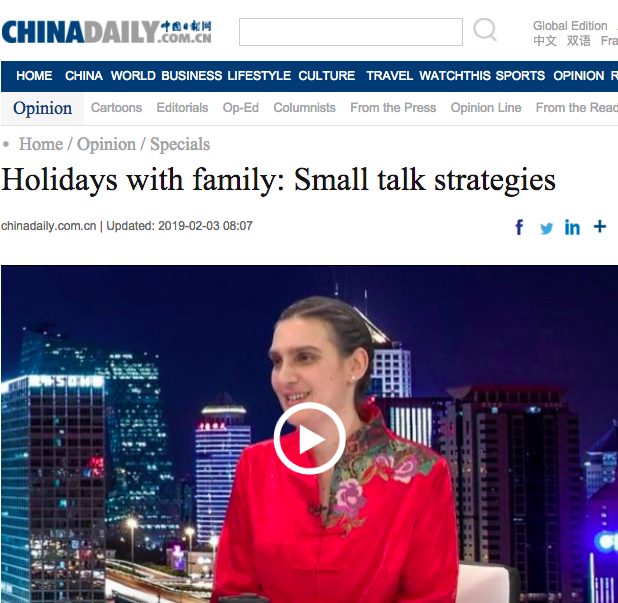
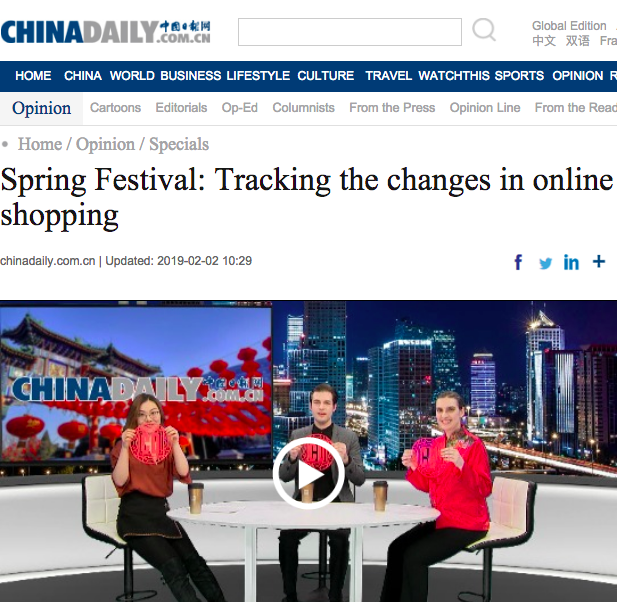
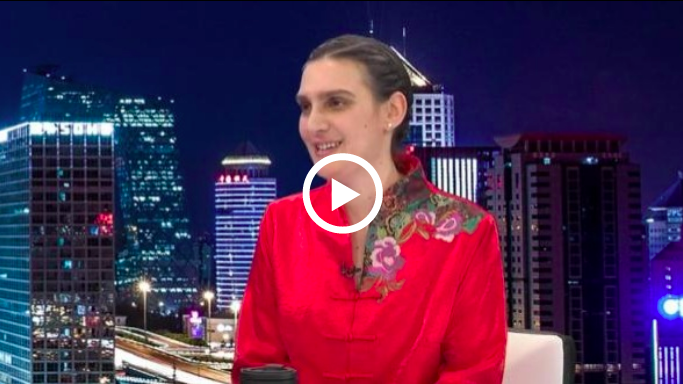
Recently, I served as a guest for two Chinese New Year-themed videos for China Daily, where we discussed online delivery of Chinese New Year goods and also how to navigate family small talk during the holidays. For anyone who has ever wondered, “What does Jocelyn sound like?” here’s your chance to hear and see me in action!

My favorite is Holidays with family: Small talk strategies:

In this video, the staff at China Daily website shares their experiences during family gatherings and summarizes a list of “safe” topics to help you navigate holiday conversations.

The other video is Spring Festival: Tracking the changes in online shopping:

For Chinese New Year, many people shop for a wide range of holiday goods, known as nianhuo in Chinese, and the staff at China Daily website are no exception. In this video, they talk about their nianhuo shopping experiences, and their concerns of the possible dark side of the shopping spree, while also delivering their best holiday wishes to you.

Have a look and let me know what you think! And if you like them, share them.

Wishing everyone a Happy Chinese New Year!

Delivering a Little Love and Care for Chinese New Year – Pub’d in China Daily

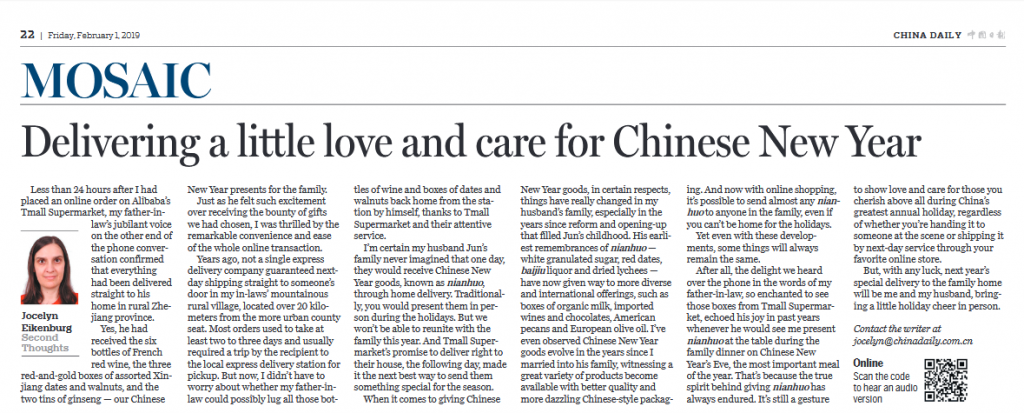
China Daily just published my latest monthly column Delivering a little love and care for Chinese New Year.

Here’s an excerpt from the piece:

Less than 24 hours after I had placed an online order on Alibaba’s Tmall Supermarket, my father-in-law’s jubilant voice on the other end of the phone conversation confirmed that everything had been delivered straight to his home in rural Zhejiang province.

Yes, he had received the six bottles of French red wine, the three red-and-gold boxes of assorted Xinjiang dates and walnuts, and the two tins of ginseng — our Chinese New Year presents for the family.

Just as he felt such excitement over receiving the bounty of gifts we had chosen, I was thrilled by the remarkable convenience and ease of the whole online transaction.

Years before, not a single express delivery company guaranteed next-day shipping straight to someone’s door in my in-laws’ mountainous rural village, located over 20 kilometers away from the more urban county seat. Most orders used to take at least two to three days and usually required a trip by the recipient to the local express delivery station for pickup.

But now, I didn’t have to worry about whether my father-in-law could possibly lug all those bottles of wine and boxes of dates and walnuts back home from the station by himself, thanks to Tmall Supermarket and their attentive service.

I’m certain my husband Jun’s family never imagined that one day, they would receive Chinese New Year goods, known as nianhuo, through home delivery. Traditionally, you would present them in person during the holidays. But we wouldn’t be able to reunite with the family this year. And Tmall Supermarket’s promise to deliver right to their house, the following day, made it the next best way to send them something special for the season.

You can read the full column here — and if you like it, share it!

Marriage Reform Empowers People to Follow Their Hearts – Pub’d on China Daily

China Daily just published my latest column, a version of the speech I delivered a few weeks ago, titled Marriage reform empowers people to follow their hearts. Here’s an excerpt from that piece:

On a summer day in 2004, a young Chinese man and a young woman from the United States walked up to a stage draped in burgundy velvet curtains, before the red national flag and the red-and-gold national seal of China at an office in Shanghai. They stood to the side as a government representative-a 30-something woman with a floppy ponytail-asked them to remain faithful and respectful to one another, to care for their parents, to support each other, and to maintain harmony in the family. Then they signed two small red books on the podium, and held those books up beside their smiling faces, as photographers snapped away and the young government representative beamed. By the powers granted her by the People’s Republic of China, the couple became legally married.

That was the day my husband Jun and I registered our marriage, a moment we had envisioned ever since January of that same year, when he had proposed to me over the phone. But none of this-the proposal, and the subsequent marriage registration-would have happened in 2004 without a very significant change that took place in China on Oct 1, 2003.

On that date, a reform of China’s Marriage Law took effect, abolishing a previous requirement: approval by your employer or work unit to register your marriage. In Shanghai, this change applied to students too, like Jun, who was in a graduate program at the time. The prior regulation had barred us from even considering marriage for a simple reason-universities would not permit it.

Thanks to this reform of the Marriage Law, we could move forward to register our marriage without concern over any impact on Jun’s graduate studies.

The only approval that mattered in the process was our own.

We weren’t the only ones that year who took advantage of the change. According to data from the National Bureau of Statistics, 2004 stood out as a boom year for marriage registrations across the country, with 8.67 million couples tying the knot, a rise of nearly 7 percent over 2003. At the time, it represented the largest year-on-year increase in marriage registrations in China since 1986.


You can read the full piece here online. And if you like it, share it!

P.S.: Yes, that photo above was taken the day my husband and I registered our marriage!

Christmas Tree a Symbol of Love, Acceptance Across Cultures – Pub’d on China Daily

Recently, China Daily published my holiday-themed column Christmas tree a symbol of love, acceptance across cultures. Here’s an excerpt:

My old Christmas tree-the very one I bought years ago at a Hangzhou supermarket-was the last thing I expected to find in my in-laws’ storage room in their rural Zhejiang home.

My husband Jun and I had just moved back to China after spending years in the United States, my home country. We had decided to stay at the family home during our transition back to life in China, which just happened to overlap with the start of the Christmas season.

While I recognized we probably couldn’t “deck the halls” with the same flair as my family had done in the US, I still longed for that one holiday necessity-a Christmas tree.

The last time we had owned an artificial tree in China, we lived in a small apartment in Shanghai, where it always occupied a place of importance in our living room every Christmas. But before moving to the US, we had left the tree behind with Jun’s family, like many other possessions we could never have packed because of the limited space in our luggage.

I knew his parents, frugal by nature, cherished the many practical household items we had passed on to them. Yet, if there was one thing I felt certain they had already jettisoned from our Shanghai days, it was the old Christmas tree. After all, they hadn’t grown up celebrating the holiday, and I had never glimpsed a single Christmas decoration in their rural home.

Why would they hold onto something that ostensibly had no obvious place or purpose in their rural Chinese lives?

So after moving back to China, when I brought up with my husband the idea of having a Christmas tree, I had assumed it would lead to talk of taking the bus to the largest supermarket in the county, sure to have a corner dressed in tinsel, filled with everything from rosy-cheeked plastic Santas to artificial evergreens of all sizes covered in shiny baubles and twinkling lights.

Instead, hours later, my husband poked his head into the bedroom, to bring great news of a package he and his parents had pulled out of one of the storage rooms: my old Christmas tree.

You can read the full piece here — and if you like it, share it! 

Wherever you are, here’s wishing you a very Merry Christmas and a Happy New Year!

A photo of the Christmas tree we used during our Shanghai days.

Photo Essay: Speaking of Reform at Beijing Bookworm Event for China Daily

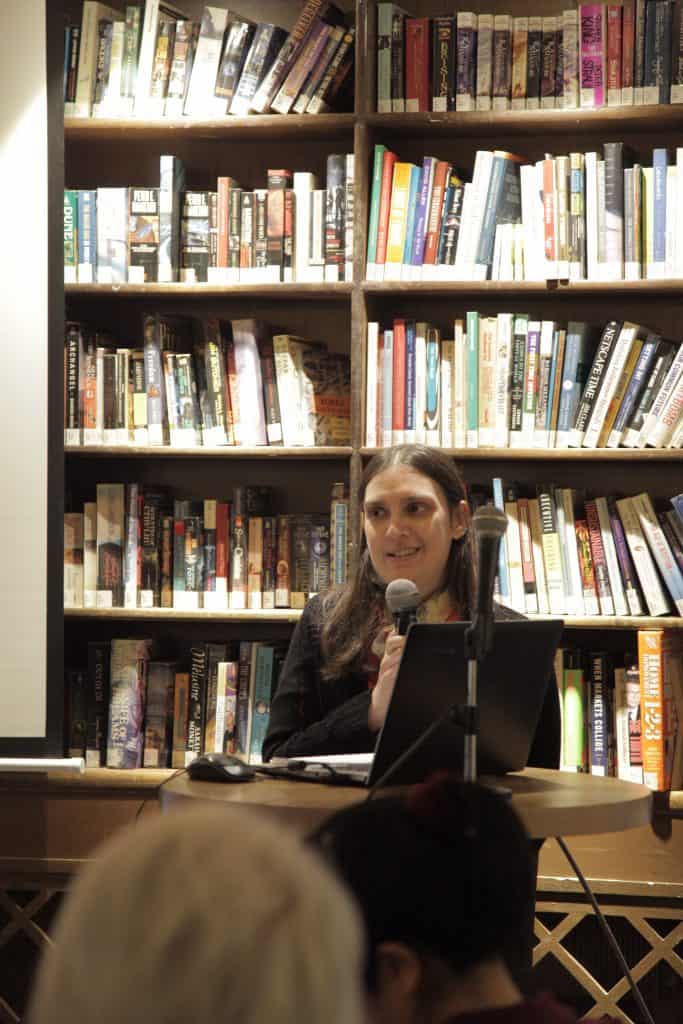
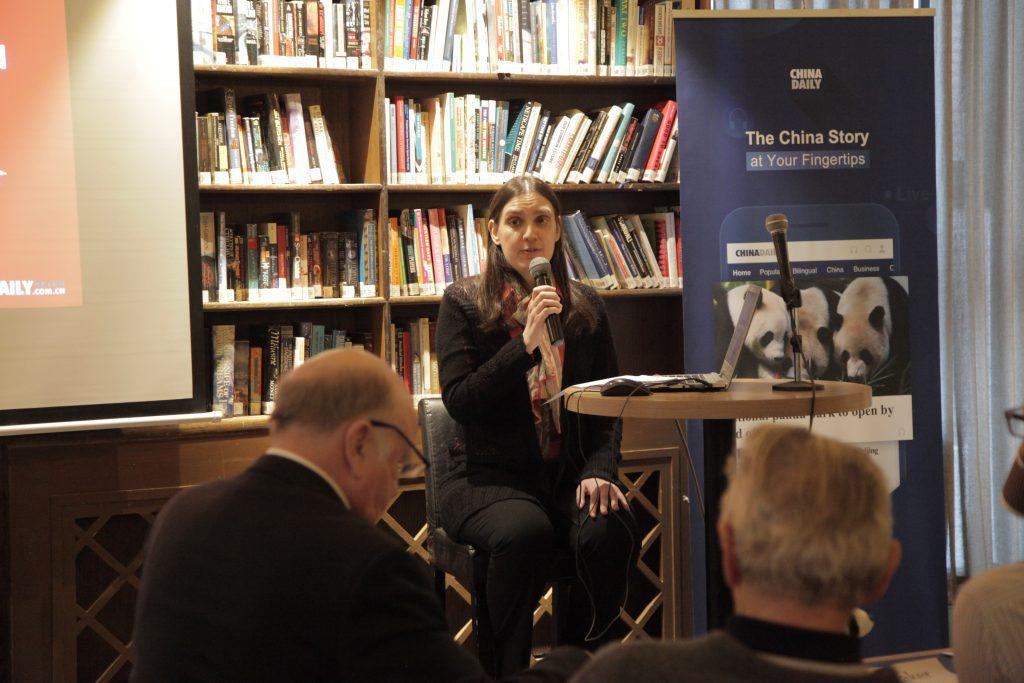
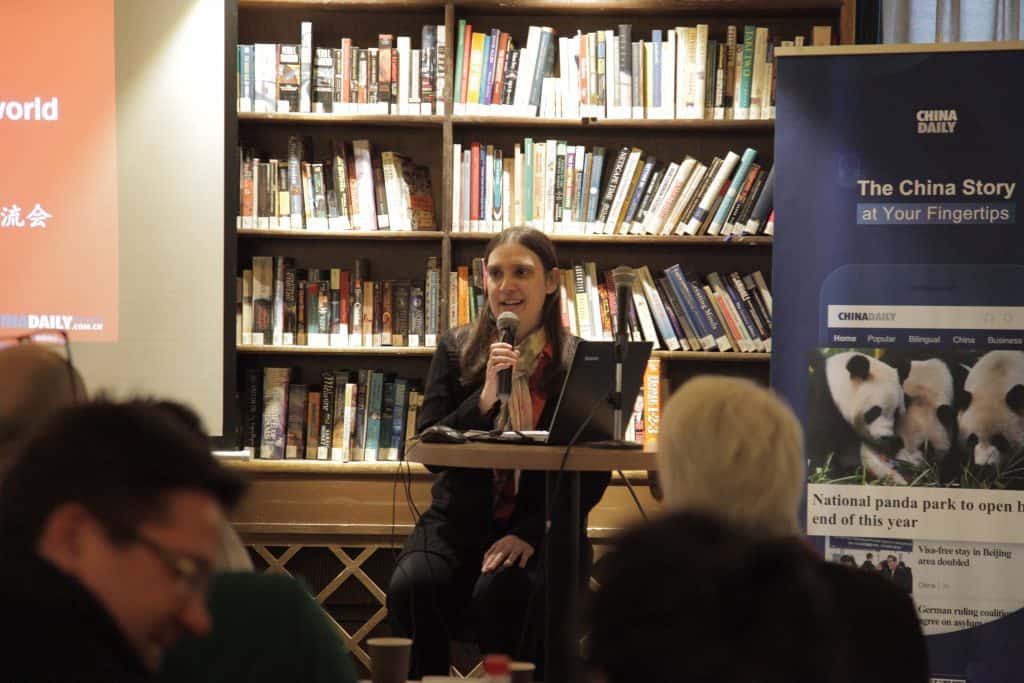
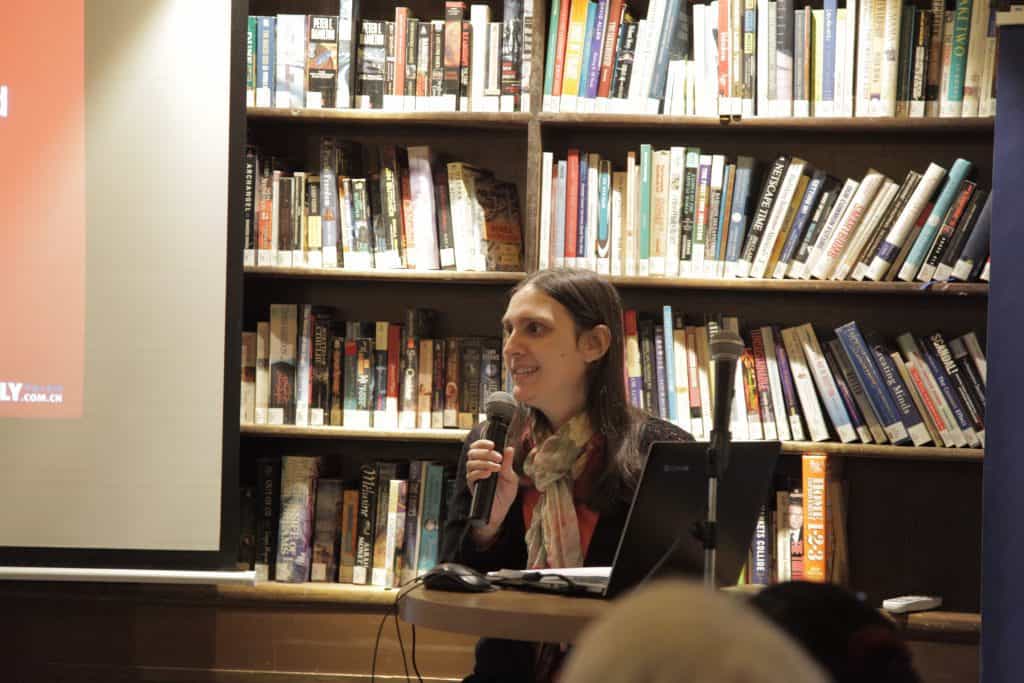
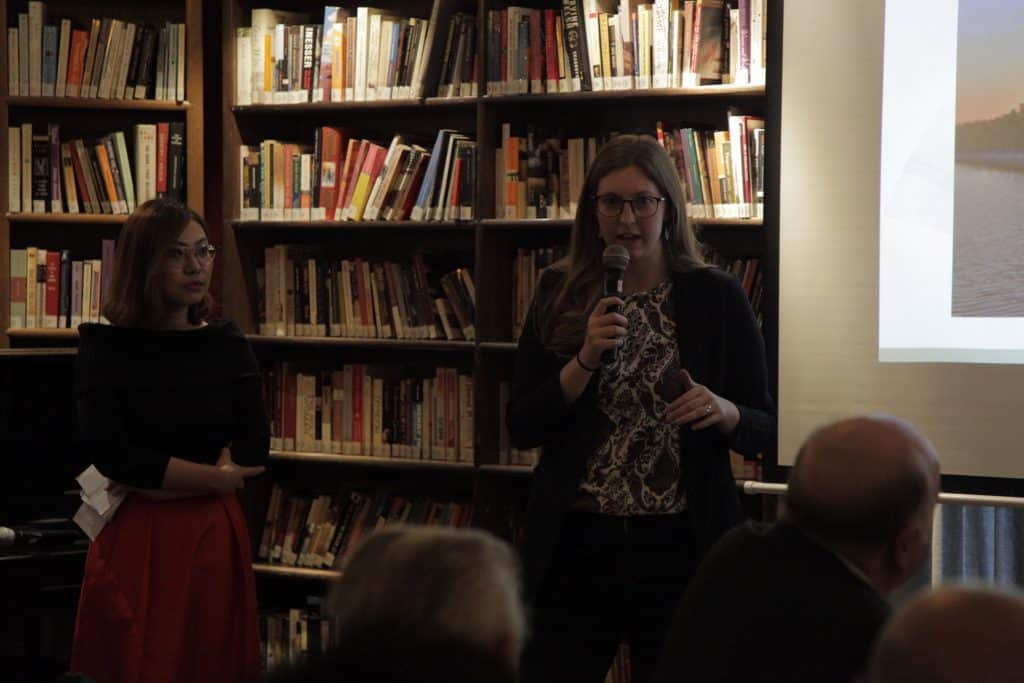
This past Wednesday, China Daily featured me as a speaker at a meetup event for foreign professionals timed to China’s 40th anniversary of their reform and opening-up. I shared my personal experience with reform as it relates to the country’s marriage law. In lieu of a post, I’m sharing a few photos from that event.

Wonderful also to see many of my fellow colleagues at China Daily as well as other friends, including Jessica Luo of China Radio International, who stood up and shared some of her experiences with reform and opening-up.

Translating a US Thanksgiving to Family in China – Pub’d in China Daily

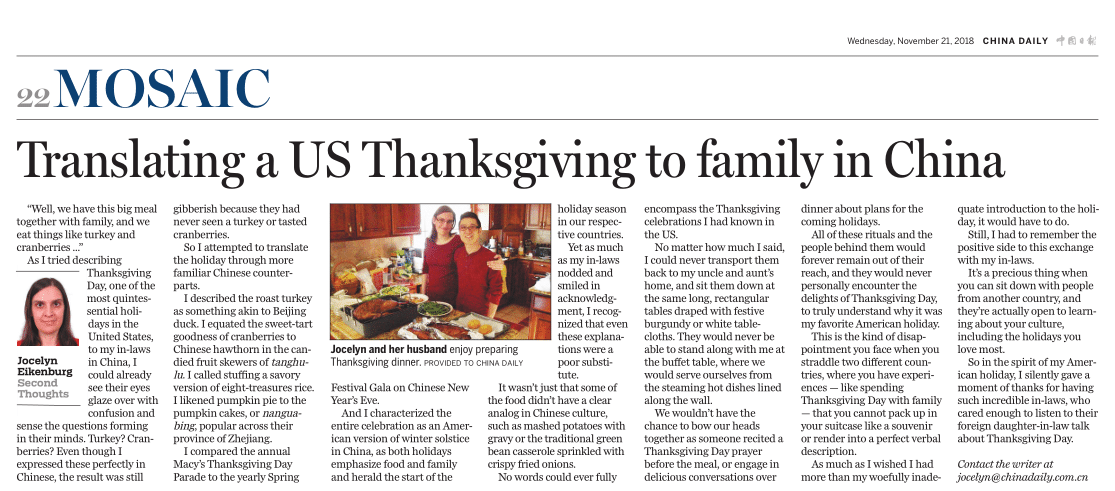
China Daily published my column titled Translating a US Thanksgiving to family in China, where I share my memories of trying to explain this favorite American holiday of mine to my Chinese in-laws. Here’s an excerpt:

“Well, we have this big meal together with family, and we eat things like turkey and cranberries …”

As I tried describing Thanksgiving Day, one of the most quintessential holidays in the United States, to my in-laws in China, I could already see their eyes glaze over with confusion and sense the questions forming in their minds. Turkey? Cranberries? Even though I expressed these perfectly in Chinese, the result was still gibberish because they had never seen a turkey or tasted cranberries.

So I attempted to translate the holiday through more familiar Chinese counterparts.

I described the roast turkey as something akin to Beijing duck. I equated the sweet-tart goodness of cranberries to Chinese hawthorn in the candied fruit skewers of tanghulu. I called stuffing a savory version of eight-treasures rice. I likened pumpkin pie to the pumpkin cakes, or nanguabing, popular across their province of Zhejiang.

I compared the annual Macy’s Thanksgiving Day Parade to the yearly Spring Festival Gala on Chinese New Year’s Eve.

And I characterized the entire celebration as an American version of winter solstice in China, as both holidays emphasize food and family and herald the start of the holiday season in our respective countries.

Yet as much as my in-laws nodded and smiled in acknowledgment, I recognized that even these explanations were a poor substitute.

It wasn’t just that some of the food didn’t have a clear analog in Chinese culture, such as mashed potatoes with gravy or the traditional green bean casserole sprinkled with crispy fried onions.

No words could ever fully encompass the Thanksgiving celebrations I had known in the US.

You can read the full column here — and if you like it, share it. And for those of you who do celebrate it, wishing you a Happy Thanksgiving holiday!

Finding the Faith to Move Forward in the Darkness – Pub’d in China Daily

China Daily just published my latest monthly column, titled Finding the faith to move forward in the darkness, on their official WeChat account. It’s about this one time several years ago when my husband and I found ourselves lost in the dark on mountain, with no clear trail. Here’s an excerpt:

When the mountain trail you thought would take you downhill suddenly ends in a great snarl of thorny bushes, and it’s nearly dusk, you know there’s trouble ahead.

That’s the situation my husband Jun and I faced years ago when we decided to summit the mountain at the center of his rural village in Zhejiang. And I never imagined that, in getting lost there, I would find something far more important.

While we had always wanted to reach the top, which drove us to hike there in the afternoon, we hadn’t planned for such a precarious descent. But our experience hiking around the village and its hidden network of unofficial trails should have prepared us for this possibility. 

How many times had we followed a well-trodden dirt path, only to have it stop in a thicket of weedy grass or a maze of bamboo? In fact, the very trail we used to climb the mountain had also disappeared into the woods, forcing us to improvise a way through a dense cluster of bushes and trees. 

However, the summit appeared deceptively neat, with a clearing and what seemed to be a far easier trail winding down the other slope of the mountain. We thought it would be a fast, straightforward trip back, until the trail petered out and left us stranded in the remnants of abandoned fields swallowed up by layers of weeds and crawling thorns, stretching down the mountain as far as we could see. 

If we wanted to make it back home, we would have to blaze our own way out of there, in the dark. 

As a lifelong hiking enthusiast, I had logged hundreds of miles on trails in parks across the US, my home country, but never at night. And yet there we were, trapped on the side of a mountain in near darkness with no established trail at all. 

I felt scared, beyond just the fact that walking ahead meant facing a prickly field of thorns. I worried we might take the wrong step and tumble down, or fall into something even worse than those thorns, since we couldn’t see the ground. How could we possibly move forward?

“Just take one step at a time,” my husband told me. “Don’t worry.” It was his way of encouraging me to have faith.

Faith is something I’ve struggled with in life, and being on that mountain was a test for me. It took all of my resolve to lift my foot up and place it among those thorns. 

You can read the rest of the column right here. And if you like it, share it! Also, if you would like to hear me read the article, check it out on the China Daily official WeChat account.