Discovering Chestnuts Roasting on an Open Fire in China – My China Daily Sept Column

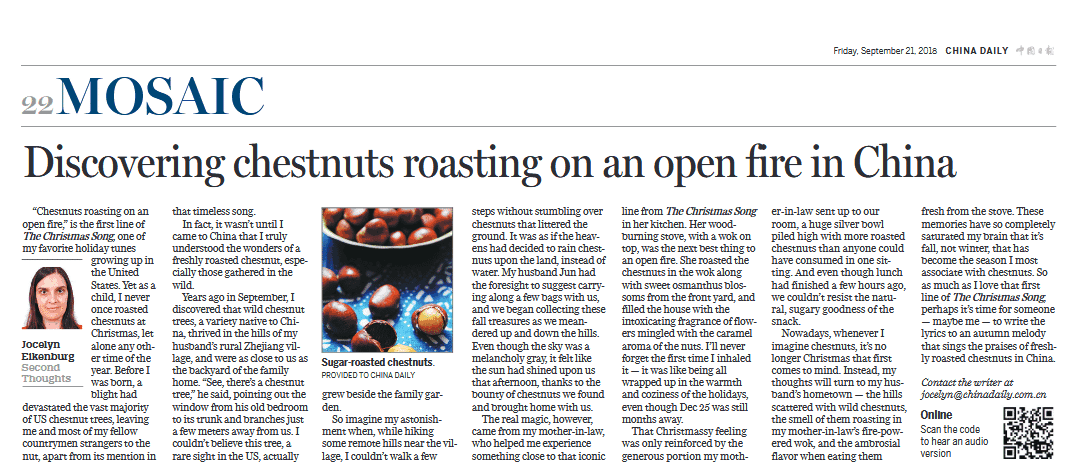
Last Friday, China Daily published my column for the month of September: Discovering chestnuts roasting on an open fire in China. Here’s an excerpt:

“Chestnuts roasting on an open fire,” is the first line of The Christmas Song, one of my favorite holiday tunes growing up in the United States. Yet as a child, I never once roasted chestnuts at Christmas, let alone any other time of the year. Before I was born, a blight had devastated the vast majority of US chestnut trees, leaving me and most of my fellow countrymen strangers to the nut, apart from its mention in that timeless song.

In fact, it wasn’t until I came to China that I truly understood the wonders of a freshly roasted chestnut, especially those gathered in the wild.

Years ago in September, I discovered that wild chestnut trees, a variety native to China, thrived in the hills of my husband’s rural Zhejiang village, and were as close to us as the backyard of the family home. “See, there’s a chestnut tree,” he said, pointing out the window from his old bedroom to its trunk and branches just a few meters away from us. I couldn’t believe this tree, a rare sight in the US, actually grew beside the family garden.

So imagine my astonishment when, while hiking some remote hills near the village, I couldn’t walk a few steps without stumbling over chestnuts that littered the ground. It was as if the heavens had decided to rain chestnuts upon the land, instead of water. My husband Jun had the foresight to suggest carrying along a few bags with us, and we began collecting these fall treasures as we meandered up and down the hills. Even though the sky was a melancholy gray, it felt like the sun had shined upon us that afternoon, thanks to the bounty of chestnuts we found and brought home with us.

Read the full piece here online. And if you like it, share it!
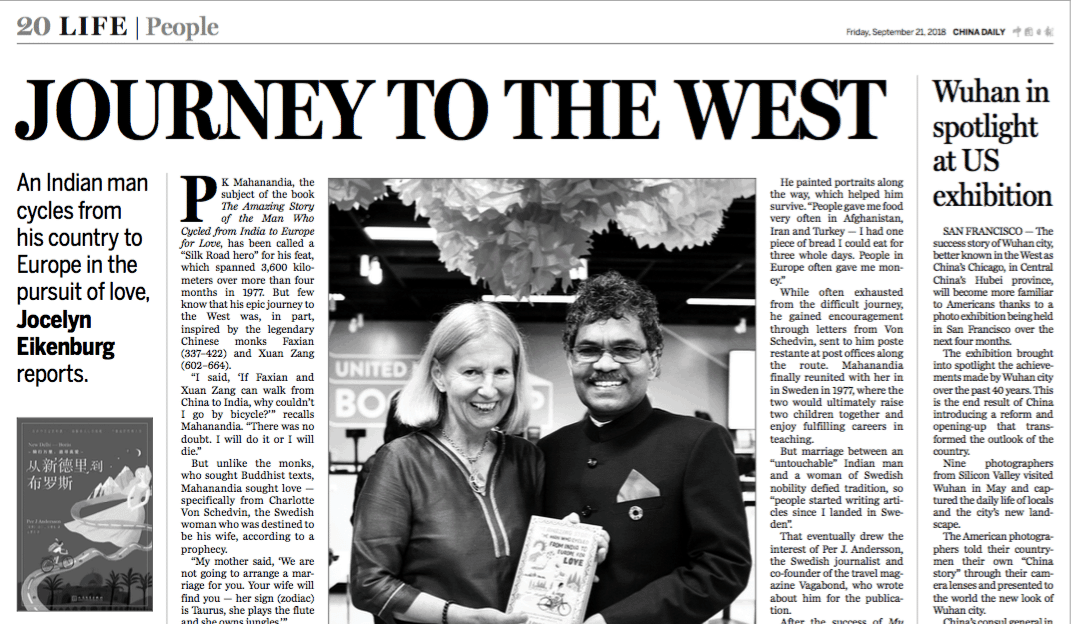
Journey to the West: An Indian Man Cycles From His Country to Europe in the Pursuit of Love (Pub’d in China Daily)

China Daily just published my feature story, titled Journey to the West, about PK Mahanandia and his extraordinary journey from India to Sweden by bicycle for love (which I blogged about earlier this year). Here’s an excerpt from the piece:

PK Mahanandia, the subject of the book The Amazing Story of the Man Who Cycled from India to Europe for Love, has been called a “Silk Road hero” for his feat, which spanned 3,600 kilo­meters over more than four months in 1977. But few know that his epic journey to the West was, in part, inspired by the legendary Chinese monks Faxian (337–422) and Xuan Zang (602–664).

“I said, ‘If Faxian and Xuan Zang can walk from China to India, why couldn’t I go by bicycle?’” recalls Mahanandia. “There was no doubt. I will do it or I will die.”

But unlike the monks, who sought Buddhist texts, Mahanandia sought love — specifically from Charlotte Von Schedvin, the Swedish woman who was destined to be his wife, according to a prophecy.

“My mother said, ‘We are not going to arrange a mar­riage for you. Your wife will find you — her sign (zodiac) is Taurus, she plays the flute and she owns jungles.’”

He and Von Schedvin met in New Delhi in 1975, at a time when Mahanandia was an impoverished art student from the “untouchable” caste who drew portraits in the popular shopping district of Connaught Place.

“When I started doing her portrait, I felt a strange feel­ ing in my body. I was breath­less.”

She returned, and after asking her questions, he learned she was a flute player born in May, whose family owned forests.

“Then I knew that we are destined to meet. I said, ‘You will be my wife, it is decided in the heavens.’”

You can read the full article online. And if you like it, share it!
Ancestors Have a Special Seat at the Table for ‘Ghost Festival’ – Pub’d in China Daily

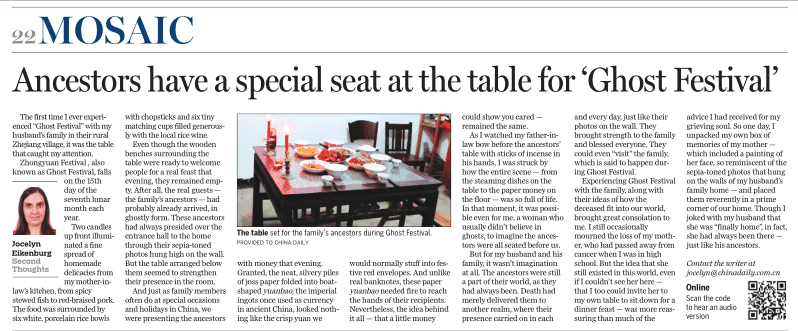
On Friday, China Daily published my latest monthly column: Ancestors have a special seat at the table for ‘Ghost Festival’. It traces my first experience with the festival and also how it ultimately moved me to re-imagine my own relationship with ancestors (particularly my mother, who passed away when I was in high school). Here’s an excerpt from the piece:

The first time I ever experienced the “Ghost Festival” with my husband’s family in their rural Zhejiang village, it was the table that caught my attention.

Two candles up front illuminated a fine spread of homemade delicacies from my mother-in-law’s kitchen, from spicy stewed fish to red-braised pork. The food was surrounded by six white porcelain rice bowls with chopsticks and six tiny matching cups filled generously with the local rice wine.

Even though the wooden benches surrounding the table were ready to welcome people for a real feast that evening, they remained empty. After all, the real guests — the family’s ancestors — had probably already arrived, in ghostly form. These ancestors had always presided over the entrance hall to the home through their sepia-toned photos hung high on the wall. But the table arranged below them seemed to strengthen their presence in the room.

And just as family members often do at special occasions and holidays in China, we were presenting the ancestors with money that evening. Granted, the neat, silvery piles of joss paper folded into boat-shapedyuanbao, the imperial ingots once used as currency in ancient China, looked nothing like the crisp yuan we would normally stuff into festive red envelopes. And unlike real banknotes, these paper yuanbao needed fire to reach the hands of their recipients. Nevertheless, the idea behind it all — that a little money could show you cared — remained the same.

As I watched my father-in-law bow before the ancestors’ table with sticks of incense in his hands, I was struck by how the entire scene — from the steaming dishes on the table to the paper money on the floor — was so full of life. In that moment, it was possible even for me, a woman who usually didn’t believe in ghosts, to imagine the ancestors were all seated before us.

But for my husband and his family, it wasn’t imagination at all. The ancestors were still a part of their world, as they had always been. Death had merely delivered them to another realm, where their presence carried on in each and every day, just like their photos on the wall. They brought strength to the family and blessed everyone. They could even “visit” the family, which is said to happen during the Ghost Festival.

Experiencing the Ghost Festival with the family, along with their ideas of how the deceased fit into our world, brought great consolation to me.

You can read the rest of the column (in full color) right here. And if you like it, share it!

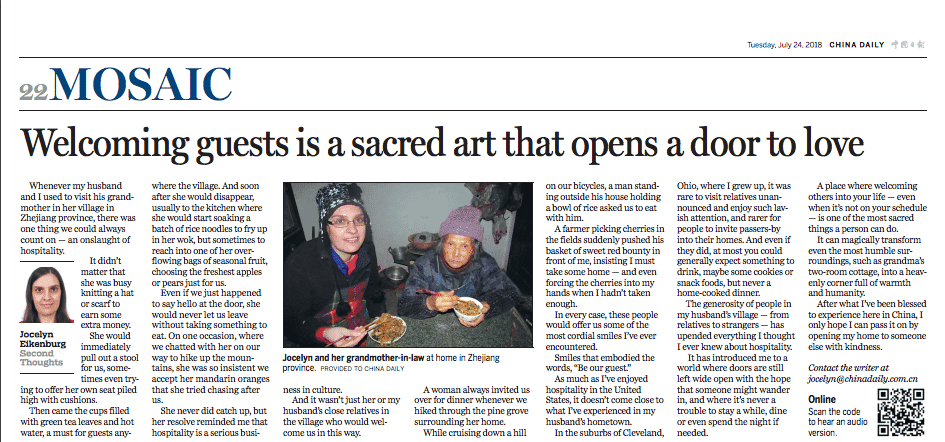
Welcoming Guests Is a Sacred Art That Opens a Door to Love – Pub’d on China Daily

I’ve been so busy in the past few weeks that I’m late in sharing my latest column for China Daily (which is also — drum roll — now in full color, with a photo)! It’s titled Welcoming Guests Is a Sacred Art That Opens a Door to Love, inspired by the hospitality I’ve enjoyed in my husband’s hometown. Here’s an excerpt:

Whenever my husband and I used to visit his grandmother in her village in Zhejiang province, there was one thing we could always count on — an onslaught of hospitality.

It didn’t matter that she was busy knitting a hat or scarf to earn some extra money. She would immediately pull out a stool for us, sometimes even trying to offer her own seat piled high with cushions. Then came the cups filled with green tea leaves and hot water, a must for guests anywhere the village. And soon after she would disappear, usually to the kitchen where she would start soaking a batch of rice noodles to fry up in her wok, but sometimes to reach into one of her overflowing bags of seasonal fruit, choosing the freshest apples or pears just for us.

Even if we just happened to say hello at the door, she would never let us leave without taking something to eat. On one occasion, where we chatted with her on our way to hike up the mountains, she was so insistent we accept her mandarin oranges that she tried chasing after us.

She never did catch up, but her resolve reminded me that hospitality is a serious business in culture.

You can read the full piece here online — and if you like it, share it!

Local Dialect Is Language From the Heart – Pub’d on China Daily

China Daily just published another one of my columns in the paper and on their WeChat official account. It’s titled Local dialect is language from the heart, and here’s an excerpt from the piece:

My husband’s late grandmother, who had lived her entire life in the family’s rural Zhejiang village, was known for her feisty sense of humor, her nimble hands that could knit beautiful hats and scarves, and her homemade fried rice noodles, which were so delicious you could forgive her for adding a little too much salt.

But for years, I struggled to know her because she only spoke the local language.

Anyone familiar with this region of East China knows it is a land rich in dialects, which can differ greatly among neighboring counties.

The most notable example in Zhejiang province is Wenzhounese, considered the least comprehensible Chinese dialect, which is why China used it for communications during World War II.

While grandma’s local dialect wasn’t nearly that divergent from the Mandarin Chinese I had learned, the distinctions were enough to make understanding her a challenge.

Despite that, for years I had shrugged off the possibility of learning the dialect.

You can read the full column online — and if you like it, share it!

Additionally, if you’re fascinated by this topic, take a look at the blog post that inspired the column: To learn dialect or not? When your Chinese family doesn’t speak Mandarin Chinese

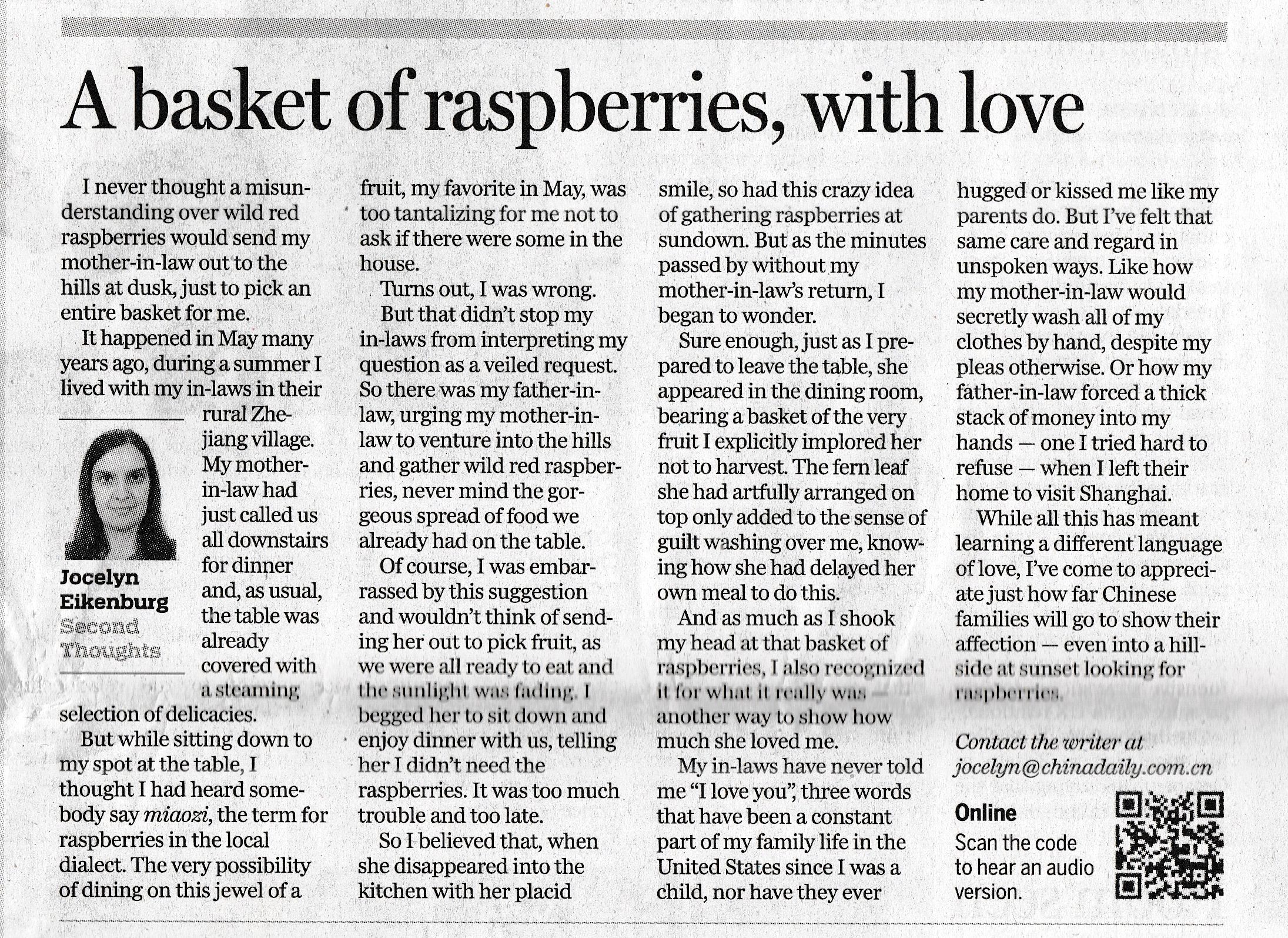
Pub’d on China Daily: A Basket of Raspberries, With Love

Earlier this month my column appeared in the China Daily — both in the paper and its WeChat account. It’s titled A basket of raspberries, with love and recounts a touching gesture from my mother-in-law when I lived at the family home one summer. Here’s an excerpt:

I never thought a misunderstanding over wild red raspberries would send my mother-in-law out to the hills at dusk, just to pick an entire basket for me.

It happened in May many years ago, during a summer I lived with my in-laws in their rural Zhejiang village. My mother-in-law had just called us all downstairs for dinner and, as usual, the table was already covered with a steaming selection of delicacies.

But while sitting down to my spot at the table, I thought I had heard somebody say miaozi, the term for raspberries in the local dialect. The very possibility of dining on this jewel of a fruit, my favorite in May, was too tantalizing for me not to ask if there were some in the house.

Turns out, I was wrong.

But that didn’t stop my Chinese in-laws from interpreting my question as a veiled request.

You can read the full piece here online. And if you love it, share it!

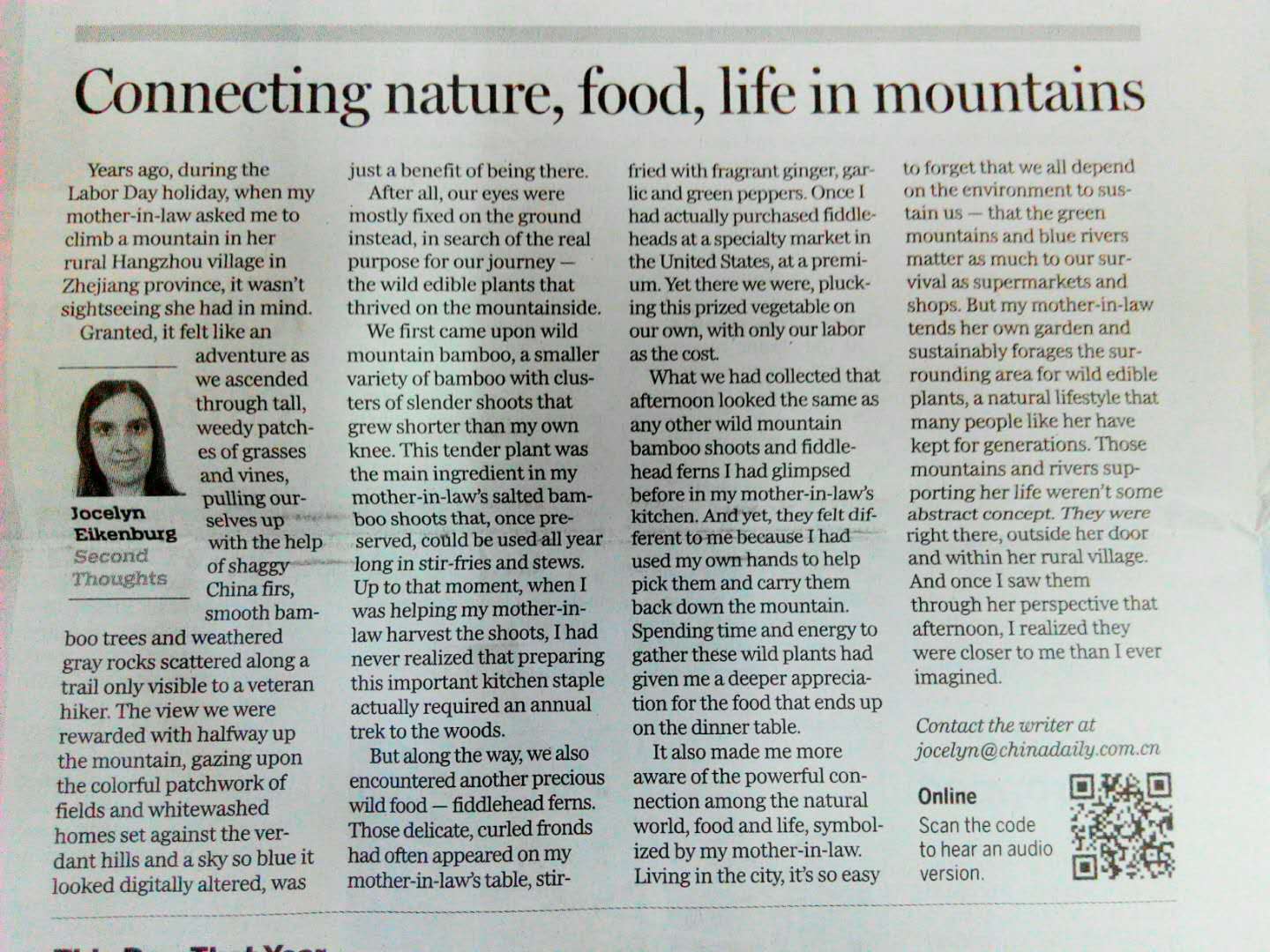
Now a Monthly China Daily Columnist — Here’s ‘Connecting Nature, Food, Life in Mountains’ for May

China Daily has made me a monthly columnist for the newspaper, starting in May! Here’s an excerpt from my May column Connecting nature, food, life in mountains:

Years ago during the Labor Day holiday, when my mother-in-law asked me to climb a mountain in her rural Hangzhou village, it wasn’t sightseeing she had in mind.

Granted, it felt like an adventure as we ascended through tall, weedy patches of grasses and vines, pulling ourselves up with the help of shaggy China firs, smooth bamboo trees and weathered gray rocks scattered along a trail only visible to a veteran hiker. The view we were rewarded with halfway up the mountain, gazing upon the colorful patchwork of fields and whitewashed homes set against the verdant hills and a sky so blue it looked digitally altered, was just a benefit of being there.

After all, our eyes were mostly fixed on the ground instead, in search of the real purpose for our journey — the wild edible plants that thrived on the mountainside.

The column also ran on the China Daily WeChat account, where you can also listen to me reading the article. You can read the full column online — and if you like it, share it!

P.S.: If you’re curious about my experiences with wild edible plants and rural life, I recommend reading my posts Things I’ve Learned from My Chinese Family: 3 Amazing Wild Edible Plants and 8 Surprising Things I’ve Learned from Living in China’s Countryside.

Pub’d on China Daily: Inheriting Memories – My Feature on Kaitlin Solimine and “Empire of Glass”

China Daily just published my first feature story for the paper, an interview with Kaitlin Solimine about her debut novel Empire of Glass. It was published in the paper and also on the website. Here’s an excerpt from the piece:

At the heart of Kaitlin Solimine’s lyrical debut novel Empire of Glass are relationships she first forged over two decades ago with her Chinese homestay family in Beijing.

“I hadn’t married into this family. Really, there was nothing except the happenstance of having been assigned to them. But we were very, very close,” says Solimine, who spent a high school semester living with them in 1996.

“My family was very American middle class, which meant something very different compared to what was Chinese middle class in the 1990s. Yet I was taken in. It wasn’t like, ‘Oh you’re American, how special you are.’ It was really, ‘Hey, you’re family now.'”

That intimacy deepened after a death in the family.

Just weeks into her first year in college, Solimine received a letter from her host family with a photo of a gravestone bearing the name of its matriarch Liming (her given name).

You can read the full piece here on the website. Or if you’d prefer, you can also read a PDF version of what was published on the paper this morning.

BTW, if you would like to learn more about Empire of Glass, read my interview here last year with Kaitlin Solimine for the blog.

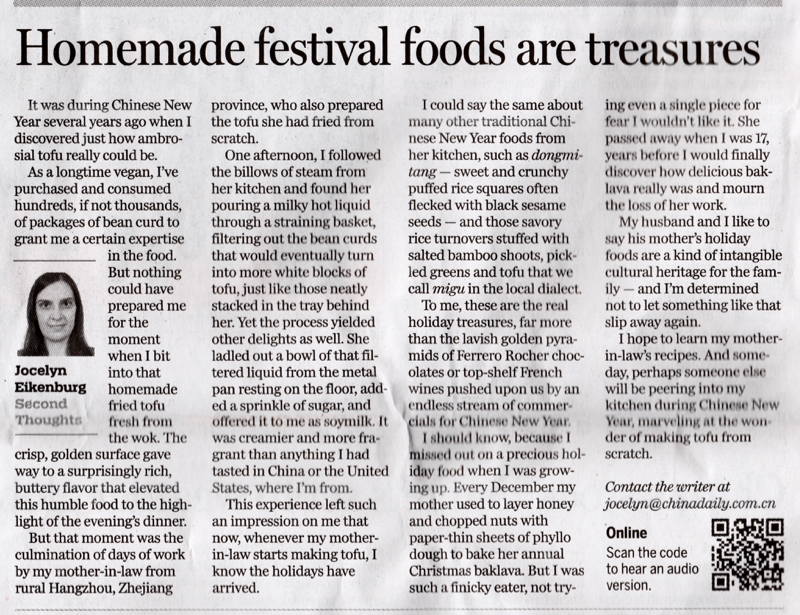
Pub’d on China Daily: Homemade festival foods are treasures

The China Daily just published another column I wrote titled Homemade festival foods are treasures. Here’s an excerpt from the column:

It was during Chinese New Year several years ago when I discovered just how ambrosial tofu really could be.

As a longtime vegan, I’ve purchased and consumed hundreds, if not thousands, of packages of bean curd to grant me a certain expertise in the food. But nothing could have prepared me for the moment when I bit into that homemade fried tofu fresh from the wok. The crisp, golden surface gave way to a surprisingly rich, buttery flavor that elevated this humble food to the highlight of the evening’s dinner.

But that moment was the culmination of days of work by my mother-in-law from rural Hangzhou, who also prepared the tofu she had fried from scratch.

The article was shared on the China Daily WeChat account and has received over 4,000 views as I write this! Here are some of the lovely comments readers have left in response in WeChat:

Many foreigners will enjoy the chinese foods so much as to forget leaving.Chinese food even the same name has dozens of recipies in different areas. Some of them taste sweat in the north,but some of them spicy or salty in the south on tbe contrary. In some places,the recipies are secrets and they are handed down only by families. The author is so lucky to have tried a lot of chinese holiday foods during every year,for nomal people would not get them in the street except special days.By the way,I dont like tofu whatever way it is made of.

Really a good narrative article which combine west culture and east culture into the one that is the love for our great mother and theirs masterpiece homemade food which is not only the treasures for us but also the intangible heritage for our respective families. I also remember the culmination of our spring festival eve is the moment of our feast dinner come into our table l have prepared the tableware for a longtime to enjoy those ambrosial and palatable food really delicious and unforgettable.

You can read the full piece here, which also includes a recording of me reading the article. And if you love it, share it!

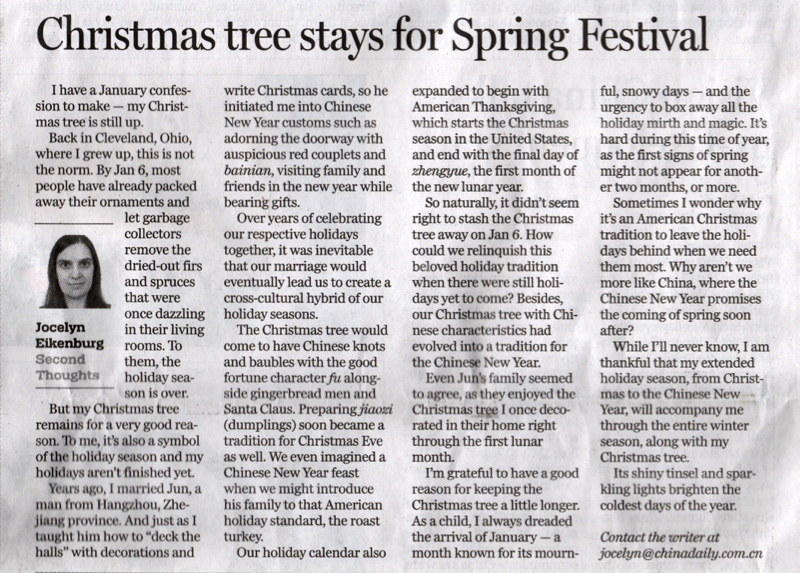
Pub’d on China Daily: Christmas tree stays for Spring Festival

China Daily just published another one of my columns in their newspaper today — it’s titled Christmas tree stays for Spring Festival. Here’s an excerpt:

I have a January confession to make – my Christmas tree is still up.

Back in Cleveland, Ohio, where I grew up, this is not the norm. By Jan 6, most people have already packed away their ornaments and let garbage collectors remove the dried-out firs and spruces that were once dazzling in their living rooms. To them, the holiday season is over.

But my Christmas tree remains for a very good reason. To me, it’s also a symbol of the holiday season and my holidays aren’t finished yet.

You can read the full piece here. And if you like it, share it!