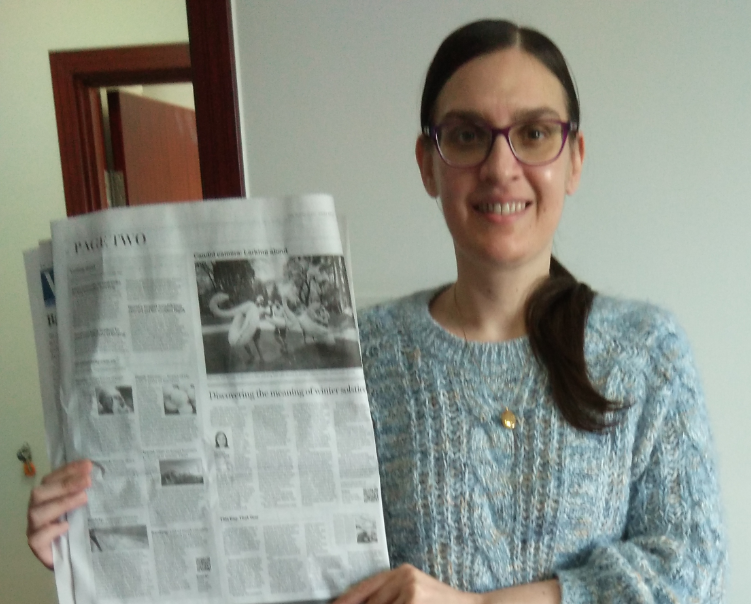
Recently, China Daily published my Christmas story in a piece titled Christmas memories from foreigners living in China. (I know I’m a bit late updating you but I’ve been busy battling a cold and also caring for my husband, who caught the flu. But hey, if you subscribe to the 12 days of Christmas, it’s still technically the holidays. 😉 ) Here’s an excerpt from the piece:
In December 2013, I had to spend Christmas in the Hangzhou countryside with my husband’s family, who never had the tradition to celebrate this holiday.
It was my first Christmas away from America in many years, and the loss felt palpable in this rural village, where there wasn’t even a hint of the holidays. But in the end, I made a resolution — if they could not bring Christmas to me, I would bring it to them.
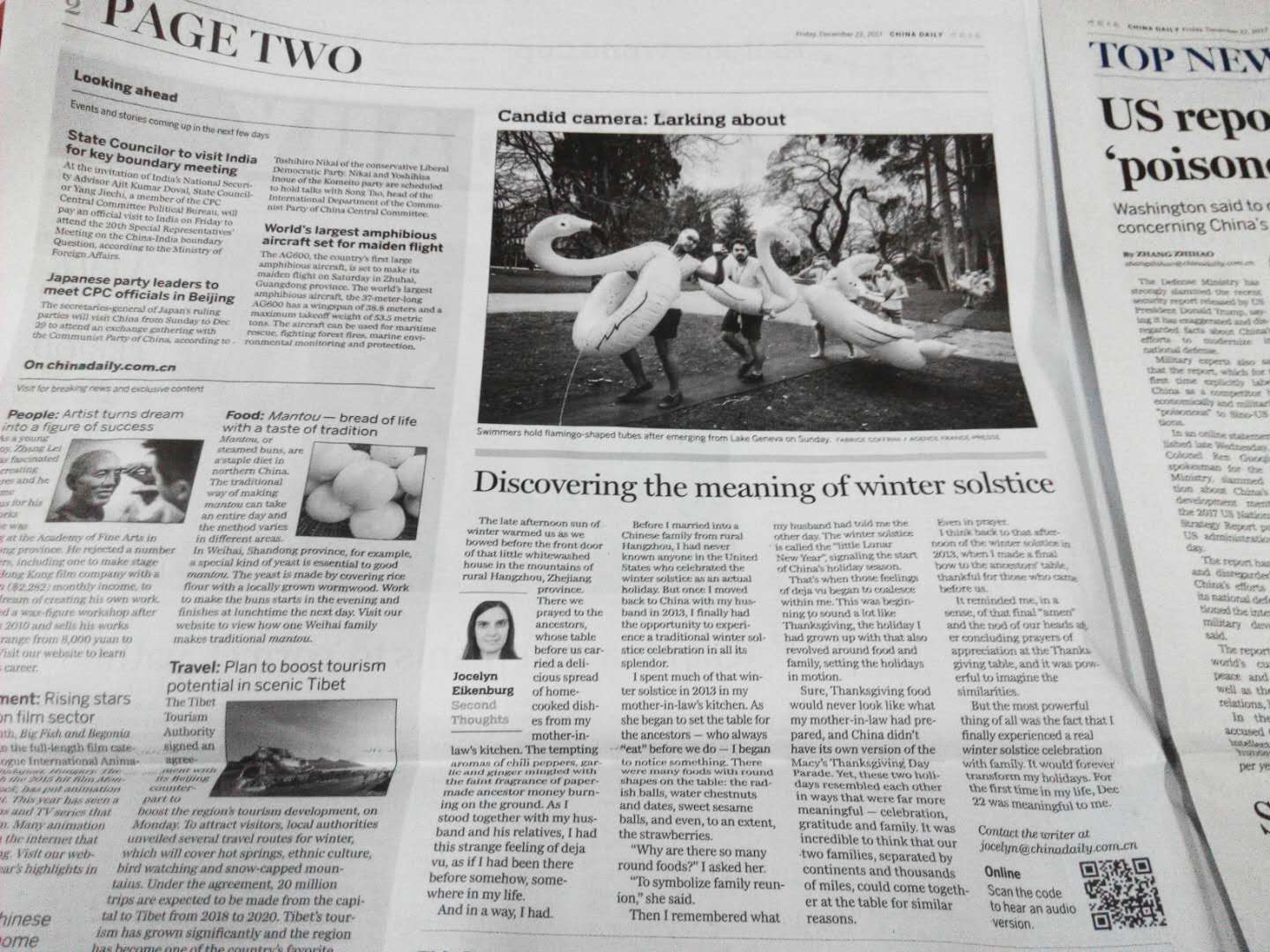
The late afternoon sun of winter warmed us as we bowed before the front door of that little whitewashed house in the mountains of rural Hangzhou, Zhejiang province. There we prayed to the ancestors, whose table before us carried a delicious spread of home-cooked dishes from my mother-in-law’s kitchen. The tempting aromas of chili peppers, garlic and ginger mingled with the faint fragrance of papermade ancestor money burning on the ground. As I stood together with my husband and his relatives, I had this strange feeling of deja vu, as if I had been there before somehow, somewhere in my life.
And in a way, I had.
Before I married into a Chinese family from rural Hangzhou, I had never known anyone in the United States who celebrated the winter solstice as an actual holiday. But once I moved back to China with my husband in 2013, I finally had the opportunity to experience a traditional winter solstice celebration in all its splendor.
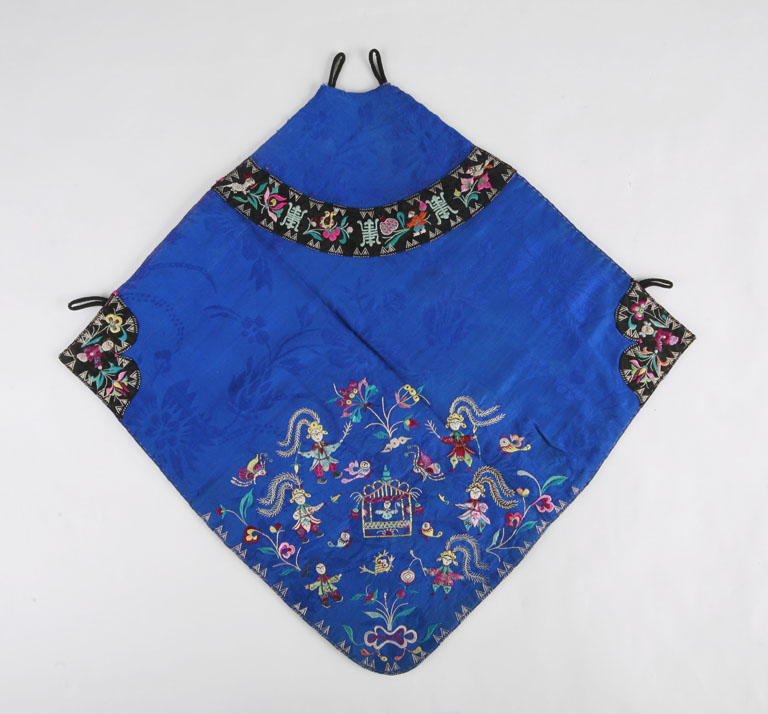
By The Children’s Museum of Indianapolis, CC BY-SA 3.0, https://commons.wikimedia.org/w/index.php?curid=17132756
Picture this. You loved someone so much, you gave the person your underwear as a token of your affection – and they loved you so much, they wore it.
As kinky as this sounds, it was a real phenomenon in ancient China, where women would give their dudou, a type of underwear that covered the chest and was worn by women and men alike, to their lovers.
If you’ve never seen a dudou before, it’s an octagonal piece of cloth with strings you could tie around your neck and back to keep it in place. The dudou reminds me of a halter top, except instead of being a sexy, seasonal summer thing, it was traditionally tucked beneath one’s clothing all year long, safely out of sight.
There are no reliable historical records regarding the origin of the du dou. Yet a similar type of clothing called ri fu was mentioned in Zuo Zhuan, the earliest annals in China.
It was about a woman, Xia Ji, who had an affair with a king and the king’s two secretaries. The woman sent her ri fu as a gift to the king to show her love. The king was thrilled and wore her underwear all the time. One day, he showed the underwear off to his two secretaries. He didn’t expect that the latter two also took off their clothes and revealed ri fu that Xia Ji had sent to them.
The affair was recorded in the annals to criticize the shamelessness of the king. Yet it also implies underwear was a secret gift between lovers.
Many folk tales in the Yuan, Ming and Qing dynasties (1271-1911) have similar plots about lovers exchanging their du dou.
In Yu Shi Ming Yan, edited by litterateur Feng Menglong from the Ming Dynasty (1368-1644), there is a story about a du dou called “pearl underwear”. A woman also sent the underwear to her lover as a token, for they could not meet every day.
It’s fascinating that this was a thing in ancient China. After all, when modern lovers exchange underwear, it’s usually because someone just bought you, say, some sexy lingerie from Victoria’s Secret – and not because he or she just handed over their bra or panties or boxers for you to wear. Even if you could overcome that natural aversion to putting on someone else’s underwear (particularly for men, who would probably not want to be caught in something frilly, lacy or pink), could you even fit into it? I’m willing to bet that, for many of us, the answer is no.
That was the beauty of the dudou, though. It was designed to fit a wide range of bodies – men’s and women’s — and the ties made it inherently adjustable. Because it covered the chest and not the crotch, there wasn’t that ick factor involved in sharing it among lovers. Besides, everyone wore it, even the guys, so nobody would question your masculinity if you suddenly revealed you had on a dudou.
Could modern lovers revive this traditional gift? I have to confess I’m skeptical about the willingness of modern men to actually wear a dudou designed for women. But I’m pretty sure most guys wouldn’t say no to seeing you wear one – and maybe, if you gave him a really special one, he might just cherish it as much as the ancients did in China.
P.S.: If you’re interested in buying a dudou this holiday season and giving it to your lover, you can find them on Amazon, where your purchases help support this blog.
Finally, time to share the big news with you — I’m bound for Beijing this weekend, where I’ll be working for the China Daily website as a copy editor.
It’s really a dream job for me, and so hard to put into words just how excited I am to work for China’s most prominent English-language newspaper.
But I’m also thrilled about relocating to Beijing, where a lot of my friends happen to live. We’ve had to manage long-distance friendships, so the prospect of actually meeting these friends in person is also like a dream. Or an early Christmas present. 😉
I also look forward to making new friends up in the great Chinese capital, including readers like you.
And don’t worry, the blog isn’t going anywhere. I’ll continue to publish the same outstanding content you’ve come to love from Beijing.
Here’s wishing everyone a gorgeous October!
P.S.: For anyone wondering, yes, my husband will move with me.
When Chinese students in the US returned to universities in 2017, they began a new semester under a cloud. The Los Angeles Times reported that, in the wake of Trump’s election, the Chinese Consulate in San Francisco warned students of rising anti-China sentiment that might be dangerous. The Consulate’s letter cited instances of verbal abuse directed at Chinese students. Meanwhile, Asian Americans Advancing Justice has recently reported a huge uptick in hate crimes against Asians, thanks to Trump’s demonization of China as America’s enemy.
But it would be naïve to assume that all of this started with Trump’s election. In fact, there has always been a negative bias against Chinese students in the US
Much of the mainstream news coverage of Chinese students in America has a negative slant – from stories like “Heavy Recruitment of Chinese Students Sows Discord on US Campuses” (Wall Street Journal) to more exaggerated headlines such as “How Chinese Students Are ‘Cheating’ To Get Into US Universities” (Forbes) and “Fraud frenzy? Chinese seek US college admission at any price” (CNN). Meanwhile, that bias has trickled down to the public. I’ve had many conversations about Chinese students in America with academics and the general populous; most often, people allege Chinese are ruining the quality of education, or stealing admissions spots from more deserving American students. Even Google displays this bias; when I searched for Chinese students in the US, of the four suggested search strings, two were the following: Chinese students in the US problems, and Chinese students in the US rich.
The negative bias against Chinese students in America needs to stop.
Recently, I shared the story of my own unlikely pathway to marrying a Chinese man, including what I originally thought of Chinese men before coming to China, in an opinion piece for the China Daily. Here’s an excerpt from that:
When I think back to the months I spent in preparation for that year of teaching English in Zhengzhou, I draw a blank on Chinese men, apart from one simple thing. I assumed they weren’t dating material for me, and I wasn’t alone. An American man who had once taught in China famously told me, “You don’t have to worry about the students falling in love with you.”
It made sense to me. I had only ever forged friendships with foreign Asian men at my university, feeling romance was never a possibility, and had yet to move past “Hello” with any of the Chinese men on campus, who almost never noticed when I smiled or waved at them while passing by on the way to classes. I never saw white women dating Asian men on television or in the movies. Even the handful of Asian men who went to high school with me in my very white, very middle-class suburb didn’t seem to date anyone, let alone a girl like me. It was as if the universe decreed that there was a racial and cultural line that I was never meant to cross if I wanted to find love.
But beyond all expectations, love happened to me in China – and it was a love deeper and more passionate than anything I had ever experienced before. It was as if I had never truly loved before. Here was China, giving me a real-life lesson in what it actually meant to be intimately connected with someone else.
None of this would have happened if I hadn’t opened my heart to the possibility of love – if I hadn’t transcended my own past assumptions and biases about dating in China.
For me, the interracial and intercultural relationships I’ve enjoyed in China – including, most of all, my marriage to John – have been a transcendental experience. They’ve allowed me to go beyond what I used to believe about Chinese men and Asian men, and have made me more aware of how prejudices and stereotypes against certain racial groups still loom large in the dating world.
Granted, I know that one person isn’t a lot. But I’d like to think that every time someone like me ends up loving beyond their own boundaries — their own perceptions of what it means to be in love – it brightens our world a little more.
Do you think that interracial/intercultural relationships can be a transcendental experience?
The idea of dating or marrying a Chinese man never really crossed my mind before I first came to China in 1999. That’s probably the last thing you expected to hear from a woman known for writing and blogging about her marriage to a Chinese man, but it’s true.
When I think back to the months I spent in preparation for that year of teaching English in Zhengzhou, I draw a blank on Chinese men, apart from one simple thing. I assumed they weren’t dating material for me, and I wasn’t alone. An American man who had once taught in China famously told me, “You don’t have to worry about the students falling in love with you.”
Megan Millward and husband Zhang Lie -- one of the couples of Western women and Chinese men featured in this China Daily article (photo from http://www.chinadaily.com.cn/)
In case you missed it (or, like me, you spent the weekend away — in my case, a wedding in Hangzhou — and are just catching up), the China Daily just published an article titled Western Women, Chinese Men — about the growing trend of marriages between Western women and Chinese men. It features me, as well as fellow bloggers Jo Gan of Life Behind the Wall and Melanie Parsons Gao from The Downtown Diner. Here’s an excerpt from the article with some quotes from me and my husband:
Jocelyn Eikenburg, a 33-year-old American who blogs on speakingofchina.com, had a similar experience [of having the relationship get serious fast] when she first began dating her husband, Jun Yu. “Immediately after we first started dating, he was calling me laopo.” That is Chinese for “wife”.
She was surprised by how quickly the relationship had gone from friend to potential spouse. Her blog focuses on cross-cultural relationships between Chinese men and Western women.
Family can also be another hurdle for many foreign women in relationships with Chinese men.
When Jun told his family about his relationship with Eikenburg, his father did not approve. “He cautioned me about dating a foreign girl and did not want me to get hurt,” Jun says.
His family’s attitude toward their son dating a foreign woman quickly changed when Eikenburg went home with Jun for Chinese New Year. When she showed his father pictures of her family at home, “it really opened him up”, she says. As filial piety is important to Chinese families, Eikenburg says that experience helped break down barriers….
This website uses cookies to improve your experience. We'll assume you're ok with this, but you can opt-out if you wish.AcceptRejectRead More
Privacy & Cookies Policy
Privacy Overview
This website uses cookies to improve your experience while you navigate through the website. Out of these cookies, the cookies that are categorized as necessary are stored on your browser as they are essential for the working of basic functionalities of the website. We also use third-party cookies that help us analyze and understand how you use this website. These cookies will be stored in your browser only with your consent. You also have the option to opt-out of these cookies. But opting out of some of these cookies may have an effect on your browsing experience.
Necessary cookies are absolutely essential for the website to function properly. This category only includes cookies that ensures basic functionalities and security features of the website. These cookies do not store any personal information.
Any cookies that may not be particularly necessary for the website to function and is used specifically to collect user personal data via analytics, ads, other embedded contents are termed as non-necessary cookies. It is mandatory to procure user consent prior to running these cookies on your website.

 Recently, China Daily published my Christmas story in a piece titled Christmas memories from foreigners living in China. (I know I’m a bit late updating you but I’ve been busy battling a cold and also caring for my husband, who caught the flu. But hey, if you subscribe to the 12 days of Christmas, it’s still technically the holidays. 😉 ) Here’s an excerpt from the piece: