9 Awesome Olympic Moments from Asian Figure Skaters Around the World

If there’s one thing I love about the Winter Olympics, it’s figure skating. And at this year’s Winter Olympics in Pyeongchang, Asian figure skaters from around the world have delivered some incredible Olympic moments in figure skating, even making and breaking records.

Here are 9 awesome Olympic moments from Asian figure skaters from around the world:

Vincent Zhou becomes first to land quadruple lutz at the Olympics

While American figure skater Vincent Zhou ultimately ended up in sixth place, he created a golden moment at the Olympics with his pioneering quadruple lutz, becoming the first person to complete the jump at the Games.

Boyang Jin pulls off record fourth-place performance for China

Never mind that Chinese figure skater Boyang Jin came in fourth place, just shy of a medal. He’s now beloved in China for becoming the country’s highest-ranked Olympic athlete in men’s figure skating. Besides, his choice of Star Wars music won plenty of applause from audiences, so maybe the force will be with him next time around.

Nathan Chen lands a record six quadruple jumps in his free program

While American figure skater Nathan Chen couldn’t bring home a medal in men’s figure skating, he stunned audiences by landing a record six quadruple jumps during his free program, with a score that even topped Yuzuru Hanyu’s free skating performance. Wow! He’s proven he’s worthy of a medal, and at 18 he still has Olympic chances ahead of him.

Mirai Nagasu thrills as first American woman to nail a triple axel

Despite her inconsistency on the ice, Mirai Nagasu still delivered one of the most thrilling moments of the Olympic Games when she successfully landed a triple axel during the ladies free skating event in the team figure skating competition — a first for American women. Mirai Nagasu also became the third woman to do so in any competition after Tonya Harding and Kimmie Meissner, and her performance helped America walk away with a team bronze.

Alex Shibutani and Maia Shibutani become first ice dancers of Asian descent to receive Olympic medals

American ice dancers Alex Shibutani and Maia Shibutani (the “Shib Sibs”) didn’t just wow audiences with stunning performances in ice dancing. They also made history as the first ice dancers of Asian decent to win Olympic medals — a bronze as part of team USA and a bronze in ice dancing. Alex Shibutani also shared an inspiring thread of tweets, noting “Our differences are what make us unique.”

China’s silver medalists Han Cong and Sui Wenjing dazzle with near-perfect short program

While this duo ultimately took the silver in figure skating pairs, Chinese figure skaters Han Cong and Sui Wenjing will be remembered for a powerful short program performance — one that judges considered the second strongest the world has ever witnessed.

“Pocket rocket” Shoma Uno delivers silver for Japan

Though Japanese figure skater Shoma Uno was invariably overshadowed by Olympic champion and fellow compatriot Yuzuru Hanyu, Uno — also known as the “pocket rocket” for his superlative jumping skills — secured a silver medal in his first Olympic appearance, allowing Japan to occupy two positions on the podium.

Hallelujah! Patrick Chan finally gets Olympic gold through Canada’s team medal

The Canadian figure skater’s song for his free skate program — Jeff Buckley’s “Hallelujah” — turned out to be apropos. After years of chasing Olympic gold, Patrick Chan finally secured the medal through Canada’s team win in figure skating.

Yuzuru Hanyu clinches a second consecutive Olympic gold in men’s figure skating — and gets showered with Winnie-the-Pooh bears
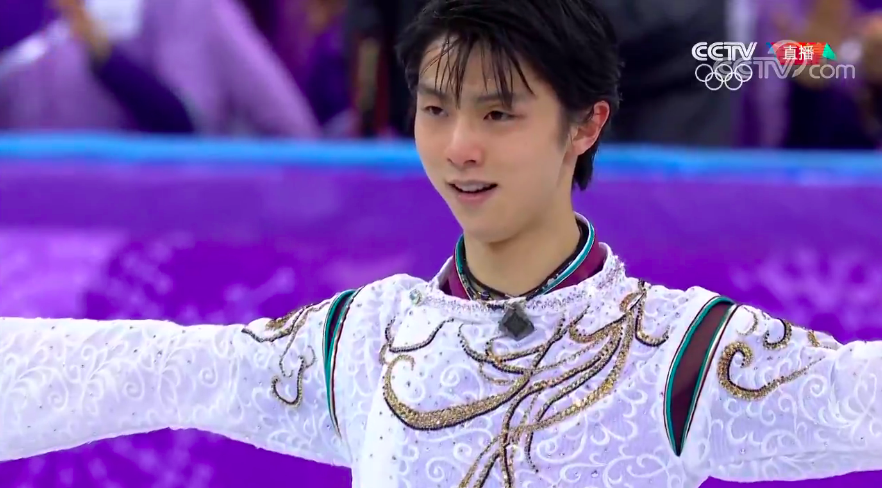
Japanese figure skater Yuzuru Hanyu’s consummate run in the men’s figure skating competition earned him a second consecutive Olympic gold, and legendary status as the second person to accomplish this after Dick Button. Some are calling him the greatest figure skater of all time. But he’s also famous for his love of Winnie the Pooh, leading his entourage of fans to rain down stuffed Pooh bears after his performances. It’s quite a phenomenon to behold at the Olympics, much like Yuzuru Hanyu himself.

What are your favorite Olympic moments?
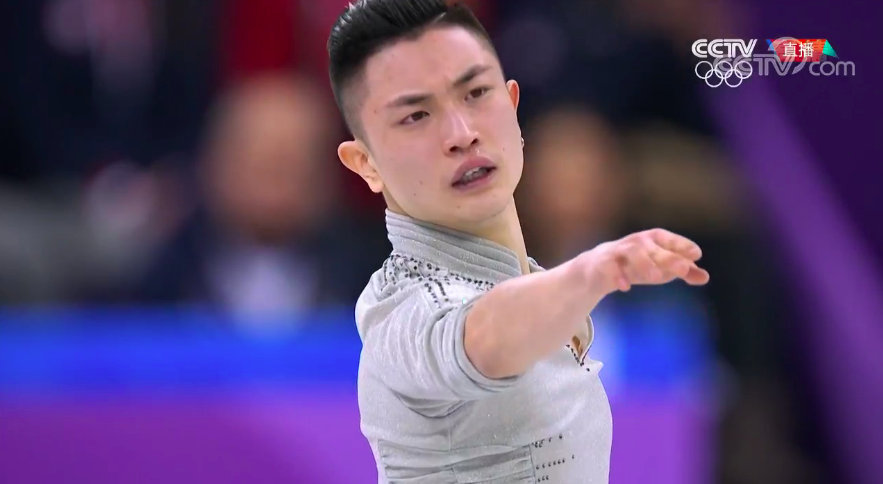
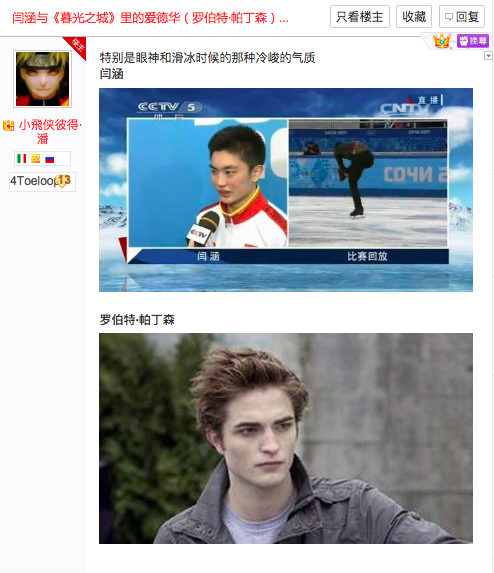
Olympic Figure Skater Yan Han Performs to “Twilight” Song, and Reminds Us of Edward in “Twilight”

Yan Han TwilightRecently, Chinese Olympic figure skater Yan Han took to the ice to a version of Christina Perri’s “A Thousand Years” — and audiences cheered his choice of such a romantic, moving song. (In 2011 and 2012, the song became synonymous with Bella, Edward and their legendary human-vampire romance when it played in the “Twilight: Breaking Dawn” movies).

Never mind that he had some stumbles. His song for the men’s figure skating short program was endearing to audiences, especially those of us who adore “Twilight”. (Team Yan Han, anyone?)

But if you’ve seen the Edward in the “Twilight” movies (played by Robert Pattinson) and witnessed figure skater Yan Han on the ice, you might just agree with something Chinese fans have been saying. That he looks like Edward in “Twilight”.

When asked about it by the Chinese media, Yan Han acknowledged the similarity. (Interestingly, CCTV mentioned in their Olympic commentary that his choreographer Lori Nichols noticed the resemblance between Yan Han and Edward, and used this to tailor his moves for the short program.)

In response to a question about who was more handsome, Yan Han said that in the movies, of course Edward was more handsome, but joked that on the ice, he is more confident.

It’s great to see him display a little humor after his uneven performance. Let’s hope that spirit and confidence, boosted by this gorgeous song, will help him land those jumps next time around. (Admittedly, he’s has had a tough Olympics, since he is still healing from a number of injuries, as he told Chinese press in an emotional interview.)

In the meantime, you can once again sigh over his routine set to “A Thousand Years” online. And you can learn more about the Olympic figure skater at his Wikipedia page.

Did you see Olympic figure skater Yan Han perform to the “Twilight” song? Do you think he looks like Edward in “Twilight”?

Olympic Speedskater Shaolin Sandor Liu Has a Cool China Connection Beyond His Chinese Father

While Jun and I were watching China compete in the men’s 1,500m speedskating event at the Pyeongchang Winter Olympics, we happened across a fascinating young man among the competition: Hungary’s Olympic speedskater Shaolin Sandor Liu.

Shaolin Sandor Liu Chinese

After seeing his name, I knew one of his parents must be Chinese. Turns out, besides his Hungarian mother, he has a Chinese father.

But that’s not his most fascinating connection to China. Here’s what I discovered on his athlete page at the Olympics website:

He and younger brother Liu Shaoang were given the opportunity to train in People’s Republic of China earlier in their career. “We were really lucky. When we started there was a world championships in Hungary and the Chinese team came. My father, being Chinese, started speaking with them, helped with different things in Hungary and getting to know the country. They said since his two sons were Chinese they should come and train in China. It sounded good to him so he decided to take the chance to bring us to China and we were training there for one-and-a-half years. Before our results weren’t really good. After that time we came back from China and we won every competition.”

As anyone who follows short track speedskating knows, China has a powerhouse of a team in this sport, with a total medal count only second to the leading country, South Korea. So I’m not surprised that Shaolin Sandor Liu improved so much after training with the Chinese team.

Shaolin Sandor Liu claimed gold in the 500m short track speedskating event at the 2016 World Championships in Seoul. During the current World Cup short track speedskating season, he’s had a number of strong performances, including ranking first in the 500m event at Budapest and the 1,000m event at Seoul.

That’s why, while he only finished in fifth place in the 1,500m short track speedskating finals the other day, Shaolin Sandor Liu is still a solid contender in the Pyeongchang Winter Olympics. He’s set to compete in the 1,000m event Tuesday, February 13 at 19:26 Korea time. If you happen to tune in, watch for him — and why not root him on as well?

Additionally, here are few more interesting things about Shaolin Sandor Liu:

  • His parents — a Chinese father and Hungarian mother — aren’t the only reason I’ve tagged this post AMWF (Asian male/White female, in this case). Liu’s current girlfriend is Elise Christie, the short track speedskating star from Britain.
  • For curious readers who happen to know Chinese, his name Shaolin is written as 少林 (shàolín), the same as the famous Shaolin Temple in Henan province. (And according to an anonymous post online in Chinese, his Mandarin is pretty good.)

To learn more about Shaolin Sandor Liu, head on over to his athlete page for the Olympics or follow him on Facebook and Twitter.

What fascinating athletes have you encountered so far while watching the Pyeongchang Winter Olympics?

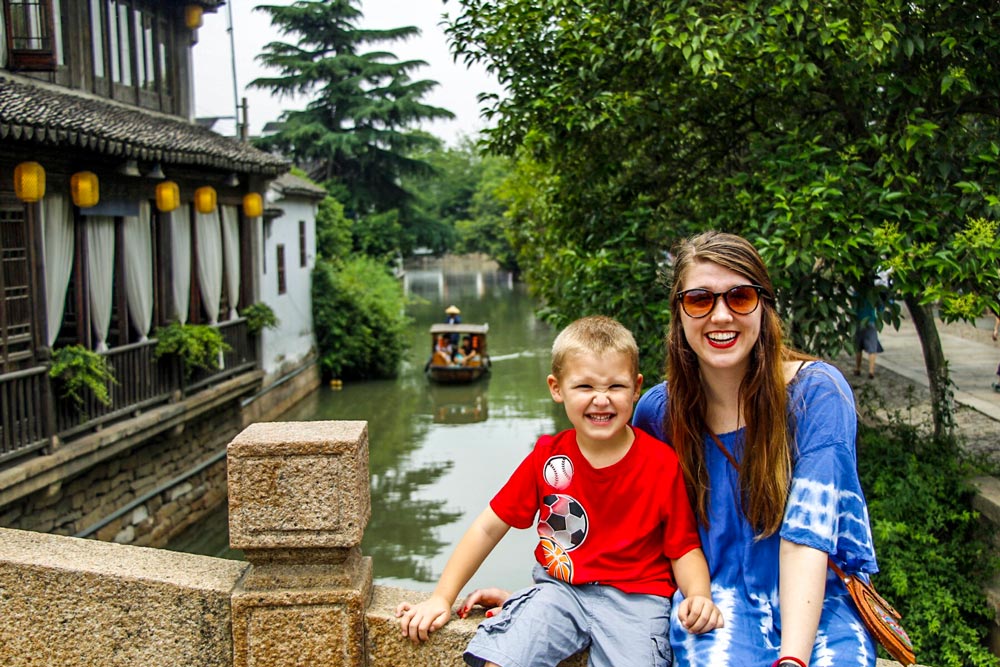
Guest Post: Expat Dad Shares Tips for Raising Kids in China

I’m honored to run this guest post from Josh Summers, who started the phenomenal blog Far West China covering Xinjiang province and just started a new website called Travel China Cheaper. He’s also a dad here in China and today shares some of his tips for raising kids in this country.

Do you have some experiences or other stories you would like to share on the blog? Check out the submit a post page to learn how to have your words featured here.
—–

I remember when I first arrived in China with my 1-year old son. It was an emotional moment as I sat on the hotel bed thinking to myself, “What have I done? Is this really fair to make my son live as an expat?” Away from his loving grandparents. Away from a reliable school system. Away from everything I had known growing up.
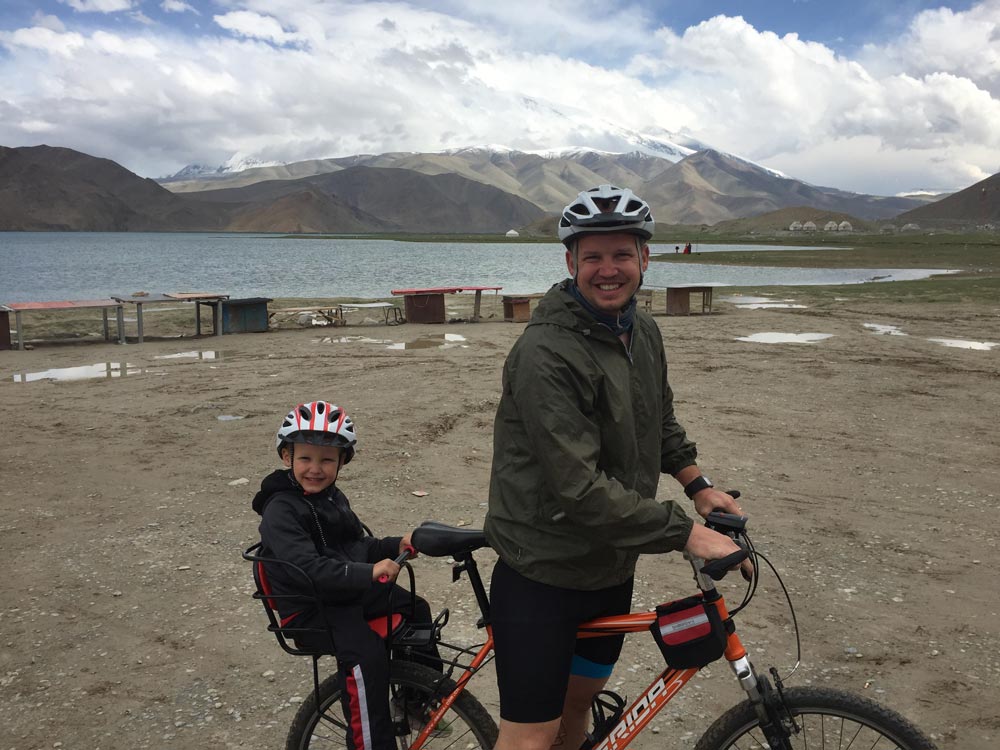
It’s been more than 4 years since that evening and I’ve learned a lot as a dad. It’s not that I’m an expert now, but looking back I realize a lot of the things I’ve done well as well as those things that I’ve done poorly.

Hopefully I can share some thoughts that might encourage you as you consider raising your kid in China – or any country for that matter.

Give Your Child an “Exit Word”

In China, this was a big deal for us. Outside of China’s major cities, cute little foreign babies and toddlers are still fawned over like crazy. I can’t even count the number of times that a Chinese lady has taken my son from my arms to hold or show off to their friends.

When my son was a baby, he made his feelings known by crying if he didn’t like this. As a walking, talking toddler, this wasn’t always the case.

My wife and I decided to give our son an “exit word”. What this means is that if people ever wanted to take a picture with him (which happened often on the road) or tried to take him over to play with their son, he could go if he wanted. However, if he didn’t want to for any reason, all he needed to say was “No, thank you” and we would immediately step in and remove him from the situation.

We want our son to be comfortable in the Chinese culture. We also know that he gets special attention as a foreign kid, so giving him this “exit word” has been key to keeping him from growing bitter toward China.

Include Your Child in Major Decisions

My son didn’t make the decision to move to the other side of the world away from his family and friends. The least I can do is respect him enough to include him in other major decisions that affect his life.

Will he go to Chinese school or be home schooled? (We don’t have an international school option where we live.)

Where will we take our vacation?

Is our time in China done? Should we move back to the US?

Mind you, including him in the decision doesn’t mean he gets to make the final decision. I merely want him to know that we’re not dragging him around or asking him to do something without giving it proper consideration.

Be an Example of an Adventurous Attitude

I know a lot of parents who want their kid to be that model expat kid who speaks Mandarin, loves local food and gets along well with both expat and local kids. At the same time, they don’t study, they eat at McDonalds and they only hang out with their expat crowd.

I’m a firm believer that I need to model what I hope to see in my kids. I am the biggest influence in his life!

I want my son to grow up with a sense of an adventure, a desire to learn and an ability to adapt to very different situations. My hope is that he can see me doing that on a daily basis and learn from that.

Are you trying new things? Are you attempting to learn the Chinese language and culture? If not, don’t be surprised if your child doesn’t either.

Be EXTRA Involved in your Child’s Life

As parents, we often don’t realize how good we had it in our home country. We had family we could rely on to love on our children, social clubs for interaction (church, athletic teams, etc.) and a familiar education system.

When we leave that environment, we unknowingly shift a lot of that responsibility on ourselves. And often, unfortunately, we come short. At least I do.

I’ve learned that I need to be very intentional about being involved in my son’s life. He doesn’t have a grandpa around who can share that load. He doesn’t have a basketball coach that can teach him to play basketball.

That’s on me. And I need to own that responsibility if I’m going to live as an expat dad.

Be Intentional with your Child’s Education

Building upon the burden of responsibility I just mentioned, I believe it’s important that my wife and I are intentional about our child’s education.

Most of the time the schools in our home country take on the responsibility of planning for the future. It’s assumed that students will at least attempt to go to university within the country and are prepared accordingly.

Unless you can afford to send your child to a fancy international school, this kind of preparation often falls on us as parents when living as China expats. My son is only 5 years old and we’re not only putting away money for his college every month, we’re making sure we understand all the different tests and other requirements that will be expected when he considers high school or college in the US (our home country). Every country has different requirements and within the US, even each state is different!

Conclusion | Raising a Child in China

I am convinced that raising my child in China is giving him advantages that most other kids don’t have – Chinese language immersion, multi-cultural experience, etc. If I didn’t believe that, I wouldn’t be here!

But these advantages don’t come automatically. I have learned over the past few years that if I want my family to thrive in China, I need to be personally responsible and very intentional about how our family operates.

Our time in China won’t be forever. I want to take advantage of it while we can!

Josh Summers has been living in China since 2006 with his wife and two sons, all of whom have spent more of their lives in China than in their home country of the United States.
—–

Speaking of China is always on the lookout for outstanding guest posts! If you have something you’d like us to feature, visit the submit a post page for details — and then submit yours today.

Is Beijing China’s Best City for Western Women Married to Chinese Men?

Over 20 years ago, the TV series “Foreign Babes in Beijing” (洋妞在北京) became a sensation across China. Say what you want about the show – which Rachel DeWoskin, one of the show’s stars, described as “an apt, if tacky, example of China’s very conflicted feelings about the West“ – I couldn’t help thinking about it recently after moving to China’s great capital city. That’s because there’s one thing I’ve noticed about this city: there are a LOT of AMWF (Asian male, Western female) couples who call Beijing home.
Among the online groups of Western women with Chinese husbands I belong to, the Beijing group stands out for a very simple reason – sheer numbers. It has over 100 ladies! This blows my mind. Back in Hangzhou, I felt lucky to find one or two in the city (even though Hangzhou is pretty large, expats tend to come and go pretty quickly, making it difficult to connect to new folks). But here, there are so many women it could take me months, if not nearly a year, to meet all of them.

In my opinion, this is a good problem to have. A very good problem.

So I’ve been thinking about Beijing and its status as the unofficial epicenter of the AMWF community in China. What makes Beijing the number one city for couples of Western women and Chinese men? It’s even more intriguing to me because Shanghai appears to have a slight advantage over Beijing among foreigners as a whole (see this BBC report and this story from the China Daily).

So why Beijing over, say, Shanghai?

Is it a matter of job opportunities? (One foreign woman with a Chinese husband, who happens to live in Shanghai, once privately shared her frustrations over the city’s job market, which she considered stagnant compared to Beijing). Do more of us come as university students, landing in the one city that attracts the most foreigners to study abroad? Is it the wealth of resources in town, from great schools and hospitals to an airport connected to every major city across the globe? Or are we simply more enamored with Beijing’s rich cultural and historical traditions reflected in the many superlative sightseeing attractions here, from the Forbidden City and the Temple of Heaven to the Great Wall?

Whatever the reason, I’m loving this city just for the opportunity to have some good company with fellow yangxifu (the foreign wives of Chinese men) on a regular basis.

And if China’s entertainment industry ever finds out about Beijing’s pre-eminence among AMWF couples, maybe they’ll decide it’s high time for a proper “Foreign Babes in Beijing” sequel. But this time, it’ll be “Foreign Wives in Beijing.” 😉

Do you think Beijing is China’s best city to live in? Why or why not?

3 Delicious Fall Treasures in Hangzhou, China

If Hangzhou truly is one of the heavens in China, it might just be because of these three delicious treasures you can enjoy there in the fall. While visiting with this family this fall in rural Hangzhou, I rediscovered these treasures – and want to share them with you:

#1: Pomegranates

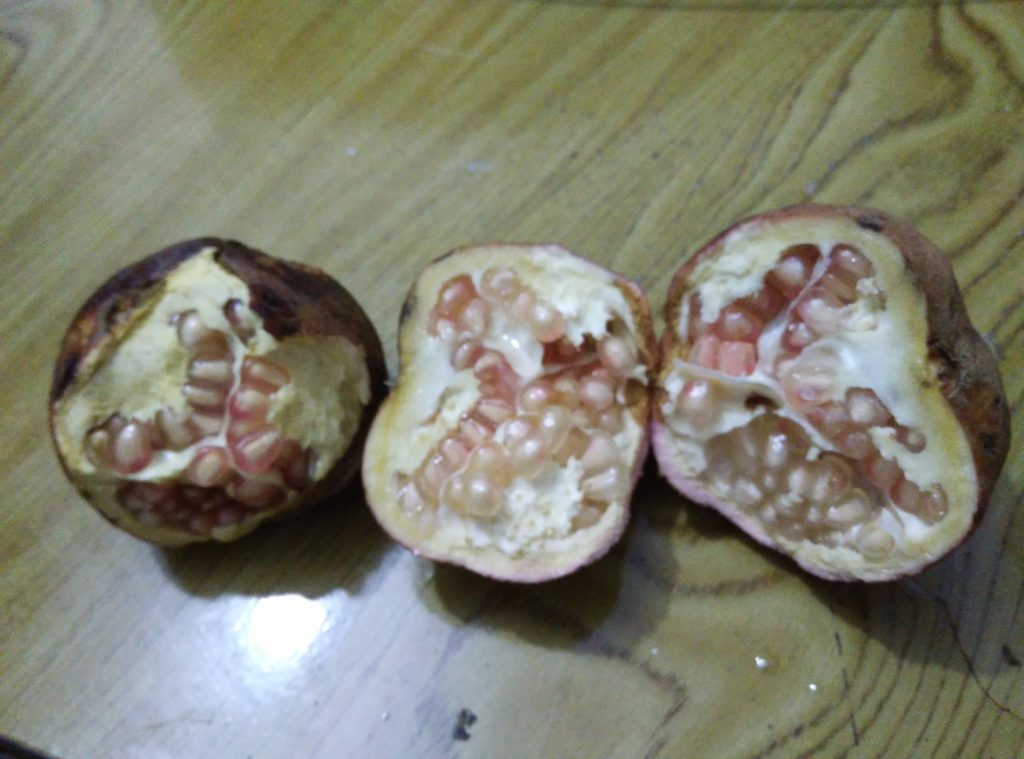
As much as I’ve loved pomegranate juice, I didn’t have the same affection for the fruit. It’s a bunch of pulpy little seeds. How could anyone love eating that?

My anti-pomegranate bias was challenged, however, when my mother-in-law gifted us with a heaping bag of the fruit, freshly harvested from the tree in her yard. Not long after that, my husband broke one open and started sharing the seeds with me. So I popped a handful in mouth – and was stunned. They were bursting with that same rich, sweet-tart flavor I’ve come to love about pomegranate juice. But better! These weren’t a bunch of pulpy seeds – these were ambrosial fruit jewels.

Just like that, I became a pomegranate fan.

Here’s the best part – the pomegranates also healed me. I’ve faced a lot of exhaustion and stress recently from moving around, which usually leaves me with an uncomfortable, nervous stomach. Well, pomegranate is actually good for your digestion and pretty soon I found I no longer needed my usual peppermint tea after dinner. Now that’s a superfood!

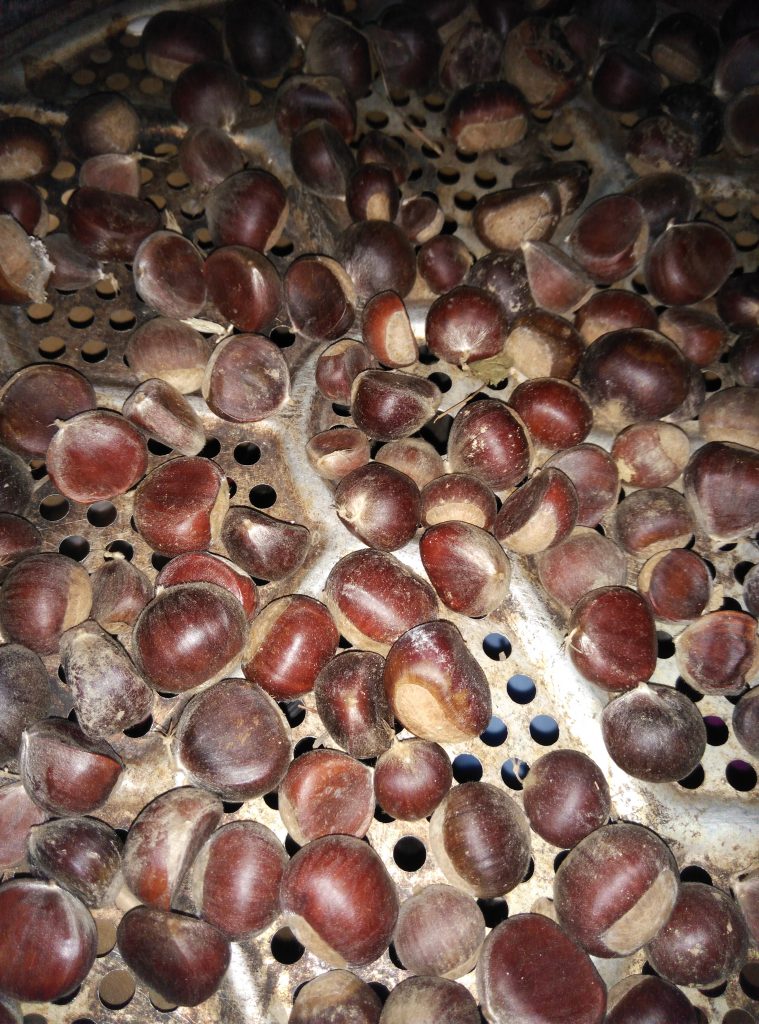
#2: Roast Chestnuts

As a kid, I used to sing the praises of roast chestnuts every holiday season in the form of Christmas carols. But I never once tried a roast chestnut until I came to the Hangzhou region – and especially, until I stayed with my husband’s family in the countryside.

Here the hillsides become a land of plenty as the chestnut trees shower their delicious fruit everywhere. People like my mother-in-law scour the natural areas for chestnuts, and then take them home to roast. There’s nothing quite like the aroma of roasted chestnuts, especially on a chilly fall evening. I also love the subtle flavor reminiscent of sweet potatoes, and the fact that they can be a terrific after-dinner snack. Open fire optional. 😉

#3: Osmanthus Flowers

In China, people call October the “golden month.” But I believe the real gold of the season is when the air is redolent with the intoxicating aroma of sweet osmanthus flowers.

Osmanthus trees produce some of the smallest blooms. But if heaven was a fragrance, it would probably smell something like this. Even better, these flowers are a delightful addition to a number of fall treats, including roast chestnuts and mooncakes. You can even make a tea out of the flowers.

But the best way to enjoy them is to take a fall stroll in a garden filled with blooming osmanthus trees, inhaling a scent so luscious it must have been reserved for the gods. This experience should be on everyone’s bucket list.

What are your favorite fall “treasures”?

AMWF History: Chinese Surgeon Qiu Fazu and His German Wife Loni Saved Jewish Prisoners During World War II

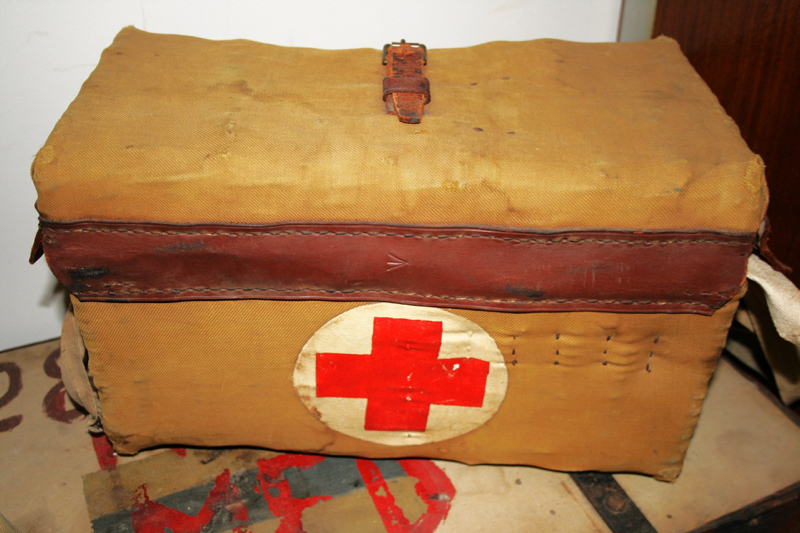
It’s April 30, 1945, a little over a week before unconditional surrender by Germany and the declaration of Victory Europe Day, ending World War II in Europe. Qiu Fazu, a German-educated Chinese surgeon, is the attending physician at a hospital in the Bavarian region of southern Germany. Suddenly, a nurse calls him to come out to the street in front of the hospital, where Qiu Fazu discovers a group of Jewish prisoners from a concentration camp, guarded by the SS. A death march. Here’s an account from The BMJ:
…Qiu remembered clearly that he was getting ready to operate when a nurse shouted that there were many prisoners from a concentration camp lying outside. He ran out of his room with his operation cap on, as he had already learnt what happened in the camp. More than 40 ragged prisoners were squatting down on the ground in the corner of a street. Sick and weak, they could not move any further. The SS troops standing there shouted at them and ordered them to stand up.

“I was shocked that they were not able to move any further,” Qiu recalled. He summoned up his courage and told the troops, “These prisoners have typhoid fever. Let me take them away.” The prisoners were released, and the doctors led them to the basement, saving their lives with careful nursing.

One of the supporting nurses, a German student named Loni, would become more to Qiu Fazu than just a colleague at the hospital. The two married soon after the war ended and moved to China in 1946, as he missed his homeland. They would have three children together, surviving the hardships of that tumultuous era known as the Cultural Revolution. The BMJ notes, “Qiu had to clean toilets—‘and this was the only time they were really clean,’ he used to joke. The family had to grow its own food, and he was sent into faraway rural areas to provide medical care for peasants.”

Nevertheless, Qiu Fazu rose to prominence in China, pioneering modern organ transplants in China and authoring a classic textbook on surgery still used in the country. Some have dubbed Qiu, who was a member of the Chinese Academy of Sciences from 1975 to 1983, “the father of modern surgery”.

Let’s remember Chinese surgeon Qiu Fazu and his German wife Loni, a couple who once helped save precious lives during World War II.

Arcadio Huang and Marie-Claude Regnier, the First AMWF Couple in Recorded History?

What’s the earliest example of an AMWF couple in recorded history? That distinction might just go to Arcadio Huang and Marie-Claude Regnier, who married in Paris in 1713.

Arcadio Huang was one of the first Chinese men to visit Europe, arriving in the early 1700s. He was the son of a Catholic convert in Fujian, and went abroad to initially fulfill his father’s wish that he become a priest. The religious orders, however, weren’t to his liking. So instead missionaries helped him settle in Paris, where he fulfilled a different destiny:

In the early years of the 18th century, European scholars made huge advances in their understanding of Chinese language and culture. Much of this work rested on the efforts of a remarkable young man named Arcadio Huang.

Huang became the Chinese interpreter for King Louis XIV of France, and began his groundbreaking work on a Chinese-French dictionary.

Along the way, Huang met and fell in love with a white French woman, Marie-Claude Regnier, who would become his lawfully wedded wife in 1713. According to research by Jonathan Spence, the couple faced some tough times:

Life was hard for Arcadio Huang in the autumn and early winter of 1713. Paris was bitterly cold and covered in fog. France’s long war over the Spanish Succession had demoralized the population, driven up the cost of food and eroded the value of money. Arcadio had married a young Parisian woman, Marie-Claude Regnier, in April 1713; their life quickly became a struggle for survival and self-respect. Their rented room in rue Guénégaud, on the south bank of the Seine across from Notre Dame cathedral, was always cold since they had not enough money for a regular supply of wood or coal. Their furniture was sparse, they had few clothes and they could not afford a decent matrimonial bed. Salt for their simple meals was too expensive. And, worst of all, on some mornings Huang would awaken spitting blood. After these episodes he felt a terrible lassitude and would need to rest in bed for hours.

Tragically, Marie-Claude would later die in childbirth in 1715. Huang passed away a year and a half later, leaving behind their daughter, who would die a few months after him. Nevertheless it is said the couple enjoyed a happy marriage during their short time together.

Let’s raise our collective glasses to Arcadio Huang and Marie-Claude Regnier, who might just be the first AMWF couple in recorded history in Europe, if not the world.

“Rotten Sweet Potato” & Other Funny but Unflattering Nicknames Among Chinese Friends and Family

By Llez – Own work, CC BY-SA 3.0, https://commons.wikimedia.org/w/index.php?curid=10483011

Note to everyone waiting on my moving announcement – sorry to keep you all in suspense on this, but I promise I’ll share the news soon. Please bear with me and in the meantime, enjoy this lighthearted post!

Do American men love to give their male friends unflattering nicknames? That was the conclusion of one American standup comedian I once watched years ago on cable television. He claimed women never do this, and followed it up with the seemingly preposterous example of a fictional woman dialing up her close girlfriend saying, “Hey Betty, you water-retaining cow, how are you?”

If only that comedian heard about the nicknames among my husband’s circle of male friends and relatives. Most are unflattering, and some are even downright derogatory. In other words, they’d be right at home in any standup comedy routine.

Is this phenomenon a worldwide guy thing or just a coincidence? While we ponder that, here are several examples of those unflattering nicknames from my husband’s own circle of guy friends and relatives in China.

Jīpìgu/鸡屁股 – literally “chicken butt.” I wonder if this guy always gets the rear end of all the chicken served at banquets as a joke?

Làlìtóu/瘌痢头 – literally someone with a head of favid, a rare fungal disease usually affecting the scalp. You can read about it in this Wikipedia article, though I don’t recommend checking it out during dinnertime. Makes you wonder about the guy with this nickname and how he ended up with it.

Lànfānshǔ/烂番薯 – literally “rotten sweet potato.” I have no idea where this nickname came from, but I’m pretty sure it has nothing to do with his cooking ability.

Mázi/麻子 –refers to someone with either a pockmarked face or a face covered in moles. I know a number of folks in the US who suffered through childhood because of freckles or other facial features such as moles or scars. I guess in China you don’t get a pass on this; and sometimes, you get a nickname.

Sóng/ — a term for male reproductive fluid. Try imagining someone with this nickname and see if you don’t laugh.

Yánghuǒdànzǐ/洋火弹子 – literally “matches and a shot from a bullet,” this nickname refers to the fellow’s prominent mullet. I guess this guy’s hair is really “on fire.” 😉

What unflattering nicknames have you heard?

Photo Essay: Celebrating Our Anniversary By Hangzhou’s West Lake

So August has turned out to be one of the busiest months of this year for me. Who’d have thought the traditional “vacation month” could be so hectic?

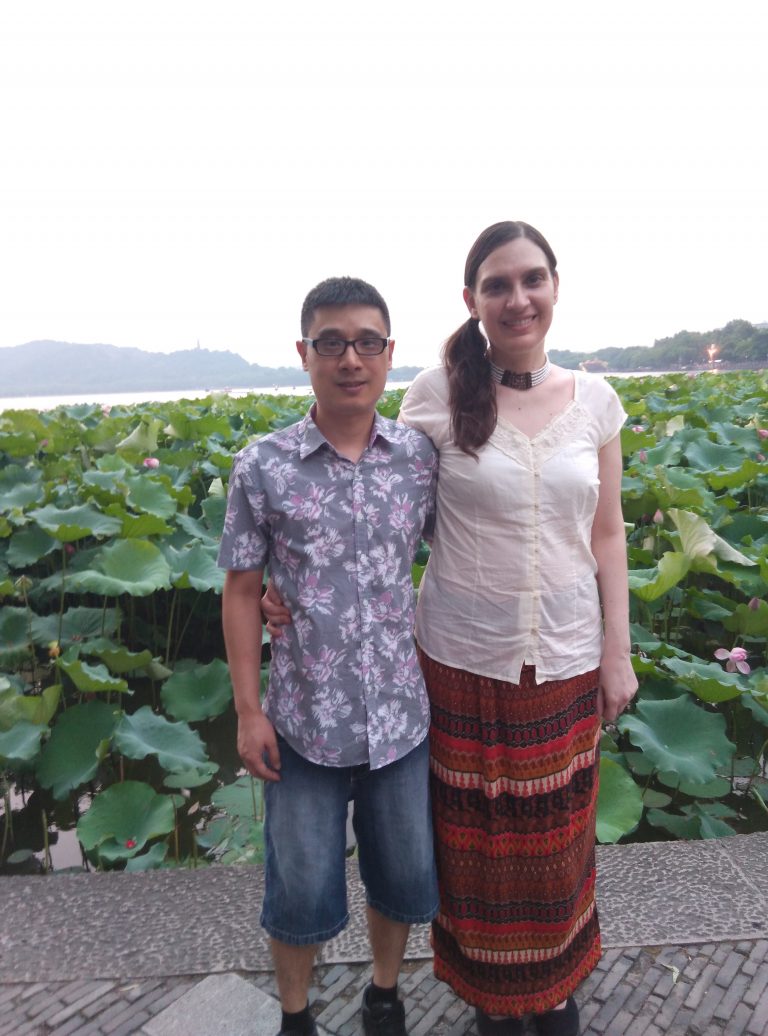
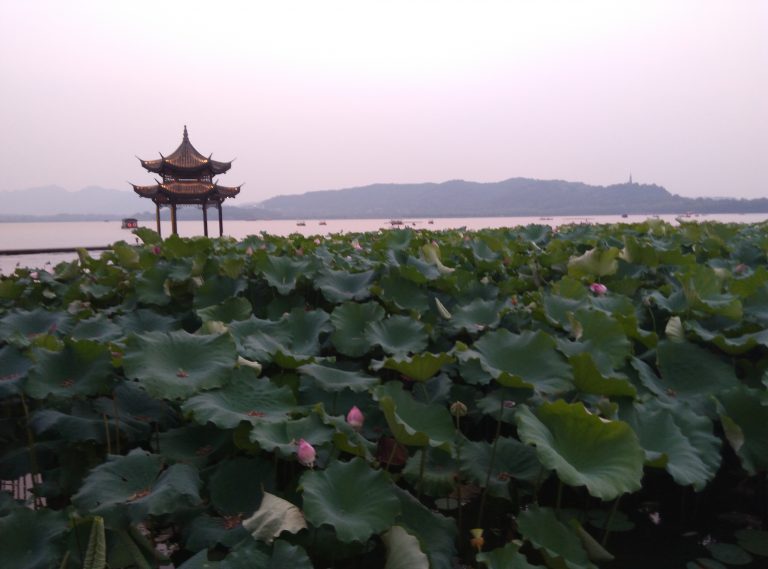
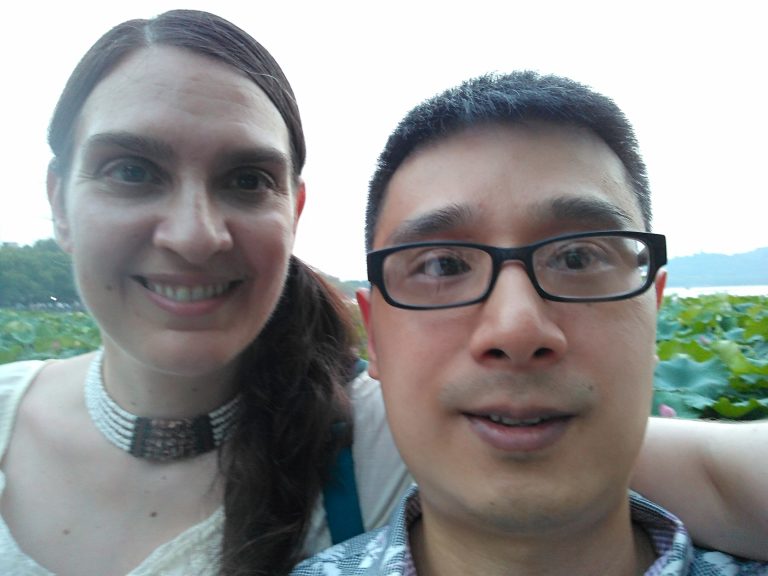
While I’m catching up on things, I thought I would share a few pictures from our anniversary celebration by Hangzhou’s West Lake a few weeks ago. Sure, Hangzhou summers can be ferociously hot. But take a stroll by the West Lake when the lotus flowers are in full bloom, and you could almost forgive the weather.

Almost. 😉

Anyhow, here are the photos — enjoy!