“It Was Her First Time to Sleep With a Chinese Man”: Chinese Men Open up About Dating Foreign Women on Vice.cn

“Of course, the most tantalizing topic between men and women is sex. So she once asked me, ‘Do you want to try it with a foreign girl?’ Then somehow we went back to my dorm. It was her first time to sleep with a Chinese man.”

This is the third installment of my English translation of a Chinese-language article on Vice.cn featuring interviews with four Chinese men who dated foreign women. Today’s interview is with an ad professional in Shanghai who gets personal about his relationship with his white American girlfriend, including a few blushworthy details.

If you missed the first two installments, have a look at “She Liked Having Threesomes”: Chinese Men Open up About Dating Foreign Women on Vice.cn and “The Moment Our Eyes Met, I Froze”: Chinese Men Open up About Dating Foreign Women on Vice.cn. And stay tuned for the final post!


26 years old, advertising professional, living in Shanghai

VICE: How many foreign women have you dated?

Only one, who is my current girlfriend. She’s an American.

How did you two meet?

To talk about this makes me blush a little. We were at the same university in the US – she was studying ancient Chinese, and I was studying old English. We got together and became language partners. At first we would always study together. Once we became more familiar with one another we would talk about almost anything. Of course, the most tantalizing topic between men and women is sex. So she once asked me, “Do you want to try it with a foreign girl?” Then somehow we went back to my dorm. It was her first time to sleep with a Chinese man.

And afterwards you both decided to have a relationship?

Well, not exactly. Because of cultural differences, we were not accustomed to each other’s ways of living at first, and we went back and forth for a period of time before we settled things.

How does she understand your Chinese style of dating?

My girlfriend thinks that in Chinese or Asian culture, relations between men and women are either guided by patriarchy or strict management by wives, different from the gender equality and mutual respect that her culture values.

She often says that I am a typical Chinese guy. The more she says this, the more I want to shatter her stereotypes about Chinese men. Even though we have a good relationship and I’ve already changed some of her attitudes toward Chinese men, she will still inadvertently reveal that she doesn’t like Chinese men very much.

A view of the Pudong skyline in Shanghai, China.

Does this make you feel that there’s additional pressure in your relationship?

Yes, especially in relationships, as you will run into many more practical problems. If I was with a Chinese girl, if there were some living habits that I couldn’t accept I would just directly say so. For example, I really don’t like it when girlfriends are too close to their ex-boyfriends. But now I haven’t said it, because I have this pressure, which makes me consider whether or not to speak out. But in order to not let her think that Chinese men are petty, for now I won’t tell her.

Another burden brought about by ethnic pride?

Yeah, perhaps a little. There are times when I wonder, do I care too much about my Chinese identity and do I want to prove anything? And as a result I will not want to express my feelings. Perhaps it’s not really that necessary to abandon your feelings because of an ethnic burden.

Where do you think your sense of having an ethnic burden comes from?

I think this has something to do with the environment. The other Chinese men around me who have dated white women all seem to have a very similar situation. Perhaps from a young age we’ve all accepted this concept of the Chinese ethnicity, and how we have to bring honor to the country. We were always shouting slogans about how we shouldn’t make Chinese people lose face. Men in particular are especially this way, and in the end it becomes a habitual way of thinking.

Do you have a lot of friends around you who have dated foreigners?

Very few men have sought out foreign girls. But when I was at university in the US, there were quite a few Chinese women dating foreign men. Overseas, there are very few Asian men who pursue white women, and even Asian-Americans basically hang out with other Asians. Plus, Asian men are not as popular as white men in the eyes of foreigners. But women are different – there are always some women who can adapt well into Western life.

What is the biggest difference between dating foreign girls and dating Chinese girls?

The respect for personal space. Foreign girls are very independent and have this awareness of personal space. Even though she really loves you, that doesn’t mean she will do anything for you. This is something Chinese men are not aware of. Additionally, it’s a matter of destiny. Romantic relationships can’t be too deliberate.


This is the third installment of my English translation of a Chinese-language article on Vice.cn featuring interviews with four Chinese men who dated foreign women. If you missed the first two installments, have a look at “She Liked Having Threesomes”: Chinese Men Open up About Dating Foreign Women on Vice.cn and “The Moment Our Eyes Met, I Froze”: Chinese Men Open up About Dating Foreign Women on Vice.cn. And stay tuned for the final post!

“The Moment Our Eyes Met, I Froze”: Chinese Men Open up About Dating Foreign Women on Vice.cn

“Her name was Olivia, and she was extremely passionate. … I still remember when I handed the drink to her, the way I felt when she raised her head to look at me. The moment our eyes met, I froze, because her laughter was too enchanting.”

This is the second installment of my English translation of a Chinese-language article on Vice.cn featuring interviews with four Chinese men who dated foreign women. Today’s interview is with a Chinese man who is an architect living in England, and he has dated women from many different countries there.

If you missed the first installment, have a look at “She Liked Having Threesomes”: Chinese Men Open up About Dating Foreign Women on Vice.cn. And stay tuned for the third and final posts!


24 years old, architect, living in England.

VICE: From what countries are the women you’ve dated?

Actually quite a few. America, England, Brazil, South Korea, Poland, Vietnam, Switzerland. I came in contact with all of these women after arriving in England to study abroad.

Which girl left the deepest impression with you?

Currently it’s this girl from Brazil. Her name was Olivia, and she was extremely passionate. I was particularly impressed by her when we first met. I worked at a pub at the time, and she came by herself to have a drink. I still remember when I handed the drink to her, the way I felt when she raised her head to look at me. The moment our eyes met, I froze, because her laughter was too enchanting. I think I must have stood there for a while, and now that I think about it, I imagine I must have looked especially ridiculous. I also remember when she noticed I didn’t say anything, she asked one thing: “What do you find in my eyes?” She was laughing as she asked me. I will never forget this.

Having dated so many foreign girls, do you have any vanity or sense of pride?

Yes, in China. Many people will look at me, so there times when I feel a little vanity. And overseas as well. Even though people won’t say so, but I’ve felt that they think it’s strange to see white women and Asian men together, so I can feel I am relatively special.

Why do you think Westerners feel it’s strange? Is it because of stereotypes about Asian men?

Exactly. Most people believe Asian men, particularly Chinese men, are very nerdy. Dating Asian men, it’s just like what we call “science and engineering dudes,” and these men are not the most popular no matter where you are. Western women prefer athletic, humorous and sociable guys, as they were taught by their culture. It’s the complete opposite of our educational environment. Of course, there are times when I feel that this stereotype has some basis.

Does this influence your relationships with foreign girls?


Yes. Honestly speaking, especially in England, the locals are very traditional. My former English girlfriend didn’t have a high estimation of Eastern culture, and thought that the Eastern way of being more restrained was not a good characteristic. Her only goal to date me was to learn about Eastern culture, so she could add some content to her report…she always said, “All of my friends don’t like Chinese men because they think you’re too awkward.” But I felt her xenophobia was also rather awkward.

Are there many Chinese men around you who have dated foreign girls?

Very few. I only know of one friend who has.

Is it easier for Chinese women to find foreign boyfriends?

Yes. There’s a big difference in how foreigners treat Chinese men and Chinese women. For example, when there’s a party, the best place for people to hook up, they will invite the Chinese women who are studying with us to go, but won’t invite Chinese men. It clearly shows that, overseas, Chinese men are not as welcome as a group.

As a Chinese man, how do you break through this kind of “dating barrier”?

To connect with foreign women, you need a lot of confidence. This is the core problem, which affects your language, communication and personal charisma. So, if you want to date foreign women, perhaps you need to have confidence in yourself first. I know many guys who were these huge ladies’ men in China that, after coming to England, never mind that they had no luck with the women, they found it was strenuous to get accustomed to life overseas.

When I first went there I was like that, I had no confidence to speak up among foreigners. But in China, a foreign man who can’t even speak Chinese clearly can get a Chinese girlfriend. It’s not just that they are more “coddled” because Chinese women like foreign men. It’s also that foreign men will confidently express themselves no matter what, and let others get to know them.


What do you think of the interview?

P.S.: This is the second installment of my English translation of a Chinese-language article on Vice.cn featuring interviews with four Chinese men who dated foreign women. If you missed the first installment, have a look at “She Liked Having Threesomes”: Chinese Men Open up About Dating Foreign Women on Vice.cn. And stay tuned for the third and final posts!

“She Liked Having Threesomes”: Chinese Men Open up About Dating Foreign Women on Vice.cn

An article on the Chinese version of Vice caught my attention, with very personal interviews with Chinese men on their experiences and perspectives on dating foreign women. Intimate and illuminating, the stories provide a much-needed Chinese perspective on relationships between Chinese men and Western women and also touch upon stereotypes and prejudice. I’ve translated the piece in full from Chinese to English — and because it’s a long piece, I am sharing it in four installments.

Today’s first installment includes the introduction to the article as well as an interview with an IT specialist in Harbin, China, that might just make you blush a little. Stay tuned for the second, third and final installments!


“Tell me, why do your Chinese women all like our foreign men?”

“……”

“All of my foreign friends in China, even those who are considered the most unpopular men, all of them can find girlfriends here, and the girls are all quite pretty. Sometimes I think it is your cultural problem.”

“Don’t say anymore, OK? I already told you, this topic is meaningless.”

“But I really think it’s a problem of your culture.”

“Yes, our culture has problems, so let’s break up.”

For the last time, this was the last time I talked about this topic with my presumptuous white boyfriend. Of course, it was hard to say whether he really was my boyfriend. We only just used to hang out often, and we never clarified our relationship. When we were together for that half year, we had countless discussions on these issues – first these were discussions, then they evolved into disputes and arguments. Until the day before yesterday, I was finally tired and chose to break up.

I’m not a blind regionalist who can’t stop defending China’s exceptional culture with 5,000 years of history. But every time I hear this kind of talk, I can’t help thinking that the man who made that point is very low.  On the contrary, what I’m more interested in, is that for many outstanding Chinese men around me while living abroad, their living environment has still not escaped the Chinese community, and that emotionally speaking, they have almost never landed in the Western world.

I don’t know if this counts as another manifestation of some gender inequality, or if it is the existing reality of cultural colonization. Why it is that so few Asian men are together with white women? What is it that created this cultural stereotype? White men in China are in high demand, while Asian men abroad are not. So what are Asian men like in the eyes of Western women? Why is it that when Chinese girls are with white men, they are often accused of “attaching to foreigners” and “worshipping foreigners,” while when Chinese guys have a Western girlfriend, they are “bringing glory to the country”?

So I talked to four Chinese guys who have been in love with Western women to see how they felt about this topic. [Jocelyn’s note: today I’m sharing the first interview in the article — and I will publish the other three subsequent interviews as separate posts]

The city of Harbin, China, at sunset.

31 years old, IT specialist, currently living in Harbin, China

VICE: What kind of experience have you had dating Western women?

I had a brief relationship with a German girl; also a longer one with a Russian girl.

Did you meet the Russian girl in Harbin?

No, I met her when I went out for travel to Mohe, Heilongjiang, China. Just across the border is her country.

How did the relationship feel to you?

That was it. My English wasn’t very good, and she could only manage the most basic conversation, but English was the only language we could use for communication. When we couldn’t express ourselves clearly, we had to use body language and consult the dictionary.  People say, there are three things that don’t require language: soccer, music and sex. We tried all of them. In soccer, I couldn’t play as well as her. She used to be captain of the Voronezh amateur soccer team. Russians are too fierce. Her shots for goals were even more powerful than the strongest player in the dorm next to mine in college. In music, we didn’t really have a common language either. She liked local Russian folk music, which included some rather shrill instruments, while I only listened to Jay Chou. …

What about the sex?

Overall, it was actually not bad. But she had some peculiar idiosyncrasies – she liked having threesomes. At first it was really hard to accept. But later we tried it. Sometimes when we found another girl it was OK, but she specifically liked watching me and another girl do it. Sometimes she hoped to find another man, and that I really could not accept. Additionally, she was so strong, it was like she emptied out my manhood.

In terms of sex, do you think “made in China” has a disadvantage?

There are no disadvantages. I think this is guided by culture, where it’s purely Westerners creating a malicious portrayal of Easterners. I looked up information on the internet, and in terms of size Asian men don’t have an advantage. But research has found that women aren’t as demanding about size as the rumors suggest – it’s only men who aren’t confident about themselves that care.

So sex was never a problem in your relationship?

No. When we first got together, I was not confident, and I even thought, how could Asian men possibly match up with white girls. I was especially embarrassed. But in the end, she gave me a lot of confidence in this respect.

Apart from sex, what was her impression of Chinese men?

She really liked Chinese men. A lot of her friends had also dated Asian men. Some people say that in Northeast China there’s more male chauvinism, but I never heard her complain about it. She actually thought Chinese men were more responsible than foreign men, and the way they treated her made her feel more comfortable.

Have your friends ever dated Western women?

Around here, there aren’t that many foreigners to begin with, so it’s even rarer to see a Chinese man with a Western woman together. There aren’t any friends around me who have. Whenever she and I would go out, we would turn a lot of heads.

Did you feel a little proud?

No. Some people believe that going out with Western women gives you more face, but I didn’t feel that way. At first it felt like a fresh experience, but later on I got used to it and felt annoyed. Whether people praise you or not, who wouldn’t feel a little uncomfortable to always have people pointing at you.

What do you think of the prejudice Westerners have against Asian men?

I haven’t felt much prejudice myself, but I feel that most of the prejudiced people have never really had much contact with Asians – they just have a very superficial understanding. For example this topic of sex you’ve mentioned, you can see this kind of idea in the movies or advertisements, that men need to be solid, have these six-pack abs, Asian men are perceived as not having this kind of physique, so then they cannot be become a popular standard of attractiveness. Besides, many movies and TV shows deliberately make fun of Asian men, giving people this feeling that Asian men are very nerdy or stupid, which is completely different from the reality.

So how would you get rid of this stereotype?

Improve your language ability and express yourself. My English is no good, so there are times when I don’t dare to express myself. I’m afraid that this is an impression that foreign girls often have of Asian men, that we shrink away from daring to start a conversation. I think this is mainly because of language. But foreigners like these active and enthusiastic people. If you’re not willing to talk, how can someone be with you? Smooth communication can promote a relationship between two people.


What do you think of this interview?

P.S.: Stay tuned for the second, third and final installments of this article.

Translators? Tour Guides? Teachers? More Mistaken Identities for AMXF Couples

Last week, I shared my experience of having a foreign man in China mistake me and my husband for being “mother and son”. (Though, it wasn’t entirely surprising because I’d once had a woman working at a cash register in the US wonder if my husband was my foreign exchange student!)

Well, readers took to this blog and social media to share their own experiences of mistaken identity as part of interracial couples of Asian men and non-Asian women (AMXF). The comments were fascinating, highlighting a number of “mistaken identity” situations that I’ve either heard of or experienced myself.

AMXF couples are still a rare enough sight in China that people often don’t assume you’re actually husband and wife when they first see you. (And sometimes they don’t even believe you when you tell them that, yes, you are in fact a couple, which once happened to me and my husband.)

Here are a few common themes, inspired by your comments. (Note: A big thank you to Ana Hudson (IG: whitechocolateplayer) for permission to run the her photo with this post, featuring models Justin Zhang (IG: NoobStrength) and Marina Bruzadin (IG: marinabruzadin). You can see more of these photos in the post 13 Sexy, Fun ‘AMXF Deadpool’ Photos to Make You Smile.)

Is he your translator?

One fellow on Facebook chimed in with what must surely be the No 1 thing that comes to mind when people in China happen to see Chinese men walking around with a woman of a different race: “I have been considered as her interpreter more than husband ????”

This actually happens all the time to me and my husband as well — so much so that I’ve come to expect it from people in China, particularly when we’re in places like banks or stores!

Is he your tour guide?

Similar to “Is he your translator?”, a “tour guide” is another form of mistaken identity frequently experienced by AMXF couples together here in China. Especially if you happen to be together at any tourist attractions in China. As a woman commented on Facebook, “When we were young people thought my husband was a tour guide ????”

Is she your teacher?

As everyone knows, English teacher is the most common profession for foreigners in China. Well, when some folks in China see a Western woman walking with a Chinese man — two people who are actually in a couple — they might assume she’s his English teacher.

That’s what happened with one woman who commented on Facebook, noting, “My husband is always asked if I’m his English teacher but actually he used to be my Mandarin teacher!”

And more…

A Chinese man and a white woman, who were husband and wife, walked into a restaurant…but – no joke here — the staff didn’t take them for a couple, as one woman took to Facebook to share: “I get this constantly when we eat out together. ‘Is this one check or two?’ – to which my response is always, ‘Since he is my husband, yes I will be paying the check for us together.’”

Then again, speaking of jokes, sometimes the best response to all of this is a smile and good sense of humor.

Have you ever been mistaken as something other than a couple?

My 3 Magical Chinese Must-Haves for Surviving Long Flights To/From Asia

As the summer travel season has begun, my friends are already talking about their forthcoming trips to and from Asia. For most of us, this invariably means one thing:

Surviving a very long flight.

Since I’m from the US, I’ve had to endure countless plane trips that lasted anywhere from 11 to 14 hours. And over the years, I’ve encountered a lot of secrets for surviving these trips:

  • I always fly with Gatorade or a similar sports drink like it to stay hydrated onboard and ward off the jetlag (thank you for that advice, Susan Blumberg-Kason!). You can even buy it powdered to pack ahead before your trip. For example, powdered Gatorade is available in the US. In China, I often buy powdered Aptonia sports drink from the Tmall store for Decathlon, which also works great.
  • Also in that vein, I travel with a few empty bottles, which I can fill with water after clearing security and then bring on the plane, to ensure that I drink plenty of fluids and lessen the effects of jetlag.
  • I usually have a pair of disposable slippers (often accumulated from hotel stays in China) to use during the flight for extra comfort when those feet swell during the journey. (Additional tip — last time my husband flew Air China, they passed these out to everyone in economy, so just booking with the right airline can save you the trouble of packing them.)
  • There’s always a stash of ginger candies in my purse to manage nausea or motion sickness. When I’m in the US, I like buying Ginger Candies from the Ginger People.
  • I never forget moisturizer and lip balm, absolutely essential for combatting the dryness in flight.

But I’ve also discovered some additional must-haves for long-haul flights after living in China (and also, in part, thanks to my Chinese husband) — things that, to me, can be magical and life-saving. Here are 3 of my personal favorites:

#1: Feng You Jing Essential Balm Oil (风油精)

Headaches. Nausea. Stuffed nose. Scratchy throat. Any of these could turn a long-haul flight into an extended nightmare. Everyone has their remedies for managing them, but for me, you can’t beat Feng You Jing essential balm oil, known in Chinese as fēngyóujīng (风油精).

Dab it on your forehead to ease headaches. Add a few drops on your temples and under your nose to relieve nausea. Apply a little on your nostrils to help clear your stuffy nose. And yes, if you’ve got a bit of a scratchy throat, rub directly on it and it’s almost as good as having a lozenge.

Plus, it’s also handy for masking unpleasant odors you might encounter in airports or planes (especially if, God forbid, you end up being the unlucky person seated right near the bathrooms).

Every pharmacy in China carries Feng You Jing essential balm oil (fēngyóujīng, 风油精) and you’ll find it on Taobao. But in the US, you can also buy it on Amazon as well.

#2: Chinese Hawthorn Fruit Snacks (山楂卷/糕/片/球)

Chinese hawthorn fruit, known here in China as shānzhā (山楂), is already known for being a magical and healthful fruit that has great cardiovascular and digestive benefits. In particular, it has become a must-have in my home just because of its ability to ease indigestion and nausea — two symptoms that could make anyone miserable en route.

Thankfully, it’s easy to bring Chinese hawthorn fruit on the plane because it’s made into lots of packable snacks here in China. Rollups are my favorite version, but I also like the cakes and even candies, which can all be purchased online (just search Taobao for 山楂) or in any major supermarket in China. In the US, Amazon has a number of possibilities, including these haw flakes.

Another added benefit of bringing Chinese hawthorn fruit candies with you? They’re perfect for easing hunger between meals or connecting flights.

#3: Golden Throat Lozenges (金嗓子喉片)

Any veteran flyer knows just how dry it can be when you’re cruising over 30,000 feet — and that dryness can make for uncomfortable throats. That’s why I always pack throat drops. But far and away, nothing beats the magic of the Chinese brand Golden Throat Lozenges (jīnsǎngzi hóupiàn, 金嗓子喉片). They’re incredibly soothing and effective, and I’ve sworn by them for years. They’re always available at pharmacies across China (ask for jīnsǎngzi hóupiàn, 金嗓子喉片) or on Taobao, but you can also pick them up on Amazon in the US.

What are your magical must-haves for long haul flights?

P.S.: This post contains some affiliate links, where your purchases help support this blog.

Roseann Lake’s “Leftover in China” and Leta Hong Fincher’s “Leftover Women” Compared

A huge thank you to Susan Blumberg-Kason, author of Good Chinese Wife, for this comparison review of Roseann Lake’s Leftover in China and Leta Hong Fincher’s Leftover Women.


Some months ago, there was a stir on social media about a new book on leftover women. Leta Hong Fincher is the veritable scholar on this subject, so was Roseann Lake’s new book taking credit from Hong Fincher by not crediting her work? I set out to read both books and compare the two since I hadn’t seen anyone else do so in detail.

Let’s start with the titles. Leftover Women: The Resurgence of Gender Inequality in China (Zed Books, 2014) by Leta Hong Fincher tells me that her book will show how women in China no longer hold up half the sky and women who don’t marry by twenty-six are suffering from this inequality. (Up until the mid-90s, before I read Nicholas Kristof and Sheryl WuDunn’s book China Wakes, I had thought China had done better a better job with gender equality than most other countries. If it wasn’t clear since then, Leta Hong Fincher certainly makes that case in her book.) Roseann Lake’s book is titled Leftover in China: The Women Shaping the World’s Next Superpower (Norton, 2018) and to me sounds like it focuses on the women in China who are not marrying by twenty-six and are influential in China’s rapid rise. Both books are pretty true to their respective subtitles.

But could there be overlap? And how much and in which ways? These were the questions I was looking to answer when I read both books. I first kept my eyes open for statistics since those are easy to compare. I found similar facts on page 47 of Hong Fincher’s book and page 188 of Lake’s.

  • According to Hong Fincher, “The 2011 interpretation of the Marriage Law by the Supreme People’s Court, however, specifies that upon divorce, if both parties are unable to reach an agreement on the division of property, each side is entitled to keep whatever property is registered in his or her own name.”
  • And this from Lake’s book: “A 2011 amendment states that in the event of a divorce, the marital home belongs exclusively to the person whose name is on the deed.”

While these two passages are not word-for-word duplicates, the information is the same. It’s important to note here that Chinese parents strive to buy their sons property as a way to attract a bride. Even if the bride-to-be owns her own apartment, she sometimes puts it in her husband’s name so the husband doesn’t feel emasculated. The bride may sell her property and put the proceeds towards a new property she and her husband jointly own—with his name solely on the title per the custom in China. Hong Fincher doesn’t have copyright on this 2011 amendment, but this was a good place Lake could have cited Hong Fincher’s work, mostly because this information is the crux of Hong Fincher’s book.

Another part that stood out was when both authors cited statistics from Mara Hvistendahl’s fabulous book, Unnatural Selection: Choosing Boys over Girls, and the Consequences of a World Full of Men (Public Affairs, 2011).

  • In Leta Hong Fincher’s book, she writes on page 22, “Mara Hvistendahl writes in her book on the global sex ratio imbalance, Unnatural Selection, about some remote parts of China with villages teeming with men, where the ratio of boys to girls had reached 3 to 2.”
  • Lake expands on this on page 23 of her book. “As reported by Mara Hvistendahl in Unnatural Selection…, there are places in China like Yichun, in Jiangxi province, where the ratio is 137 males for 100 females under age 4…and in Tianmen, Hubei, it escalates to a perilous 176 to 100, or the mathematical equivalent of 1 in every 3 men being unable to find a bride.”

So did Lake lift material from Hong Fincher in this case or not cite her? I don’t think so. Mara Hvistendahl’s work was cited and it’s interesting that both Hong Fincher and Lake use this material in similar places in their books.

As a sidenote, Tianmen is next to my former in-laws’ hometown. Two decades ago, I left my AMWF marriage because I was terrified my then-husband was going to whisk our son to his parents’ home so they could raise him. I didn’t know about the gender imbalance there, but that could have been the life my son would experience had the ex and his parents had their way. It makes me shudder.

Both authors address the somewhat common occurrence of gay men marrying women but not telling their wives about their true identity. Women are desperate to get married and not become leftover women (according to Hong Fincher, this label was created by the Chinese government to get independent and highly educated single women onto the marriage track when they realized the surplus of men, called “bare branches”, was left without wives). Because they don’t want to become leftover women, sometimes women won’t ask questions when their partner doesn’t seem quite into them.

Hong Fincher writes about LGBTQ activism and how property ownership is an issue for gay men who won’t and cannot marry. I didn’t find any similar wording in Lake’s book, which talks more about the history of gay rights in China. Both authors interview women who were or are still married to gay men. In Hong Fincher’s book around page 91-92, the woman was still in denial about her husband’s need to live apart from her while he shared an apartment with a college roommate (they shared the same bed), while around page 109 in Lake’s book a woman divorced her husband after she suspected he was leading a secret life that didn’t include her.

I may have missed other similarities, but the reason for that is that these books really did seem like different stories. Hong Fincher’s book reads like a thrilling narrative that centers around property ownership and all that entails in contemporary China:

  • parents not giving their daughters money for a down payment and instead giving it to a male cousin;
  • how property ownership is tied to masculinity and how independent women give up their property rights or are stripped of it by Chinese custom when they marry in order to avoid becoming a leftover woman; and
  • how Chinese women have enjoyed property ownership rights in the past, even going back to the Ming dynasty.

Hong Fincher also includes chapters on spousal abuse and women activists.

Lake, on the other hand, includes profiles of women she met in China and tells their stories about becoming leftover women and how they’ve tried to find suitable partners or have escaped terrible marriages. Her book is lighter in some ways, for instance when it features a bikini waxer, which segues into the section about women marrying gay men in China. I’m still not sure about the relevancy of the bikini waxer, but it gives the book a different tone from Hong Fincher’s. On the other hand, Lake writes about the mistress culture in China, whereas I can’t remember Hong Fincher discussing it at all. Hong Fincher is not so optimistic about women’s rights in China as long as the property market is skewed against them, whereas Lake views the status of women in China to be on the right track if they can find better marriage prospects or feel all right about being single for life. They both conclude that women have it pretty rough in China.

Back to the controversy: should Lake have credited Hong Fincher? I think that would have been the decent thing to do, especially since she had contacted Hong Fincher while researching her book. In her footnotes, Hong Fincher meticulously credits scholars even for a conversation about a particular detail she wrote about in her book, whether or not said scholar wrote a book she used in her bibliography. Lake admits she didn’t read Hong Fincher’s book because she wanted to form her own ideas. I would have taken a different approach, but this isn’t the first time I’ve heard of an author admit to not wanting to be influenced by outside ideas. She’s certainly not alone in this.

After thinking about both books and recently reading Mara Hvistendahl’s, the bottom line to me is this: we need more books in this space. Between Hong Fincher, Lake, Hvistendahl, we’ve seen different ways leftover women and bare branches shape China today. Still other authors like Mei Fong and Lenora Chu write about the one-child policy and how that is shaping China, too. If we can have over half a dozen memoirs written by white American Peace Corps volunteers in China, I think it’s high time we listen to women’s voices, too.

Susan Blumberg-Kason is the author of Good Chinese Wife.


Leftover in China and Leftover Women are available at Amazon.com, where your purchases help support this blog.

“Mom” And “Dad” Is What I Call My Chinese In-Laws — and Here’s Why It’s Easier Than I Thought

Years ago when my husband Jun and I got our little red marriage books in China, I remember traveling back to his village and proudly showing off the photos of our civil marriage ceremony. While it still didn’t count to his family as a real wedding (in China, it’s normal to get married on the books, called dengji/登记 in Chinese, well before you actually have a wedding ceremony), they were pleased to see the two of us committed for life.

And as I learned, that commitment meant changing how I addressed Jun’s parents. From then on, Jun instructed me to call them Laoba (老爸) and Laoma (老妈), just like him. Or Baba (爸爸) and Mama (妈妈) — the universal Chinese words for “Dad” and “Mom” — if I so desired. The bottom line was, I would now refer to them as if they were my own parents, in the most intimate terms once only reserved for my father and mother.

This isn’t the norm in the America I grew up in, where you call your in-laws by their first names. And given all the jokes about in-laws (and the American tendency to want to live as far from your in-laws as possible), I’m sure there are some Americans out there privately referencing their in-laws using expletives. The bottom line, though, is that in America there’s always this implied distance from your in-laws — a distance that I was never expected to have with Jun’s parents.

Being suddenly asked to call two people who never raised me “Mom” and “Dad” should be an adjustment. And to be sure, it did take some getting used to. But it was actually a lot easier than I thought for a very simple reason.

I was calling them “Mom” and “Dad” in Chinese, not in my native language of English.

Even though Laoba, Laoma, Baba and Mama were just as intimate as the words “Mom” and “Dad” that I grew up using, I had never called my parents by the Chinese versions. So in way, it actually freed me to easily adjust to using them with Jun’s parents. I didn’t feel like I was stretching any definition of who “Mom” and “Dad” were because it sounded different.

Now it’s like second nature and I don’t even think about it anymore. That’s who they are — Laoba and Laoma.

So I have to wonder, is it harder for Chinese people to get used to this? Do they struggle to refer to in-laws with such intimate terms?

Then again, this is just about what to call someone. Now family relationships, the day-to-day stuff, that’s the real struggle (one that, admittedly, can lead to the use of expletives or other unflattering names at times).

But that’s another story for another day.

What do you think?

“Marrying Chinese Men Means Less Talk, but More Respect and More Help in the Household” – Featured in the Global Times

People close to me know this has been an extraordinary busy month — which is why I’m late in sharing some good news.

Earlier this month, the Global Times featured me (along with two other women, including fellow blogger Jo Bai of Life Behind the Wall) in an article titled Marrying Chinese Men Means Less Talk, but More Respect and More Help in the Household.

Here are some excerpts from the piece:

Jocelyn Eikenburg, who lives in Beijing and founded the popular expat blog Speaking of China, describes being married to her Chinese husband as “intercultural, interracial, international and bilingual.”

Like De Leye, Eikenburg also found that there are major differences in the way she and her husband express their feelings. Growing up in the US, she watched her parents express love through words, kisses and hugs.

“Here in China, love is something that is shown through actions, such as making you your favorite dinner or buying you something special, and married Chinese men are less likely to kiss or hug their spouses in front of others.” …

Eikenburg says her husband is wonderful at home. He does a lot of housework and always helps prepare dinner. His ideas about couples sharing the work might have been influenced by his parents. When he was growing up in rural Zhejiang Province, both of his parents had to work and also helped around the house, she said.

“There’s no doubt that in a country as large as China, there are regional differences in terms of culture and that may influence what families tend to consider the norm in marriages and households. And I have heard some of these ideas, such as how Shanghai men supposedly make great husbands,” she said.

“My husband’s family is also an example of a household that might not have followed the typical pattern for the village, which reminds me that it’s always important to keep an open mind and never assume that a person will fall in line with the general beliefs or stereotypes.”

Eikenburg also noted that there is a drastic difference on this point between the urban areas and the countryside.

“I’m pleased that my brother-in-law and sister-in-law, who have a daughter, always tell her that they want her to go to college and do well in school; that’s encouraging to see.”

You can read the full article here on the Global Times. And if you like it, share it!

Photo Essay: Amazing Buddhas in Living Color at Yungang Grottoes, Datong, China

The first time I heard of Datong, it was in a Saturday morning Mandarin Chinese class.

Anyone who has ever studied a language class will remember their share of dialogues in that language. Especially the ones you encounter when you’re just starting out. There was nothing terribly special about the dialogue that referenced Datong. It was just a conversation about places to travel — places that happened to be close to Beijing. A kind of, “Hey let’s go to Datong!” suggestion.

Datong, China? What’s in Datong, I thought.

Then I cracked open my dogeared copy of Lonely Planet China, and discovered Datong was home to one of the most spectacular displays of ancient Buddhist cave carvings, the Yungang Grottoes. I was familiar enough with the Longmen Grottoes in Luoyang, an extraordinary collection of Buddhist cave carvings that I eventually visited in 2009.

But the Yungang Grottoes had a huge draw over its counterpart in Luoyang — color. Brilliant, vivid, inspiring color.

It’s one thing to witness a collection of Buddhist carvings, and another to see them painted with royal blue, gold, scarlet red and many more striking hues. Just beholding these great works of art in color felt like a spiritual experience itself.

Who would have thought the humble and windswept city of Datong, deep in the heart of China’s northern coal country, could deliver such an experience?

I thought I’d share with you a few of my favorite pictures from our recent visit to Datong’s Yungang Grottoes, when we braved below-freezing temperatures to see this wonder of China.

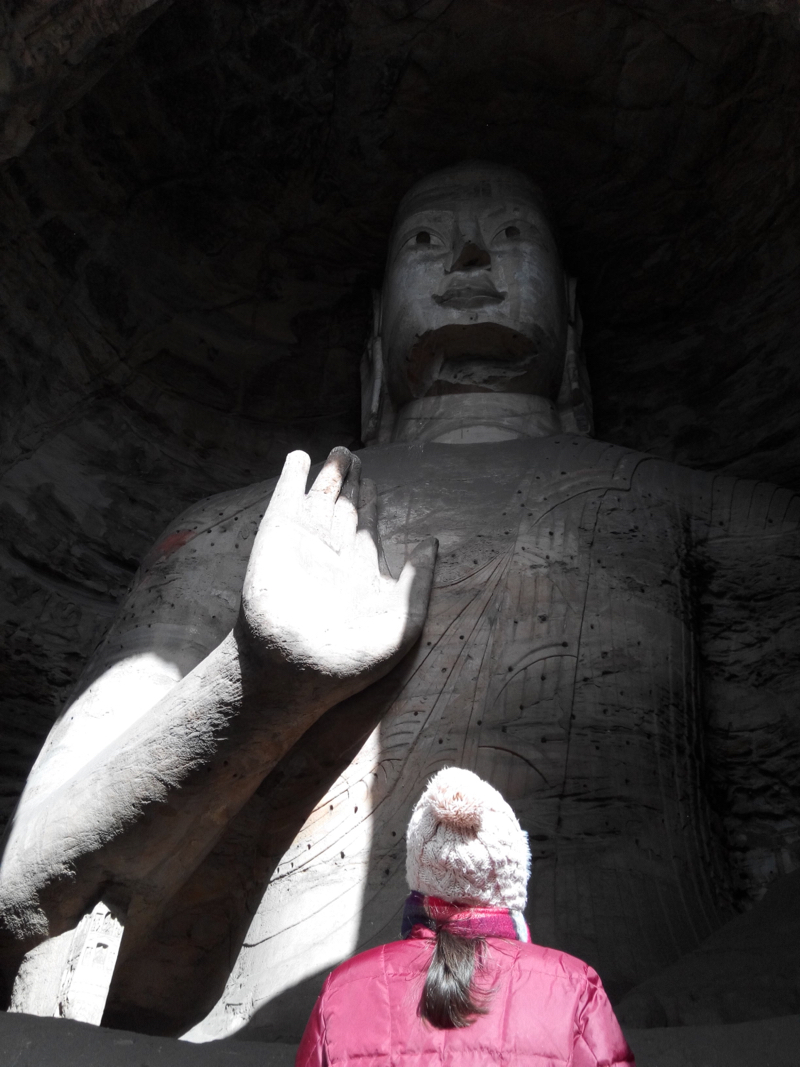
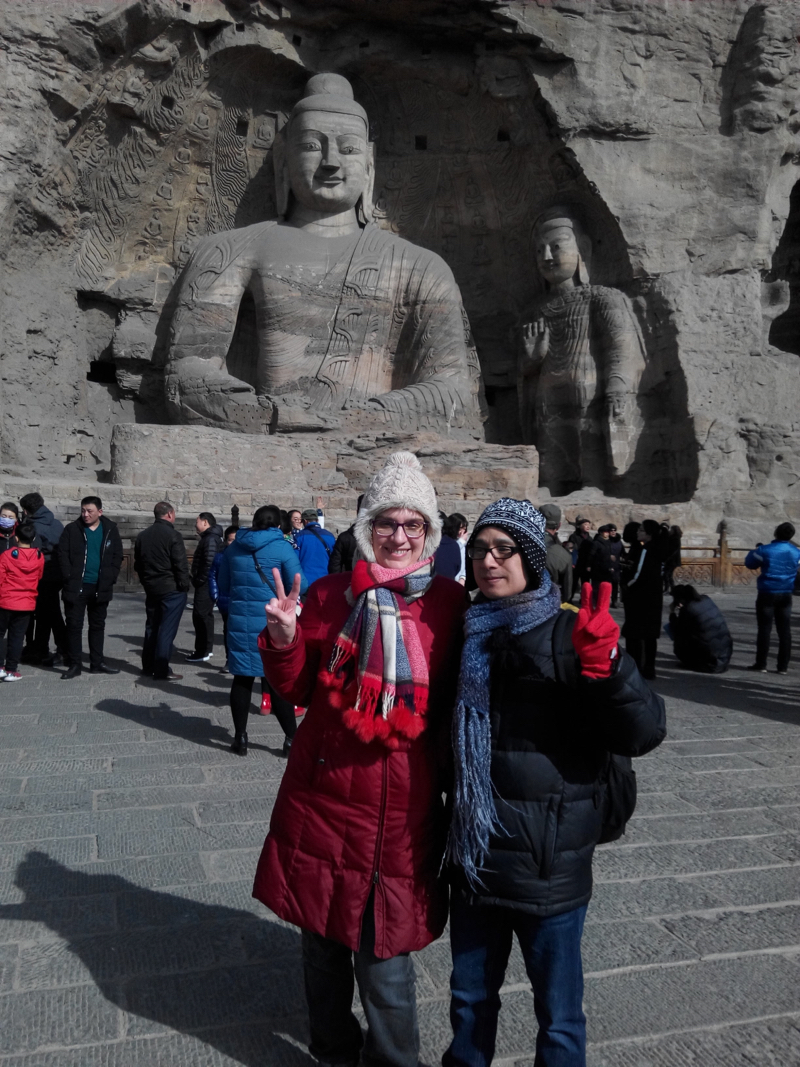
The scale of the Yungang Grottoes is incredible itself. You feel dwarfed just by the imposing cliffs that house these historical treasures.

Just consider how high up this statue is…

Or how enormous this one is!

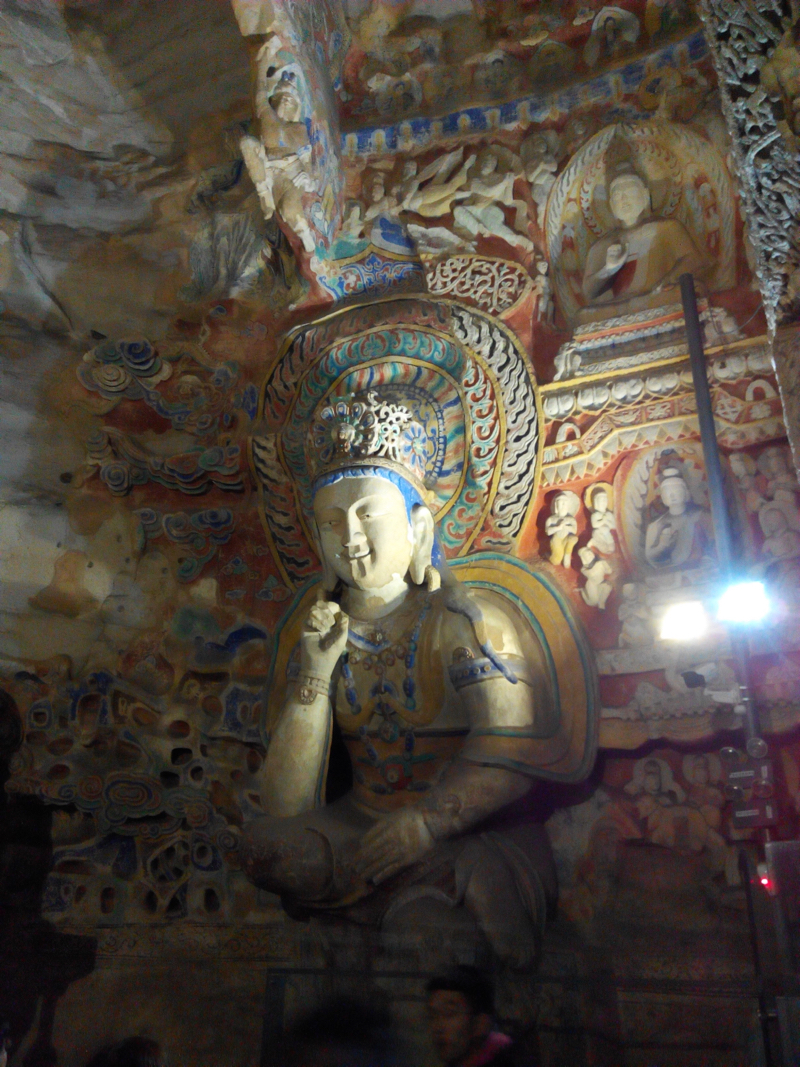
But the true wonder of the Yungang Grottoes is tucked away within several caves that still house full-color carvings, murals and statues.

This massive Buddha, crowned with royal blue hair and a golden face, is one of my favorites.

It’s amazing how many colossal Buddhist statues we found at the Yungang Grottoes — many more than the Longmen Grottoes.

I highly recommend a trip to Datong, China to view this extraordinary world heritage site.

Wishing all of you a wonderful March, filled with colorful adventures of your own!

Chinese Gymnast Li Donghua Marries Swiss Woman, Wins Olympic Gold After Great Hardships

By Christophe95 – Own work, CC BY-SA 3.0, https://commons.wikimedia.org/w/index.php?curid=26833408

Team or love. That was the choice that Chinese Olympic gymnast Li Donghua faced in 1988 when he fell for Esperanza Friedli, a young Swiss woman he met in Beijing when she was visiting China that year, as reported by China Daily. Li could either stay with China’s national gymnastics team or wed Friedli, but not both.

By then, Li was accustomed to hardship, surviving a number of devastating injuries in the course of his gymnastics career with China, including one that nearly claimed his life. Even if he stayed with the team, he would only serve as a coach, which meant he couldn’t continue pursuing his dreams of Olympic gold.

So Li Donghua left the team to marry Esperanza Friedli.

Their joyous reunion, however, couldn’t satisfy his longtime goal of medaling at the Games — which is why the couple moved to Switzerland. But the move put Li Donghua’s Olympic ambitions on hold:

Swiss law stipulated that immigrants married to Swiss nationals must wait five years to acquire Swiss nationality, which meant that Li would have to wait that long before he could compete internationally.  Li ended up watching the bulk of his prime athletic years, including 1992 and the Barcelona Olympics, agonizingly tick away.

Those years were tough on him:

He had to train without any funds and his only coach was a set of video tapes.

“I had to rent the apparatus and install them by myself, but I was jobless.

“At first, there was naturally much jealousy from local gymnasts, and many Swiss did not understand why they should have a Chinese person on their team.

His wife Esperanza struggled during this time to support Li with her job at a department store.

By the time the 1996 Summer Olympics began, Li Donghua was already a decorated gymnast, winning bronze in 1994 and gold in 1995 at the World Artistic Gymnastics Championship. In Atlanta, Li finally realized his Olympic hopes, walking away with a gold medal on the pommel horse.

You have to love what he said of his Olympic win:

“There is no question in my mind,” Li said six months later, “half of this medal is mine and half of it is Esperanza’s.”

While Li Donghua and his Swiss wife ultimately divorced in 2004, their legendary story of overcoming hardships for love and Olympic gold lives on.

Want to read more coverage of Olympic-related stories? Check out our Olympics archives, where you’ll find Olympic Speedskater Shaolin Sandor Liu Has a Cool China Connection Beyond His Chinese Father and 9 Awesome Olympic Moments from Asian Figure Skaters Around the World.