When East Marries West: When One Wedding Won’t Do

Many years ago, fellow blogger Tianjin Shannon, an American woman, penned a post titled The Most Married, where she wrote about her third wedding ceremony with her husband Haike, from Hunan, China. Yes, you read that right — third. (And in fact, she would go on to later hold a fourth ceremony!)

While Shannon might indeed claim the title of “Most Married,” in fact, many other intercultural and/or international couples straddling the East-West divide have also held more than one wedding ceremony.

Tying the knot across cultures and borders makes it that much harder to have all your family and friends together at one single ceremony. Travel costs and even securing visas can already get in the way of well-intended supporters who would love to watch a couple say “I do”. Plus, every country and culture has its own distinctive wedding customs and foods, often difficult to replicate outside those borders. And what about those of us who, say, grow up with a dream of getting married at home?

For all of these reasons — and more — many East-West couples prefer to organize at least two wedding ceremonies (and yes, sometimes even three or four)!

Whether you’re looking for wedding inspiration, a way to remember your big day, or a delightful diversion, here are two different examples of how East-West couples have chosen to walk down the aisle more than once.

Traditional ceremonies in the East (Japan) and West (Italy) – My Japan Slice

The blogger at My Japan Slice represents the most traditional choice for those who decide to have two wedding ceremonies. Their reasoning would surely resonate with most East-West couples:

Since the beginning we planned a double ceremony. We are both interested in each other’s culture and we like to learn and experience about it so having our wedding ceremony only in one of our countries would have meant missing something.  Besides, we both have aging grandparents who could not travel. A double ceremony, one in Japan and one in Italy, was the perfect solution.

They set their dates in winter with Dec 23, 2016 for the Japanese ceremony in Kyoto:

My husband’s family lives in Kyoto so it was natural for us to get married there. We choose Kamigamo Shrine because the Kamo river had played an important role in our story being the place where we strolled hand in hand for the first time on our first date. Again we were lucky because the shrine was already almost fully booked and we got the 12.45 slot.

For the Italian ceremony, they chose Jan 5, 2017, at a church in a small mountain village in the northern Alps:

I choose this village because it is the place where the priest who celebrated my parent’s wedding lives. He moved there some years ago and we kept in contact. He was overjoyed when I asked him to celebrate our wedding on January 5th 2017. He also helped us a lot because, since my husband is not Catholic, we needed to obtain a special permission from the Catholic Church in order to get married with a Catholic ceremony. My priest is so dear!

The couple also decided to sandwich their honeymoon between the two ceremonies (they went to Norway — Northern Lights and dog sledding!).

This blogger went on to chronicle every moment of each wedding ceremony, with lots of Instagram-worthy photos. In Kyoto, the couple organized the day a little differently to reflect their cultures and also accomodate guests from outside Japan. Here’s my favorite quote about their ceremony:

The ceremony lasts twenty minutes and ends with further blessings and prayers. We leave the wedding hall and walk to the inner shrine where we pay our respect to the god. In the meantime it has stopped raining. My father in law says it is the hare hito hare onna power. Hare hito hare onnameans sunny guy, sunny girl, my father in law likes to say that when me and my husband are together the sun always shines. The funny thing is that it is actually true almost all the time, we have always been lucky with the weather.

And here’s a highlight from their wedding in Italy:

We didn’t exchange rings during the Japanese ceremony because we choose to do it during the Italian ceremony since the rings exchange originally is a western tradition. Our wedding rings are a gift from my parents and our Best Men. Usually inside the wedding rings there is the wedding date engraved but we got married twice and we didn’t want to choose one date over the other so we decided instead to write 二人三脚 (nininsankyaku) that means “two people, three legs”. It is a Japanese proverb and it describes two people cooperating and sharing responsibility to achieve a common goal. To us it is the perfect synthesis of what being a married couple means.

You can read both posts for a vicarious look into the ceremonies in Japan and Italy (and to ooh and ahh over the photos)!

East-West ceremonies in each country (China, USA) – Adventures in Asia

If you’re an East-West couple, then shouldn’t each ceremony truly reflect your cross-cultural relationship? That’s the kind of reasoning that Katie at Adventures in Asia shared about her decision to have a Chinese-style wedding in the US and an American-style wedding in China:

My dream was to have an American-style wedding in China and a Chinese-style wedding in America. I thought this sounded fun and interesting! Until our wedding, none of my family had visited China before, so giving my relatives and friends a taste of my relationship and my life in China at our wedding in the U.S. was very important to me. I felt that doing cross-cultural weddings would express our cross-cultural identity as a couple. Doing our weddings this way would mean sacrificing certain customs – that is, I couldn’t have a truly and completely American wedding in China on a reasonable budget, and we couldn’t do all of the Chinese family traditions in America. That’s reality.

So how did they pull it off?

Here’s a quote about what Katie and her husband did for their Chinese-style wedding in the US:

The Chinese wedding dinner usually includes a Western-style ceremony inserted halfway, complete with the bride dramatically entering in a white dress and the exchanging of rings and simple vows. This is sandwiched between the Chinese traditions of the bride and groom welcoming all the guests at the door (and receiving all the red envelopes of cash money), and the couple toasting each table of guests (after the bride has changed into a red dress or qipao). There is also usually entirely too much food stacked onto the tables, the parents give speeches, someone sings a song or performs a dance, and an emcee entertains with games and prizes. We tried to replicate this dinner at our States-side wedding and got decently close!

She also shared some of the pros and cons of doing an American-style wedding in China, including the following:

+We had our ceremony at the church where we attend, and as such we did not pay anything for the building, the officiant, the pianist, or the sound guy. In China, it’s all about who you know!

-Finding an officiant to marry us was surprisingly difficult. Most of the people we asked weren’t too keen on the attention of a Chinese-foreigner wedding. (For Chinese, the emcee usually narrates the vows, if they do them.) I wrote the entire script for the wedding myself (mostly inspired by traditional Western ceremony I found online), and my husband translated it.

+We were able to hire a company to handle the reception decorations (as mentioned previously). Our dining tables were outdoors with candles and dangling lights in the trees and dancing under the stars! This definitely would have been outside our budget in the U.S.

-Finding everything from candles to the flower girl basket in white, not red, was a constant struggle, but possible!

I recommend reading Katie’s entire blog post, which details everything from some of the initial challenges to their East-West engagements and both of the ceremonies.

For East-West couples who are considering two wedding ceremonies, what do you think is the best solution?

Photo Essay: Taking Time to Smell The Roses – Our Beijing Summer

It’s hard to believe summer will officially end later this week! Despite the scorching temperatures we saw here in Beijing (like much of the world), Jun and I still enjoyed our share of light moments (including, yes, taking the time to smell the roses). While I’m catching up on some work, I’m bringing you a few of my favorite summer images from here in Beijing.

Wherever you are, here’s wishing you had a sensational summer!

We took this photo in the rose garden at China Daily, where we also took a moment to take in the roses’ fragrance as well. Ah!

Jun and I visited Yuanming Yuan (the Old Summer Palace), which reminded us of our old stomping grounds in Hangzhou.

Here’s a picture we took of Qianmen, the gate just south of Tian’anmen Square.


Also near the Qianmen neighborhood, but looking in the opposite direction down the old streets.

Jun and I stroll through through a park filled with beautiful willow trees beside a canal in the Ditan Park area.

Chinese Man Seeks Lost American Wife, Son Who Disappeared in Hangzhou

I first learned of this story on WeChat when people began sharing news of a lost mixed-race 2-year-old boy who went missing in Hangzhou. Later reports revealed the boy had actually disappeared with his mother, an American woman. I’ve translated a news story on the incident initially published in Chinese.
—–

“All-powerful circle of friends, please ask everyone if they have seen this child. He is lost. I already alerted the police, but still haven’t received any information about him. Yesterday this information was heavily reposted on social media, saying this 2-year-old boy went missing at Xin Qingnian Guangchang. His name is Chenchen, also known as Milan. Accompanying the information is a picture of the little boy. He has really big eyes, just like a foreign child.”

The person who sent this information is the boy’s father Xiao Xue, a 27-year-old fitness coach in Hangzhou. Yesterday, when someone was trying to get in touch with him, he was a little embarrassed to say, “The boy probably left with his mother.”

The boy’s mother is an American. Her Chinese name is Bai Xue, and she’s two years older than Xiao Xue.

The two of them got together in a romantic way on April 4, 2015, when they both met at the Drum Tower, where it was love at first sight.

At the time, Xiao Xue had been in Hangzhou for about a year or so, while Bai Xue was a foreign student at Zhejiang University. “She was a very bright student and did well in her studies. She could speak many languages, at least eight,” Xiao Xue said, his voice showing pride as he spoke of his wife.

Bai Xue was beautiful, while Xiao Xue was handsome. The two young people had no language barrier to deal with, so they quickly moved from meeting each other to love, and, hand-in-hand, entered marriage together.

“Our relationship was very good, and there was no doubt she loved me,” Xiao Xue said. After they married, his wife Bai Xue’s living habits gave him a bit of a “breakdown”. “She loved to do as she wished, and she would leave things all over the house, and didn’t like to put them back in their place.”

Xiao Xue however prefers things to be neat and tidy, and he would remind Bai Xue about this many times. When Bai Xue became angry over his words, Xiao Xue would soothe her and the situation would pass.

After one year of marriage, their son was born – fair-skinned, chubby, and a mixed-race child. He was very cute. The young couple took care of him themselves and found an Ayi to help them out.

With the birth of their child, the differences in living habits between the two turned into a more acute conflict. During the day, Xiao Xue would work, and Bai Xue would take care of the child.

They were both young and had no experience caring for children. But Xiao Xue said, there were times when he would come home and see the child in the middle of winter with one bare foot, or wearing mismatched shoes, etc. He would say something to Bai Xue, but she felt Xiao Xue was nagging.

Later on, Bai Xue found a job at an early childhood education center, and she could take her son with her to work, so they got rid of their Ayi.

On May 20, also known as young people’s “520” online Valentine’s day holiday, Xiao Xue had to work that day. When he got off work and came home, he was very upset to see an entire box of children’s clothes lying on the ground. All of his desire to enjoy the holiday disappeared. He tidied up the clothing on the ground and then waited for Bai Xue and the boy to return.

After 9 pm that evening, Bai Xue and the child came back, and Xiao Xue asked Bai Xue to put away the clothes on the sofa. But Bai Xue said she wanted to go to sleep. On that day, Xiao Xue was in a bad mood, so he spoke in anger. “That day I was a bit harsh to her, I said the house is such a mess, you must put your clothes away!”

In anger, Bai Xue placed the child in bed, and organized the clothing. Xiao Xue grabbed his notebook to write a journal entry. It wasn’t until after 1 am that he returned to the room and found that Bai Xue and the boy were gone.

Xiao Xue ran outside the building to look, and couldn’t find a trace of the mother and son in the gardens there. Bai Xue’s usual electric scooter wasn’t there either.

Xiao Xue said, Bai Xue had stayed in Hangzhou for over 10 years, she had classmates and friends there. So he sought them out, but they didn’t know where she had gone.

Xiao Xue then reached out to his mother-in-law in the US. She said she didn’t know were Bai Xue was, but she received a Skype message from Bai Xue, asking her to send some living expenses.

In early June, Xiao Xue went to the police station to make a report, and the police searched for information. They discovered that, on the second day that Bai Xue had run away from home, she had gone to Xinchang, then two days later returned to Hangzhou, where she stayed at an inn near Zhejiang University. “I was too slow, she had checked out of the room.”

In early June, Xiao Xue heard friends say they had seen on social media that Bai Xue was carrying her son in Ledigang in Gongshu district.

Xiao Xue has been unable to contact Bai Xue. After she ran away from home, she canceled her WeChat account. Xiao Xue sent her emails but she hasn’t replied.

Bai Xue hails from a scholarly family. Her mother is a university professor, and her father is an expert in nuclear physics. She also has two younger sisters, and one of them is a Chinese girl born in Hubei who was adopted by her parents. “I saw that it said on her Skype that in early June she went to the place where her younger sister was born,” Xiao Xue said. He guessed that she had possibly gone to Hubei. “She is a very innocent person, and I fear that she has been conned by someone.”

When all is said and done, in fact these two young people just didn’t know how to get along after marriage.

“When we were first married,we often went out for fun in the evenings and enjoyed holidays together. After our child was born, there were fewer holidays,” Xiao Xue said, noting he may have neglected Bai Xue’s emotional needs.

Xiao Xue said that, concerning their marriage, while Bai Xue’s father supported his daughter, her mother had some dissatisfaction. At the end of last year, Bai Xue’s father passed away and she returned home. Xiao Xue, because he had to work and also perhaps feared seeing Bai Xue’s mother, didn’t go with her, staying at home to care for their son.

As for Xiao Xue, perhaps he harbored some macho ideas. He thought that he should go out to earn money, while his wife should take care of things at home. Now, Xiao Xue said he really regrets his behavior: “That day I shouldn’t have been so angry at her.” Xiao Xue said that, previously, because Bai Xue had made the home so untidy, he threatened to break up with her and such. “Those were angry words, but she probably thought I was being serious.”

What do you think?

Chinese Student in Germany Gives Dating Advice to Fellow Countrymen

I recently found this answer on Zhihu from a Chinese student in Germany, who offers dating advice to his fellow countrymen who are studying or living abroad, and translated it into English.
—–

It’s my first time to answer a question, so please be gentle with me.

I studied abroad in Germany — it was a small place and Europeans made up most of the population there. Also the international students came from different European countries. My roommate M was one of these super-beautiful Nordic girls. Recently she went out on a date with a Vietnamese guy (this fellow was not as tall as she was), and she and I had a deep conversation about this issue.

Your average ABC (American Born Chinese) studs don’t have this kind of trouble. So my answer is regarding those foreign students who left China after they became adults, and my examples are based on personal experiences among European students.

My response is, sorry, it’s really hard to date European or American girls.

Let’s first start by talking about the requirements for man to date these women:

  • To begin with, you have to pay attention to personal appearance and posture. First you need to be in good shape. That doesn’t mean you have to be tall — you have to have the features (women think) you should have, such as biceps, and you should not have the features (women think) you shouldn’t have, such as a beer belly. These are things that can be acquired through hard exercise. People still look at muscles. It’s not a problem if you’re not tall, but being healthy and strong are characteristics a guy must have. Europeans/Americans really do have many short (shorter than 165 cm) but beautiful, buxom girls. Their boyfriends are not all tall. Looks are even less of a problem. People don’t know much about Asian features. Again, I say personal appearance, this is something I really need to mention. What is up with the few Asian guys on campus, with their hair so greasy it reflected light and the shiny collars and cuffs on their jackets? I think these guys, from when they were young in China, just didn’t have this habit of washing their own clothes or tidying themselves up. After I came here, I went to a friend’s house for fun, the way German guys were so neat and orderly threw me several blocks behind even the standards of neatness of Chinese girls. Clean yourself up, and then buy a bottle of fresh-scented men’s cologne. Don’t feel emasculated by it, this is about showing respect to others and it also reflects the quality of your life.
  • Your language must be good, at a minimum you should be able to have small talk with Europeans/Americans without any pressure. It’s not a problem if you have an accent. But you must be able to freely joke around, make fun of yourself, and flirt with girls. Being humorous and funny is a very important standard. Who doesn’t like to make friends with someone who is interesting? Most of the Asian foreign students I know are not good at talking. Never mind European/American girls — even the Asian girls all think they’re dull. If you’re free just take a look at all the clever postings on Zhihu [a Q&A site in China] and learn from them. Humor requires intelligence, and it is something that reflects wisdom. It would be a plus if you have character, opinions, independent values, confidence, and can intelligently communicate with girls. This is easy. With China’s 5,000 years of history, you can just choose a few amusing anecdotes from history to talk about. And if you can tell a girl about some European/American history or anecdote even she doesn’t know about, great – you will immediately look even more impressive.

Meeting those requirements would enable you at least to ask a girl out. At least the girls in my dormitory would go out with you (Can you take me with you?). This is enough. If people aren’t interested, why would  they go walk the streets with you, right? Whether it develops into some kind of relationship, that’s a matter of destiny, right?

To conclude, in general the reason guys cannot get a date isn’t a matter of their Asian looks (there are some who think we look exotic), and it’s not about biology. It’s that Asian men who typically leave the country to go to school are studious. They don’t have these basic features mentioned above that attract foreign girls, and they don’t know how to improve themselves. Most of them only carry a backpack and immerse themselves in the library. To put it cruelly, these Asian men would have a hard time attracting Asian girls, let alone European/American girls. But, for some Asian men who meet the above requirements, what kind of girls  couldn’t they find in Asia? They can find light-skinned, gorgeous, buxom, long-legged, well-educated girls who share the same cultural background. These men are not going to look for a foreign girl who is more independent, can’t make Chinese food and probably cannot communicate with your parents. (Of course, dating [foreign girls] is still very cool!) So the buyer’s market and the seller’s market are seriously not matched, and this has always been a difficult thing!

At last, please search for Lorde’s boyfriend [James Lowe]. Ah, this is probably the best answer.

What do you think?

Are Couples with Height Differences Better in China? Even When Woman Is Taller?

When I told a colleague the other day that I was taller than my husband, she gave us an unexpected thumbs-up – even though it’s more unusual for women to date and marry shorter men.

“That’s great,” she said, which was probably the first time anyone has ever congratulated me for standing several inches higher than Jun. “Because you know, it’s better for couples in China to be of different heights than the same height.”

“Even when the woman is taller than the man?” I asked her.

While she conceded it might not be true for rural areas, she felt confident that this was the case for big cities in China, like Beijing.

Meanwhile, if I had been in a comic that moment, I would have had a string of question marks circling about my head. Her assertions clashed with everything I thought I knew about dating preferences and height in China. Sure, I had seen other couples like me and my husband – including one of his best friends from middle school who was a few inches shorter than his own wife. But was this really a thing? Did urban China truly applaud any height differences between couples, even when it’s the woman who’s taller?

Well, one thing is sure — there are people in China who think it’s better for couples to be of different heights, including someone on a Chinese dating show called “Take Me Out”. (People actually wrote an article (in Chinese) to discuss and challenge the idea.) And there are conversations about what is apparently the “ideal height difference” (in Chinese) (it kind of boggles my mind people would actually contemplate this, down to the exact centimeters.)

But when they say it, does it apply to all couples, even those who belong to the taller wife, shorter husband club?

While it’s not a definitive answer, I happened to come across a rather telling Baidu Zhidao thread under the following question:

What if you you walk down the street and see a couple. They are almost the same height, with the woman taller than the man. Would you think it strange? (如果你们走在街上看到一对情侣,这对情侣的身高差不多高。 女的比男的高一点!你们会觉得奇怪吗?)

Here’s what the best responder had to say (with my English translation):

Thinking it strange is too one-sided to fully understand enough. (觉得奇怪的前提是看法太片面了解的不够多的缘故。)

Different people have different understandings. Early modern society emphasized men over women. Although it’s normal for women to be taller than men, there are some people who have a kind of male chauvinism in their hearts, believing that it’s not proper for women to be taller than men, that it would embarrass the man. (不同的人不同的理解,近代社会就是重男轻女,虽然女比男高也是意见很正常的事情,但是有些人从心里就始终有一种大男子主义的情怀,觉得女比男高就不合适,觉得男人没面子。)

In reality all of this doesn’t exist. Now society emphasizes the freedom to choose who you love. Age is not a problem, height should not create distance. As long as two people are happy, what’s wrong with that? (其实这些都不存在的,现在社会提倡自由恋爱,年龄都不是问题,身高都不是距离,只要两个人喜欢,那又何妨?)

Wang Zulan is also not as tall as his wife Li Yanan. [Jocelyn’s note: See them at the top of this article.] (王祖蓝也一样还没他老婆李亚男高呢。)

What do you think?

Ancestors Have a Special Seat at the Table for ‘Ghost Festival’ – Pub’d in China Daily

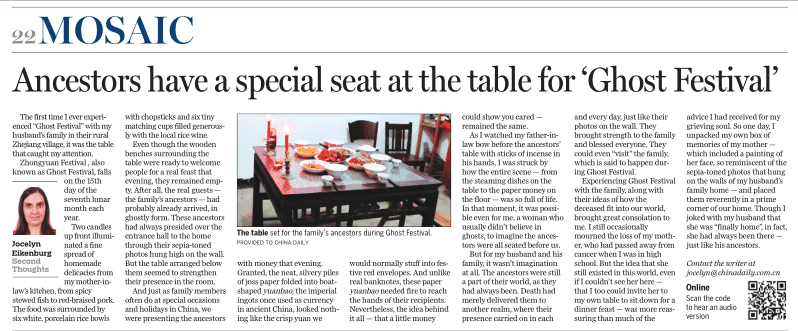
On Friday, China Daily published my latest monthly column: Ancestors have a special seat at the table for ‘Ghost Festival’. It traces my first experience with the festival and also how it ultimately moved me to re-imagine my own relationship with ancestors (particularly my mother, who passed away when I was in high school). Here’s an excerpt from the piece:

The first time I ever experienced the “Ghost Festival” with my husband’s family in their rural Zhejiang village, it was the table that caught my attention.

Two candles up front illuminated a fine spread of homemade delicacies from my mother-in-law’s kitchen, from spicy stewed fish to red-braised pork. The food was surrounded by six white porcelain rice bowls with chopsticks and six tiny matching cups filled generously with the local rice wine.

Even though the wooden benches surrounding the table were ready to welcome people for a real feast that evening, they remained empty. After all, the real guests — the family’s ancestors — had probably already arrived, in ghostly form. These ancestors had always presided over the entrance hall to the home through their sepia-toned photos hung high on the wall. But the table arranged below them seemed to strengthen their presence in the room.

And just as family members often do at special occasions and holidays in China, we were presenting the ancestors with money that evening. Granted, the neat, silvery piles of joss paper folded into boat-shapedyuanbao, the imperial ingots once used as currency in ancient China, looked nothing like the crisp yuan we would normally stuff into festive red envelopes. And unlike real banknotes, these paper yuanbao needed fire to reach the hands of their recipients. Nevertheless, the idea behind it all — that a little money could show you cared — remained the same.

As I watched my father-in-law bow before the ancestors’ table with sticks of incense in his hands, I was struck by how the entire scene — from the steaming dishes on the table to the paper money on the floor — was so full of life. In that moment, it was possible even for me, a woman who usually didn’t believe in ghosts, to imagine the ancestors were all seated before us.

But for my husband and his family, it wasn’t imagination at all. The ancestors were still a part of their world, as they had always been. Death had merely delivered them to another realm, where their presence carried on in each and every day, just like their photos on the wall. They brought strength to the family and blessed everyone. They could even “visit” the family, which is said to happen during the Ghost Festival.

Experiencing the Ghost Festival with the family, along with their ideas of how the deceased fit into our world, brought great consolation to me.

You can read the rest of the column (in full color) right here. And if you like it, share it!

Romanced on a Shanghai Bicycle (Almost) for Two: Cherished Memories of When My Husband ‘Picked Me up’ on His Bike

Recently, I discovered bicyclists in Beijing could no longer have an extra passenger in the back.

While I understood the safety rationale behind the move, I couldn’t help feeling it was the end of an era. After all, some of my fondest memories with Jun happened while I was riding on the back of his bicycle in Shanghai.

We dubbed the bike our “official car”, and Jun would use it to pick me up when I would arrive late in the evening from business trips outside the city. I would message him when I was about 10 or 15 minutes from the subway stop near our apartment, and then he would pedal over and wait for me. No matter how exhausted I might have been, the thought of Jun and our humble little bicycle made me bound up those subway stairs with a bounce in my step.

He would always immediately take my bags for me and place them in the basket, and then I would settle myself on the platform behind his seat, and hug him with my arms. Riding with him was like an extended embrace in a sense, and maybe that’s why I liked it so much. It was romantic, but with a purpose. After all, you had to hold on to the person pedaling the bicycle for safety.

I think I liked these trips even better because, honestly, Jun didn’t need to pick me up like that. Our apartment was only about four blocks from the subway and could easily be reached in a 10 or 15 minute walk. But Jun insisted on meeting me with that bicycle, regardless. He never made any grand declarations in the process, but he didn’t have to — the whole thing was an act of love.

I understand why things have changed in Beijing. And those changes come at a critical time when motorized vehicles, including scooters, rule the roads, not bicycles.

But this reality makes those memories of riding on the back of Jun’s bicycle all the more precious to me.

Have you ever ridden on the back of someone’s bicycle? Was it ever a romantic experience to you?

Photo credit: By 齐健 from Peking, People’s Republic of China – Down the Hutong, CC BY 2.0, https://commons.wikimedia.org/w/index.php?curid=18200257

Riding the ‘Love Boat’: Ukrainian Woman Falls for Chinese Cruise Ship Colleague

Have you ever imagined romance on the wide, open seas? Meet Mary, a Ukrainian woman who worked on a cruise ship and fell for her colleague from South China. I’m honored to share the tale, along with a lovely collection of photos that document their precious love.

Do you have a love story or other post you’d like to see featured here? Visit the submit a post page to learn more and then contact me today with your ideas.
—–

He asked if he could accompany me on this trip … and he became my companion for life.

I was working on a luxury cruise ship and my day off looked pretty fun. I planned to sail up to Manaus, the capital of northwestern Brazil, for shopping, lunch, a crocodile safari tour in the Amazon river just for crew members, dinner in a traditional Mexican restaurant and clubbing all night.

When my girlfriends and I entered the l boat for the safari tour, which was supposed to take us to see dangerous crocodiles, he was already onboard, taking pictures of the Amazonian waters.

He was the handsome IT engineer on the cruise ship.

I had talked to him on our ship before. He was always very polite and friendly, and this moment was no exception. He asked if he could sit next to me and accompany me on this trip.

I said “Yes,” never realizing it was the beginning of our romance.

The next day we had a date in Manaus city. Then we got together Curacao island, Aruba, St. Martin and Puerto Rico, and along the way our love grew.

Both of us had worked on cruise ships for a few years, traveling all over the world. We shared a lot in common, including the fact that we were both dreamers who were accustomed to taking action to achieve our goals. With him everything always felt easy and enjoyable.

When our working contracts had ended, I flew back to the Ukraine, while he went home to South China. Yet the bond between the two of us remained strong.

Three months after we parted, he arrived in my city of Lviv and we traveled together to all the best places in Ukraine.

Later, I was invited to visit him and his family in Guangzhou, where he proposed to me. I went back home and announced to my parents that I would move to China.

We did not find any obstacles in our way. My parents really liked him, and his parents liked me.

Before the wedding, we lived together for one year. We established our own home and found jobs (as we had resigned from the cruise company). We also traveled together to Shanghai, Hong Kong and Macau, and had a paradise honeymoon in Hawaii. Our wedding supposed to be small, but we ended up with 120 people in attendance. My parents, a few relatives and friends came from Ukraine. It was mix of traditions, with sea-inspired decorations, Chinese cuisine, Ukrainian embroidered towels, a first dance and a hip party for younger guests on the 65th floor of the Hyatt rooftop bar.

Eleven months after the wedding, we were blessed with our gorgeous daughter Alicia, becoming the happiest parents ever. Now seven months old, she is a very interesting and cute little baby.

When we are together, nothing seems impossible. There are no distances, no obstacles and barriers for us. We are citizens of the world. And we will continue to open up this world together and show all of its beauty to our girl.
—–

Speaking of China is always on the lookout for outstanding guest posts! If you have something you’d like us to feature, visit the submit a post page for details — and then submit yours today.

Was There a Dating Tradition in Inner Mongolian Forest Among Chinese Men, Russian Women?

“But apparently this stems from a tradition whereby Russian ladies would meet Chinese men here in the forest and kind of go on dates. But I guess it’s evolved to become more of a, you know, all encompassing thing.”

Those were the remarks in a recent episode of Travelogue on CGTN, or China Global Television Network (formerly CCTV International), that piqued my curiosity.

In Inner Mongolia 2: Life in the saddle, the host of the program Tianran He walked through a virgin forest in the Hulunbuir region of Inner Mongolia, China, when he started talking about these small messages dangling from the trees: “…in the forest there’s loads of these little good luck charms, and most of them are for love, but this one’s like, I wish my dad, mom, granddad and grandma good health.”

And then he explained this came about because of these rendezvous in the woods between Chinese men and Russian women who were apparently lovers.

Naturally, I was intrigued and set off to find whatever I could about this secret tradition in one of northern China’s border regions.

And I looked…and looked…and looked. But nothing definitive surfaced among the many searches I made in Chinese. (Incidentally, the host’s description of those items as “good luck charms” is inaccurate. Chinese would call them 许愿牌, xǔyuànpái, which could translate to “wish cards”.)

To be sure, Inner Mongolia’s Hulunbuir is a very remote destination in China. It’s tucked right up in the northeast corner of the country, sharing a border with Mongolia and Russia.

The close proximity to Russia does add plausibility to stories of cross-border dating in a forest. And if parents back then were anything like today — after all, it’s not uncommon for families to oppose interracial or intercultural love — chances are couples like this would welcome the cover and privacy of all those trees.

But exactly where is this forest in Hulunbuir? Based on the trees in the video, I suspect it’s a virgin birch forest — and there is such a place in Hulunbuir: 白桦林, báihuàlín, the white birch forest or white birch corridor in Ergun (额尔古纳). This area of Hulunbuir borders Russia, making it the most likely candidate.

Chances are, I’ll have to travel there to get the full story from the locals.

Then again, given that China has a long border with Russia (and the fact that white women in China like me are often mistaken for being Russian), there are probably many more forests out there that have served as sanctuaries of Chinese-Russian cross-border love. What stories have you heard?

P.S.: If want to see the episode for yourself, watch it in full on the CGTN Youtube channel:

“I Awoke to Find a Girl Lying by My Side”: Chinese Men Open up About Dating Foreign Women on Vice.cn

“One evening, I drank heavily and the next morning I awoke to find a girl lying by my side. At the time I was incredibly embarrassed, and she was very shocked, because the night before she had also drank a lot. We couldn’t even remember who checked us into the room.”

This is the final installment of my English translation of a Chinese-language article on Vice.cn featuring interviews with four Chinese men who dated foreign women. Today’s interview is with a journalist and writer in Beijing who had many foreign girlfriends when he lived in southern Europe, including one he met the morning after a night of revelry under surprising circumstances.

If you missed the other three installments, have a look at “She Liked Having Threesomes”: Chinese Men Open up About Dating Foreign Women on Vice.cn, “The Moment Our Eyes Met, I Froze”: Chinese Men Open up About Dating Foreign Women on Vice.cn and “It Was Her First Time to Sleep With a Chinese Man”: Chinese Men Open up About Dating Foreign Women on Vice.cn.


28 years old, journalist/writer, living in Beijing

VICE: I heard you’ve had many foreign girlfriends.

I’ve had some. That’s because in my former media work, I would often get sent out of the country. So I would contact with many people, mainly in southern Europe. Spain, Portugal, Italy, Greece — I’ve lived for at least half a year or longer in all of them, and got to know many women.

Could you share some impressive stories?

Ha ha, there are quite many. The countries I went to are relatively laid-back. The economies are not that developed, but the flavor of life is very strong and the people are very warm. I remember the first time I went out with a foreigner was with a Portuguese girl. At that time I was really young, just 24 and it was my first time to live independently overseas. One evening, I drank heavily and the next morning I awoke to find a girl lying by my side. At the time I was incredibly embarrassed, and she was very shocked, because the night before she had also drank a lot. We couldn’t even remember who checked us into the room. Later we went downstairs to the reception desk to find someone to ask about this, and then went to a bar looking for friends to inquire about what happened the previous night. The whole process was really quite ridiculous, but also very romantic. That evening we were once again having dinner together, and then continued to reserve a hotel room. Everything just happened naturally.

Have you had a long-term relationship with any of them?

Yes, she was French. But I don’t really want to share this story, it’s a little painful and I haven’t yet gotten over it.

With so many foreign girlfriends, do you feel like you’ve brought honor to your country?

No. Because my work was often overseas, my circle of friends included people of all different nationalities. To me, the individual means more than the nation.

As a Chinese guy, it’s rare to date so many foreign girls, right?

Before, I had never really thought about it, because this kind of situation is really uncommon. But after the first time I did, I realized that even thinking about this was a way of underestimating myself. Even though Chinese men in the eyes of foreigners are mostly thought of as martial arts experts or bespectacled geeks, Westerners have a really narrow understanding of us. But when it comes to actual relationships, Western women are willing to get to know me well.

A view of Lisbon, Portugal, at sunset.

So Western stereotypes about Chinese men haven’t affected your relations with foreign women?

After I got to know that first Portuguese girl, they affected me less and less. The individual differences between women are really not that big. Every person’s needs are very similar, especially emotional ones. Everyone needs to be loved, cared for, acknowledged. But because of culture, these might manifest themselves in different ways. Individual differences are much greater than differences because of country, culture or race. Once I no longer paid attention to the sense of inferiority brought by these stereotypes, I was more confident and smooth in my encounters with foreign girls. It’s like a guy from Henan chasing a girl from Jiangsu – what stereotypes would he consider?

Are there a lot of Chinese men around you together with foreign women?

Very many, and it has always been their Chinese character that attracts the girls. One friend went to university in Argentina and he said, “Actually, foreigners have a much stronger curiosity about Easterners because we’re more mysterious, and who wouldn’t want to try something new?”So the point is that, for this person, at the appropriate time their particular traits are a plus.

Did these women gain any new impressions of Chinese men because of you?

Of course. When I was dating them, I would share some Chinese culture with them and prepare some Chinese dishes for them. Although some things are cultural differences brought about by history, having a new interpretation is always better than unilaterally listening to Western media.

But does it seem easier for Chinese girls to be together with foreigners?

Because in the eyes of foreigners, Asian men have a lower status than Asian women. The typical stereotype of Chinese, or say Asian men, among other countries is: high achievers at school, introverted. These are the qualities that we carry with us. Capitalist culture distorts this notion in books, movies and the media. So who would be willing go on a date with some guy who is not even a little cool?

But for women, although some were rather quietly intelligent when they were young, when they leave the country they can easily fit right in. On one hand it’s related to how women have a strong tolerance. On the other, it’s that Western culture is more accepting of Chinese women. And when you look closely at foreign men with Asian women, for the most part they are very close to each other’s cultural traits, and it’s hard to see Western men following the living habits of Eastern women. That’s because Western men, in today’s mainstream cognition, have an advantaged position in terms of skin color and gender, the symbolic meaning of the more “advanced” human existence. So naturally it will be easier for them to find people no matter where they are.

Do you have any advice for Chinese men who want to pursue foreign women?

You only need to remember this: you and her are both people.


This is the final installment of my English translation of a Chinese-language article on Vice.cn featuring interviews with four Chinese men who dated foreign women. If you missed the other three installments, have a look at “She Liked Having Threesomes”: Chinese Men Open up About Dating Foreign Women on Vice.cn, “The Moment Our Eyes Met, I Froze”: Chinese Men Open up About Dating Foreign Women on Vice.cn and “It Was Her First Time to Sleep With a Chinese Man”: Chinese Men Open up About Dating Foreign Women on Vice.cn.