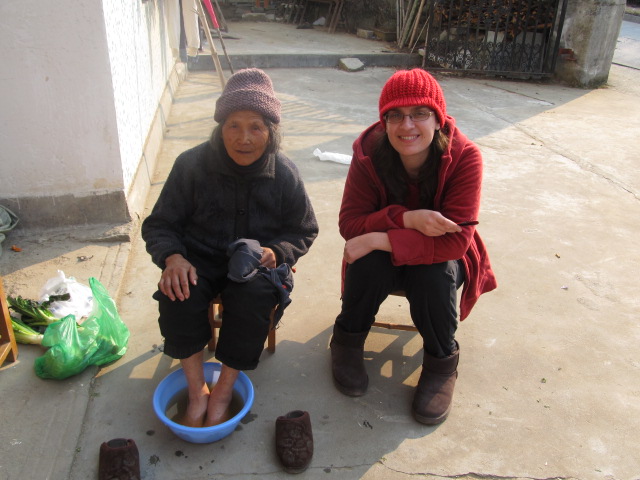
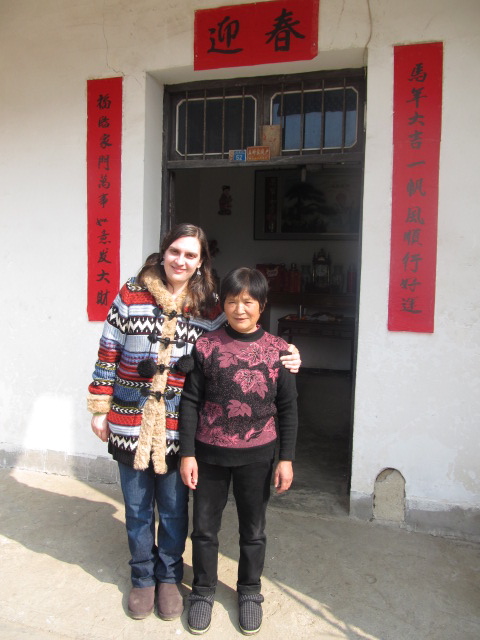
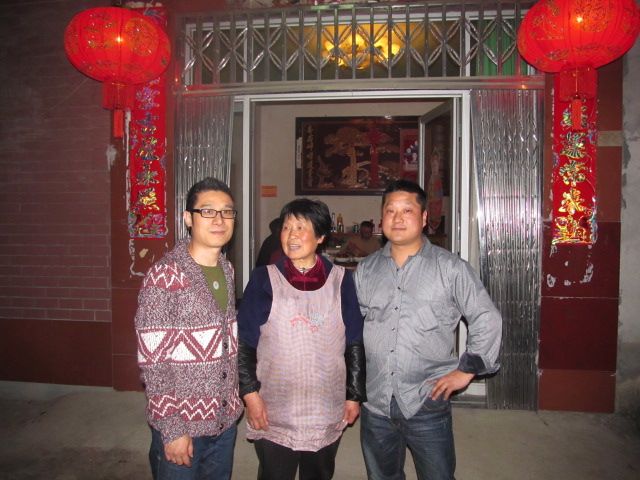
When you live a lot of your life online like I do, it’s easy to make things look perfect. Like, for instance, Chinese New Year. Last year I spent much of the run-up to the holiday posting eye-catching photos of Chinese New Year – from shots of mouth-watering homemade goodies from my mother-in-law’s kitchen to handwritten red couplets shining in the winter sunshine.
But here’s the thing – it’s not all perfect or fun when you actually spend Chinese New Year with the family here. Sometimes, it’s even nerve-wracking. So in the spirit of being totally honest about Chinese New Year, here are 4 things that actually make me anxious about spending this year’s holiday with family here in China:
1. Firecrackers and fireworks
Confession time – I’m a jumpy person. If you startle or scare me (like, sneaking up on me all of a sudden), I will literally jump!
That’s why I’m not exactly the biggest fan of two of the biggest symbols of Chinese New Year: firecrackers and fireworks.
Whenever the family sets them off at our house, it’s like they’ve kicked me into a war zone. I head for the safest corner of the house to duck down and cover my ears, praying it will all be over soon.
Of course, it doesn’t help that every Chinese New Year generates a frightening bunch of tabloid-worthy news stories about tragic accidents (including deaths) caused by firecrackers and fireworks, making me even more nervous whenever I hear that great “boom” outside.
If only my husband’s family would go for those electronic firecrackers that I heard about on the news in China last year – they have a prerecorded “boom” but none of that destructive or dangerous force.
But I know better — they’re traditionalists to the core when it comes to their choice of explosives. Which means I’ll have to prepare myself for another year of explosions outside the door – and another year of me nervously crouching in the corner of the house…with my ears plugged.
The other night, while talking to our close Chinese friend Caroline during Chinese New Year, my husband asked a common question. “Did you go out to bàinián?” Bàinián (拜年), of course, is the tradition of paying new year’s calls to your relatives and friends, usually by going over to their homes.
Caroline laughed with embarrassment. “I didn’t want to go out, I’ve stayed at home. People ask too many questions!”
That’s because Caroline still hasn’t, as they say in Chinese, “solved her personal problem”. She’s a single Chinese woman in her thirties. And because she’s single and well above 30, a sort of unofficial marriage expiration date for young people in China (especially women), her relatives will ask her the bomb of all questions: “Do you have a boyfriend?”
Caroline’s not alone in detesting the questions about her personal life. After all, one of the hottest topics trending on Chinese social media in the lead to Chinese New Year was Counter Annoying Chinese New Year Questions From Relatives.
Even I’m not immune to such questioning. John and I still have no children, which makes the questions “Do you have a kid?” or “Are you planning to have a kid soon?” — questions I frequently get from Chinese friends and relatives — sting at times. Of course, my mother-in-law doesn’t even bother to ask us; she just simply tells me I’m “too old,” which does wonders for my self-esteem! (Not.)
So, since we still don’t have a kid, guess what I’m expecting to hear from the relatives this Chinese New Year? Yep. And I’m definitely not thrilled.
It’s really scary when alcohol gets co-opted in China to measure things like filial piety or loyalty. Some of the biggest bullies often end up being some of your closest friends or relatives.
Big tobacco must love how China’s culture has successfully linked cigarette smoking to masculinity, guaranteeing that pretty much every family in the country includes smokers.
But I’m a rabid nonsmoker who finds secondhand smoke repulsive, so having smokers in my family here in China is another thing to worry about during the holidays.
Last year, it was almost impossible to find a dinner table where someone wasn’t lighting up. I experienced some uncomfortable conversations about smoking and often had to steal away from the dinner table because my lungs just couldn’t take it.
I’m expecting another round of “dodge the secondhand smoke” this year – and it’s definitely not going to be the highlight of my holidays. Ugh.
What worries you about spending the holidays with your family?
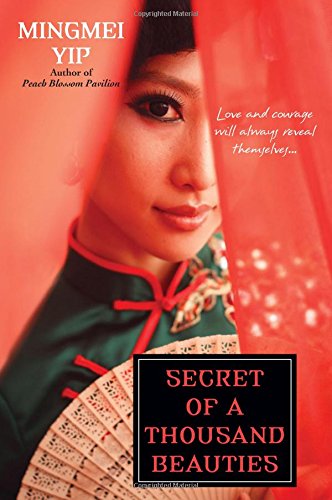
It’s not everyday you come across a novelist who is also a qin musician, painter and calligrapher. Mingmei Yip stands out for many reasons, including her beloved series of historical novels set in China. In Mingmei’s fiction, strong women rule and there’s plenty of love and romance to go around.
That’s because the story introduces us to a talented group of young women in Suzhou engaged in the traditional art of Chinese embroidery. Spring Swallow finds shelter in this sisterhood of embroiderers after escaping a ghost marriage, where she discovers the secrets of their celebrated art – and the determination to live life on her own terms (including when it comes to love). Fans of Lisa See and Gail Tsukiyama will enjoy this and the many other novels by Mingmei Yip.
In this interview, I asked Mingmei about everything from ghost marriages and Chinese embroidery to how interracial relationships were viewed in 1930s China.
—–
Your book offers a window into the world of Chinese embroidery, which has a 2,000-year history in China. What inspired you to build a story around the lives of women embroiderers?
In traditional China, women, considered men’s possessions, didn’t have much independence or freedom. A Chinese saying goes “The worst thing that can happen to a woman is to marry the wrong man. The worst thing that can happen to a man is to enter the wrong profession.” Unfortunately, because marriages were usually arranged, many women ended up marrying the wrong man at the cost of any chance for happiness. Wary of a bad marriage, some decided to remain single for the rest of their life. These women would join small communities established for non-marrying women. They displayed this choice by tying up the hair in a long pigtail.
Intrigued by these women and their sisterhoods, I decided to write a novel about them. Most worked as maids, but some were more fortunate and could learn a traditional woman’s craft. One of these was embroidery, an art that has always appealed to me, so I decided to write about this small group of embroiderers. They are supposedly celibate, but of course many succumbed to desire.
I was taught embroidery in elementary school and came to love it as a craft and art form. So it was natural for me to write about women embroiderers in China. As I wrote it I often imagined that I was moving the needle to create images in delicate colors.
Why did you choose to set the novel in 1930s China?
I love history, because it is like a mirror reflecting all that’s good and bad in humanity. I think 1930’s Shanghai was one of the sexiest eras in world history, populated with larger than life characters: glamorous women, cynical politicians, and corrupt police. But also with idealists trying to help China find its way in the modern world. It was also a time of extremes – from sybaritic luxury to abject poverty. I have tried to describe both from the indulgences of the rich to the miseries of the poor.
The thirties China was a time when everything was changing and the world seemed new.
At the heart of the novel is Spring Swallow, a “bad-luck woman” determined to fight for her own happiness at a time when women had few options in life. Could you talk about how you conceived of this character?
Most of my novels are about strong women who never give up despite all difficulties. I feel great rapport with these women because I went through very difficult times myself during my youth. Had I grown up in that earlier era, my difficulties would have been far greater. Though Spring Swallow faced much bigger challenges than I, I hope I share her indomitable spirit.
Your story offers many different aspects of love and marriage in China — including arranged marriages, secret love affairs and even concubinage. Could you share with us something fascinating or surprising about love and/or marriage in China that you learned while working on your book?
Ghost marriage was one of the many ways women were oppressed in traditional China. Couples were often betrothed in childhood, or even before birth. Since only half of children survived to adulthood, many lost their fiancés. Because they had already pledged marriage, the cruel custom was to marry the woman to the dead man. As a practical matter, this meant she was a slave to her supposed in-laws. And also she was denied the possibility of actual love with a living human. Chinese women have always been resourceful and many found ways to have affairs, though secretly and at great risk. Of course such relationships tended to be fleeting, leaving many women to a lonely old age.
A foreigner and a Chinese end up falling in love in the course of the novel. How did people in a 1930s China view interracial relationships?
Even when I was a teenager living in Hong Kong, people disapproved interracial relationship, especially between a Chinese woman and a white man. However, in the 1930ies, China’s jazz age, such relationships were more shocking, except in cosmopolitan cities like Shanghai and Beijing. But many believed such unions were based on lust, not true love. Chinese men were particularly resentful, blaming the Chinese women for benefiting a foreigner instead of their own race. However, though there might be name-calling, active oppression or violence was extremely rare. Now, White-Asian marriages are so common they attract little notice.
What message do you hope readers come away with from your novel?
Novels and movies provide entertainment, but I strongly believe that readers should also be given something more. Besides enjoying an escape filled with excitement and adventures, I hope my readers will discover some ancient Chinese wisdom and come to know a little more about human nature.
When I write about strong women who overcome obstacles, I feel that they became my teachers. Now I have a comfortable life, but getting there was a long journey. I hope my characters will inspire others not only to succeed, but also to develop wisdom and compassion.
Bringing family together for the holidays is bound to produce a few awkward experiences – including when it’s your family spending Chinese New Year. Here are four I’ve had that have stayed with me over the years (making me wonder what’s in store this Chinese New Year!):
1. Family pressure to have a baby at the most important dinner of the year
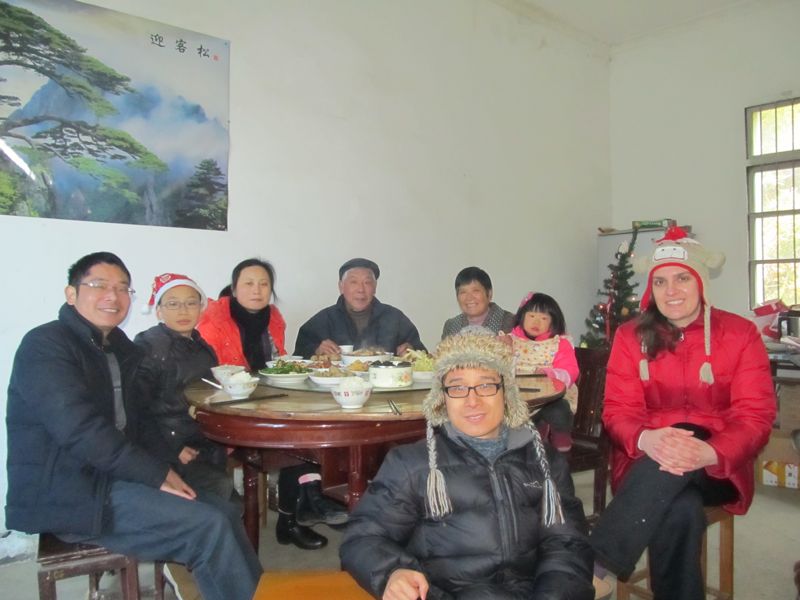
Last year, just as we sat down to nianye fan (Chinese New Year’s eve dinner – the most important feast of the year), one of John’s brothers turned to me and said, “Next year, we’ll have a new person around the table, right?” The meaning wasn’t lost on me – that, obviously, he expected us to get pregnant and have a baby in the year of the horse.
Not exactly the kind of thing you like to hear when you know that’s not going to happen. (We just can’t have kids right now for personal reasons.)
My face completely flushed red as everyone around the table looked at me, and I couldn’t think of a single thing to say. It was one of those moments where time nearly ground to a halt – an incredibly awkward one, to say the least.
Fortunately, everyone soon started eating. Thank god Chinese New Year’s Eve dinner was so distracting! (And delicious!)
2. Seeing a relative so drunk he was practically unconscious and covered in vomit
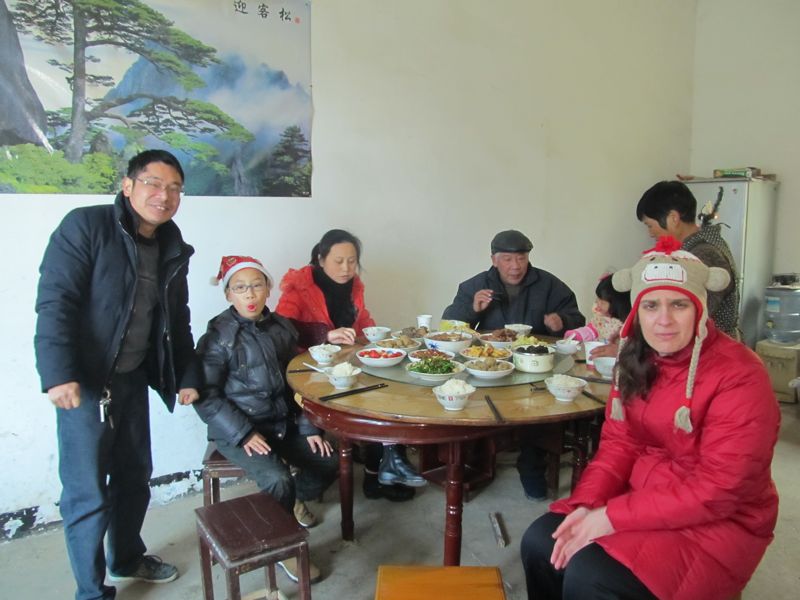
This is the lunch where it all started.
This wasn’t just awkward – it was dangerous.
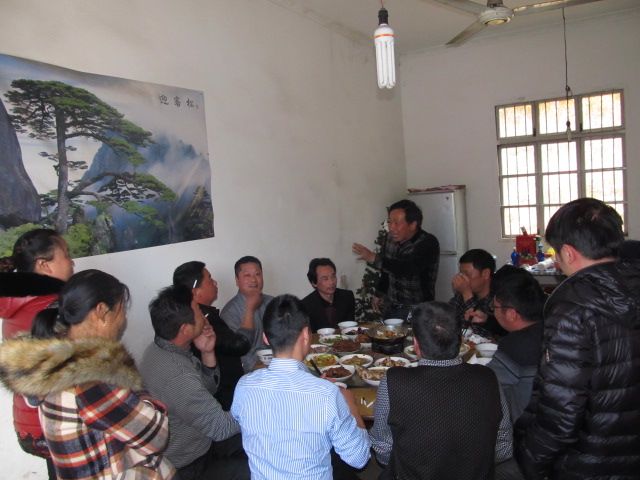
On the second day of the Chinese New Year, our family invited over some relatives for a loud and raucous lunch where the alcohol flowed quite freely. A little too freely, in fact.
The main culprits were a mob of older male relatives in the dining room pressuring the younger guys to drink as a sign of respect to them. It became a neverending request, where one shot glass of high proof baijiu led to another and another and another.
I never cared for boisterous and drunken family meals, so I had positioned myself on a chair outside, chatting with some of the women in the family.
An hour or so later, my husband discovered one of his cousins had gotten so sloppy drunk that he hid himself in the shed behind the family’s beehive. When John finally carried him out of the shed and plunked him into a bamboo chair, he looked almost unconscious – and then puked all over his shirt.
I swear, the baijiu on his breath mingled with the stench of vomit has forever been etched into my memory. (And, I will never, ever, sit in that bamboo chair.)
Later, family members sent him to the hospital, where they pumped his stomach and revived him. Fortunately, he didn’t consume enough to threaten his life.
But those moments when his almost comatose self, reeking of alcohol and puke, were seated right across from me rank as some of the most awkward and frightening ones I’ve experienced during the holidays.
3. Using a chamber pot in the bedroom while having my period
The family chamber pot looked something like this.(Photo via http://www.budou.com/detail/6/6242577.html)
Well, it’s one thing to manage your “monthly gift” when you’re in your own apartment – and another thing entirely to deal with it in a home where the only flush toilet is downstairs and too far from your bedroom to use at night.
Enter in the family’s chamber pot (it resembled a bucket, complete with its own lid). Yes, folks, that’s what I had to use one year when nature called and it was late at night. I’ll spare you all of the really gross details, but suffice to say it felt awkward trying to squat over a bucket AND manage the messy side of being “on the rag” at the same time.
(Thank goodness our suite at the family home now has a modern bathroom with a real flush toilet!)
4. Calling John’s parents to tell them we were stuck on a mountain after dark
John and I were so thrilled we made it to the top — never realizing we nearly ended up trapped on the mountain after dark.
Last year, we had an unseasonably warm start to the year of the horse – so much so that the glorious sunshine on the second day of the new year beckoned John and I outside for a walk. We didn’t actually intend to climb the mountain but the beautiful weather spurred us on – and besides, we had always wanted to make it to the top. We lucked out on finding a path that brought us close to the summit and couldn’t resist clawing our way through the brush and bushes until we made it. Woo-hoo!
Well, that euphoria lasted right up until the path we chose down the mountain petered out until we were trapped in a minefield of thorny vines as the sun was just disappearing behind the mountains. There we were, trapped on a mountain at dark with no idea exactly how to make it down and not a flashlight in sight.
We did, however, have our mobile phone – thus came the awkward call sometime around 6:30pm or so, announcing what was surely my mother-in-law’s worst nightmare. (She never did care for us gallivanting around the mountains in the village).
Fortunately, we did eventually make it down the mountain – slowly and step-by-step as we held hands the entire way for safety. It was one of the craziest things we’ve ever done and we suffered some nasty looks from John’s family (including his eldest brother, who gave us the silent treatment as proof of his extreme anger at us for getting lost). Not fun.
What awkward experiences have you had during the holidays?
A few years back when I co-wrote an article titled Western Wives, Chinese Husbands (exploring what it’s like to date and marry Chinese men), we touched on the subject of money — specifically, that sometimes Western women end up being the breadwinner in the family.
I was reminded of that when I first read this post from Judith (who blogs in Dutch at Judith In China). She’s from the Netherlands and currently dating a Beijing local (who she considers her perfect match). But, “Even though I don’t earn much at all, own a house or car, or have savings worth mentioning, I am much more economically stable than he will probably ever be.”
I grew up in a middle-class family in a small town in the Netherlands. My two siblings and I basically had everything we could wish for. We went on modest holidays within the country once a year, got nice birthday gifts and our parents supported us throughout our studies. My boyfriend was born a one-child-policy son and grew up in Beijing’s hutongs. His parents are real lǎobǎixìng; his mother used to sell bus tickets and his father worked as the repair man for a large hotel. Although his parents cared for him much, they lived in one room without private sanitation. Some days all his father could afford for lunch was to share a pancake with his son.
Although our backgrounds couldn’t have been more different, we really are a perfect match.
I have been interested in Chinese language and culture since I was a little girl, and he has been crazy about Western music and culture since he first encountered it in Beijing’s early nineties. I have never had a preference for Asian men or an interest in the AMWF community, on the contrary: if you would have told me a few years ago that I would end up with a real Beijing boy I probably wouldn’t have believed you. When we met, my Chinese wasn’t that great and he didn’t speak much English, but we have been in a loving relationship for over five years now. He is very caring, makes me laugh, and makes me feel like the most beautiful girl on the planet despite being so much whiter, taller and larger than those cute Chinese girls. Most of all, he makes me feel safe.
There is one thing that keeps coming up in our relationship though. I wouldn’t call it a problem, but it is definitely something coming from our different backgrounds that will probably always linger right below the surface. Even though I don’t earn much at all, own a house or car, or have savings worth mentioning, I am much more economically stable than he will probably ever be. His attraction to Western music made him choose to become a professional musician. And although I really believe he is one of the most talented musicians in China and truly has the talent to make a stable income from his profession, it’s not easy in this industry and especially not in China.
When we met, my boyfriend was the member of a rather famous band, but he quit shortly after we became a couple. Since then he has been working on various projects on and off, some of which are more profitable than others. This means that his income was quite OK for the last two years. Although he didn’t earn millions he had frequent gigs, and combined with my stable salary I felt we were quite well off. This year however, there have been some changes in the projects he has been working on and he has barely made any money. At the same time we are looking to get married, but the only thing holding us back is not wanting to spend all my savings on an (even simple) wedding.
In some ways my boyfriend can be very traditional. As the man in the family, he feels horrible about me being the main breadwinner, and this year even supporting him to a certain extent. He doesn’t want to speak about it too much and doesn’t want to let me know how he feels, but I sense it more and more. I don’t mind sharing my income with him. We’re a team and should he one day become world famous I’m sure he would share his wealth with me just the same. But if I offer to buy him new clothes as a present, nicer lunches for him when we don’t eat together or suggest to go on a weekend trip, he says he doesn’t need it. He prefers to wear the same old shoes, eat a 10 kuai bowl of noodles for lunch and not travel much.
I feel this also has to do with a Western approach to finding a good balance between saving and enjoying your money, while he feels that we should not spend much until we’re in a better financial position. And then things such as marriage and buying a house would come first. Whereas I feel that although we shouldn’t spend all our money on an expensive holiday abroad, we can allow ourselves to enjoy an occasional weekend away within China, for example. He doesn’t want me to spend that kind of money for the both of us if he can’t contribute much or anything at all. Which means that I visit friends in other cities and he doesn’t join me, or that I go to a café to work while enjoying a latté and a sandwich while he just eats his bowl of noodles for lunch. He simply does not want to join me, even if I explicitly say I want him to.
I feel bad for him feeling this way, because I don’t see his financial situation as a problem. I fell in love with him because of the man he is, not because I thought that one day cash would come flowing in because of his profession and I wouldn’t have to worry about money anymore. I guess this is a very different perspective compared to many Chinese girls, as they often think in practical terms first when it comes to relationships (such as Ted highlighted in his excellent guest post on this blog titled “What I’ve Learned from 15 Blind Dates in China”).
I hope my boyfriend will someday get used to how I feel and that he can find a way to accept that his girlfriend’s income will probably always be more stable than his.
Judith lives and works in China and blogs about her daily life and the special things she encounters at judithinchina.com(in Dutch).
My husband and I spent Christmas Eve in Shanghai’s Xintiandi many years ago.
Initially, I had this perfect little holiday-themed post all sketched out to run today. It would snappy, upbeat and fun. Everything Christmas should be, right?
But after I let it sit for a day and revisited it, I realized it didn’t hit the right note with me. The thing is, I wasn’t feeling snappy, upbeat or fun.
I didn’t like the idea of having to force a happy face out there when it wasn’t the truth. The heaviness in my heart that weighed upon me as I stared at the computer screen told me I just couldn’t run that post in good conscience – not when I’m still facing my own share of ups and downs over spending Christmas in China, a country that doesn’t officially celebrate it.
I live here in China because it’s my husband’s home country. We moved back here from America in November 2013 and plan to reside here permanently for the rest of our lives. Part of that means that, sometimes, I’ll spend Christmas in China too.
In theory, the holidays can be a lot of fun here in China. We’ve got our own Christmas tree decked out in shiny ornaments, sparkling colored lights, and golden ribbon. “Santa Claus” already has gifts ready to go for us. We’re planning a romantic Christmas Eve dinner at our favorite restaurant, followed by a nighttime stroll beside the West Lake to take in the stunning views of the gardens lit up in pink, blue and green lights. On Christmas Day, we’ll climb up to the top of a beautiful pagoda and enjoy some breathtaking views of the city. It’ll be a Christmas like no other – in theory.
But in practice, in anticipation, it doesn’t always feel as fun as you might expect. I can hardly find a hint of the Christmas season on the Chinese TV stations I have available and it’s tough to find more than a handful of Christmas movies. In my community, I don’t see folks making the same Christmas preparations I remember from back home – and I have a feeling that my Christmas tree is quite possibly the only one in the entire block. I can’t make Christmas cookies at home and the ones I tried finding online looked nothing like the batches of warm, cinnamon-scented joy that used to come out of your mother’s oven. I told my family not to send Christmas cards because it can take up to a month to receive the mail here and, anyhow, I’d get it late because an out-of-town relative receives our mail; but a part of me secretly mourns the fact that this might just be the first Christmas I won’t receive a single physical Christmas card from anyone.
That’s what it feels like for me on some days – the days when nostalgia for Christmases past gets the best of me.
Now, this isn’t the end of the world. I know that things could be far worse. I know this Christmas will come and I’ll be okay. In fact, in all likelihood it’ll turn out to be a nice Christmas. But that doesn’t mean that some days I won’t be a little down – like I have been recently.
It’s a relief to finally be honest about how I’m feeling – especially when it seems the online world would rather us all put on our best “holiday cheer” face. I was on Facebook the other day and confronted by a neverending stream of happy, confident, “we have perfect lives and never get depressed” kind of posts. It was really hard for me to read it at times. It was as if every ultra-positive post was saying to me, “This is the holiday season and if you’re not happy, there must be something wrong with you.”
But when I got off social media, meditated along with my favorite meditation song, and chatted with my husband about how I was feeling, I remembered that, in fact, there’s nothing wrong with me. That’s it’s all right to have those down days during the holidays – especially when you’re far from your family and friends in your home country. And that social media is often like smoke and mirrors, hiding away the darkest parts of our own lives.
My holiday wish to you is honesty – as in, being honest with yourself during this holiday season. No matter where you are in the world, perhaps you might find yourself facing another round of the holiday blues. Maybe you don’t even have the “I’m living abroad and missing family” excuse. Whatever the reason, know that it’s okay. Know that you’re not alone. A lot of us don’t speak up because it’s not cool or not the kind of thing everyone wants to hear. But we should.
I can’t predict exactly how I’ll feel on Christmas. I’d like to hope it will be a very merry Christmas. But I know that if it isn’t, I’ll give myself the permission to acknowledge that, to feel my feelings, and to remind myself that it’s part of being human. That life – even a Christmas spent abroad with your husband in China – will have its share of ups and downs.
Has spending the holidays abroad — or even, in a country that doesn’t celebrate your holiday — left you with a touch of blues sometimes?
I am a 24 year-old Chinese man from Beijing. I am currently in California in the US. Your articles reminded me my memories of dating Western women back in Beijing. I do find myself very attracted to Western women. And I have a strong will to develop a long-term relationship, or even marriage, with Western women. I am currently a student and will graduate next March. Due to the nature of my job, it would be better for me to stay in the states and work there (I’m pretty sure I could find a good job here). It’s also highly possible that I would finally end up in Chicago or NYC. I think it would be better if I could find my significant one who have been to China rather than date a local in the states. Given the truth that I would not live in Beijing for a long time period in the next few years, what is your advice for me to find someone who will come back to U.S. soon?
—
That’s great you’re a student, because colleges and universities are some of the best places to meet women to date. You’re also lucky to live in California, which boasts a surplus of Asian studies programs (check this list of programs arranged by state to see if your institution hosts one). Asian studies (or better, Chinese studies) majors, whether undergrad or graduate students, are the folks who are most likely to have spent some time in China and have an interest in China.
If your university has an Asian studies program, see if they host a Chinese language corner (where students get together to practice their Mandarin Chinese on campus). This is a perfect chance to meet lots of people at once. Ideally, they already have one, so all you have to do is figure out the time and just show up. But if not, here’s an opportunity for you to approach the department and offer to help set up a Chinese language corner. Tell them you’ll recruit your fellow native Chinese speakers to make it a valuable experience for anyone who attends.
Some Asian studies programs also put on events during the school year that could offer opportunities to mingle with women interested in China. For example, I once attended a one-day China conference at Oberlin College that was open to the public filled with young people (including young women).
What if you’re too busy between now and March – and want to wait until you end up in a big city like Chicago or New York City? Then you should get to know the site Meetup.com, where you can discover Chinese language and culture meetup groups in these and many other cities. (See my search results for New York City and Chicago to give you a taste of what’s out there.)
Good luck – and here’s hoping in a few years I’ll be getting an e-mail from you about your upcoming wedding in America.
What advice do you have for Frank?
—–
Do you have a question about love, dating, marriage or family in Chinese or Western culture? Send me yours today.
“Well, we have this big meal and eat things like turkey and cranberries…”
As I tried describing one of the most essentially American holidays of the year to my Chinese in-laws, I could already see their eyes glaze over with confusion and sense the questions forming in their minds. Turkey? Cranberries? Even though I expressed these perfectly in Chinese, the result was still gibberish because neither of them had ever seen a turkey or tasted cranberries in their entire lives.
Sigh.
When you’re an American like me, living abroad as part of a foreign family that doesn’t understand the importance of what we call “Turkey Day”, let alone what foods we traditionally eat, it can be frustrating. American Thanksgiving is part of the culture I grew up with. It’s something I’d like to share with my family in China – or at the very least, describe the holiday to them in a way that actually makes sense to them.
Fortunately, there is a way. Over the years, I’ve discovered that some of the most important things about Thanksgiving dinner have counterparts or equivalents in Chinese culture. You know, something your Chinese family actually knows and has probably tasted in their lives.
So if you’re struggling to explain American Thanksgiving to your Chinese loved ones, here are 5 suggestions that might just help you:
1. Roast turkey is America’s version of roast duck (kǎoyā, 烤鸭)
“Dry for 5 hours cropped” by FotoosVanRobin – http://www.flickr.com/photos/fotoosvanrobin/324209168/. Licensed under Creative Commons Attribution-Share Alike 2.0 via Wikimedia Commons – https://commons.wikimedia.org/wiki/File:Dry_for_5_hours_cropped.jpg#mediaviewer/File:Dry_for_5_hours_cropped.jpg
Outside the world of China’s well-heeled expats and cushy five-star hotels, turkeys just aren’t a thing here. They’re not native to China – so of course, most people haven’t actually tasted one. Even using the appropriate Chinese word for “turkey” (huǒjī, 火鸡) won’t necessarily make it easier for people like Baba and Mama to understand what you mean.
Fortunately, Chinese cuisine includes roast poultry (Beijing duck, anyone?), so you could always start off by comparing roast turkey to China’s roast duck (kǎoyā, 烤鸭). It doesn’t taste same (so this vegan has heard) but it’s in the ballpark.
What about stewed chicken (dùn jīròu, 炖鸡肉)? You usually baste roast turkey in the bird’s own juices, which is sort of like stewing chicken meat. You could even tell them what I’ve said before – that turkey is really just an oversized chicken.
P.S.: For those of you looking for a great Chinese-American turkey recipe, this soy sauce and honey-glazed turkey will satisfy Chinese and American palates alike.
2. Cranberries are like Chinese hawthorn (shānzhā,山楂)
Chinese hawthorn (image via http://baike.baidu.com/view/6877.htm)
How do you explain the sweet-tart goodness of cranberries to people who have lived all their lives without cranberry sauce or Craisins (those fantastic raisin-like dried cranberries that have become one of my favorite snacks ever in America)?
Simple – tell them it’s like Chinese hawthorn (shānzhā,山楂). These sour berries are the quintessential fruit for tanghulu, delectable candied fruit skewers made popular in Northern China and now available in most Chinese cities. When Chinese hawthorn are warmed up and sugar coated, they taste surprisingly like cranberry sauce – a crunchier, less sauce-like version, mind you.
So guess what I’m cooking up for Thanksgiving this Thursday to substitute for cranberry sauce on the table? If you’d also like to try your hand at making candied Chinese hawthorn, check out this recipe.
3. Stuffing is like a savory version of eight-treasures rice (bābǎofàn, 八宝饭)
Eight-treasures rice (image via http://www.xiachufang.com/dish/512948/)
In a China where rice, noodles and steamed buns rule, try explaining stuffing — seasoned Western-style bread mixed with things like carrots, onions and celery — to your Chinese relatives. I once tried listing off the ingredients to my Chinese mother-in-law; while she never said “That’s weird,” I could somehow read it in her puzzled eyes – eyes that have never seen or heard of Stove Top (the number one stuffing brand in the US).
If only I had realized that China already has a stuffing-like dish called eight-treasures rice (bābǎofàn, 八宝饭). Granted, the sweet, rather than savory, flavors reign in this dish of sugary glutinous rice stuffed with all sorts of colorful dried fruits, seeds, and nuts. But many versions of Thanksgiving stuffing include dried fruits and other “treasures”. So just tell your Chinese family and friends stuffing is like a savory version of eight-treasures rice (xián de bābǎofàn, 咸的八宝饭), where we use bread instead of rice and vegetables or spices as the “treasures”.
4. Pumpkin pie is like a pumpkin-flavored gāodiǎn (糕点)
Mung-bean cakes, a Chinese dessert or gaodian.
No Thanksgiving Day – or explanation of a Thanksgiving Day – is complete without a little dessert. But here’s where it gets challenging, because desserts as Americans know them – you know, death by chocolate and the endless fluffy white frosting and whipped cream – just aren’t in traditional Chinese culture.
Fortunately, Western-style bakeries serving up pastries, cakes and loaves of bread have exploded all over China, which means a lot of people – especially the younger set – know what you mean when you’re talking about cakes and pies.
It’s the older generations — people like my mother-in-law and John’s grandma – you have to worry about. They’ve probably never even set foot in one of these bakeries.
Still, China has plenty of home-grown pastries or gāodiǎn (糕点), such as mooncakes (yuèbing, 月饼) and mung-bean cakes (lǜdòugāo, 绿豆糕). For the elders in your family, you could call pumpkin pie a sort of pumpkin gaodian (nánguāgāo, 南瓜糕).
5. American Thanksgiving itself is like China’s Winter Solstice (dōngzhì, 冬至)
Winter Solstice dinner with the family in China.
I’ve heard lots of people equate Thanksgiving Day with China’s Mid-Autumn Festival because both holidays occur in the fall and stress being together with family. But honestly, it’s a terrible comparison for lots of other reasons – especially in terms of food.
To celebrate China’s Mid-Autumn Festival, people eat mooncakes. Meanwhile, to celebrate American Thanksgiving Day, people feast on turkey and mashed potatoes and stuffing and everything else until their stomachs can’t bear it. Food and family both take center stage in Thanksgiving – something you can’t say about China’s Mid-Autumn Festival.
My suggestion? American Thanksgiving equals China’s Winter Solstice (dōngzhì, 冬至). Not only do both of these holidays bring family together and involve huge feasts, they also share a very important characteristic – they both kick off the holiday season in their respective countries. While American Thanksgiving signals the start of the Christmas season, it’s China’s Winter Solstice that reminds us Chinese New Year is just around the corner.
Now if you’ll excuse me, I’ve got an American Thanksgiving dinner of my own to prepare for here in China. To those of you celebrating, happy American Thanksgiving Day!
How do you explain American Thanksgiving dinner to your Chinese family and friends?
“Nervous” doesn’t even begin to describe how I felt when I was about to meet John’s parents in rural Hangzhou for the first time. After all, once John told his parents he was dating me, his father famously told him that while he could be friends with a foreign girl, but shouldn’t date her.
Ouch.
Meeting the parents inspires all sorts of anxiety no matter where you live in the world – but even more so when you’re a foreigner and you’re about to meet the parents of your Chinese boyfriend or girlfriend here in China. On top of all the usual pitfalls, you’re also dealing with a different culture, language and living customs. It’s like getting ready for an exam when you don’t even know the entire curriculum.
Fortunately, I’ve survived meeting the parents. And I’ve heard from a lot of others who have successfully made it through. Here are 6 tips I’ve learned over the years to help you prepare for meeting the parents in China:
1. Ask your girlfriend or boyfriend all about their parents
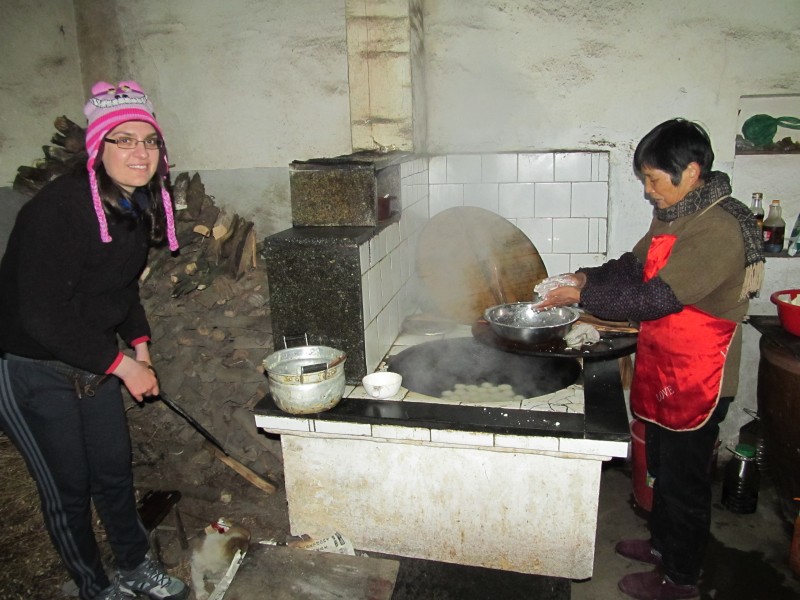
My husband’s mother is a fantastic cook.
There’s always a story behind everyone’s parents. Why not find out? It’s a great way to get to know them before you actually meet them and figure out potential ways to bond with them.
I always wish I had done this before I first met John’s parents. Maybe then I would have figured out how much his mom loves to cook – just like me — and asked to watch her in the kitchen more? Or that his dad likes to read classic Chinese texts – which I’m always interested in — so I could have asked him about, say, Confucianism or Taoist stories.
2. Learn everything you can about the hometown
John’s hometown is famous for this mountain at the center of it all.
One thing I’ve learned from years of living in China? Everyone has a little hometown pride. So if you want to get a little closer to the parents, what better way than to learn about their hometown?
Start with your boyfriend or girlfriend first – they’re your closest experts – and also don’t forget to consult travel guides (which, depending on what attractions/history the hometown has, might tell you something). Most Chinese cities and counties even have Wikipedia pages in English, which might even teach you something your significant other doesn’t know.
3. Prepare gifts for the family
By Goaname (Own work) [GFDL (http://www.gnu.org/copyleft/fdl.html) or CC-BY-SA-3.0 (http://creativecommons.org/licenses/by-sa/3.0)], via Wikimedia CommonsGift giving is such an important thing in Chinese culture – so important, that you don’t want to show up to your first meeting with the parents without a gift in your hands. Chances are, they’re going to entertain you with a home-cooked dinner and even put you up for the night. There’s no better way to show your appreciation from the moment you enter their home than bearing a present for them.
But if they can’t think of anything – and you’re still stumped about what to purchase – repeat after me: fruit basket. You really can’t go wrong with buying them a nice fruit basket. You’ll find fruit baskets at any major supermarket in China or those fruit stores on the street. Everyone loves them.
4. Learn a few phrases in the local dialect
My husband’s grandmother only speaks the local dialect.
Mandarin Chinese may be the official language – but chances are, it’s not your girlfriend’s or boyfriend’s mother tongue. The vast majority of people grew up speaking a local dialect. It’s their linguistic equivalent of that comfy pair of jeans you love wearing around the house, and that’s what you’ll probably hear around the dinner table.
Just think how amazed they’ll be if you can master a handful of simple words or phrases in the local dialect! Even if it’s as elementary as “Hello” or “Thank you” you’ll probably have everyone in smiles. Or laughing! After all, you’re probably the first foreigner they’ve ever seen speaking it. (My husband always giggles whenever I try out his local dialect!)
5. Dress casual, comfortable and err on the conservative side
Here in urban China, I’ve seen enough Daisy Dukes, mini-skirts and skorts, and tank tops to know that fashion has come a long way since the days of dull blue and gray Mao suits. And after witnessing my sister-in-law pull off an ultra-short jean skort at Grandpa’s funeral – something I would have never dared to do for a funeral in the US — I also know that my idea of what’s appropriate doesn’t always apply.
Still, if you want to give Baba and Mama a great first impression, you’re better off leaving your Daisy Dukes and ultra mini-skirts behind. Many Chinese parents feel wary about having foreigners in the family, and stereotypes about foreigners (such as the idea that Western women are promiscuous) only fuel their concerns. Yeah, I know it’s unfair, but that’s the reality.
Look at it this way. Even in Western countries – like the US, my home country – people agonize over what to wear to meet the parents for the first time, enough to write articles about it. Here’s what one of them wrote: “No matter how classy your mini-dress is, his mom will say the skirt was too short.”
Enough said.
Instead, go for something that’s casual, comfortable and on the conservative side. Think nice jeans and T-shirts (with long or short sleeves) or sweaters if it’s cooler out; for summer, you can do nice shorts or skirts just above the knee or below.
Even though John’s hometown is not that cold in the wintertime, I must wear multiple layers to stay warm inside homes without central heating.
My husband is still shocked that I never used to wear long johns under my clothing while growing up in Cleveland, Ohio. Even though I faced a winter that could last as long as four months or more, with below-freezing temperatures and tons of snow, staying warm was never an issue. We had central heating at home and pretty much anywhere we traveled. Even our car had heat.
Meanwhile, my husband’s hometown sits at the very same latitude as New Orleans and Houston, and he’s spent his entire life counting on long johns to help stay warm through the fall, winter and spring. Why? Because he’s used to having no heat inside the house, wherever he is – even in school.
So don’t just look at the weather when you’re packing your bags – ask your girlfriend or boyfriend what it’s actually like in their home. Find out whether they have any heat, including hot water, and if it will be available when you’re there. Also, ask him or her what they usually wear around the house at home.
Here’s a good general rule of thumb – China’s Yangtze river is like the Mason-Dixon line of heating through the country, where North of that people usually have some form of heat provided by the government (they turn it on sometime in November and off sometime in April) and South of that people do without. That said, there are ALWAYS exceptions and it pays to ask ahead of time.
And please, if you’re traveling during the winter months, don’t forget your long johns – trust me!
6. Bring photos
I brought photos like this one of me and my grandmother to show to John’s parents.
As the old cliché goes, a picture’s worth a thousand words – and who couldn’t use an extra thousand words or two when you’re in front of two parents you’ve never met? Photographs provide a perfect way for you to connect with your significant other’s Baba and Mama without saying a lot. You can show them your family, pictures from your hometown and even the beautiful places you’ve visited. Thanks to the photos I lugged around to my first visit to meet John’s parents, I was able to break the ice with his dad and finally make a connection – enough to make him realize I was the kind of foreign girl worth dating (and, later, marrying).
What has been your experience with meeting the parents? What advice do you have?
Whenever we take walks in the park every afternoon, my Chinese husband John takes on what he considers an incredibly important responsibility.
He “guards” my butt from the wandering eyes of other men.
I always used to think John was going a little overboard when, not long after we moved to Hangzhou, he chose to start walking behind me. At some point, I know there was a conversation between the two of us that went something like this:
Me: “Why are you walking behind me?”
John: “To protect your butt.”
Me: “My butt needs to be protected?”
John: “Absolutely!”
I never thought I had the kind of butt – like, say, Kim Kardashian – that could go viral or inspire butt-envy. Why would anyone need to guard it?
But then there was this one day where, while strolling through the park (yes, with John behind me guarding my own behind) we came upon a group of men. There were at least three of these guys and they were loitering on this bridge we had to cross. I happened to be wearing a light pink shirt over a hot pink sports bra, and a pair of navy blue spandex exercise pants that fell just below my knees.
Most days, I try not to stare too much at the people around me – especially men – because, chances are, they’re already looking at me. I’m a foreigner, after all.
On this day, I wasn’t looking directly at any of these men, yet I felt their dirty stares all over my body. This wasn’t foreigner curiosity in China, but something perverted.
Behind me, my husband whispered in my ear, “Move, get away from them. Fast!” We both hurried past them across the bridge and jogged until they were far away and out of sight. Even though not one of those men had laid a hand on me, I still remember feeling disturbed by the whole experience. I wondered, How could someone look at me like that? Why had I never noticed this before?
The thing, once this happened, I started noticing shades of the same behavior while walking through the park. Like glancing back at some guys we just passed, only to catch them stealing a look at my behind. Or passing a group of men, ogling me in a decidedly uncomfortable way.
I don’t think it’s fair to simply blame the attention on my spandex pants or how my butt happened to appear while wearing them. Still, as ridiculous as it sounded for my husband to “guard my butt,” I understood he did it for love.
(Well, love and the fact that he likes to stare at my butt while we walk.) 😉
My husband John, me and our friend Caroline on a walk in the park, wearing my spandex pants.
So why am I writing about this experience? Something that, frankly, I push from my mind more than I want to admit?
There were 3 men. They were middle aged and obviously transients to the city from their country-side, labor-worn appearances.
“She speaks Chinese!” one of the men exclaimed. Now I had really sparked their interest. They got closer and started to critique my appearance more. They told me how I didn’t look American because I wasn’t fat. They said they loved my blond hair. I kept walking assuring myself that I was in public in broad daylight, but I felt awkward.
They started talking about my pale skin. Then as one of men pointed out I was slighted tanned on my chest, he literally used his hand to point it out by brushing his finger above the opening of my button down dress.
I reactively swatted his hand away and looked the man in horror. The men smiled. I was feisty.
I started forward but was detained. The other men had grabbed my arms and my attempts to get away only brought them forward with me. Panic rushed through me. I momentarily looked around at the passersby who watched me with curiosity and pity. I had been in China before and I knew that no one would ever help a stranger; They would simply stop and watch. I had been in Shenzhen long enough to know that the police wouldn’t help, even if I had happened to see one in that very second. I was scared.
I fought against the three men as they started to pull me away out the crowds, move their hands towards forbidden places, and start to tear at buttons on my dress.
I am not a passive person. I have dealt with sticky situations before but never 3 men at the same time. I fought and struggled and squirmed some more. I finally got an arm free. It was enough freedom to physically assault one of my assailants. In all of the times I had been harassed in China, I had never physically punched anyone for fear of legal ramifications as a foreigner. I wasn’t thinking about that right then.
I could see the shock on the hit man’s face. Did Chinese women not fight back? Did he still think I was a prostitute and would take it as long as I was paid? I don’t know, and I didn’t stay to find out.
While the 3 men were momentarily stunned, I freed my other appendages and ran. I took off in my heels running through the busy crowd. I can run distance so I knew I would out run them. I ran as fast as I could and went a round about way back to my apartment in case they somehow kept up. I ran into my building and up the 9 flights of stairs. No one was following so I opened the door, went inside, and locked it. A million thoughts rushed through my mind, but I couldn’t sort through them and I couldn’t breathe.
Whoa.
The worst thing, though, is that I can relate to her experience. I was once sexually assaulted in China myself. And like the Shandongxifu, I’ve not wanted to share it for a long time – believing, as she did, that somehow it was all my fault.
It happened in Beijing when a driver a friend arranged to send me to the airport ended up touching one of my breasts. He did it just before I was about to leave his car – as if he had wanted to touch me the entire time and held out for the right moment. It was creepy and despicable and the kind of thing I hope will never happen again.
I wore this same outfit that day when the driver in Beijing sexually assaulted me.
I honestly thought nothing like this could ever happen to me in China. I always used to feel so safe and even protected in China. Years ago, I often told friends how I would walk through Shanghai late into the evenings and never feel worried about getting raped or jumped by anyone.
But now I wonder if I really had it right or not. Was I safe in Shanghai because we lived in the center of the city, where lots of people streamed through the streets day and night? Or was I simply naïve?
But then again, I never thought I would be sexually assaulted in the US either – and that also happened to me. Back in the Spring of 2001, while riding in the passenger side of a fifty-something man’s car, he suddenly laid his hand on my thigh and caressed it in a creepy and even disgusting way (I don’t suppose there is any other way when you’re touching a woman who doesn’t want you to touch her that way). This silver-haired fellow was the president of a professional organization I belonged to (I never went to another meeting again after that). There I was, utterly trapped in this man’s car (with no cell phone, mind you), with the frightening thoughts flashing through my mind. Is this it or will he do more? Will he do worse?
Thankfully, that’s all he did.
One night, while John and I were traversing the park beside our community in Hangzhou with our Chinese friend Caroline, she said she was feeling a little nervous. When I questioned her about it, she told us she was worried about running into bad people in the park. John naturally reassured her that, with the three of us together, that was unlikely to happen. It did reassure her, in a way. But then she admitted she wouldn’t dare to walk through the park at night on her own. “I’d be worried about rape or assault.”
It’s the kind of thing I always used to think to myself in the US. And now that I’m in China – and understand that the same dangers exist here too – I realize it’s my worry too.
What do you think about this subject? Have you ever experienced sexual assault?
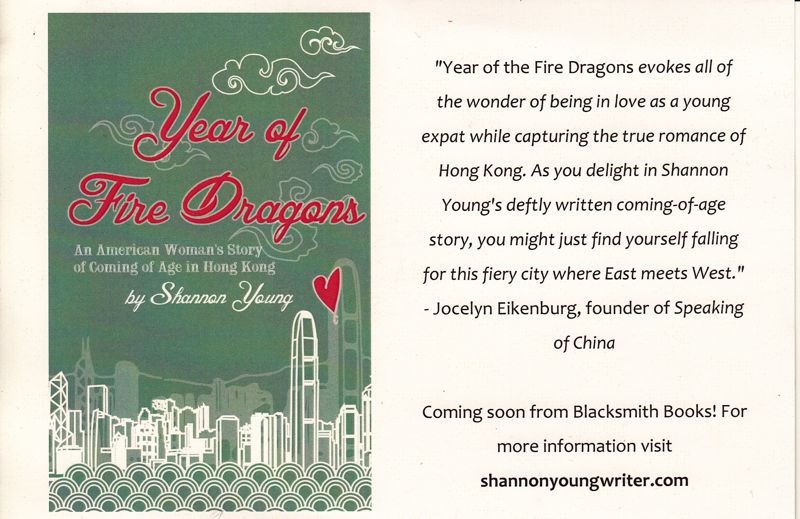
In her post, Shannon writes about her own marriage to a half Chinese (from Hong Kong) and half British man she first met while studying abroad in London. She also shares an excerpt about how they first fell in love from her new memoir Year of Fire Dragons: An American Woman’s Story of Coming of Age in Hong Kong (Blacksmith Books), which details that life-changing year she lived in Hong Kong while managing a long-distance relationship with him. It’s a beautifully written story about how far people will go for love — and the unexpected joys life can bring us when things don’t work out as planned.
My husband is half Chinese (from Hong Kong) and half British, and I am an American. Sometimes this means we connect easily, thanks to his Western side. He’s a native English speaker, and we share a common cultural language: American movies, Harry Potter, an independent streak, an appreciation for British humor.
He looks more like his English father, so he can easily pass for a Westerner — until he starts speaking Cantonese. We live in Hong Kong, and it’s always fun when my husband speaks Cantonese to shopkeepers, taxi drivers and acquaintances for the first time. We’ve had countless variations on the scene:
The man at the goldfish market explains something to us in tentative English.
My husband asks a clarifying question in Cantonese.
The goldfish seller stares at my husband’s Western features for a moment, then laughs and unleashes a string of compliments about his fluency.
My husband explains that, yes, he is half English and half Chinese (I understand this part).
The goldfish seller and my husband chat for a few minutes in Cantonese (I don’t understand this part).
Because he seems so Western at first, both culturally and in appearance, my husband’s Chinese side can come as a surprise. He has a strong sense of filial responsibility. He was raised in a Hong Kong family where the only acceptable career choices were doctor, banker or lawyer. He followed the common Hong Kong practice of living with his parents until our marriage (not counting the ten years he spent on his own in the UK). He has an all-consuming passion for good food: he cooks; he talks about restaurants a lot; he has strong opinions about frying pans and the right way to prepare instant noodles. This can be hard to match for an American girl who grew up on Kraft mac’n’cheese and weekly backyard barbecues.
Shannon on her wedding day.
On the other hand, I care more about saving face than he does. He worries that I’m too concerned about being embarrassed. He’s very good at having frank discussions and urging me to talk through problems until they’re resolved. It’s a quality that’s all his own.
Living at the intersection of two cultures has made him the perfect candidate for our multicultural relationship. He is good at compromise — a nonnegotiable part of mixed marriages — and at seeing things from different points of view. I’ve learned a lot from him.
As we settle into our second year of marriage, I wonder which parts of myself I’ll compromise. Will I become a bit more Hong Kong in my thinking? Will he become a bit more American? I suspect it’s both. All couples, whether we’re blending two or three distinct cultures or two families from different parts of town, have to learn how to hold on to the best parts of ourselves as we work to form new families.
More importantly, we have to learn how to speak each other’s languages. People are more than the sum of their cultures. We each have our own special brand of communication. Marriage is all about learning how to speak your partner’s language, no matter where you’re from.
***
In my new memoir published in Hong Kong this month, I share the story of how I followed my long distance boyfriend to Hong Kong and his company immediately sent him away to London. Over the course of one year I got to know the city on my own terms, which allowed me to better understand his culture — and myself.
Jocelyn has allowed me to share the first chapter of my book below. It is the beginning of our love story, the story that brought me to Hong Kong.
***
YEAR OF FIRE DRAGONS
Shannon in Hong Kong, her husband’s hometown.
The fire dragon trundled toward me through the crowded street. Smoke curled from the incense protruding from its long, thin body like thousands of spines on some mystical porcupine. Sweat poured down the faces and backs of every spectator. The fire dragon wound back and forth through the streets, faster and faster, dancing to the beat of drums. A wave of cheers rippled through the crowd each time it came near. The drums rattled the high-rises, the dragon danced, and the pavement shuddered under our feet.
This was the Mid-Autumn Festival in Hong Kong, a time to celebrate the moon goddess and her flight across the sky.
My flight wasn’t like that of Chang’e, the moon goddess who escaped her lover in a blaze of luminescence. I was flying toward mine. His gravitational field had pulled me across the sea, drawn me to a distant isle of fire dragons and skyscrapers. I’d follow him anywhere—even to Hong Kong. We hadn’t lived in the same country since we’d met, but this was our chance to be together, to build a life in the city where he grew up.
But one month ago, his company sent him to London.
I first met Ben in London, at a fencing club. I was a bookish American student on a semester abroad. He was an opportunity for a real live English romance, my very own Mr. Darcy, except that unlike Darcy, Ben was talkative—and half Chinese.
I’d taken up fencing several years before, attracted by the romance of sword fighting and the fact that it was something unique, historic, literary even. I wasn’t bad, and the sport brought me unexpected confidence. It seemed like a great way for an introvert like me to connect with people at the university in London.
When I pushed open the door to the club, the familiar buzz of the scoring machine and the squeak of athletic shoes on the floor reached my ears. I rocked on the sides of my feet, unsure how to join in. Ben came over immediately, introduced himself, and invited me to fence him. I was relieved at being included and already curious about this open-faced young man whose accent I couldn’t place. He won our first bout by one point; he always said I wouldn’t have dated him if I had been able to beat him.
We fenced a few more bouts, and then sat cross-legged in our matching gear, masks forgotten on the floor. He prodded at my shy shell; he asked me questions, joked about fencing, told me he was from Hong Kong. He had an eloquent vocabulary mixed with an offbeat sense of humor. He didn’t seem to mind when people didn’t get his jokes. He put me at ease, and I found myself stealing glances at him as I adjusted my equipment and met the other fencers. By the time I changed my shoes and left the gym, I was already lecturing myself about reading too much into his attention. I didn’t want to get swept away, blinded by the novelty of an international fling. But it was too late.
For two months, we wandered the streets of London together, kissed on street corners, and took spontaneous trips to Oxford and the coast. He took the time to get to know me, using our shared love of fencing to get me talking. He surprised me with his insight, his persistence. He seemed to understand why I, analytical and introverted, never quite fit into any group. As someone who had grown up shuttling between Hong Kong and London, not quite Chinese and not quite British, he knew what it was like to be an outsider. Ben had a gift for coaxing people to confide in him and trust him. Before long, he got even the most reserved, responsible American girl to give him handfuls of her heart.
When the semester ended, we said goodbye at Heathrow in a flurry of kisses and long-distance promises: “It will just be for a year, maybe two.”
“I can visit you in America.”
“I’ll get a job wherever you live after graduation.” Our confidence in each other was reckless and optimistic, but staying together felt like the only sensible thing to do.
In 2010, thoroughly in love, I moved to Hong Kong to be with him.
It lasted for one glorious month.
Ben left me in Hong Kong on the eve of the Mid-Autumn Moon Festival. Instead of exploring the city with him, I was at the airport saying my goodbyes while the children of Hong Kong flooded the streets and parks with lanterns. Instead of walking beneath the Mid-Autumn moon together, we shared a fierce hug and made a hundred tiny promises. The next day, still reeling from the sheer solitude, I found my way to Tai Hang—to the incense and the drums. The fire dragon loomed, full of possibilities.
It had already grown dark, or as dark as it ever gets in the city, when I emerged from the subway into a night that felt nothing like the end of September. The humidity surrounded me like steam pouring out of a broken dumpling. I made my way along the street. An arch announced the festival in gold foil and tissue paper fringe. I found a spot beside a Chinese family of three or four generations. A group of Mainland girls chattered in shrill Mandarin in front of me. The balconies of a hundred apartments teetered over our heads.
I hadn’t had a chance to ask Ben what the fire dragon would be like before the airport security line swallowed him and carried him away. The fire dragon in my mind looked like a dancing, tuft-eared Pekinese dog, with people standing under a big sheet to form the body, holding up the head. Of course, that’s an image from a lion dance, not a dragon dance, I would soon learn. I was just starting to discover that Hong Kong was full of surprises—and I was ill prepared. I jumped up on my toes and looked for the Pekinese head.
The drums began. “Want me to hoist you up?” An American man stepped close behind me. He was tall, and the scent of stale alcohol mixed with the incense.
“No, thanks,” I said.
“You sure? You want a good view when they bring out the dragon,” he reached for my arms.
“I can see just fine.” I maneuvered away from the man, finding refuge on the other side of the Chinese family. My fingers curled tighter around my purse. Suddenly, I was aware just how alone I was in the crowd, and in the country.
“Why didn’t you just go to London instead of Hong Kong when you found out Ben would be leaving?” my friends had asked me. “You’re already moving across the world for him.” I wondered the same thing myself—now. But this was 2010. I wasn’t in a position to jet around the world after men lightly. I’d graduated from Colgate University with nearly $80,000 in student debt, debt I had taken on before the economy crumbled. Moving without a job was not an option. Employment would be hard to find in London for an English major with limited work experience and no visa. I didn’t have a chance.
Jobs were not easy to come by anywhere in the Western world. My generation faced the worst job market in living memory. My college-educated friends competed tooth-and-nail for part-time barista work, borrowed more money for graduate school, and moved in with their parents. There was a mounting sense of desperation among those of us who had taken out big student loans only to discover there was no work for us in our own country when we graduated.
Asia was another story.
There were rumors going around that this was where the jobs were to be found. Ben had found work in Hong Kong, his hometown. My own sister had recently begun teaching English in South Korea. So, I spent nearly a year applying and interviewing for a job in Hong Kong (and yes, living with my parents while I did it). When a local school emailed and asked me to be their new English teacher, it seemed the long distance part of our international romance, which had lasted two and half years by now, was finally done. I showed up with a work visa and a salary advance, ready to take on the city and the next stage in our relationship. Yet here I was, alone in a crowd as the fire dragon approached.
I couldn’t afford to give up my new job when Ben’s circumstances changed. With a one-way ticket and a monthly student loan payment of $935, I stayed in Hong Kong.
The drums pounded. A row of children appeared, carrying lanterns that bobbed above the crowds. Their glow mixed with the lights from the apartment buildings looming over our heads. My arms brushed an elbow on one side, a woman’s handbag on the other.
Ben had been lucky, really, to be sent to London. It was a one-year placement at a law firm with the prospect of a permanent contract afterwards. All I had to do was spend this year in Hong Kong looking for an opportunity in London where we could be reunited once again. “It’ll be for one more year, and then we’ll be together,” we promised each other as we set up our web cams. “We already know we can handle the whole long distance thing.” We plotted our reunion in a whirl of emails and long distance calls. “It’ll just be this year,” we said, “and then that’s it. No more long distance.”
Of course, the other thing people asked was, “What if you don’t get along when you finally do live in the same country?” That was a question I couldn’t answer.
As I stood in the Mid-Autumn crowd, little did I know that my move to Hong Kong would bring about our longest separation ever, a separation that would bring me face to face with the reality of the risk I had taken.
The pounding of the drums intensified. The people around me drew closer together, choking what little breeze there was. Finally, the fire dragon appeared, followed by more children carrying lanterns. I was surprised when I saw what it was really like. It had an elaborate head, made from branches twisted into impossible shapes and filled with a thicket of incense. The thin body was over 200 feet long and muscular bearers danced beneath its undulating shape. The people around me cheered as the dragon’s head passed us and then turned back on itself, leaving behind a million tiny trails of smoke. I felt a growing sense of excitement as the fire dragon whirled and darted through the streets. Its wiry, crackling body defied my expectations. It was fast. It was wild. I pushed forward so I could see better. I was a part of the crowd. I didn’t feel like a foreign girl, alone, in an interrupted romance. This was an adventure! I could do this; I could live in Hong Kong, alone. Ben and I would be together soon enough.
As the dragon twirled in front of me, I didn’t know that in nine months I’d be sitting on the floor of my single apartment, cell phone pressed to my ear, feeling the foreign ground shift beneath me, feeling a panic I’d been too confident to anticipate. I pulled my hair away from my neck, trying to find relief from the suffocating heat, too stubborn to guess at the coldness that was coming.
This was not what I had planned. Nothing happened the way I expected. This was Hong Kong.
As the rumble of the drums reached a crescendo, the men carrying the dragon pulled off the sticks of incense and passed them to the crowd. Within seconds, the fire dragon dispersed into a thousand tiny sparks in the night.
Thanks so much to Shannon for this post and lovely excerpt! Don’t forget, if you’re in the Hong Kong area this weekend and would love to have your very own signed copy of her excellent memoir, Shannon will be appearing at the Hong Kong International Literary Festival on Sunday, November 9 at 10am at Room 202, Duke of Windsor Building. Tickets are $90 to attend (purchase yours here).
This website uses cookies to improve your experience. We'll assume you're ok with this, but you can opt-out if you wish.AcceptRejectRead More
Privacy & Cookies Policy
Privacy Overview
This website uses cookies to improve your experience while you navigate through the website. Out of these cookies, the cookies that are categorized as necessary are stored on your browser as they are essential for the working of basic functionalities of the website. We also use third-party cookies that help us analyze and understand how you use this website. These cookies will be stored in your browser only with your consent. You also have the option to opt-out of these cookies. But opting out of some of these cookies may have an effect on your browsing experience.
Necessary cookies are absolutely essential for the website to function properly. This category only includes cookies that ensures basic functionalities and security features of the website. These cookies do not store any personal information.
Any cookies that may not be particularly necessary for the website to function and is used specifically to collect user personal data via analytics, ads, other embedded contents are termed as non-necessary cookies. It is mandatory to procure user consent prior to running these cookies on your website.













![By Goaname (Own work) [GFDL (http://www.gnu.org/copyleft/fdl.html) or CC-BY-SA-3.0 (http://creativecommons.org/licenses/by-sa/3.0)], via Wikimedia Commons](https://www.speakingofchina.com/wp-content/uploads/2014/11/HK_Lunar_New_Year_Fruit_Gift_Basket.jpg)