What are YOU looking forward to most for Chinese New Year? – Pub’d on WWAM BAM

The blog WWAM BAM! just published a group post titled What are YOU looking forward to most for Chinese New Year?, and it includes a contribution from me. Here’s what I wrote:

This is my first Chinese New Year ever in Beijing, and there’s something thrilling about living in a city that has these larger-than-life historical monuments, particularly during the holidays. My husband and I always traditionally include worship as part of our Chinese New Year customs – usually paying respects to ancestors, but also visiting temples when we have the opportunity. But this year, we can follow in the footsteps of past emperors in Beijing and pray at the Temple of Heaven.

I’m also psyched about food. Since I’m on duty during the holiday, we won’t have a lot of time to prepare. But we’re going to order out jiaozi dumplings from one of my favorite restaurants in town, Xian Lao Man (which happens to have quite a few vegan-friendly options). We’ll also prepare a couple of our own dishes – a fancy tofu stir-fry for me, and a spicy stir-fried fish for Jun.

Finally, as a huge fan of the Olympics, I’m looking forward to all of the outstanding holiday programming provided by the international sporting event.

Happy Chinese New Year!

To find out what the other 6 contributors are looking forward to during Chinese New Year, read What are YOU looking forward to most for Chinese New Year? And if you like it, share it!

Pub’d on China Daily: Christmas tree stays for Spring Festival

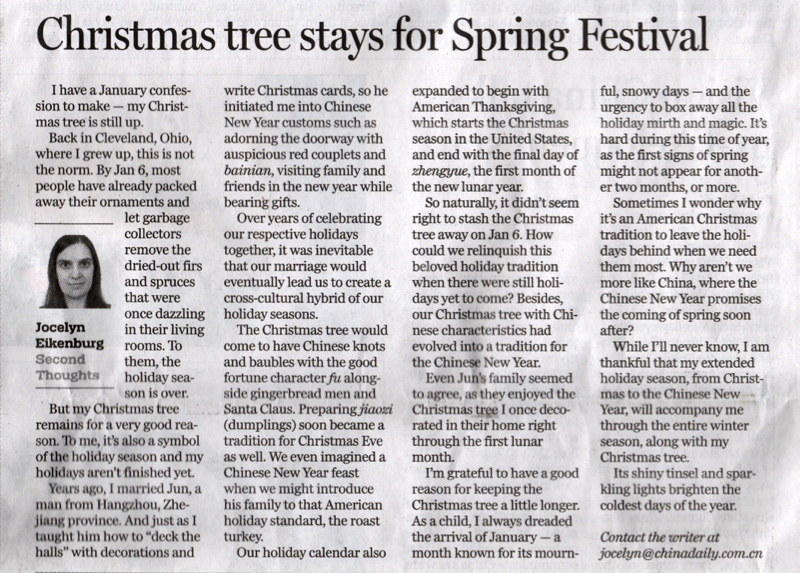
China Daily just published another one of my columns in their newspaper today — it’s titled Christmas tree stays for Spring Festival. Here’s an excerpt:

I have a January confession to make – my Christmas tree is still up.

Back in Cleveland, Ohio, where I grew up, this is not the norm. By Jan 6, most people have already packed away their ornaments and let garbage collectors remove the dried-out firs and spruces that were once dazzling in their living rooms. To them, the holiday season is over.

But my Christmas tree remains for a very good reason. To me, it’s also a symbol of the holiday season and my holidays aren’t finished yet.

You can read the full piece here. And if you like it, share it!

7 Great Chinese New Year Gifts Sure to Impress Friends, Family and Coworkers

The new year may be upon us — but in China, there’s another one just around the corner. Chinese New Year, of course!

Chinese New Year is also a time for giving gifts, especially when it comes to the tradition of bainian, where you visit friends and family bearing gifts known as nianhuo or Chinese New Year goods.

What makes a good gift for Chinese New Year? While I have a list of suggestions below, here’s my bottom line for Chinese New Year gifts. Always go for quality and don’t forget to get it wrapped and/or in a gift box.

The good news is, there are plenty of quality Chinese New Year gifts available, and if you purchase in China, most goods on sale usually come all boxed up, often in auspicious red and gold packaging. All you need to do is buy and give, it’s that simple!

So here are my 7 suggestions for great Chinese New Year gifts:
Money

#7: Hongbao (red envelopes)

Children all across China eagerly await Chinese New Year for a lot of reasons, including the many hongbao (red envelopes) they’ll receive, filled with auspicious amounts of money, as the World of Chinese notes:

If you’re stuffing it with hundreds, go for even numbers for good luck: 200, 600, or 800. Don’t hand out bad luck with a gift of 400, or anything with the number four, the unluckiest of all numbers. Instead, stick to ones, fives, and, best of all, eights.

So if there happen to be kids with the people you’re visiting, don’t forget to give each of them a hongbao as a Chinese New Year gift!

Hongbao are also terrific for those in your employment, such as an ayi who might clean your home or care for your children. Think of it as a year-end bonus for the hard work they’ve done.

But hongbao can sometimes be tricky as a Chinese New Year gift, as “traditional red envelopes have often been used as a vehicle for, ahem, bribes.” When in doubt, consult your Chinese friends or colleagues — or, better still, consider my other suggestions for Chinese New Year gifts.

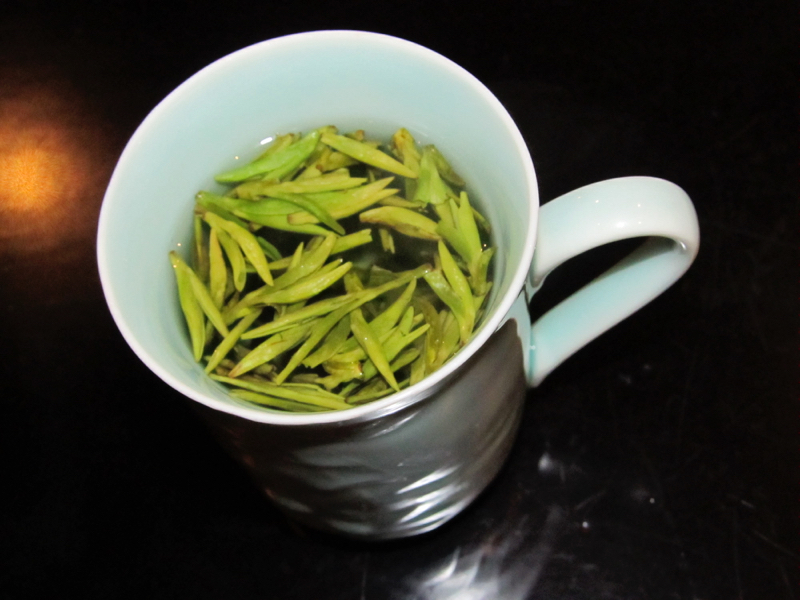
#6: Tea

As I wrote a few years back in my post The Top 6 Gifts Sure to Please Your Chinese Family:

Say what you want about China’s national hot beverage. It really makes one fantastic gift….

What home in China doesn’t have a top-shelf box of tea (or even two), ready and waiting to entertain guests? Plus, everyone…loves drinking it.

But if you’re going to give tea as a gift, be prepared to pay top money for it. Most Chinese can taste the difference between the expensive, high-grade varieties (which are great gifts) versus the cheaper average teas (which you should never buy for anyone but yourself).

I wouldn’t buy tea online. Your best bet is to find a high-end tea shop in your vicinity and try the teas before purchasing this for Chinese New Year gifts.

#5: Nuts and dried fruits

No Chinese New Year is complete without the requisite hours of lazing around with friends and family, snacking on everything from walnuts and pecans to dates and raisins. They also make outstanding Chinese New Year gifts.

Nuts: Here in China, I’ve seen walnuts, pecans, hickory nuts, macadamia nuts, almonds, pine nuts, sunflower seeds and chestnuts given as gifts. You’ll even encounter Chinese New Year gift boxes that offer an assortment of nuts, nicely packaged up and ready to give someone you know or love.

Dried fruits: Dried jujube dates are always excellent Chinese New Year gifts because the name sounds auspicious. Dates are known as zǎo (枣), and the name sounds like the character zǎo (早) in the phrase 早来福到 (zǎoláifúdào), which means good fortune comes early. So if you bring dried jujube dates, it symbolizes your hope the recipient will enjoy good fortune soon. While there are lots of varieties of dates available, I happen to love the large Xinjiang dates, which you can always find online on Amazon and in China on Taobao, including the Tmall Supermarket, and usually at your local supermarket.

Raisins from Xinjiang (particularly the Turfan region) are also a special treat to send someone during Chinese New Year, and are incredibly delicious. Amazon has them. If you’re in China, check Taobao, including the Tmall Supermarket, to buy online. Your local supermarket may also have some available.

Or,  if you can’t decide on dried fruits or nuts, consider buying them this ingenious Chinese creation — dried jujube dates stuffed with walnuts. They are so heavenly they’ve become my favorite snack, and your recipient will love them because they combine two of the most nutritious winter foods together in one convenient bite-sized morsel.

#4: Chocolates, candies and cookies

Sweets — including chocolates, candies and even cookies — have become as ubiquitous as the standard nuts, dried fruits and fresh fruits you see at homes during Chinese New Year. Even I can’t resist, often stopping by the candy plate to devour a small chocolate — or two.

If you’re going to give chocolates for Chinese New Year gifts, I recommend imported brands such as Ferrero Rocher (their traditional chocolate hazelnut candies wrapped in gold foil are always a festive addition at Chinese New Year), Dove, Hershey’s or even Godiva. You can find all of these online at Taobao or Amazon, most at Tmall Supermarket, and also many at your local supermarket.

Imported cookies in gorgeous gift tins, such as Danish butter cookies, are also a good choice for Chinese New Year. Besides Amazon, buy them in China at your supermarket or online at Taobao’s Tmall.

And if you’re shopping from abroad, Gift Baskets Overseas offers gift baskets with chocolates, candies and/or cookies that you can send to most cities in China.

#3: Traditional herbal remedies and vitamins

There’s a saying in Chinese — dōnglìng jìnbŭ (冬令进补), which refers to how winter is a season for increasing your nutrition with a good tonic or medicinal herbs/foods. So naturally, these have also become popular Chinese New Year gifts, particularly for people over 50.

You’ll encounter lots of possible herbal remedies and foods in China, many related to traditional Chinese medicine. But sometimes even I find the selection overwhelming! Personally, I like to stick with the ones I know and recognize. For example, ginseng is something I’ve bought for family members with great success, and it’s available on Taobao. And if I’m in the US, I love to stock up on American ginseng, prized for its medicinal and nutritional qualities, to give as gifts, including during Chinese New Year. You can buy American ginseng on Amazon.

Vitamins are the “modern version” of these traditional health foods, and can also make wonderful Chinese New Year gifts if your recipients would use them. I’ve found that people living in cities tend to be more open to taking vitamins, compared to those living in rural areas — but it’s always good to ask ahead of time. Foreign brands make a better impression, so I try to buy overseas as much as I can (including on sites like Amazon). That said, you can still buy in China. Besides foreign brands, one option is By-Health (汤臣陪建), available online and in most supermarkets.

#2: Wines and spirits

Ganbei (“empty glasses” in Chinese) is the equivalent of “cheers” you’re sure to hear around the table during Chinese New Year, as people toast each other, usually with wine or spirits. It’s no wonder these make terrific gifts for Chinese New Year.

One option is top-shelf baijiu, such as Moutai or Wuliangye, especially if your recipient is a fan of China’s most fiery liquor.

But because I’m a foreigner who knows next to nothing about baijiu, I prefer to give imported wines, usually red (since red is the lucky color for Chinese New Year). Wine from France is highly cherished among the Chinese, so French red wine is an excellent choice. If it’s in your budget, French champagne is also sure to impress for Chinese New Year. But generally speaking, any quality imported wine will be a welcome addition to the Chinese New Year table.

In China, you can purchase baijiu either online or at your local supermarket or wine and cigarette store. If you’re not bringing your wine from abroad, you’ll find excellent options available online on Taobao, including the Tmall Supermarket; you can also shop your local supermarket for imported wine too, though you may be more limited in options.

If you’d like to send wine over to China, one option is Gift Baskets Overseas, which has a number of gift baskets available that include wine and spirits.

#1: Fruit and fruit baskets

If you’re still totally stumped on what Chinese New Year gifts to buy, please repeat after me: fruit!

As Huan Hsu, author of The Porcelain Thief, once wrote, “Fruit is China’s apple pie.” Chinese people treasure fine fruit because it’s often what’s for dessert, and always a favorite to snack on anytime during Chinese New Year. You’re sure to endear yourself with any host in China if you show up with, say, boxes of Xinjiang Aksu sweetheart apples (冰糖心苹果), or even a fruit basket loaded with everything from sugary mandarins and crisp fresh dates to fragrant pomelos and tangy kiwis.

Where you can purchase fruit? If you’re based in China, there are lots of great deals on boxed fruit on Taobao (including the Tmall Supermarket, which offers next-day delivery in most major cities in China). You can also visit your supermarket or neighborhood fruit store, where you can purchase not only boxed fruit but also fruit baskets.

If you’re based overseas and buying for someone in your country, Amazon has a lot of great fruit basket options.

But if you would like to send fruit baskets to China from abroad for Chinese New Year, Gift Baskets Overseas is a reliable option.

You can learn more about fruit baskets through my post 4 Tips for Giving Gift Baskets in China.

P.S.: Still want more advice on giving gifts in China or for Chinese New Year? Don’t miss my most popular post on gifts, Giving Gifts to your Chinese family – A Modest Guide, or The Top 6 Gifts Sure to Please Your Chinese Family. And if you’re buying from abroad, you might also enjoy my post Gifts to Buy Abroad for Chinese Family and Relatives.


Is The Family Pressure in China Too Much?

This past Chinese New Year, we noticed a glaring absence from the family gatherings – one of Jun’s relatives, a fellow close to his own age.

At first I figured it was just bad timing. Maybe we missed him because I had woken up a bit late? Or maybe he was dining with other relatives?

But as we visited more family over the holiday – with no sign of this guy — another theory came to mind.

Maybe he was too ashamed to face the family during Chinese New Year after what had happened last year.

In early 2016, he opened a specialty restaurant in the closest city. It was a gutsy move, given that he had zero experience in the restaurant or hospitality business. He had taken out loans to cover the rent (paid years in advance) as well as the costs of renovation and professional kitchen equipment.

After less than six months, just like that, he closed down the place.

It was so sudden. I’m not sure if he failed spectacularly, or if he just lost confidence in himself. Either way, he went back to his old industry and got himself a job again. Except now he was saddled with the burden of his debts and the failure of his business.

If my suspicion was right – that he hadn’t returned for the holidays – it’s easy to understand why. He would be forced to contend with other relatives his age, people awash with more money and all the trappings of success by China standards. You know, cousins who drive BMWs and Audis, giving out those extra-generous hongbao (red envelopes stuffed with money). People in the family might openly compare his situation with theirs – perhaps even wondering aloud why he had bothered to even open that restaurant.

It’s a painful proposition, even for those accustomed to managing criticism.

From time to time, I hear stories about people like this – people who refuse to return home for the holidays, sometimes for years. People who just cannot face the family, because their lives don’t look like what others would consider “success” or “normal”. Sometimes it’s because they’re down on their luck in business or employment, like the guy I mentioned. Sometimes it’s because they’re not married yet.

Whatever the case, they have enough stress in their lives – and could do without the additional stress from their families during the holidays. They don’t want to be compared to so-and-so, who just bought a new BMW or apartment in Shanghai. They don’t want to be told that, say, they’re getting too old for marriage or kids.

While it’s normal for parents to worry about their kids, sometimes I wonder, is the pressure here too much? Is there too much of an expectation for people to conform to a narrow societal norm? Is there too much pressure for people to be “successful”?

Is that why my husband’s relative didn’t come back?

Photo Essay: Chinese New Year 2017 in Rural Hangzhou, China

It’s the year of the golden rooster. Happy Chinese New Year! While I’m taking a little time off to recharge a little during the holidays, I thought I’d share some photos from our Chinese New Year celebration in rural Hangzhou, China.

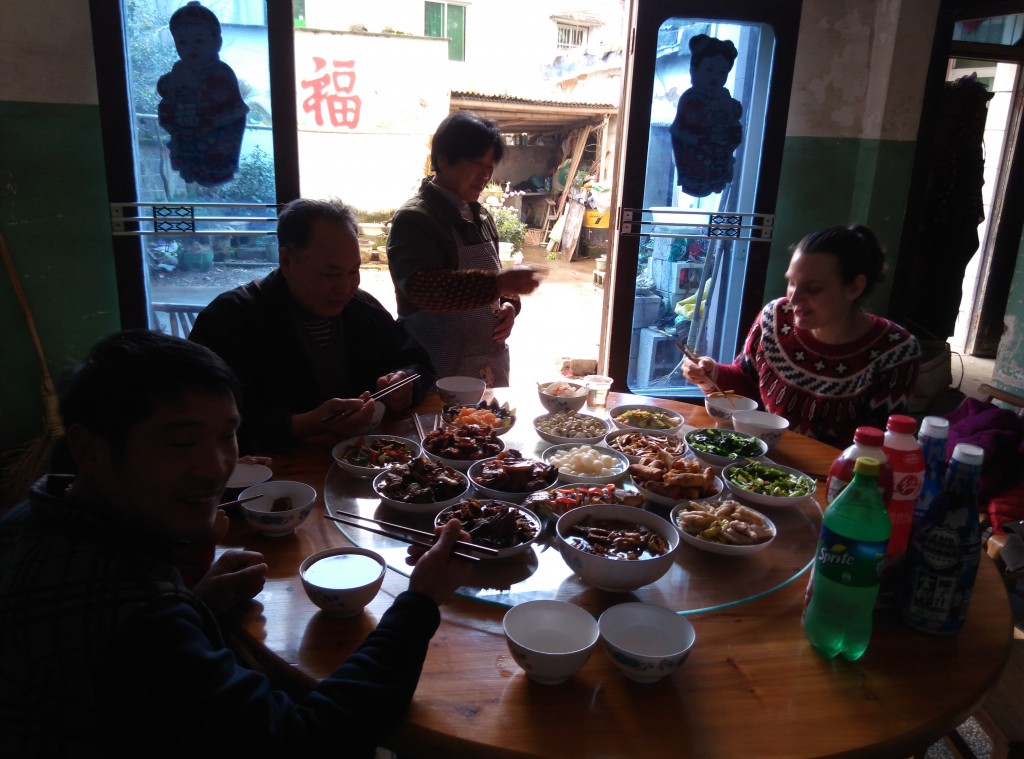
The biggest dinner of the year — Chinese New Year’s Eve dinner!

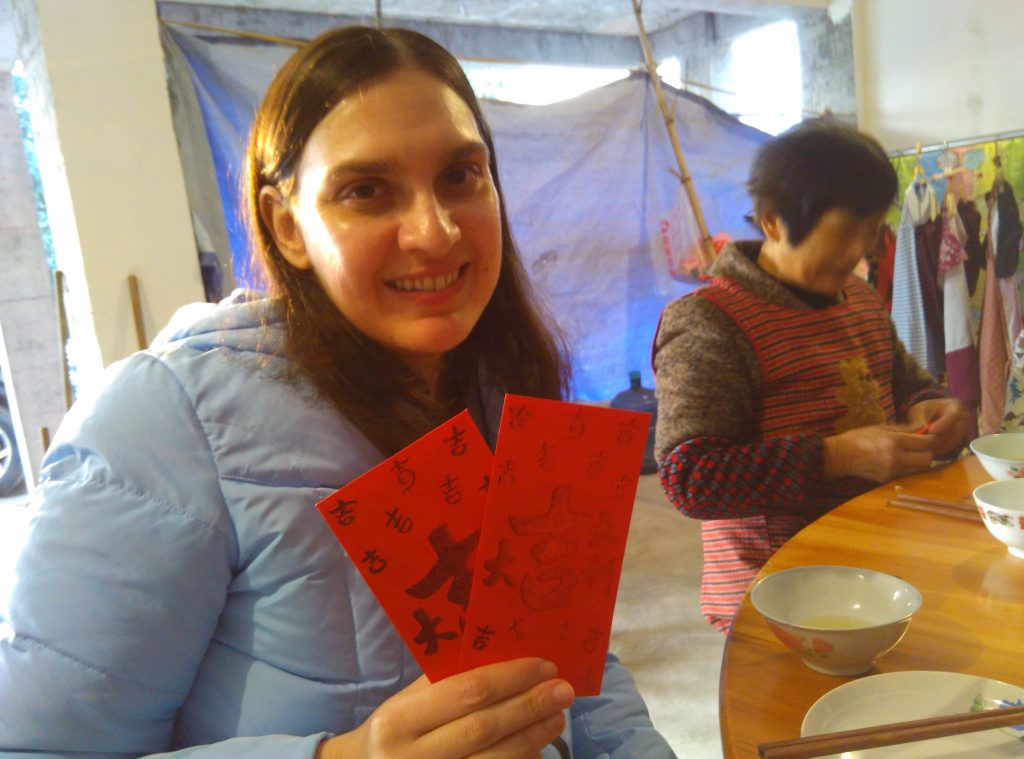
As always, every Chinese New Year’s Eve includes passing out the hongbao (红包,red envelopes) stuffed with lucky money for the new year.

As always, Jun and I brought some Chinese New Year gifts (nianhuo, 年货) to share with the family. On the left I’m carrying a gift box filled with an assortment of fancy nuts (complete with a “golden egg” design visible on the box); on the right, a gift box of large Xinjiang jujube dates.

On the first day of the new year, it’s time to wear your new clothes! Jun and I are both wearing new sweaters.

With such beautiful weather on the first day of the new year, we couldn’t resist stealing away to the countryside to enjoy the gorgeous scenery. Here we discover a waterfall cascading down the cliffs.

As we wandered beside the river, we were bathed in the golden sunshine. It was one of the most relaxing afternoons I’ve enjoyed in a long time.

The evening of the first day of the new year, I also helped my mother-in-law make migu, a special turnover we enjoy during the holidays. The dough is made from rice flour, and the filling is usually tofu and pickled vegetables and/or bamboo.

We visited Jun’s godfather during the holidays, presenting him with a hongbao and some baijiu liquor. He prepared us some sugar cane to snack on. Above, there he is, peeling off the rough exterior of the cane as I watch in the background.

As usual, we dined on some of the most delicious food of the year. One of our most memorable meals was at Jun’s Aunt and Uncle’s home next door to us. She even prepared a special hotpot of savory tofu and napa cabbage, plus her mouthwatering homemade kimchi. Yum!

Wishing everyone a prosperous and auspicious Chinese New Year!

3 Ways NOT to Impress Family During Chinese New Year

Chinese New Year is coming! If this is your first time spending the holidays with a Chinese family, here are 3 things that will definitely NOT impress:

head-in-her-hands#1: Be totally antisocial

Chinese New Year is all about reuniting with family and friends to celebrate. You’re meant to get out there, attend those dinners, and knock on those doors with red gifts in hand.

Which means the worst thing you could do is be utterly antisocial.

Now, let’s get clear about what antisocial really means in this context. Sitting quietly at the dinner table or among guests, not speaking much, doesn’t necessarily apply. You don’t have to be chatty to win their hearts over. Just being present, butt in seat and chopsticks in hand, will suffice.

But if you spend the whole holiday locked up in your room, only consuming crappy ramen noodles (I actually witnessed someone in my husband’s village who did this), you’re definitely going to piss off more than a few people.

Photo by Garrett Charles

#2: Don’t prepare any gifts

Years ago, when I was getting ready to experience Chinese New Year for the first time ever, a friend clued me in on my obligation to my hosts. “You need to buy them some gifts,” she said, even taking me shopping in the supermarket next door to pick out the perfect one for them.

Chinese New Year gifts are such a big deal that every supermarket creates huge red-and-gold displays filled with all the usual suspects to lure shoppers – from fine alcohol and spirits, to dried fruits and nuts, to even traditional Chinese remedies like ginseng and Dong quai. These are all neatly packaged, often with their own attractive red-and-gold gift boxes or bags. All you have to do is show up at the house, goods in hand.

But if you show up empty handed, you won’t win any favors. Especially if you’re a foreigner. Most Chinese think foreigners have a lot of money, despite your current financial circumstances. They’re probably expecting you to bring some of the best gifts at the table – or at the very least, something as good as everyone else.

With nothing in hand, you’ll be branded as either rude or stingy. And quite possibly might be the talk of the family…but not for the reasons you’d hope.

shoe-682215_960_720#3: Dress in shabby or old clothing

I’m pretty sure my mother-in-law was privately shocked when, one Chinese New Year, I didn’t have a single new sweater or jacket to wear.

It didn’t matter that my down jacket was a gorgeous ruby red that glimmered in the sun, and nicer than most of the jackets I could have bought in the stores in Hangzhou. Or that my sweater was less than a year old and still in fine condition. Or even that my Calvin Klein jeans looked as good as new.

I had broken one of the cardinal rules of Chinese New Year. I was wearing something old, which is totally inauspicious and against the usual custom.

My mother-in-law has often reminded me about the importance of wearing nice clothes. Clothing is like your public face, and how everyone dresses reflects on the whole family.

Now, it’s one thing to wear old clothing…but if you really don’t want to impress the family, show up in something old and shabby. Dress like you’re about to renovate an apartment in the middle of China’s winter, or beg on the streets for a few extra kuai.

(Chances are, your family would be so embarrassed they’d probably give you something decent to wear. And force you to wear it.)

P.S.: Want to know how to impress family during Chinese New Year? Read all about how to impress your boyfriend or girlfriend’s family in China during Chinese New Year, or how you can prepare to meet the family in China.

How to Deal with 3 Major Chinese New Year Annoyances – Pub’d on WWAM Bam

屏幕快照 2017-01-18 下午6.05.14WWAM Bam, the new group blog for Western women who love Asian men, just published my piece titled How to Deal with 3 Major Chinese New Year Annoyances. Here’s the introduction to that article:

As China in January turns into a festive wonderland of red and gold everywhere you look, some of us don’t feel as excited as the Chinese New Year décor might suggest.

The biggest holiday in China is also fraught with a number of annoyances, particularly when you have family there. I know it all too well. There have been some years when I’ve actually dreaded heading home for the holidays.

Fortunately, though, there are ways to manage your way through Chinese New Year, sanity intact! Here are 3 major Chinese New Year annoyances – and how to deal with them:

Read the full piece at WWAM Bam — and if you like it, share it!

Photo Essay: I Survived! Making it Through Chinese New Year 2016 with the Family

Every year, I swear this Chinese New Year is not going to kick my butt. And somehow, every year, I’m totally wrong on this.

Yes, Chinese New Year 2016 — welcoming the year of the monkey — has been an exhausting parade of lunches, dinners, toasts, and meetings.

By the last day I had rings under my eyes (the “panda” look that my husband kids me about) and a desperation about me that said, “Please, Chinese New Year, let me have a little peace and quiet.”

And so it came. Finally! I survived!

While I’m recovering from all the hustle and bustle of the holidays, I thought I’d share some of the pics from Chinese New Year 2016.

IMG_20160208_160634_BURST3New year, new picture of John and me in front of the family house. We may be smiling, but we’re beat. With all the fireworks set off all night, I got maybe four or five hours of decent sleep.

IMG_20160208_164147This is our first dinner of the new year at an uncle’s house. There’s lots of toasting, and lots of fantastic food. My husband’s aunt is an extraordinary cook and she happened to dish up a serving of Chinese-style kimchi more delicious than anything I’ve ever had (Must corner her and get the recipe!)
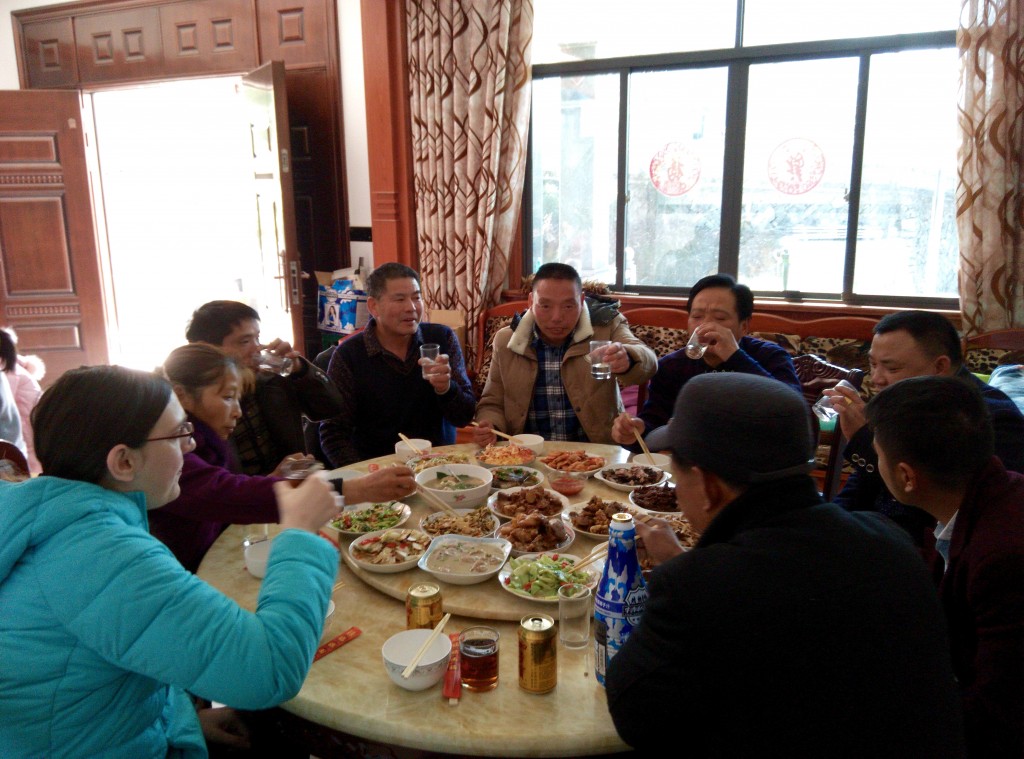
IMG_20160210_112440_BURST1Yeah, I know, eating again. Seriously, that’s the heart of this holiday. Lots and lots of lunches and dinners. As always, we ate…
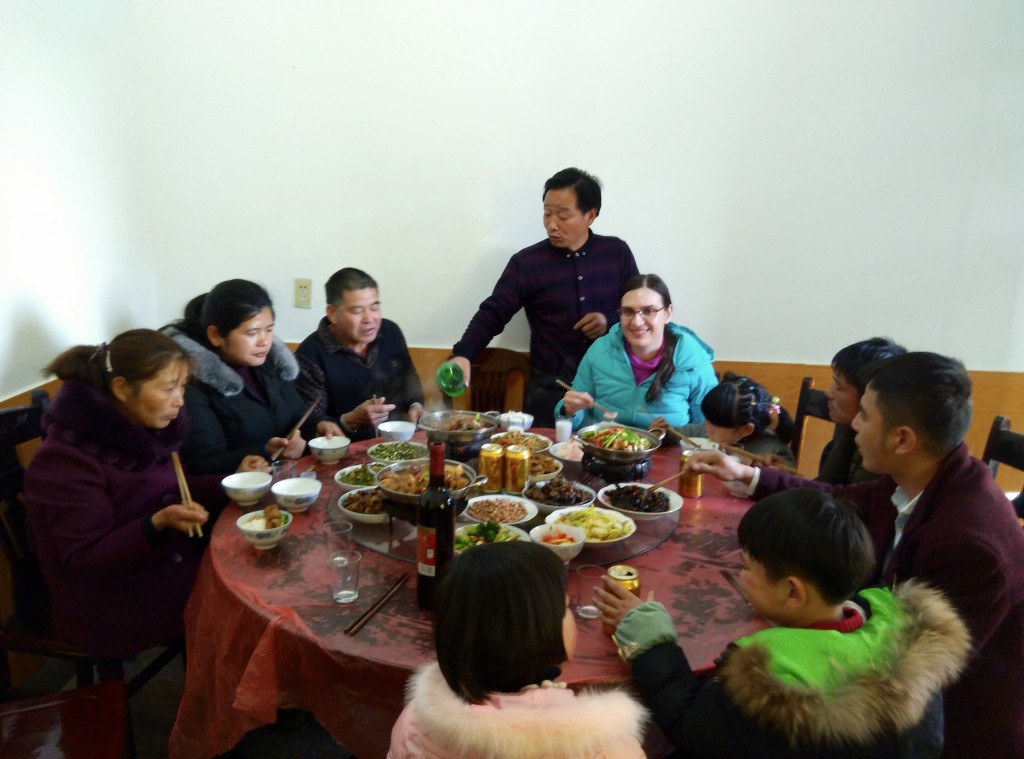
IMG_20160210_165223…and ate…

IMG_20160213_113430…and ate!

IMG_20160213_112247Even when you’re not having lunch or dinner, people usually offer you lots of food to snack on. Notice the trays of assorted nuts, fruit and candies arranged on the tables before us.

IMG_20160213_142542Here I am at an aunt and uncle’s home, attempting (unsuccessfully) to snack on raw sugar cane. Sweet, but a little too pulpy for my taste. This was day 6. Do you see the fatigue on my face yet?

IMG_20160213_170645This is John and me at the end of the holiday. I’m looking haggard (see the “panda” eyes?) — and longing for a little peace. Fortunately, when we returned from this walk, the village was quiet. Finally, I could rest.
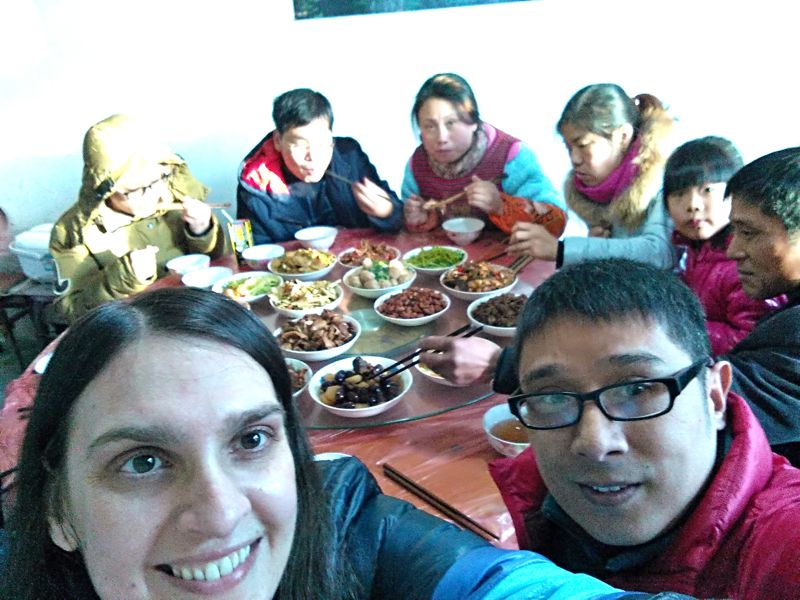

Wishing everyone a wonderful year of the monkey (with hopefully more sleep than I got during the first days of the new year)! 😉

Photo Essay: 2016 Chinese New Year’s Eve at the Family Home

We’re busy celebrating Chinese New Year, the biggest holiday of the year here in China, at John’s family home in rural Hangzhou. I thought I’d share a few photos from Chinese New Year’s Eve.

IMG_20160207_134148

It was a lovely day to celebrate Chinese New Year’s Eve, with some of the most gorgeous blue skies of the winter.

IMG_20160207_151917

My brother-in-law took his daughter to pay her respects to the spirits in an old camphor tree beside the river, as he does every year on this day.

IMG_20160207_163726

On Chinese New Year’s Eve, ancestors come first. Here we pay our respects to the ancestors at their table, filled with dishes fresh from my mother-in-law’s kitchen.

IMG_20160207_165200

Let’s eat! It’s the most wonderful dinner of all the year, the table loaded with delicious dishes made by my amazing mother-in-law. (I consider her kitchen one of my favorite “restaurants” in China… 😉 )

IMG_20160207_173212

As usual, John is one of the last to leave the table — he loves to eat, and takes his time. Here he’s enjoying some free-range chicken raised by my mother-in-law (his favorite dish of the evening).

Wishing you all a very auspicious and prosperous year of the monkey! Happy Chinese New Year!

I Bought It for Love (or How My New Jacket Made My Mother-In-Law Smile)

IMG_20160126_130934_2

Ah, the things we do for love.

I wasn’t supposed to buy those new clothes. Even though I knew full and well about the tradition for Chinese New Year – that you should always start the year wearing new clothing.

Call me frugal. I’ve always been the sort of woman who sticks to her budget, who buys things carefully. Especially clothing, like winter jackets and coats. Growing up, we didn’t necessarily buy new ones every year. Instead, we’d just invest in a nice one that could last several years or more and get as much use out of it as we could.

Besides, this year finances were a little tight. I figured, why not save the money instead?

I was all ready to stick to my “no new clothing” plan for Chinese New Year. That is, until that evening at my in-laws’ house, when my mother-in-law pulled out two shiny new jackets for my husband. She had bought them from the local market, and beamed at John once he tried them on. One was a navy blue, the other a nice tan brown. Even I had to agree he looked handsome.

Yet a guilty feeling washed over me because of the money she spent. She shouldn’t have bought them. It’s something I would have rather done myself – except I hadn’t.

Then she said to me, “I could find something for you too.”

Uh oh.

It’s bad enough when your mother-in-law spends her hard-earned cash on the husband you should have bought for, but worse when she does it for you too. I tried to discourage her with the practical realities of buying for me – namely, that she’d never find my size. Not in the countryside markets where she goes.

But her smile and determination wouldn’t budge. “I can find your size.” Pretty soon she was measuring me up and promising to go shopping the following day.

“Really, you don’t need to,” I pleaded with her, thinking she had better things to do with her time and money than shopping for me.

But, no, she wouldn’t hear it. She said that how you dress is important in the village. That people notice if you’re wearing new clothes or the same thing all the time. It reminded me of something she once mentioned during dinner – that what you wear matters more than what you eat.

And more specifically, it mattered to her. Why else would she have bothered to buy my husband clothes or offer to shop for me? How we look reflects on her. And if we make a nice appearance, she’ll look good too. To put it simply, donning a little new clothing for the new year would make her very happy.

It’s hard not to care about the happiness of my mother-in-law when, frankly, she spends so much of her time caring about ours. She always loads the lazy susan up with vegan dishes just for me (really delicious ones, mind you). She’s been known to get up early on weekends to make steamed bread from scratch for us, or stay up late on a Saturday to fry up flatbread that we can bring to Hangzhou to have for lunches. She has done my laundry more times than I’d like to admit, and often hangs my clothing out to sun. She doesn’t really criticize us that much. And let’s not forget how she bought us all of these necessities when we first moved to Hangzhou, things she totally didn’t need to buy.

In short, she is the most amazing, devoted and loving mother-in-law I could ever ask for. So if wearing some new clothes would make her happy, how could I refuse?

So I said, “Okay, you go out shopping for me.”

The next day, she set out with my husband to the market. (I had to stay home – my foreign face would have jacked up all the prices, since it’s all bargaining.) John sent me photos of jacket after jacket that my mother-in-law hoped to buy for me. They were, to put it nicely, not my kind of clothing. I basically cringed at the thought of wearing them or, worse, being photographed in them. My frugal side shuddered. After all, the only thing worse than spending money on a jacket you really don’t need is a jacket you’ll never want to wear. So I vetoed every single one of them.

But that meant I still had nothing to wear – which wouldn’t do for my mother-in-law. After all, I was doing this to make it a good Chinese New Year for her. I’d have to think of another solution, and fast.

I grabbed my computer and immediately started browsing my favorite online clothing stores – the ones that actually have stuff in my size. Sure enough, they had some lovely jackets on sale that would definitely fit me. I liked them and felt certain my mother-in-law would too.

I still can’t believe how quickly I scooped up those jackets into my online shopping cart. I’ve never bought anything so fast in my entire life!

That, my friends, is how I ended up with this powder blue down jacket (which was, thankfully, discounted 50 percent off the original price.)

So, my bank account is now out a few hundred RMB. But that’s okay. When I tried on that powder blue jacket the other night, my mother-in-law also smiled with such pride – and even complimented me on how I had an eye for choosing good clothes.

In short, she loves it. And I don’t think you could ever put a price on that.