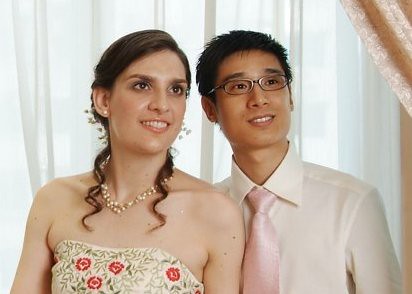
Eating dinner at the family table at my Chinese wedding ceremony -- while I dine on the veggies, my husband goes for the pork.
I’m excited to share with you my first-ever collaborative article, which I wrote with Susan Blumberg-Kason. Susan is the author of All the Tea in Chicago and the forthcoming book Good Chinese Wife, a memoir of the five years she spent trying to assimilate into a Chinese family.
This article grew out of stories that Susan and I swapped over the past year about going meatless in China, and especially going meatless in a Chinese family. Hope you enjoy it.
Forbidden. That’s what someone once called my writing back in 2004 when I started sharing my relationships with Chinese men. It’s not as if I put some adult-store-version of my life out there, complete with salacious descriptions that would have everyone heading for a cold shower. Sex never even came up.
No, I just happened to write about my former Chinese boyfriends.
I broke with Chinese tradition, where you keep your past loves buried away in your heart (to be sure, I never used their actual names and changed some of their details, though everything I shared was essentially true). That comment shook me then — I never realized I crossed a cultural line in my writing. If my old files from that time are any measure — I steered clear of intimate topics for years — the comment impacted me in ways I didn’t even realize. Continue reading “Why I Write About “Forbidden” Love in China”
This is the longest story I’ve ever published in my Double Happiness series. But Mayte’s unexpected journey towards China and love really touched me, and I’m really excited to share her story of two different, surprising and beautiful relationships with Chinese men.
——
I came to China to enjoy my dream trip. But before I arrived, I met and fell in love with a Chinese man who was by far the most amazing person I had ever met.
It began as a language exchange so that I could improve my Chinese enough to get through a backpacking trip I had planned in China. I wasn’t looking for any relationship at the time but as I prepared for the trip, it made sense to start working on learning Mandarin if I was going off on my own for the latter half. I met C.J. when he responded to a post asking for a language exchange. We talked briefly by phone before meeting and the day I met him, I thought he seemed sweet. When we talked, it was like talking to your best friend after not seeing them for years. We laughed a lot and shared lots of stories. He told me about China and I told him about life in the States, among other things. We closed down a cafe and a bar while we talked that night.
I am a white 19YO university student living in America, and for one year now I have been in a serious relationship with a PRC national six years older than me. I was already studying Mandarin before I met him and his English is commendable, so communication hasn’t been an issue, and therefore everything between us on a personal level has been ideal. We both feel completely comfortable talking about the future, already assuming we’re working toward marriage after graduation.
However, my parents are none too pleased. They remained generally quiet for the first six months of dating, then all of a sudden began voicing protests. I do my best to ignore their complaints about his age and religion (we’re Christian, he was raised Buddhist), but there is one problem that really puts me between a rock and a hard place.
My father’s job requires him to have a high-level security clearance. Because of this, my parents understandably fear that were I to marry my “Communist” Chinese boyfriend, my father would be forced to quit his job. Even though my boyfriend is not a CCP member, his nationality is all that matters in the clearance. Every time I go home or open an email, I am reminded that I am ruining my family with attacks like:
John and I have fūqī xiàng? How could anyone think we look that much alike?
You two really have fūqī xiàng (夫妻相).
I can’t tell you how many times I’ve heard this from Chinese friends. As much as I love when people suggest my husband and I are a lucky match, a couple destined to stay together forever, fūqī xiàng leaves me puzzled. How could anyone think we look that much alike?
I could imagine why such a saying came from China, a country dominated by the Han people, who share the same black hair and eyes, and similar skin tones. With that background, it wouldn’t take much for any couple to look alike. At a minimum, they’d need the same nose and the same shaped eyes; maybe the same shaped face, if you were a stickler. But even so, the odds are good you’d find many couples with their match reflected in their faces.
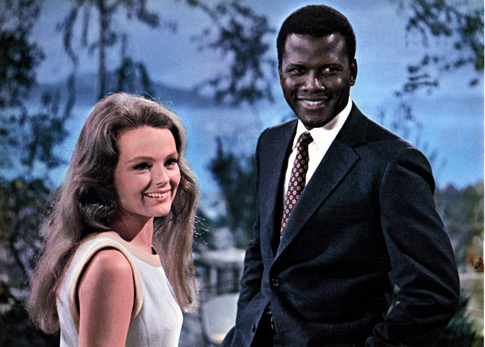
In "Guess Who's Coming To Dinner," the Monsignor cites the effort put into interracial relationships as a reason they work out more. But a reader's e-mail cited that extra effort as a reason to proceed with caution -- or not at all. (Image from ticketstubz.blogspot.com)
Last night, I saw the movie Guess Who’s Coming To Dinner. I expected a relaxing evening with some of my favorite actors of all time — Spencer Tracy, Katherine Hepburn, Sidney Poitier — but ended up with more than I bargained. Especially when I heard these words from Monsignor Ryan:
I’ve known a good many cases of marriages between the races in my time, and strangely enough, they usually work out quite well. I don’t know why. Maybe because it requires some special quality of effort, more consideration and compassion than most marriages seem to generate these days, could that be it?
I just wanted to hug the Monsignor after he said this, and couldn’t help but agree with the character Christina Drayton, that they were “beautiful thoughts.”
After her recent dating experiences in China, a woman wonders, should she expect Chinese men to have higher numbers of sexual partners and/or experience with prostitutes? (photo, a still of a sex scene from "Lust, Caution," from http://www.guardian.co.uk)
Anonymous asks:
I read your piece about dating pasts and Chinese men, but I have been having the opposite experience. I have dated some Chinese men in China. On each occasion as I became closer with the respective guy I was dating at the time, discussion of sexual history came up. Each had a fairly sizable number of partners (into double digits) and/or they had had sex with a prostitute. All other things considered, these were nice guys who treated me respectfully and didn’t seem to be players. I appreciated their truthfulness, but their sexual history combined with often poor sexual health practices (I blame poor sex-ed) kept me from becoming physically involved with any of them. My questions are these:
Are the men I’m meeting just outliers, or are higher numbers of sexual partners increasingly common among Chinese men in their 20s?
Could Westernization partially account for the higher number of partners?
At Watson’s in China, a little personal shopping got too personal when I decided to stock up on condoms. (photo by Calvin Teo from wikimedia.org)
“Your Personal Store.” That’s the tagline for Watson’s, the most popular pharmacy/drugstore shop in Asia and my go-to in China for so many health and beauty items I need. But after my experience this summer, I began to wonder if Watson’s wasn’t becoming “Your A Little Too Personal Store.”
Last summer, I lived mostly with my in-laws and visited Hangzhou or Shanghai only a few times. For me, that meant no Watson’s conveniently just around the corner or a short bus, subway or taxi ride away. So when I saw a Watson’s, I would sometimes kick into “storage mode.” That meant buying some extra peppermint hand wipes, another bottle of Johnson’s Baby Wash (for my sensitive skin), and, say, some more Durex condoms.
I’m a married woman, and yes, I wanted to replenish my condom stash. I sure couldn’t do it in my Chinese husband’s rural village, which probably sold those dodgy ones with what always looked like adult movie stills printed on the package. On this day in question, I still stayed with him in his rented room in Shanghai for a few more days, we’d have a few weeks or so together at the end of the summer before returning to the US, and what we didn’t use, we could always take home. Yes, condoms would definitely come in handy.
But I’d have to go alone on this one. “It’s easier for you,” John said. “They expect foreigners to buy these things.”
I couldn’t deny the truth in what he said — that many Chinese believed foreigners, especially foreign women, were so much more “open” about sex. Sure, I liked sleeping with my husband, and wasn’t afraid to say so. But that didn’t make me some foreign Jezebel ready to screw on the spot. Besides, I couldn’t hide in China — people noticed me everywhere as a foreigner, and that meant they might even notice my purchase even more.
“But people will stare at me, it will be so embarrassing,” I said.
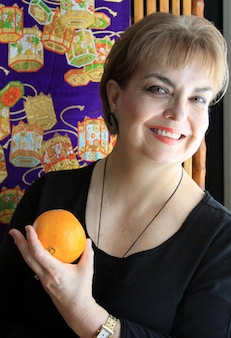
Accomplished Chinese food writer and yangxifu Carolyn J. Phillips talks with me about food and what it takes to charm your Chinese family at the table. (photo from zesterdaily.com)
Food is such an integral part of Chinese culture that it’s really hard to fit into a Chinese family if one isn’t adept at the cuisine. I suppose this is true to some extent with any country, but the Chinese are probably on par with the French and Italians when it comes to the importance of dining well.
This is probably doubly important when a yangxifu doesn’t speak Chinese fluently but still hopes to be accepted. Have your readers talked much about this? I truly feel that the old saw about the way to a man’s stomach etc is gospel for us yangxifu.
Carolyn should know — she’s a yangxifu who devoted her adult life to mastering the art of Chinese cooking. She blogs about food at Out to Lunch and tweets about it as @MadameHuang. She’s also working on two forthcoming books on the subject — “Simple Pleasures from a Chinese Kitchen: Authentic Seasonal Recipes from Every Region of China” and “Culinary Goddesses: The Women Who Changed Our Dining Landscape… Recipes Included.” — and is a regular contributor writing about Chinese food for Zester Daily. In addition, she’s even fluent enough in Mandarin to do court interpreting.
In any event, Carolyn has discovered a thing or two about what it takes to woo a Chinese family that truly loves to eat through food. So I sat down with her — from one yangxifu to another — to talk about all things related to food and Chinese family. As Chinese New Year approaches, it’s a topic that will come in handy for lots of readers.
Fred, who was born in Hong Kong and primarily raised in the US, never expected he would marry a white woman, let alone one from Brazil. (photo by André Mariana)
It’s amazing how far people will go for love, even learning a foreign language and then flying to a foreign land to ask for her hand in marriage.
This website uses cookies to improve your experience. We'll assume you're ok with this, but you can opt-out if you wish.AcceptRejectRead More
Privacy & Cookies Policy
Privacy Overview
This website uses cookies to improve your experience while you navigate through the website. Out of these cookies, the cookies that are categorized as necessary are stored on your browser as they are essential for the working of basic functionalities of the website. We also use third-party cookies that help us analyze and understand how you use this website. These cookies will be stored in your browser only with your consent. You also have the option to opt-out of these cookies. But opting out of some of these cookies may have an effect on your browsing experience.
Necessary cookies are absolutely essential for the website to function properly. This category only includes cookies that ensures basic functionalities and security features of the website. These cookies do not store any personal information.
Any cookies that may not be particularly necessary for the website to function and is used specifically to collect user personal data via analytics, ads, other embedded contents are termed as non-necessary cookies. It is mandatory to procure user consent prior to running these cookies on your website.