
More than a month ago, John’s duffel bag mysteriously appeared in my apartment — as he moved in with me. Now that blue duffel bag had turned into a maroon wheeled suitcase we bought at the corner supermarket, and that suitcase would be leaving with John for Shanghai. There was no mystery in it — John was going into a master’s program in psychology at a university in Shanghai.
We had our official sending-off dinner at the formal dining room in Hangzhou’s Town God’s Temple, perched on a hill just above Wushan Square. As we walked up the winding trail to the restaurant, weaving in and out of the shadows of pine and oriental plane trees, I sang “Rainbow” by Yuquan, a song that had become ours ever since John gave me the CD with it on my birthday. Yuquan was John’s favorite Chinese rock group, and now I was using the music he romanced me with to romance him back.
But, even as I sang to John — in the music John loved best — he wore a salmon, Italian-style buttoned shirt and slacks, one of the many outfits I had bought after discovering that, in fact, John had only two decent T-shirts, a worn pair of jeans and polyester pants with frayed hems that fluttered in the wind.
So much of our recent lives had been lived together, and influenced in subtle ways by our shared presence. Continue reading “Chapter 18: The Parts of My Chinese Boyfriend Left Behind”

 Anonymous asks:
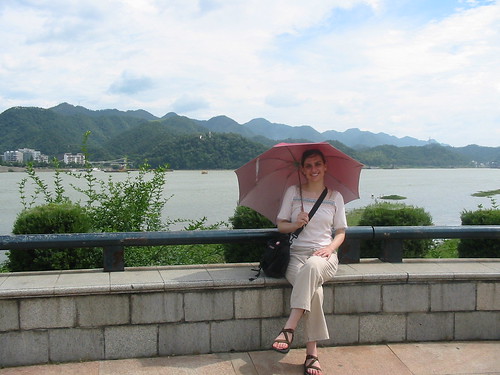 John brought me to Tonglu, his hometown in the Chinese countryside, to climb Daqi Mountain. If only I knew I’d have to do more than just climb the mountain — I’d have to climb out of the mess I created this morning.
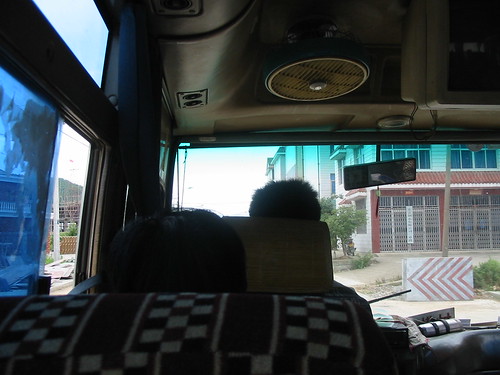 I really want to be on the new highway leading to Tonglu, John’s hometown in the Chinese countryside. The smooth concrete is perfect, unblemished by potholes or cracks. Each side of the highway has a new guardrail, with newly transplanted trees beside it, propped up by four wooden supports and rope tied around the trunk. And on the highway, a bus cannot stop to pick up new passengers — it must go nonstop to its destination, so the passengers know when it will arrive. It is China’s future, right next to me.
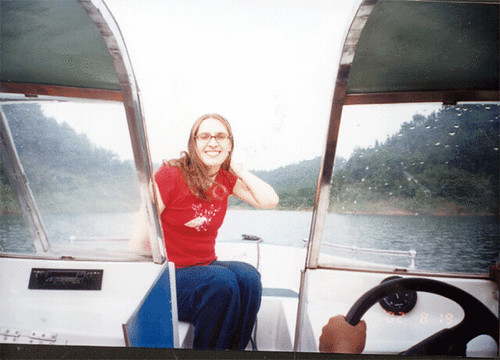 Chinese poets once praised the Xin’an River in Zhejiang Province as a mirror, so clean and clear you could see the bottom. But the Xin’an River is no more. It was dammed in 1958 to create 1,000 Island Lake, where John takes me in August 2002 to visit the country of his ancestors.
 Kelley asks:
 “Do you realize how you hurt Frank?” Xiao Yu, one of my coworkers and friends from the Internet company, confronted me one afternoon, nearly a week after