Public Kisses in the Movies: Romantic or Embarrassing?

Whenever I watch a romantic comedy with my husband Jun, we always laugh together over that inevitable moment when the couple shares a kiss – in public.

It’s almost like a game for us – let’s see how long the movie will last before lips lock among a group of people, whether that’s a handful of their closest friends or an entire flash mob (Friends with Benefits). If it’s a love story, it invariably happens somehow, somewhere.

And the funniest thing is, I never really took note of this romantic comedy troupe until I met Jun.

He grew up in a world where public displays of affection, like kissing, were generally confined to bedrooms, closed doors and any other private corner of the world. His parents in rural China never kissed and hugged in front of him, like mine did, and neither did his relatives. That kind of intimacy was always tucked out of sight in his life, and it was the normal thing for people to do.

Hence, his fascination with kissing in the presence of other people, as depicted in all those Hollywood romantic comedies.

I’ve recognized for a long time that Hollywood stretches reality for entertainment. After all, few of us will probably ever kiss, say, in the center of a baseball field at an evening game (Never Been Kissed) or on the snowy streets of London, wearing our underwear as bewildered pedestrians walk by (Bridget Jones).

Nevertheless, I often idealized, and even loved, these public kisses in the movies, even if the reality might make me blush. The idea of having others witness your kiss in public had struck me as romantic, which outweighed the ensuing embarrassment.

Jun would come to remind me that, on the flip side, sometimes the embarrassment might outweigh the kiss, depending on your culture or perspective.

Nevertheless, we still delight in those romantic comedies. And while I know it’s a total long shot, who knows — maybe someday I might just convince Jun to give me one of those ultra-dramatic kisses, say, in front of Tian’anmen Square. 😉

Have you ever noticed how romantic comedies love to feature kisses in really public places? Do you think it’s romantic or embarrassing?

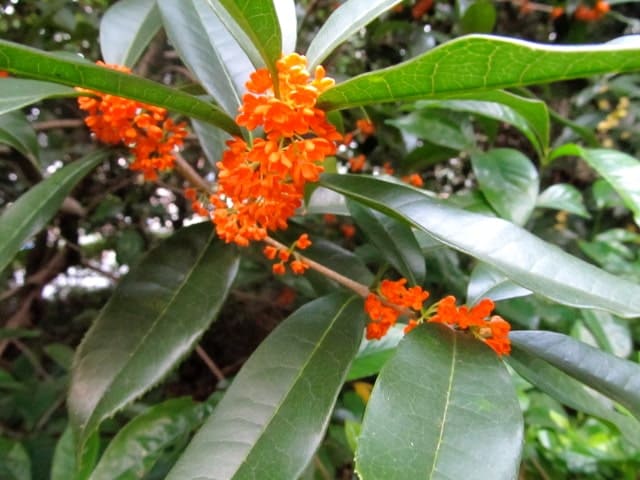
An Ode to China’s Enchanting Sweet Osmanthus Flowers (Pub’d on WWAM BAM)

The group blog WWAM BAM just ran my post An Ode to China’s Enchanting Sweet Osmanthus Flowers. Here’s an excerpt:

If dreams and hopes had a scent, it might just be the sweet osmanthus bloom.

This autumn marks the first in many years without the pleasure of one of my favorite flowers, which comes out in late September into early October in Hangzhou, my husband’s home region.

These enchanting blossoms grow on the osmanthus tree, native to a wide swath of subtropical and tropical East Asia, and their beguiling, sweet fragrance has notes of apricot, peach and even a little vanilla.

And yet, the flowers are incredibly tiny, smaller than the nail on your pinky finger. It’s amazing that these delicate blooms send out such a powerful smell. I’ll never forget one autumn when I stayed with my in-laws in their home, and the scent of the sweet osmanthus flowers wafted in through all the windows for days. It was like being engulfed in the smell of heaven everywhere I walked in that house.

I also love that you can use the flowers in your cooking. My mother-in-law always makes roasted chestnuts at home, and she sometimes tosses in osmanthus flowers collected from the village or front yard of the house. The heady fragrance of the flowers makes the chestnuts even more delicious.

You can head on over to WWAM BAM to read the full post and see some of my photos of the beguiling flower. And if you like it, share it!

And for those of you in China or from the country, here’s wishing you all a very happy National Day!

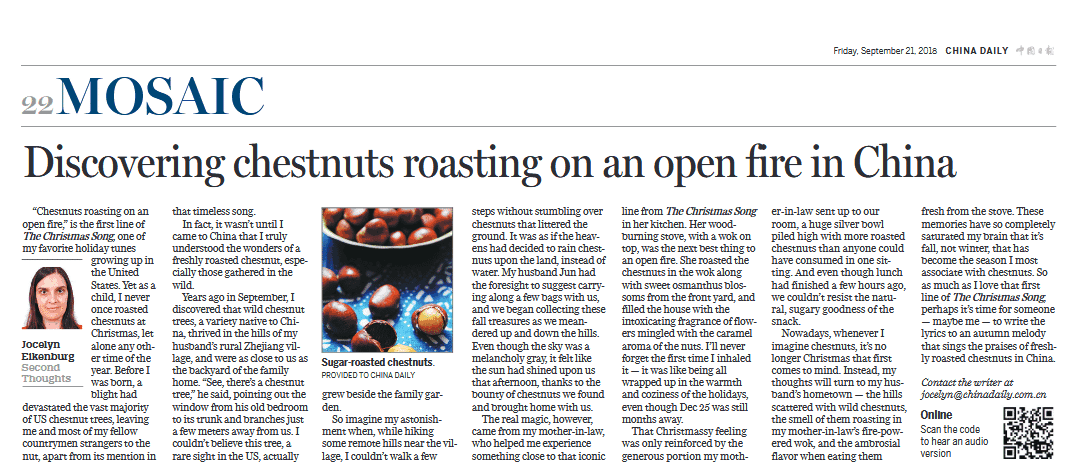
Discovering Chestnuts Roasting on an Open Fire in China – My China Daily Sept Column

Last Friday, China Daily published my column for the month of September: Discovering chestnuts roasting on an open fire in China. Here’s an excerpt:

“Chestnuts roasting on an open fire,” is the first line of The Christmas Song, one of my favorite holiday tunes growing up in the United States. Yet as a child, I never once roasted chestnuts at Christmas, let alone any other time of the year. Before I was born, a blight had devastated the vast majority of US chestnut trees, leaving me and most of my fellow countrymen strangers to the nut, apart from its mention in that timeless song.

In fact, it wasn’t until I came to China that I truly understood the wonders of a freshly roasted chestnut, especially those gathered in the wild.

Years ago in September, I discovered that wild chestnut trees, a variety native to China, thrived in the hills of my husband’s rural Zhejiang village, and were as close to us as the backyard of the family home. “See, there’s a chestnut tree,” he said, pointing out the window from his old bedroom to its trunk and branches just a few meters away from us. I couldn’t believe this tree, a rare sight in the US, actually grew beside the family garden.

So imagine my astonishment when, while hiking some remote hills near the village, I couldn’t walk a few steps without stumbling over chestnuts that littered the ground. It was as if the heavens had decided to rain chestnuts upon the land, instead of water. My husband Jun had the foresight to suggest carrying along a few bags with us, and we began collecting these fall treasures as we meandered up and down the hills. Even though the sky was a melancholy gray, it felt like the sun had shined upon us that afternoon, thanks to the bounty of chestnuts we found and brought home with us.

Read the full piece here online. And if you like it, share it!

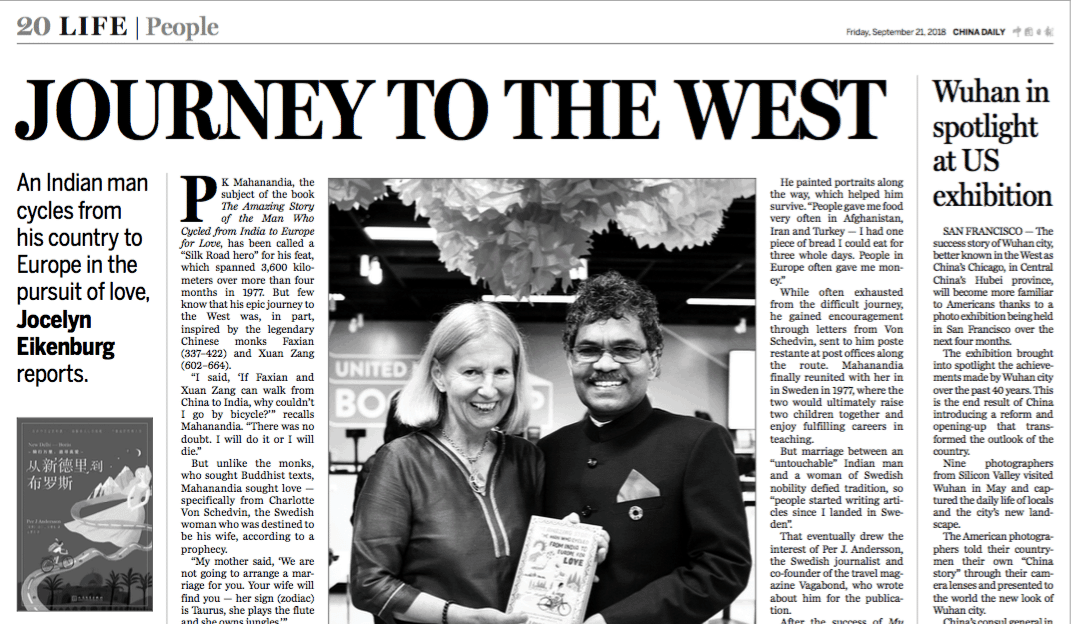
Journey to the West: An Indian Man Cycles From His Country to Europe in the Pursuit of Love (Pub’d in China Daily)

China Daily just published my feature story, titled Journey to the West, about PK Mahanandia and his extraordinary journey from India to Sweden by bicycle for love (which I blogged about earlier this year). Here’s an excerpt from the piece:

PK Mahanandia, the subject of the book The Amazing Story of the Man Who Cycled from India to Europe for Love, has been called a “Silk Road hero” for his feat, which spanned 3,600 kilo­meters over more than four months in 1977. But few know that his epic journey to the West was, in part, inspired by the legendary Chinese monks Faxian (337–422) and Xuan Zang (602–664).

“I said, ‘If Faxian and Xuan Zang can walk from China to India, why couldn’t I go by bicycle?’” recalls Mahanandia. “There was no doubt. I will do it or I will die.”

But unlike the monks, who sought Buddhist texts, Mahanandia sought love — specifically from Charlotte Von Schedvin, the Swedish woman who was destined to be his wife, according to a prophecy.

“My mother said, ‘We are not going to arrange a mar­riage for you. Your wife will find you — her sign (zodiac) is Taurus, she plays the flute and she owns jungles.’”

He and Von Schedvin met in New Delhi in 1975, at a time when Mahanandia was an impoverished art student from the “untouchable” caste who drew portraits in the popular shopping district of Connaught Place.

“When I started doing her portrait, I felt a strange feel­ ing in my body. I was breath­less.”

She returned, and after asking her questions, he learned she was a flute player born in May, whose family owned forests.

“Then I knew that we are destined to meet. I said, ‘You will be my wife, it is decided in the heavens.’”

You can read the full article online. And if you like it, share it!

Photo Essay: Taking Time to Smell The Roses – Our Beijing Summer

It’s hard to believe summer will officially end later this week! Despite the scorching temperatures we saw here in Beijing (like much of the world), Jun and I still enjoyed our share of light moments (including, yes, taking the time to smell the roses). While I’m catching up on some work, I’m bringing you a few of my favorite summer images from here in Beijing.

Wherever you are, here’s wishing you had a sensational summer!

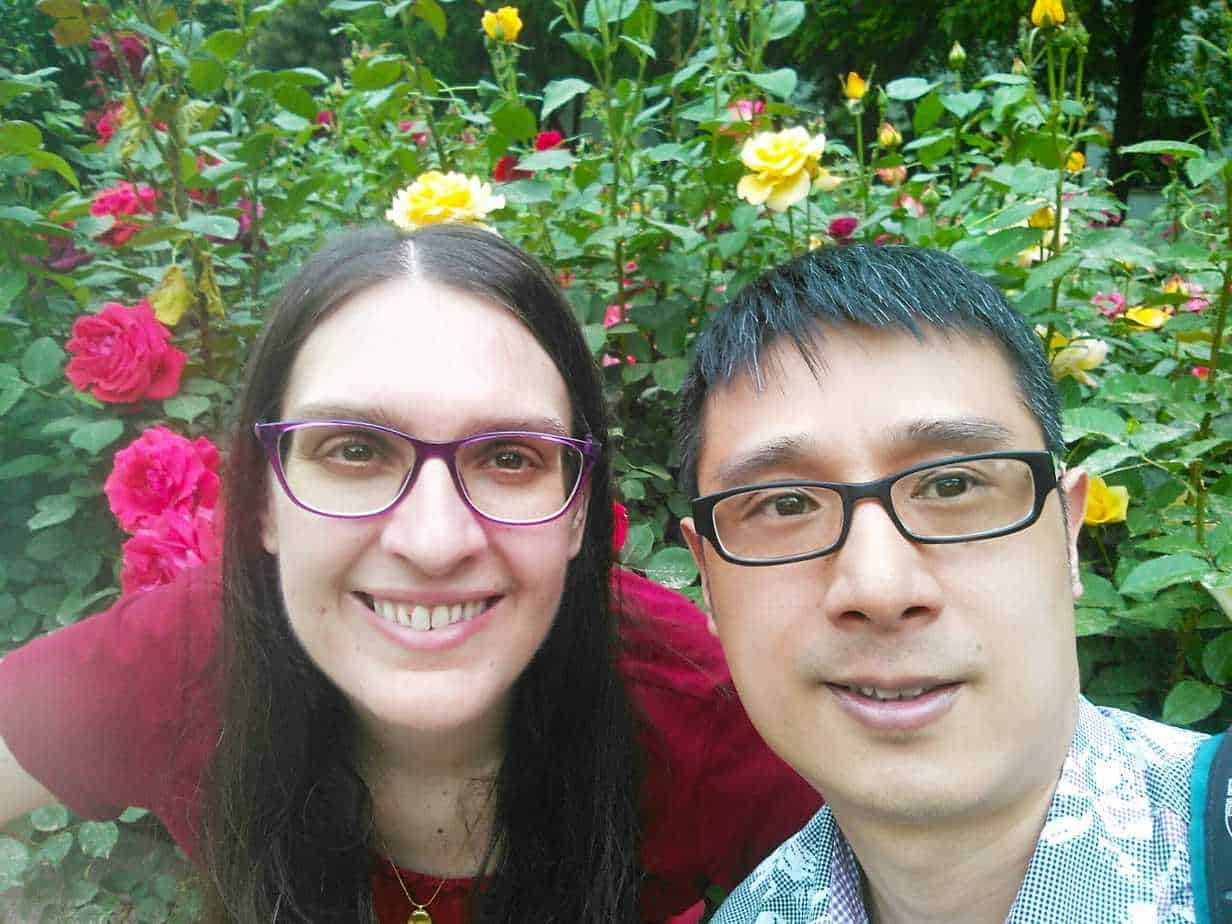
We took this photo in the rose garden at China Daily, where we also took a moment to take in the roses’ fragrance as well. Ah!

Jun and I visited Yuanming Yuan (the Old Summer Palace), which reminded us of our old stomping grounds in Hangzhou.

Here’s a picture we took of Qianmen, the gate just south of Tian’anmen Square.

Also near the Qianmen neighborhood, but looking in the opposite direction down the old streets.

Jun and I stroll through through a park filled with beautiful willow trees beside a canal in the Ditan Park area.

Chinese Man Seeks Lost American Wife, Son Who Disappeared in Hangzhou

I first learned of this story on WeChat when people began sharing news of a lost mixed-race 2-year-old boy who went missing in Hangzhou. Later reports revealed the boy had actually disappeared with his mother, an American woman. I’ve translated a news story on the incident initially published in Chinese.
—–

“All-powerful circle of friends, please ask everyone if they have seen this child. He is lost. I already alerted the police, but still haven’t received any information about him. Yesterday this information was heavily reposted on social media, saying this 2-year-old boy went missing at Xin Qingnian Guangchang. His name is Chenchen, also known as Milan. Accompanying the information is a picture of the little boy. He has really big eyes, just like a foreign child.”

The person who sent this information is the boy’s father Xiao Xue, a 27-year-old fitness coach in Hangzhou. Yesterday, when someone was trying to get in touch with him, he was a little embarrassed to say, “The boy probably left with his mother.”

The boy’s mother is an American. Her Chinese name is Bai Xue, and she’s two years older than Xiao Xue.

The two of them got together in a romantic way on April 4, 2015, when they both met at the Drum Tower, where it was love at first sight.

At the time, Xiao Xue had been in Hangzhou for about a year or so, while Bai Xue was a foreign student at Zhejiang University. “She was a very bright student and did well in her studies. She could speak many languages, at least eight,” Xiao Xue said, his voice showing pride as he spoke of his wife.

Bai Xue was beautiful, while Xiao Xue was handsome. The two young people had no language barrier to deal with, so they quickly moved from meeting each other to love, and, hand-in-hand, entered marriage together.

“Our relationship was very good, and there was no doubt she loved me,” Xiao Xue said. After they married, his wife Bai Xue’s living habits gave him a bit of a “breakdown”. “She loved to do as she wished, and she would leave things all over the house, and didn’t like to put them back in their place.”

Xiao Xue however prefers things to be neat and tidy, and he would remind Bai Xue about this many times. When Bai Xue became angry over his words, Xiao Xue would soothe her and the situation would pass.

After one year of marriage, their son was born – fair-skinned, chubby, and a mixed-race child. He was very cute. The young couple took care of him themselves and found an Ayi to help them out.

With the birth of their child, the differences in living habits between the two turned into a more acute conflict. During the day, Xiao Xue would work, and Bai Xue would take care of the child.

They were both young and had no experience caring for children. But Xiao Xue said, there were times when he would come home and see the child in the middle of winter with one bare foot, or wearing mismatched shoes, etc. He would say something to Bai Xue, but she felt Xiao Xue was nagging.

Later on, Bai Xue found a job at an early childhood education center, and she could take her son with her to work, so they got rid of their Ayi.

On May 20, also known as young people’s “520” online Valentine’s day holiday, Xiao Xue had to work that day. When he got off work and came home, he was very upset to see an entire box of children’s clothes lying on the ground. All of his desire to enjoy the holiday disappeared. He tidied up the clothing on the ground and then waited for Bai Xue and the boy to return.

After 9 pm that evening, Bai Xue and the child came back, and Xiao Xue asked Bai Xue to put away the clothes on the sofa. But Bai Xue said she wanted to go to sleep. On that day, Xiao Xue was in a bad mood, so he spoke in anger. “That day I was a bit harsh to her, I said the house is such a mess, you must put your clothes away!”

In anger, Bai Xue placed the child in bed, and organized the clothing. Xiao Xue grabbed his notebook to write a journal entry. It wasn’t until after 1 am that he returned to the room and found that Bai Xue and the boy were gone.

Xiao Xue ran outside the building to look, and couldn’t find a trace of the mother and son in the gardens there. Bai Xue’s usual electric scooter wasn’t there either.

Xiao Xue said, Bai Xue had stayed in Hangzhou for over 10 years, she had classmates and friends there. So he sought them out, but they didn’t know where she had gone.

Xiao Xue then reached out to his mother-in-law in the US. She said she didn’t know were Bai Xue was, but she received a Skype message from Bai Xue, asking her to send some living expenses.

In early June, Xiao Xue went to the police station to make a report, and the police searched for information. They discovered that, on the second day that Bai Xue had run away from home, she had gone to Xinchang, then two days later returned to Hangzhou, where she stayed at an inn near Zhejiang University. “I was too slow, she had checked out of the room.”

In early June, Xiao Xue heard friends say they had seen on social media that Bai Xue was carrying her son in Ledigang in Gongshu district.

Xiao Xue has been unable to contact Bai Xue. After she ran away from home, she canceled her WeChat account. Xiao Xue sent her emails but she hasn’t replied.

Bai Xue hails from a scholarly family. Her mother is a university professor, and her father is an expert in nuclear physics. She also has two younger sisters, and one of them is a Chinese girl born in Hubei who was adopted by her parents. “I saw that it said on her Skype that in early June she went to the place where her younger sister was born,” Xiao Xue said. He guessed that she had possibly gone to Hubei. “She is a very innocent person, and I fear that she has been conned by someone.”

When all is said and done, in fact these two young people just didn’t know how to get along after marriage.

“When we were first married,we often went out for fun in the evenings and enjoyed holidays together. After our child was born, there were fewer holidays,” Xiao Xue said, noting he may have neglected Bai Xue’s emotional needs.

Xiao Xue said that, concerning their marriage, while Bai Xue’s father supported his daughter, her mother had some dissatisfaction. At the end of last year, Bai Xue’s father passed away and she returned home. Xiao Xue, because he had to work and also perhaps feared seeing Bai Xue’s mother, didn’t go with her, staying at home to care for their son.

As for Xiao Xue, perhaps he harbored some macho ideas. He thought that he should go out to earn money, while his wife should take care of things at home. Now, Xiao Xue said he really regrets his behavior: “That day I shouldn’t have been so angry at her.” Xiao Xue said that, previously, because Bai Xue had made the home so untidy, he threatened to break up with her and such. “Those were angry words, but she probably thought I was being serious.”

What do you think?
Chinese Student in Germany Gives Dating Advice to Fellow Countrymen

I recently found this answer on Zhihu from a Chinese student in Germany, who offers dating advice to his fellow countrymen who are studying or living abroad, and translated it into English.
—–

It’s my first time to answer a question, so please be gentle with me.

I studied abroad in Germany — it was a small place and Europeans made up most of the population there. Also the international students came from different European countries. My roommate M was one of these super-beautiful Nordic girls. Recently she went out on a date with a Vietnamese guy (this fellow was not as tall as she was), and she and I had a deep conversation about this issue.

Your average ABC (American Born Chinese) studs don’t have this kind of trouble. So my answer is regarding those foreign students who left China after they became adults, and my examples are based on personal experiences among European students.

My response is, sorry, it’s really hard to date European or American girls.

Let’s first start by talking about the requirements for man to date these women:

  • To begin with, you have to pay attention to personal appearance and posture. First you need to be in good shape. That doesn’t mean you have to be tall — you have to have the features (women think) you should have, such as biceps, and you should not have the features (women think) you shouldn’t have, such as a beer belly. These are things that can be acquired through hard exercise. People still look at muscles. It’s not a problem if you’re not tall, but being healthy and strong are characteristics a guy must have. Europeans/Americans really do have many short (shorter than 165 cm) but beautiful, buxom girls. Their boyfriends are not all tall. Looks are even less of a problem. People don’t know much about Asian features. Again, I say personal appearance, this is something I really need to mention. What is up with the few Asian guys on campus, with their hair so greasy it reflected light and the shiny collars and cuffs on their jackets? I think these guys, from when they were young in China, just didn’t have this habit of washing their own clothes or tidying themselves up. After I came here, I went to a friend’s house for fun, the way German guys were so neat and orderly threw me several blocks behind even the standards of neatness of Chinese girls. Clean yourself up, and then buy a bottle of fresh-scented men’s cologne. Don’t feel emasculated by it, this is about showing respect to others and it also reflects the quality of your life.
  • Your language must be good, at a minimum you should be able to have small talk with Europeans/Americans without any pressure. It’s not a problem if you have an accent. But you must be able to freely joke around, make fun of yourself, and flirt with girls. Being humorous and funny is a very important standard. Who doesn’t like to make friends with someone who is interesting? Most of the Asian foreign students I know are not good at talking. Never mind European/American girls — even the Asian girls all think they’re dull. If you’re free just take a look at all the clever postings on Zhihu [a Q&A site in China] and learn from them. Humor requires intelligence, and it is something that reflects wisdom. It would be a plus if you have character, opinions, independent values, confidence, and can intelligently communicate with girls. This is easy. With China’s 5,000 years of history, you can just choose a few amusing anecdotes from history to talk about. And if you can tell a girl about some European/American history or anecdote even she doesn’t know about, great – you will immediately look even more impressive.

Meeting those requirements would enable you at least to ask a girl out. At least the girls in my dormitory would go out with you (Can you take me with you?). This is enough. If people aren’t interested, why would  they go walk the streets with you, right? Whether it develops into some kind of relationship, that’s a matter of destiny, right?

To conclude, in general the reason guys cannot get a date isn’t a matter of their Asian looks (there are some who think we look exotic), and it’s not about biology. It’s that Asian men who typically leave the country to go to school are studious. They don’t have these basic features mentioned above that attract foreign girls, and they don’t know how to improve themselves. Most of them only carry a backpack and immerse themselves in the library. To put it cruelly, these Asian men would have a hard time attracting Asian girls, let alone European/American girls. But, for some Asian men who meet the above requirements, what kind of girls  couldn’t they find in Asia? They can find light-skinned, gorgeous, buxom, long-legged, well-educated girls who share the same cultural background. These men are not going to look for a foreign girl who is more independent, can’t make Chinese food and probably cannot communicate with your parents. (Of course, dating [foreign girls] is still very cool!) So the buyer’s market and the seller’s market are seriously not matched, and this has always been a difficult thing!

At last, please search for Lorde’s boyfriend [James Lowe]. Ah, this is probably the best answer.

What do you think?

Are Couples with Height Differences Better in China? Even When Woman Is Taller?

When I told a colleague the other day that I was taller than my husband, she gave us an unexpected thumbs-up – even though it’s more unusual for women to date and marry shorter men.

“That’s great,” she said, which was probably the first time anyone has ever congratulated me for standing several inches higher than Jun. “Because you know, it’s better for couples in China to be of different heights than the same height.”

“Even when the woman is taller than the man?” I asked her.

While she conceded it might not be true for rural areas, she felt confident that this was the case for big cities in China, like Beijing.

Meanwhile, if I had been in a comic that moment, I would have had a string of question marks circling about my head. Her assertions clashed with everything I thought I knew about dating preferences and height in China. Sure, I had seen other couples like me and my husband – including one of his best friends from middle school who was a few inches shorter than his own wife. But was this really a thing? Did urban China truly applaud any height differences between couples, even when it’s the woman who’s taller?

Well, one thing is sure — there are people in China who think it’s better for couples to be of different heights, including someone on a Chinese dating show called “Take Me Out”. (People actually wrote an article (in Chinese) to discuss and challenge the idea.) And there are conversations about what is apparently the “ideal height difference” (in Chinese) (it kind of boggles my mind people would actually contemplate this, down to the exact centimeters.)

But when they say it, does it apply to all couples, even those who belong to the taller wife, shorter husband club?

While it’s not a definitive answer, I happened to come across a rather telling Baidu Zhidao thread under the following question:

What if you you walk down the street and see a couple. They are almost the same height, with the woman taller than the man. Would you think it strange? (如果你们走在街上看到一对情侣,这对情侣的身高差不多高。 女的比男的高一点!你们会觉得奇怪吗?)

Here’s what the best responder had to say (with my English translation):

Thinking it strange is too one-sided to fully understand enough. (觉得奇怪的前提是看法太片面了解的不够多的缘故。)

Different people have different understandings. Early modern society emphasized men over women. Although it’s normal for women to be taller than men, there are some people who have a kind of male chauvinism in their hearts, believing that it’s not proper for women to be taller than men, that it would embarrass the man. (不同的人不同的理解,近代社会就是重男轻女,虽然女比男高也是意见很正常的事情,但是有些人从心里就始终有一种大男子主义的情怀,觉得女比男高就不合适,觉得男人没面子。)

In reality all of this doesn’t exist. Now society emphasizes the freedom to choose who you love. Age is not a problem, height should not create distance. As long as two people are happy, what’s wrong with that? (其实这些都不存在的,现在社会提倡自由恋爱,年龄都不是问题,身高都不是距离,只要两个人喜欢,那又何妨?)

Wang Zulan is also not as tall as his wife Li Yanan. [Jocelyn’s note: See them at the top of this article.] (王祖蓝也一样还没他老婆李亚男高呢。)

What do you think?

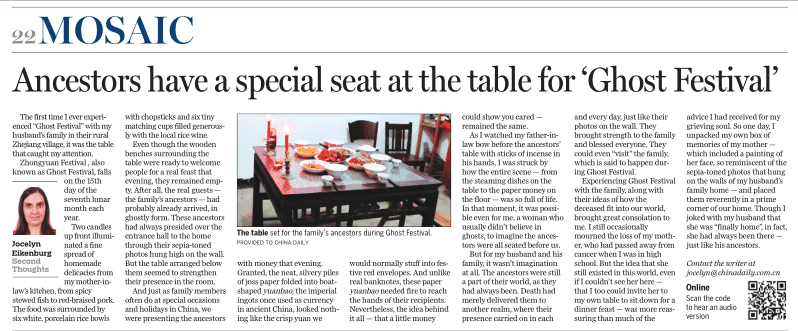
Ancestors Have a Special Seat at the Table for ‘Ghost Festival’ – Pub’d in China Daily

On Friday, China Daily published my latest monthly column: Ancestors have a special seat at the table for ‘Ghost Festival’. It traces my first experience with the festival and also how it ultimately moved me to re-imagine my own relationship with ancestors (particularly my mother, who passed away when I was in high school). Here’s an excerpt from the piece:

The first time I ever experienced the “Ghost Festival” with my husband’s family in their rural Zhejiang village, it was the table that caught my attention.

Two candles up front illuminated a fine spread of homemade delicacies from my mother-in-law’s kitchen, from spicy stewed fish to red-braised pork. The food was surrounded by six white porcelain rice bowls with chopsticks and six tiny matching cups filled generously with the local rice wine.

Even though the wooden benches surrounding the table were ready to welcome people for a real feast that evening, they remained empty. After all, the real guests — the family’s ancestors — had probably already arrived, in ghostly form. These ancestors had always presided over the entrance hall to the home through their sepia-toned photos hung high on the wall. But the table arranged below them seemed to strengthen their presence in the room.

And just as family members often do at special occasions and holidays in China, we were presenting the ancestors with money that evening. Granted, the neat, silvery piles of joss paper folded into boat-shapedyuanbao, the imperial ingots once used as currency in ancient China, looked nothing like the crisp yuan we would normally stuff into festive red envelopes. And unlike real banknotes, these paper yuanbao needed fire to reach the hands of their recipients. Nevertheless, the idea behind it all — that a little money could show you cared — remained the same.

As I watched my father-in-law bow before the ancestors’ table with sticks of incense in his hands, I was struck by how the entire scene — from the steaming dishes on the table to the paper money on the floor — was so full of life. In that moment, it was possible even for me, a woman who usually didn’t believe in ghosts, to imagine the ancestors were all seated before us.

But for my husband and his family, it wasn’t imagination at all. The ancestors were still a part of their world, as they had always been. Death had merely delivered them to another realm, where their presence carried on in each and every day, just like their photos on the wall. They brought strength to the family and blessed everyone. They could even “visit” the family, which is said to happen during the Ghost Festival.

Experiencing the Ghost Festival with the family, along with their ideas of how the deceased fit into our world, brought great consolation to me.

You can read the rest of the column (in full color) right here. And if you like it, share it!

Daniel Wu, Lisa Selesner Are My New Model Couple, But the Reason Might Surprise You

Fans of “Into the Badlands” star Daniel Wu may know he married fellow American Lisa Selesner, who is white and Asian (she has a French and Chinese father). And while that makes their marriage interracial, that’s not the reason I’m digging these two lovebirds.

First off, she’s taller than him, just like me and Jun. Sure, they’re only separated by a couple of centimeters, but still – it’s nice to see a couple that looks more like my own relationship than, say, Tom Cruise and Nicole Kidman (who were, incidentally, our original “models” when we first started dating).

The real explanation for why I’m loving these two – especially Lisa – is based on her response to a reporter, who pointed out she was shorter than then-boyfriend Daniel Wu. Here’s what the report said (which I’ve translated from Chinese into English):

She immediately clarified she was taller than her boyfriend. But she never cared about her boyfriend’s height, and even dared to use it as a positive sexual metaphor. “From my experience, there’s no difference in bed between a man who is 170 cm tall and one who is 190 cm tall.” She also playfully remarked that, although Guo Fucheng (Aaron Kwok) is “small”, “he doesn’t have a problem in bed.”

It’s much like what I wrote in Three Inches of Separation: On Loving a Shorter Chinese Man: “that the greatness of a Chinese man isn’t measured in inches.”

P.S.: For those of you interested, Daniel Wu and Lisa Selesner tied the knot in South Africa, as chronicled in this piece posted by Daniel himself. He wrote, “On April 6th, 2010 Lisa and I were married in a beautiful forest in South Africa.  It was a very very special ceremony. The energy and love that we felt was very intense and amazing. I will never forget that day!”

Photo credits:

Photo of Daniel Wu: By Gage Skidmore, CC BY-SA 3.0, https://commons.wikimedia.org/w/index.php?curid=41619488

Photo of Lisa Selesner: By Crossroads Foundation Photos – https://www.flickr.com/photos/crossroads_foundation/5820591838/in/photostream, CC BY 2.0, https://commons.wikimedia.org/w/index.php?curid=17639702