Romanced on a Shanghai Bicycle (Almost) for Two: Cherished Memories of When My Husband ‘Picked Me up’ on His Bike

Recently, I discovered bicyclists in Beijing could no longer have an extra passenger in the back.

While I understood the safety rationale behind the move, I couldn’t help feeling it was the end of an era. After all, some of my fondest memories with Jun happened while I was riding on the back of his bicycle in Shanghai.

We dubbed the bike our “official car”, and Jun would use it to pick me up when I would arrive late in the evening from business trips outside the city. I would message him when I was about 10 or 15 minutes from the subway stop near our apartment, and then he would pedal over and wait for me. No matter how exhausted I might have been, the thought of Jun and our humble little bicycle made me bound up those subway stairs with a bounce in my step.

He would always immediately take my bags for me and place them in the basket, and then I would settle myself on the platform behind his seat, and hug him with my arms. Riding with him was like an extended embrace in a sense, and maybe that’s why I liked it so much. It was romantic, but with a purpose. After all, you had to hold on to the person pedaling the bicycle for safety.

I think I liked these trips even better because, honestly, Jun didn’t need to pick me up like that. Our apartment was only about four blocks from the subway and could easily be reached in a 10 or 15 minute walk. But Jun insisted on meeting me with that bicycle, regardless. He never made any grand declarations in the process, but he didn’t have to — the whole thing was an act of love.

I understand why things have changed in Beijing. And those changes come at a critical time when motorized vehicles, including scooters, rule the roads, not bicycles.

But this reality makes those memories of riding on the back of Jun’s bicycle all the more precious to me.

Have you ever ridden on the back of someone’s bicycle? Was it ever a romantic experience to you?

Photo credit: By 齐健 from Peking, People’s Republic of China – Down the Hutong, CC BY 2.0, https://commons.wikimedia.org/w/index.php?curid=18200257

Welcoming Guests Is a Sacred Art That Opens a Door to Love – Pub’d on China Daily

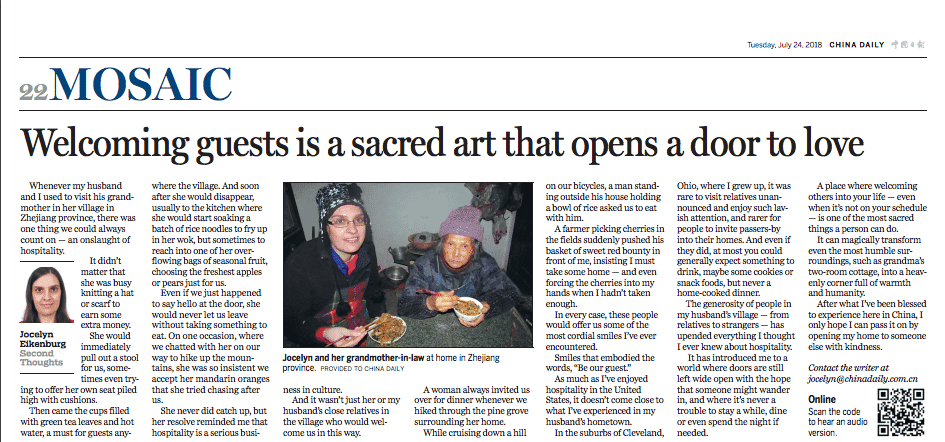
I’ve been so busy in the past few weeks that I’m late in sharing my latest column for China Daily (which is also — drum roll — now in full color, with a photo)! It’s titled Welcoming Guests Is a Sacred Art That Opens a Door to Love, inspired by the hospitality I’ve enjoyed in my husband’s hometown. Here’s an excerpt:

Whenever my husband and I used to visit his grandmother in her village in Zhejiang province, there was one thing we could always count on — an onslaught of hospitality.

It didn’t matter that she was busy knitting a hat or scarf to earn some extra money. She would immediately pull out a stool for us, sometimes even trying to offer her own seat piled high with cushions. Then came the cups filled with green tea leaves and hot water, a must for guests anywhere the village. And soon after she would disappear, usually to the kitchen where she would start soaking a batch of rice noodles to fry up in her wok, but sometimes to reach into one of her overflowing bags of seasonal fruit, choosing the freshest apples or pears just for us.

Even if we just happened to say hello at the door, she would never let us leave without taking something to eat. On one occasion, where we chatted with her on our way to hike up the mountains, she was so insistent we accept her mandarin oranges that she tried chasing after us.

She never did catch up, but her resolve reminded me that hospitality is a serious business in culture.

You can read the full piece here online — and if you like it, share it!

Qixi Festival: Popular Gifts, Celebrations for the Chinese Valentine’s Day

As the sultry days of August are upon us, there’s another celebration ready to heat things up, especially among lovers and couples. The Qixi Festival, also known as Chinese Valentine’s Day or the Double-Sevens Festival (because it falls on the seventh day of the seventh month of the lunar calendar — Aug 7 in 2019), is a traditional Chinese holiday that has surged in popularity in recent years.

If you happen to have someone special in your life, how should you celebrate Qixi Festival? What are some popular gifts for Qixi Festival? Here are a few ideas I’ve culled together, whether you’re making purchases or plans or just curious about this Chinese Valentine’s Day.

Qixi Festival: Popular Gifts

If there’s anyone who knows what people usually buy for Qixi Festival, it’s China’s e-commerce giant Alibaba, and here’s what they found in an article in China Daily: “Alibaba claims that the number of people searching key words such as flowers, roses, and chocolates on online shopping websites increases dramatically around Qixi.”

In other words, your Valentine’s Day standards make for excellent gifts for Qixi Festival, if you’re buying for someone special, like a girlfriend or boyfriend, husband or wife.

But the same China Daily article gives additional visual cues through the photographs included in the story.

There’s a gorgeous cake frosted in pink with special Qixi Festival greetings written on the top, which could inspire you to give your loved one a sweet surprise – a cake or dessert — for the holiday as well.

Another photo shows a boyfriend presenting his girlfriend with a gold necklace for Qixi Festival. So add jewelry – another typical gift of Valentine’s Day – to your list of possibilities.

Qixi Festival: Popular Ways to Celebrate

Have a romantic candlelit meal together

As this China Daily article notes, “Chinese people embrace their own “Valentine’s Day” Tuesday, when lovers send each other gifts or have romantic candlelit meals together.” So yes, why not make reservations for two at that restaurant in town with the breathtaking views, cozy interiors and, perhaps, a history of people getting on one knee with a ring in their hands. It may sound utterly clichéd and unoriginal, but sometimes we all crave a little something corny (and delicious!) in our lives.

And if you’re not attached yet, just gather together your closest friends – who doesn’t love an excuse for a nice meal with good company?

Long-distance lovers make contact

Qixi Festival might just be the ultimate holiday honoring anyone “going the distance” in a relationship, and that’s because of the story behind it. As I wrote earlier in Gifts for the Qixi Festival (Chinese Valentine’s Day):

The story goes that once an oxherd, Niulang, and weaving girl, Zhinu, fell in love after he caught a glimpse of her bathing and stole her clothes. Instead of getting a good slap, Niulang got lucky (literally) and got married. The couple had two kids, lived happily ever after — that is, until the heavens (or, in some stories, her mother) realized their love went against natural laws: mortals and fairies cannot marry. She was banished up to the heavens forever, some say to go back to her real job of weaving the clouds. Still, Niulang loved her so much he couldn’t stay away. On the advice of an ox, he slaughtered it (let’s hope that ox got a real good deal in heaven), dressed in its hide, and then traveled up to the heavens to see her. But — aiya! — the heavens interfered by scratching a wide river in the heavens to separate the two lovers, forcing Niulang and Zhinu to stare longingly at each other from opposite banks. Then the magpies took pity on them and formed a bridge over the Milky Way on the seventh day of the seventh moon, bringing the stars together (this also happens in the Northern night sky, when the stars Altair and Vega, representing Niulang and Zhinu, get close). Thus, you have Qixi, the Chinese Valentine’s Day.

So if you’re separated from a loved one – whether a lover, spouse, relative or friend – why not follow in the footsteps of Niulang and Zhinu and reunite for the Qixi Festival? These Chinese couples did just that, flying across the country to be together. But even if you can’t manage the trip, do a virtual meeting with a video call and let them know how much you care.

Get matched or even married

As China Daily reported:

Wang Juan with the Department of Chinese Language and Literature at Peking University, said that Qixi was for young women and girls to get together, do embroidery and pray for good needlework skills which in turn would help them find a partner.

Though people today rarely do needlework, finding a mate is still an important part of the day. Traditional, commercial matchmaking events are held in parks.

So technically, you could give matchmaking a go, whether that’s attending a speed-dating event, giving online dating a try or even “swiping right” on someone in your dating apps.

And yes, if you’re already engaged (or about to be), you could follow in the footsteps of these couples in China, who participated in a mass wedding dressed in traditional Chinese garb.

Or you could take the holiday as a chance to reminisce: “Chen Yi, in his fifties, from Changsha, capital of central China’s Hunan province, said he does not envy young people celebrating the festival, but is reminded of the good old days when he and his wife enjoyed a simple, romantic relationship.”

Do a little stargazing

Since Qixi Festival has its own celestial symbols – with the stars Altair and Vega, representing Niulang and Zhinu – you could look up at the night sky on a clear evening on or near Qixi Festival and observe the two heavenly bodies as they make their annual reunion.

And you wouldn’t be the first one, as China Daily reported:

Guo Houchi, a college student from Changsha, remembers his mother telling him stories about Qixi.

“She told me that when she was young she would go out on the night of Qixi to see the stars in the sky and try to find Niu Lang and Zhi Nu. It sounded like such a romantic way to celebrate.”

How will you celebrate Qixi Festival, the Chinese Valentine’s Day?

Intercultural Love Hack #108 – Movie Date Nights Can Help With Fights, Open Up Conversations

A few weeks ago, a fan wrote to me asking, “Do you and Jun ever fight?”  She mentioned fighting on occasion in her own intercultural relationship — her husband’s Chinese, she’s a non-Asian woman from a Western country — and sometimes it was not easy for her to resolve the tension because they had different ways of arguing. While she wanted to talk it out, he just stonewalled her.

She eyed my marriage with envy. While it’s true Jun and I don’t argue much these days (we’ve become“war buddies” united in our fight against injustice) like many couples, we’ve weathered our share of arguments early on in our relationship. (See Weathering Cross-Cultural Love in China and you’ll get what I mean.)

One thing I’ve never written about is that, in some ways, movies have helped us overcome fights and open up conversations, especially about cultural differences that could potentially cause a snag or too in a relationship. Call it my intercultural love hack, #108.

I’ve always been a huge fan of romantic comedies on TV and the big screen, which meant my husband and I would often watch them when we declared it a “movie night” (or “TV night”). In the early years of our relationship, we lived together in China, and at the time I was desperately missing my home country of America. Movies were a way for me to vicariously visit the US in the comfort of my own home, so I often chose titles set in America. And hey, it was great for both of us, since English is my native language and Jun’s second language.

I didn’t realize it at the time, but in choosing these English-language romantic comedies from America, I was inadvertently schooling Jun in dating and relationship culture in the US.

See, Jun and I had met in China, and while he’d studied European-American culture in college, he’d never traveled or lived outside the country before we met. Meanwhile, my two years of living in China, plus previous relationships with Chinese guys, gave me a leg up that he didn’t have when it came to my culture. (I’m the first and only woman he has ever dated, so it’s not like he had other women, or even foreign women, to compare with me.)

But movies stepped in to fill the gap, in ways I never anticipated.

The thing that first caught his eye in American movies? Kissing in public. Name me a romantic comedy from the US and there’s a more than 90 percent chance the couple ends up locking lips among a crowd of people (often their friends or family), and probably a more than 50 percent chance that said crowd showers them with applause. It was fascinating to Jun because…well…that’s not how it’s done where he grew up, where people prefer to kiss in more private places and spaces. And so it opened up a whole conversation about public displays of affection, and differences between our respective countries and cultures.

But of course, all movies – even romantic comedies – thrive on tension and drama. Which means many, many films had couples arguing about all sorts of things. Even stuff that was eerily similar to things we might have been hashing out on our own.

Here’s the thing, though. When you see people fighting about something that you’ve encountered, but it’s in a movie, it gives you a certain distance to talk about it in a more nonjudgmental way. It’s not the two of you doing it, it’s the characters.

Not everything is about culture, either. Sometimes it’s just a matter of personality too. But either way, seeing it reflected on screen can provide an opening to talk, where you’re discussing the characters instead of fingering the other person.

It’s also really helpful if you can find examples that encompass each of your respective “argument styles”, because everyone has a different approach. Bonus if they portray the fights in a humorous way, so then the two of you can laugh at them (and hopefully, later on, yourselves).

But if Jun and I were dating now, chances are I’d get even more specific and skip straight to movies about interracial and intercultural couples. They have plenty of arguments to go around, and they’re even more familiar to our lives than your average rom-com. (See Movies with Chinese Men and Western Women in Love and 11 Critically Acclaimed AMWF Movies Worth Watching for some recommendations I’ve made on this blog.)

While watching a movie won’t magically solve all your intercultural marital woes, it could raise the kind of awareness — cultural and otherwise — that opens up possibilities for resolution and understanding.  Plus, it’s fun and who wouldn’t want an additional excuse to prop up their legs, bring out the popcorn and declare it a movie night?

So maybe that old cliche should be updated to, “The couple who watches movies together, stays together”?

What do you think? Have you found movies to be a beneficial way of encouraging mutual understanding across cultural or racial lines?

Translators? Tour Guides? Teachers? More Mistaken Identities for AMXF Couples

Last week, I shared my experience of having a foreign man in China mistake me and my husband for being “mother and son”. (Though, it wasn’t entirely surprising because I’d once had a woman working at a cash register in the US wonder if my husband was my foreign exchange student!)

Well, readers took to this blog and social media to share their own experiences of mistaken identity as part of interracial couples of Asian men and non-Asian women (AMXF). The comments were fascinating, highlighting a number of “mistaken identity” situations that I’ve either heard of or experienced myself.

AMXF couples are still a rare enough sight in China that people often don’t assume you’re actually husband and wife when they first see you. (And sometimes they don’t even believe you when you tell them that, yes, you are in fact a couple, which once happened to me and my husband.)

Here are a few common themes, inspired by your comments. (Note: A big thank you to Ana Hudson (IG: whitechocolateplayer) for permission to run the her photo with this post, featuring models Justin Zhang (IG: NoobStrength) and Marina Bruzadin (IG: marinabruzadin). You can see more of these photos in the post 13 Sexy, Fun ‘AMXF Deadpool’ Photos to Make You Smile.)

Is he your translator?

One fellow on Facebook chimed in with what must surely be the No 1 thing that comes to mind when people in China happen to see Chinese men walking around with a woman of a different race: “I have been considered as her interpreter more than husband ????”

This actually happens all the time to me and my husband as well — so much so that I’ve come to expect it from people in China, particularly when we’re in places like banks or stores!

Is he your tour guide?

Similar to “Is he your translator?”, a “tour guide” is another form of mistaken identity frequently experienced by AMXF couples together here in China. Especially if you happen to be together at any tourist attractions in China. As a woman commented on Facebook, “When we were young people thought my husband was a tour guide ????”

Is she your teacher?

As everyone knows, English teacher is the most common profession for foreigners in China. Well, when some folks in China see a Western woman walking with a Chinese man — two people who are actually in a couple — they might assume she’s his English teacher.

That’s what happened with one woman who commented on Facebook, noting, “My husband is always asked if I’m his English teacher but actually he used to be my Mandarin teacher!”

And more…

A Chinese man and a white woman, who were husband and wife, walked into a restaurant…but – no joke here — the staff didn’t take them for a couple, as one woman took to Facebook to share: “I get this constantly when we eat out together. ‘Is this one check or two?’ – to which my response is always, ‘Since he is my husband, yes I will be paying the check for us together.’”

Then again, speaking of jokes, sometimes the best response to all of this is a smile and good sense of humor.

Have you ever been mistaken as something other than a couple?

“Are You Mother and Son?” No, I’m a White Woman Who Looks Older Than Her Asian Husband

When you’re in an interracial relationship with an Asian man, you get used to a number of things – including the occasional embarrassing question or assumption from other people. Take, for example, many years ago in the US when someone working the cash register at a supermarket saw my husband Jun with me and then asked if he was my exchange student.

But I have to say, nothing could have prepared me for the remark I heard the other day, when Jun and I were assisting a man in the community.

We offered to help carry his bags, and in the process also introduced himselves. After I told him our names and shook hands with him, he said:

“So, are you mother and son?”

Yes, this man actually believed my loving husband was my “love child”. Granted I am older than Jun by over a year — but whenever people joked about me “robbing the cradle”, I don’t think they meant it in the “your husband could be your son” sense.

I glimpsed a look of guilt in his eyes over the remark, but of course it was too late. This man thought I was easily 10 or 15 years older than the man I’d married. Or worse, he thought I appeared “old” for my age.

In a world where women are told not to “look their age”, this is the sort of thing that should have triggered a flurry of insecure thoughts about appearances. I know those thoughts all too well. I’ve written before about coming to grips with being a curvier woman, unlike the images of ultrathin models that we’re bombarded with in the media. And while I’d love to tell you that I’m some “wonder woman” who has conquered every single insecurity about her body or appearance, that’s just not true. I still have those moments when I struggle with aspects of how I look.

So you can imagine my surprise to find that I didn’t feel embarrassed or ashamed by what he had said about me. Was it wisdom from deep within, or just plain shock?

Whatever it was, for once in my life, my internal reaction was — f*** it. And boy, did it feel empowering.

I’m reminded of what I wrote a few years back, about a time when I was also perceived as looking much older than my husband:

…the older I get, the more I realize the importance of accepting myself, warts and all. After all, aging is a reality for everyone. Maybe some of us are lucky enough to look younger (ahem, John), while others are not so lucky (ahem, me!). But in the end, we’re all headed in the same direction.

And honestly, who hasn’t seen the person with the dyed hair that’s obviously there to hide the gray and isn’t fooling anyone? Or someone like the late Joan Rivers, with so much plastic surgery and botox she doesn’t even look real anymore?

I cringe over the extremes we turn to just to hide our real age, when the treatment we really need is simple — accepting ourselves exactly as we are.

I also recognize that looking younger isn’t always what it’s cracked up to be, as Mabel Kwong points out in her post “Asians’ Youthful Looks: A Blessing or A Curse In Disguise?”

Chances are, this won’t be the last time I’ll run into someone who thinks my husband is just a child under my care (whether someone else’s or my own). But if my reaction this time is any measure, I feel like I’ve taken a great step forward in acceptance of myself and how my relationship looks to the world. And for now, that’s enough.

Has anyone ever mistaken you or your partner for being older or younger than you actually are?

Local Dialect Is Language From the Heart – Pub’d on China Daily

China Daily just published another one of my columns in the paper and on their WeChat official account. It’s titled Local dialect is language from the heart, and here’s an excerpt from the piece:

My husband’s late grandmother, who had lived her entire life in the family’s rural Zhejiang village, was known for her feisty sense of humor, her nimble hands that could knit beautiful hats and scarves, and her homemade fried rice noodles, which were so delicious you could forgive her for adding a little too much salt.

But for years, I struggled to know her because she only spoke the local language.

Anyone familiar with this region of East China knows it is a land rich in dialects, which can differ greatly among neighboring counties.

The most notable example in Zhejiang province is Wenzhounese, considered the least comprehensible Chinese dialect, which is why China used it for communications during World War II.

While grandma’s local dialect wasn’t nearly that divergent from the Mandarin Chinese I had learned, the distinctions were enough to make understanding her a challenge.

Despite that, for years I had shrugged off the possibility of learning the dialect.

You can read the full column online — and if you like it, share it!

Additionally, if you’re fascinated by this topic, take a look at the blog post that inspired the column: To learn dialect or not? When your Chinese family doesn’t speak Mandarin Chinese

Pub’d on China Daily: A Basket of Raspberries, With Love

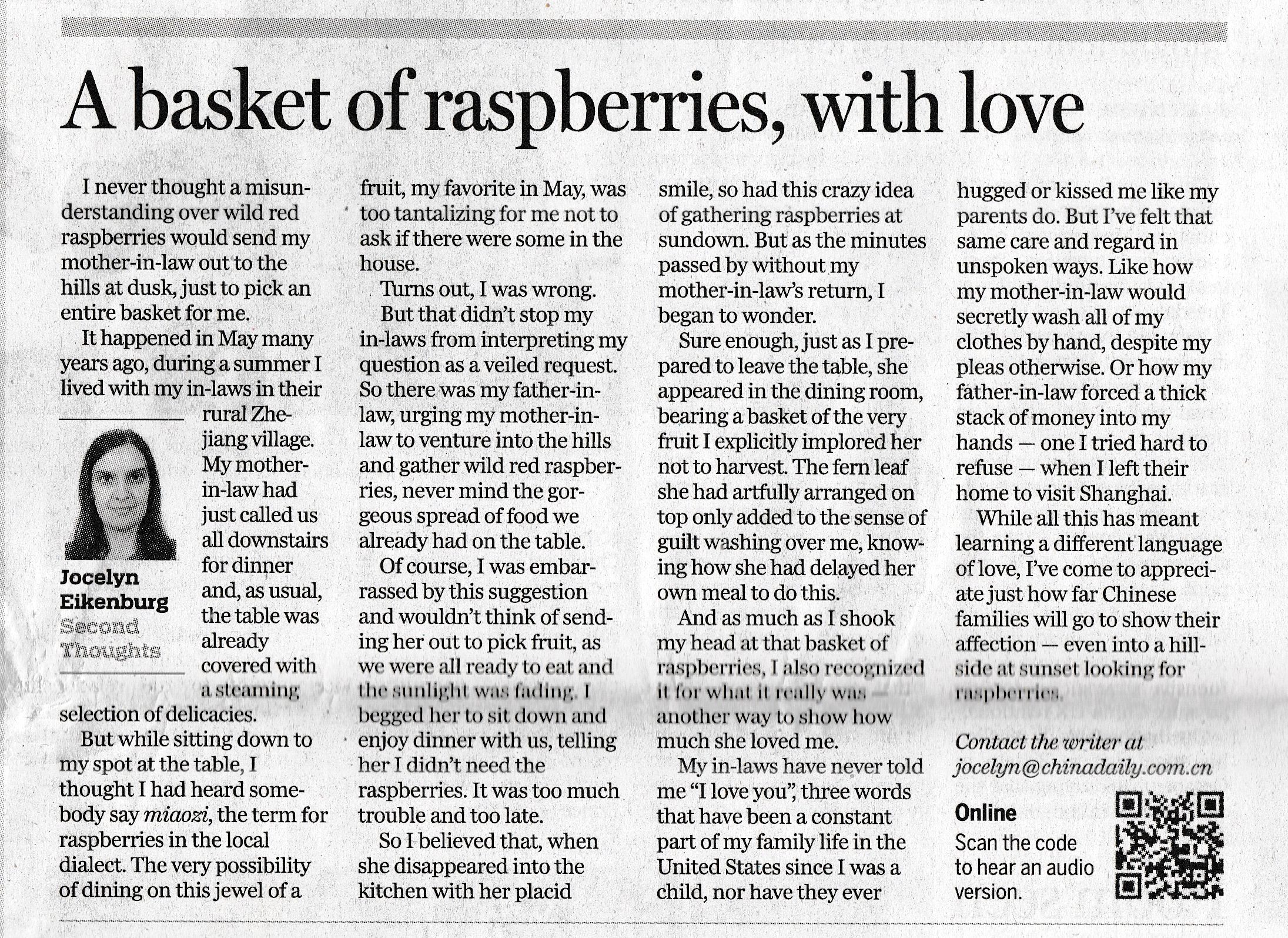
Earlier this month my column appeared in the China Daily — both in the paper and its WeChat account. It’s titled A basket of raspberries, with love and recounts a touching gesture from my mother-in-law when I lived at the family home one summer. Here’s an excerpt:

I never thought a misunderstanding over wild red raspberries would send my mother-in-law out to the hills at dusk, just to pick an entire basket for me.

It happened in May many years ago, during a summer I lived with my in-laws in their rural Zhejiang village. My mother-in-law had just called us all downstairs for dinner and, as usual, the table was already covered with a steaming selection of delicacies.

But while sitting down to my spot at the table, I thought I had heard somebody say miaozi, the term for raspberries in the local dialect. The very possibility of dining on this jewel of a fruit, my favorite in May, was too tantalizing for me not to ask if there were some in the house.

Turns out, I was wrong.

But that didn’t stop my Chinese in-laws from interpreting my question as a veiled request.

You can read the full piece here online. And if you love it, share it!

June’s Magical Yangmei Fruit Brings Thoughts of Love, Family in China – Pub’d on WWAM BAM!

The group blog WWAM BAM! just published my post titled June’s Magical Yangmei Fruit Brings Thoughts of Love, Family in China. Here’s an excerpt from the post:

Nevermind the high humidity. Or the relentless sunshine. Or anyone else who tells me how unbearably hot summers are in China. Who has time to worry about that in June in China, a month that, for me, is inextricably entwined with the arrival of what I consider the country’s most magical fruit – yangmei or Myrica rubra.

If you’ve never bit into the juicy, ruby red goodness that is a yangmei, imagine the world’s most succulent red fruits (like my favorites of cranberry and pomegranate) packed together into one tiny, koosh-ball shaped package. It’s a little bite of ecstasy that will dance across your tastebuds and probably dribble onto the table or your summer clothes, making you look like you indulged in some red wine…but who cares when there’s yangmei on the table?

You can head on over to WWAM BAM! to read the full post. And if you like it, share it!

My 3 Magical Chinese Must-Haves for Surviving Long Flights To/From Asia

As the summer travel season has begun, my friends are already talking about their forthcoming trips to and from Asia. For most of us, this invariably means one thing:

Surviving a very long flight.

Since I’m from the US, I’ve had to endure countless plane trips that lasted anywhere from 11 to 14 hours. And over the years, I’ve encountered a lot of secrets for surviving these trips:

  • I always fly with Gatorade or a similar sports drink like it to stay hydrated onboard and ward off the jetlag (thank you for that advice, Susan Blumberg-Kason!). You can even buy it powdered to pack ahead before your trip. For example, powdered Gatorade is available in the US. In China, I often buy powdered Aptonia sports drink from the Tmall store for Decathlon, which also works great.
  • Also in that vein, I travel with a few empty bottles, which I can fill with water after clearing security and then bring on the plane, to ensure that I drink plenty of fluids and lessen the effects of jetlag.
  • I usually have a pair of disposable slippers (often accumulated from hotel stays in China) to use during the flight for extra comfort when those feet swell during the journey. (Additional tip — last time my husband flew Air China, they passed these out to everyone in economy, so just booking with the right airline can save you the trouble of packing them.)
  • There’s always a stash of ginger candies in my purse to manage nausea or motion sickness. When I’m in the US, I like buying Ginger Candies from the Ginger People.
  • I never forget moisturizer and lip balm, absolutely essential for combatting the dryness in flight.

But I’ve also discovered some additional must-haves for long-haul flights after living in China (and also, in part, thanks to my Chinese husband) — things that, to me, can be magical and life-saving. Here are 3 of my personal favorites:

#1: Feng You Jing Essential Balm Oil (风油精)

Headaches. Nausea. Stuffed nose. Scratchy throat. Any of these could turn a long-haul flight into an extended nightmare. Everyone has their remedies for managing them, but for me, you can’t beat Feng You Jing essential balm oil, known in Chinese as fēngyóujīng (风油精).

Dab it on your forehead to ease headaches. Add a few drops on your temples and under your nose to relieve nausea. Apply a little on your nostrils to help clear your stuffy nose. And yes, if you’ve got a bit of a scratchy throat, rub directly on it and it’s almost as good as having a lozenge.

Plus, it’s also handy for masking unpleasant odors you might encounter in airports or planes (especially if, God forbid, you end up being the unlucky person seated right near the bathrooms).

Every pharmacy in China carries Feng You Jing essential balm oil (fēngyóujīng, 风油精) and you’ll find it on Taobao. But in the US, you can also buy it on Amazon as well.

#2: Chinese Hawthorn Fruit Snacks (山楂卷/糕/片/球)

Chinese hawthorn fruit, known here in China as shānzhā (山楂), is already known for being a magical and healthful fruit that has great cardiovascular and digestive benefits. In particular, it has become a must-have in my home just because of its ability to ease indigestion and nausea — two symptoms that could make anyone miserable en route.

Thankfully, it’s easy to bring Chinese hawthorn fruit on the plane because it’s made into lots of packable snacks here in China. Rollups are my favorite version, but I also like the cakes and even candies, which can all be purchased online (just search Taobao for 山楂) or in any major supermarket in China. In the US, Amazon has a number of possibilities, including these haw flakes.

Another added benefit of bringing Chinese hawthorn fruit candies with you? They’re perfect for easing hunger between meals or connecting flights.

#3: Golden Throat Lozenges (金嗓子喉片)

Any veteran flyer knows just how dry it can be when you’re cruising over 30,000 feet — and that dryness can make for uncomfortable throats. That’s why I always pack throat drops. But far and away, nothing beats the magic of the Chinese brand Golden Throat Lozenges (jīnsǎngzi hóupiàn, 金嗓子喉片). They’re incredibly soothing and effective, and I’ve sworn by them for years. They’re always available at pharmacies across China (ask for jīnsǎngzi hóupiàn, 金嗓子喉片) or on Taobao, but you can also pick them up on Amazon in the US.

What are your magical must-haves for long haul flights?

P.S.: This post contains some affiliate links, where your purchases help support this blog.