“Christmas Is Your Chinese New Year”: On Fascinating Similarities Between the Holidays – Pub’d on WWAM BAM!

The group blog WWAM BAM just published my post “Christmas Is Your Chinese New Year”: On Fascinating Similarities Between the Holidays. Here’s an excerpt from the piece:

Christmas is your Chinese New Year.

I’ve heard this phrase uttered countless times by people in China when the holidays roll around, whether it’s Christmas or Chinese New Year.

And while I used to think the comparison was a bit of a stretch, over the years I’ve recoginzed that Chinese New Year and Christmas share fascinating, and sometimes surprising, commonalities.

Here are the most interesting ones I’ve observed over the years:

Good fortune

While Chinese New Year customs have a more obvious connection to good fortune (such as how red couplets and firecrackers would scare away the evil Nian monster) even Christmas was traditionally about good luck and protection during the darkest time of the year.

To read the full piece, hop on over to WWAM BAM! And if you like it, share it!

Pub’d on China Daily: Homemade festival foods are treasures

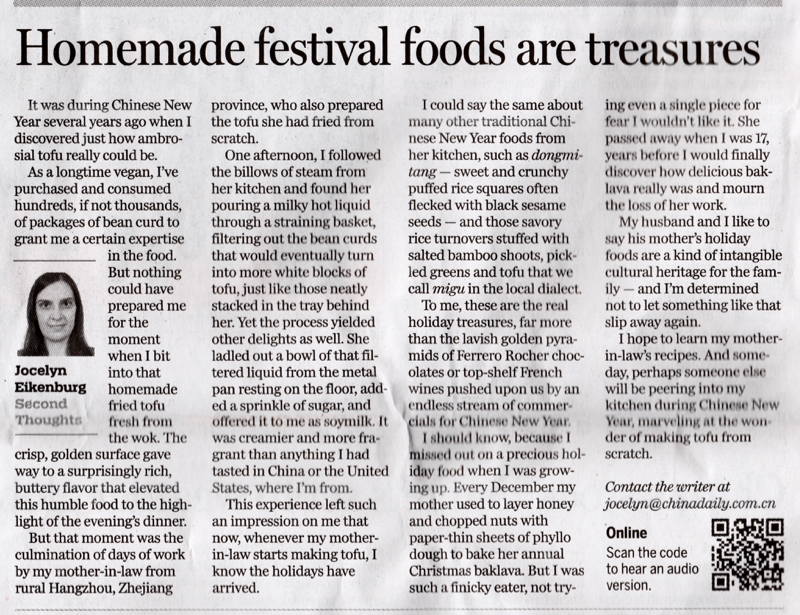
The China Daily just published another column I wrote titled Homemade festival foods are treasures. Here’s an excerpt from the column:

It was during Chinese New Year several years ago when I discovered just how ambrosial tofu really could be.

As a longtime vegan, I’ve purchased and consumed hundreds, if not thousands, of packages of bean curd to grant me a certain expertise in the food. But nothing could have prepared me for the moment when I bit into that homemade fried tofu fresh from the wok. The crisp, golden surface gave way to a surprisingly rich, buttery flavor that elevated this humble food to the highlight of the evening’s dinner.

But that moment was the culmination of days of work by my mother-in-law from rural Hangzhou, who also prepared the tofu she had fried from scratch.

The article was shared on the China Daily WeChat account and has received over 4,000 views as I write this! Here are some of the lovely comments readers have left in response in WeChat:

Many foreigners will enjoy the chinese foods so much as to forget leaving.Chinese food even the same name has dozens of recipies in different areas. Some of them taste sweat in the north,but some of them spicy or salty in the south on tbe contrary. In some places,the recipies are secrets and they are handed down only by families. The author is so lucky to have tried a lot of chinese holiday foods during every year,for nomal people would not get them in the street except special days.By the way,I dont like tofu whatever way it is made of.

Really a good narrative article which combine west culture and east culture into the one that is the love for our great mother and theirs masterpiece homemade food which is not only the treasures for us but also the intangible heritage for our respective families. I also remember the culmination of our spring festival eve is the moment of our feast dinner come into our table l have prepared the tableware for a longtime to enjoy those ambrosial and palatable food really delicious and unforgettable.

You can read the full piece here, which also includes a recording of me reading the article. And if you love it, share it!

When Returning Home for Chinese New Year is Too Painful

A few weeks before Chinese New Year in 2016, I was invited to attend a get-together in Hangzhou for a training company where an acquaintance I’ll call Jian worked. One of the themes of the evening happened to be the holidays, and the leaders called a young man (not Jian) up to the front of the room to ask him about his goals for the coming year.

“So what do you want to bring home for Chinese New Year?” the leader asked him, referring to next year’s festivities.

“Fifty thousand yuan,” said the fellow, who appeared to be in his 20s. He had an ambitious grin that, if it were a power source, could have illuminated the entire room.

I was struck both by the confident determination in his response, and the fact that he desired so much money. The sum of 50,000 yuan was the equivalent of about $7,500 at the time, which actually startled me. As much as I enjoyed a thoroughly middle-class lifestyle growing up in the suburbs of Cleveland, Ohio, USA, I doubted my parents had ever spent anything close to that much on Christmas.

But the topic of money and Chinese New Year surfaced later on over dinner with Jian, who was as much of a high-powered go-getter as the 20-something guy in front of the room. Jian confessed that he once made a promise to himself – if he didn’t hit his income goals for that year, he would not return home to face his family and friends at Chinese New year. He didn’t say so, but it was clear that a failure to “bring home the yuan” would be a huge loss of face.

Clearly, the traditional Chinese saying “money or none, return home for Chinese New Year” (yǒuqián méiqián huíjiā guònián; 有钱没钱回家过年) didn’t apply.

Yet while he was concerned about face, others in China are more concerned with the pressure to give – even if they cannot afford it. Consider this article by Sixth Tone about the growing number of migrant laborers in China giving Chinese New Year in their hometowns a pass, titled Going Home for the Holidays a Hard Sell to Migrant Workers:

“I haven’t returned home for two years,” a villager surnamed Gao in central China’s Hunan province told the newspaper’s reporter. “I didn’t dare go back. In addition to the cost of transportation, visiting my relatives would add up to a few thousand yuan.”

Gao explained that most of this cost stemmed from an obligation to give red envelopes to family members he hardly knows or hasn’t seen in years as a token of goodwill. “I’ve got a lot of relatives back in the village,” he said. “The expenses are bottomless. I’ve thought it through, over and over, and decided not to return.”

It’s alarming that even migrant workers, those earning paltry sums compared to Jian and his colleague, would be expected to dole out money during Chinese New Year that they cannot afford to give.

I too know all too well the pressure that comes along with Chinese New Year. A few years ago, I wrote “What will they think?” The fear of being seen as a failure before family at Chinese New Year and noted:

The other night, I suddenly burst out in tears over what might probably be the silliest of all things – the fact that Chinese New Year was fast approaching, and I was really afraid of spending it with the family. …

Deep down, I know it was all about face, our own mianzi. That I thought if only we had a car – even if it was a borrowed one – it would somehow make up for everything else about our lives that seems totally imperfect or open to family criticism. Like how we don’t have kids (and everyone keeps bugging us about it). Or how we don’t own an apartment or a car (unlike all of John’s relatives his own age). Or even the fact that we live in a tiny apartment. Having a car would somehow prove our “worthiness” before everyone else in the family. …

Chinese New Year is one of those times when it seems like everyone in the family makes it their business to tell you what they think about your life – whether it’s your marital status, whether you have kids, or even your own possessions. And even when people don’t say anything, sometimes just being the one who “sticks out” of the crowd – like, say, the only thirty-something couple in the family that doesn’t have a home, car, lots of money, and kids – can make you feel truly like the odd one out. As if you don’t belong (and, perhaps, never will).

And while I didn’t mention it specifically in that post, I’ve known the financial pressure too (for ongoing reasons longtime readers are well aware of).

I’ve also asked, in regards to Chinese New Year, Is The Family Pressure in China Too Much?, where I related the story of a relative whose business failed in its first year, wondering if that was the reason we didn’t see him during the holidays. I wrote:

From time to time, I hear stories about people like this – people who refuse to return home for the holidays, sometimes for years. People who just cannot face the family, because their lives don’t look like what others would consider “success” or “normal”. Sometimes it’s because they’re down on their luck in business or employment, like the guy I mentioned. Sometimes it’s because they’re not married yet.

Whatever the case, they have enough stress in their lives – and could do without the additional stress from their families during the holidays. They don’t want to be compared to so-and-so, who just bought a new BMW or apartment in Shanghai. They don’t want to be told that, say, they’re getting too old for marriage or kids.

While it’s normal for parents to worry about their kids, sometimes I wonder, is the pressure here too much? Is there too much of an expectation for people to conform to a narrow societal norm? Is there too much pressure for people to be “successful”?

Is that why my husband’s relative didn’t come back?

What do you think? Have you known people who refused to return home for Chinese New Year for monetary or “face” reasons? Or have you breathed a sigh of relief over not needing to return to your hometown for Chinese New Year?

What are YOU looking forward to most for Chinese New Year? – Pub’d on WWAM BAM

The blog WWAM BAM! just published a group post titled What are YOU looking forward to most for Chinese New Year?, and it includes a contribution from me. Here’s what I wrote:

This is my first Chinese New Year ever in Beijing, and there’s something thrilling about living in a city that has these larger-than-life historical monuments, particularly during the holidays. My husband and I always traditionally include worship as part of our Chinese New Year customs – usually paying respects to ancestors, but also visiting temples when we have the opportunity. But this year, we can follow in the footsteps of past emperors in Beijing and pray at the Temple of Heaven.

I’m also psyched about food. Since I’m on duty during the holiday, we won’t have a lot of time to prepare. But we’re going to order out jiaozi dumplings from one of my favorite restaurants in town, Xian Lao Man (which happens to have quite a few vegan-friendly options). We’ll also prepare a couple of our own dishes – a fancy tofu stir-fry for me, and a spicy stir-fried fish for Jun.

Finally, as a huge fan of the Olympics, I’m looking forward to all of the outstanding holiday programming provided by the international sporting event.

Happy Chinese New Year!

To find out what the other 6 contributors are looking forward to during Chinese New Year, read What are YOU looking forward to most for Chinese New Year? And if you like it, share it!

On Love, Beijing and My Nostalgia for Hotel Counters With World Maps

I felt a curious flutter of recognition during an evening walk in my Beijing neighborhood, when my eyes fell upon the reception desk at a hotel just around the corner.

There it was, a world map on the wall behind the desk, pinpointing the major cities of New York, London, Moscow and Beijing in a bronze and black montage that must have been more fashionable when bicycles ruled Beijing years ago.

Even though each metropolitan area displayed the current time, I was thinking of the past – my own in Beijing, a city that was once a romantic getaway for me and my first Chinese boyfriend in the country. A trip where we visited many hotels, whose reception desks were a close replica of the one I saw on my walk.

When I see the local times in Moscow and Beijing flashing across that map, I remember that long, drawn-out afternoon in Beijing when we were faced with one hotel after another, following our overnight journey to Beijing from Zhengzhou, which took nine hours at the time.

Why did we visit so many hotels in just one day? We were determined to find a hotel room we could share together, which seemed mission impossible because every hotel asked for a marriage license we couldn’t produce. With no license, we were forced to visit many lobbies, each fitted with a variation on that world map dotted with local times around the world.

My Chinese boyfriend at the time (who parted with months later) had once traveled to Beijing with a past girlfriend who was from his city, and never had difficulty finding a room for two. How had my foreign face changed the equation? Did they think I was Russian (and not necessarily in a good way)?

It should have taken us only an hour, two max, to get settled into a hotel. Instead, we spent over six hours – eventually settling in a state-owned guesthouse in the Haidian district. With, of course, a world map behind the reception counter.

And the funny thing is, after all these years, whenever I see a reception desk like those we encountered years ago in Beijing, a feeling of nostalgia rises within me. Is it a recognition of the fact that, in a sense, love prevailed in Beijing, in spite of the challenges?

All I know is, it’s fascinating to be back in the great capital of Beijing, this time in love for life — with a husband who still thrills me every single day, and in a country I’m proud to call home.

25 More Stunning Photos of Western Women & Asian Men Who Got Married or Engaged (The January 2018 Edition) – Pub’d on WWAM BAM

The group blog WWAM BAM just published 25 More Stunning Photos of Western Women & Asian Men Who Got Married or Engaged (The January 2018 Edition).

It’s my latest edition of the highly popular series of 25 Stunning Photos of Western Women & Asian Men Who Got Married or Engaged. (I first unveiled the project in April 2017 and followed up with another round in June 2017.)

Here’s an excerpt from the post:

Kristel Ouwehand is an artist from Canada married to a Tibetan man, and she started a nonprofit art and culture school together with him in Labrang (Xiahe), Gansu province of western China. Kristel’s school is in danger of closing by March 1, 2018. You can learn more and help support them at www.snowlandart.org, their GoFundMe site, the school’s Facebook page, and their Instagram page.

To see the other 24 photos, head on over to WWAM BAM to read 25 More Stunning Photos of Western Women & Asian Men Who Got Married or Engaged (The January 2018 Edition).

Photo Essay: Walking Beijing’s Gubeikou Great Wall as a Couple

Beijing’s Great Wall is a wonder of the world — and even more so, when you find yourself hiking this piece of history under breathtaking blue skies, bathed in sunshine that could almost make you forget it’s still winter.

We ventured a few hours north of the city to the Gubeikou Great Wall, where the wall has more of a dilapidated charm and — at least this time of year — you can walk it all to yourself. While I’m recovering from a busy week, I thought I’d share a collection of photos from our recent visit.

We arrived in the afternoon, and hiked up to the Great Wall, tracing the ridgetops of the mountains.

Some parts, the walk is just like a ridge trail…

And in other parts, you’re passing by the actual walls and even towers.

Through the window, the mountains in the countryside form an endless wave of ridges that stretch to the horizon.

Behind Jun, another view of the Great Wall, stretched across the ridgetop.

But the best part of all was walking the Great Wall together. We hope to return soon and discover more of the wonders of this incredible piece of history.

Pub’d on China Daily: Christmas tree stays for Spring Festival

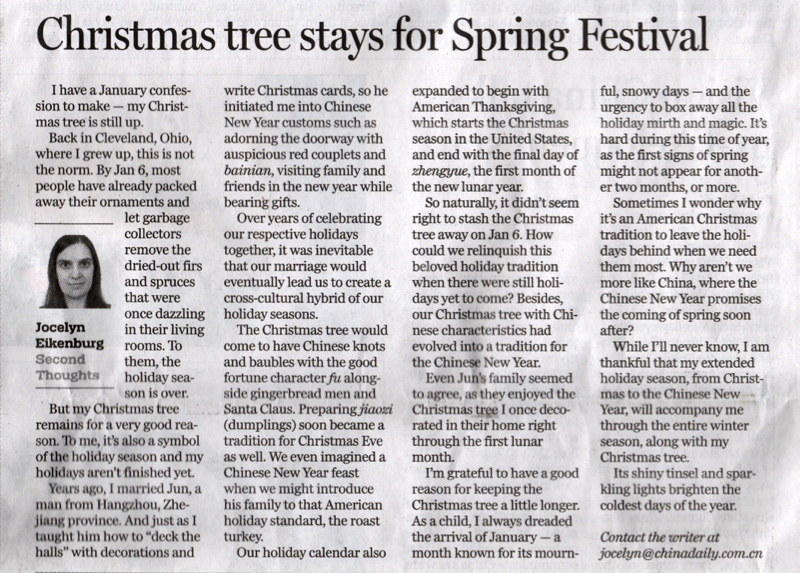
China Daily just published another one of my columns in their newspaper today — it’s titled Christmas tree stays for Spring Festival. Here’s an excerpt:

I have a January confession to make – my Christmas tree is still up.

Back in Cleveland, Ohio, where I grew up, this is not the norm. By Jan 6, most people have already packed away their ornaments and let garbage collectors remove the dried-out firs and spruces that were once dazzling in their living rooms. To them, the holiday season is over.

But my Christmas tree remains for a very good reason. To me, it’s also a symbol of the holiday season and my holidays aren’t finished yet.

You can read the full piece here. And if you like it, share it!

Phoenix News Weighs in on Why so Few White Women Date Chinese Men – and It’s Awful

Many of us have wondered why it is you see so many white men with Chinese women, and not white women with Chinese men. Call it the AMWF question if you will.

But if we’re going to talk about this, you’d hope for an insightful conversation.

And “insightful” is not how I would describe this piece from Phoenix News, the Chinese media outlet owned by Rupert Murdoch. Maybe we shouldn’t have expected much, given that Phoenix owes its existence to the same man who created Fox News.

The following is my English translation of the the original piece in Chinese, which is rife with overgeneralizations, stereotypes and worse:

In life, sometimes we across some beautiful mixed-race babies. Thick eyebrows. Big eyes. There are some whose hair is even golden.

Their mothers are usually Chinese and the fathers are foreigners.

For a minority of these babies, the fathers are Chinese and the mothers are foreigners, but this is also true a tiny fraction of the time.

Why is it that there are so few foreign women who look for Chinese men? In this case, the foreign women we speak of normally are white European American women.

Among Asian countries such as Japan and South Korea, there are quite a few women who want to marry Chinese men. Add to that in recent years the fact that rural Chinese men getting mail-order brides from Vietnam is a common occurrence.

So why is it that so few white European American women will go for Chinese men?

Originally, in current Chinese society, even though there is already equality between men and women, there are always some men who still have a certain male chauvinism and don’t respect women.

But the vast majority of foreign women are more independent, so [relationships between foreign women and Chinese men] are destined not to happen.

In addition, Chinese men are often quite reserved. Many Chinese men are quite low-key and conservative when it comes to relationships. They believe only dull [expressions] are genuine.

But almost all foreign women prefer a romantic and exciting life.

Our culture and ways of thinking are different, so naturally foreign women and Chinese men cannot live together.

Besides all of this, the aesthetic sensibilities of foreign women are different from Chinese women.

With all the blue-eyed and blonde men with tall noses that they’re accustomed to in their surroundings, when these foreign women suddenly look upon the typical Asian faces of Chinese men, it’s unavoidable that there will be some who are blind to these faces.

Plus, the average build of Chinese men doesn’t appear nearly as strong as that of foreign men, who have eaten beef since they were young. And foreign women care more about a man’s healthy physique.

So they will rarely choose to marry Chinese men.

In addition, there are issues in terms of religion and beliefs as well as living habits, but these reasons are not that important.

After all, love knows no borders.

You know, you’ve got to hand it to Phoenix for ending the piece on such a conciliatory note – as if “love knows no borders” could somehow excuse the rest of this piece that’s far beyond cringeworthy.

Phoenix News, do us all a favor and stop writing about why so few white women date Chinese men. Please.

Meanwhile, while my thoughts are not the last word on the rarity of AMWF couples, if you are interested you might enjoy On the Rarity of Foreign Women and Chinese Boyfriends/Chinese Husbands and Why Won’t Western Women Date Chinese Men?

7 Great Chinese New Year Gifts Sure to Impress Friends, Family and Coworkers

The new year may be upon us — but in China, there’s another one just around the corner. Chinese New Year, of course!

Chinese New Year is also a time for giving gifts, especially when it comes to the tradition of bainian, where you visit friends and family bearing gifts known as nianhuo or Chinese New Year goods.

What makes a good gift for Chinese New Year? While I have a list of suggestions below, here’s my bottom line for Chinese New Year gifts. Always go for quality and don’t forget to get it wrapped and/or in a gift box.

The good news is, there are plenty of quality Chinese New Year gifts available, and if you purchase in China, most goods on sale usually come all boxed up, often in auspicious red and gold packaging. All you need to do is buy and give, it’s that simple!

So here are my 7 suggestions for great Chinese New Year gifts:
Money

#7: Hongbao (red envelopes)

Children all across China eagerly await Chinese New Year for a lot of reasons, including the many hongbao (red envelopes) they’ll receive, filled with auspicious amounts of money, as the World of Chinese notes:

If you’re stuffing it with hundreds, go for even numbers for good luck: 200, 600, or 800. Don’t hand out bad luck with a gift of 400, or anything with the number four, the unluckiest of all numbers. Instead, stick to ones, fives, and, best of all, eights.

So if there happen to be kids with the people you’re visiting, don’t forget to give each of them a hongbao as a Chinese New Year gift!

Hongbao are also terrific for those in your employment, such as an ayi who might clean your home or care for your children. Think of it as a year-end bonus for the hard work they’ve done.

But hongbao can sometimes be tricky as a Chinese New Year gift, as “traditional red envelopes have often been used as a vehicle for, ahem, bribes.” When in doubt, consult your Chinese friends or colleagues — or, better still, consider my other suggestions for Chinese New Year gifts.

#6: Tea

As I wrote a few years back in my post The Top 6 Gifts Sure to Please Your Chinese Family:

Say what you want about China’s national hot beverage. It really makes one fantastic gift….

What home in China doesn’t have a top-shelf box of tea (or even two), ready and waiting to entertain guests? Plus, everyone…loves drinking it.

But if you’re going to give tea as a gift, be prepared to pay top money for it. Most Chinese can taste the difference between the expensive, high-grade varieties (which are great gifts) versus the cheaper average teas (which you should never buy for anyone but yourself).

I wouldn’t buy tea online. Your best bet is to find a high-end tea shop in your vicinity and try the teas before purchasing this for Chinese New Year gifts.

#5: Nuts and dried fruits

No Chinese New Year is complete without the requisite hours of lazing around with friends and family, snacking on everything from walnuts and pecans to dates and raisins. They also make outstanding Chinese New Year gifts.

Nuts: Here in China, I’ve seen walnuts, pecans, hickory nuts, macadamia nuts, almonds, pine nuts, sunflower seeds and chestnuts given as gifts. You’ll even encounter Chinese New Year gift boxes that offer an assortment of nuts, nicely packaged up and ready to give someone you know or love.

Dried fruits: Dried jujube dates are always excellent Chinese New Year gifts because the name sounds auspicious. Dates are known as zǎo (枣), and the name sounds like the character zǎo (早) in the phrase 早来福到 (zǎoláifúdào), which means good fortune comes early. So if you bring dried jujube dates, it symbolizes your hope the recipient will enjoy good fortune soon. While there are lots of varieties of dates available, I happen to love the large Xinjiang dates, which you can always find online on Amazon and in China on Taobao, including the Tmall Supermarket, and usually at your local supermarket.

Raisins from Xinjiang (particularly the Turfan region) are also a special treat to send someone during Chinese New Year, and are incredibly delicious. Amazon has them. If you’re in China, check Taobao, including the Tmall Supermarket, to buy online. Your local supermarket may also have some available.

Or,  if you can’t decide on dried fruits or nuts, consider buying them this ingenious Chinese creation — dried jujube dates stuffed with walnuts. They are so heavenly they’ve become my favorite snack, and your recipient will love them because they combine two of the most nutritious winter foods together in one convenient bite-sized morsel.

#4: Chocolates, candies and cookies

Sweets — including chocolates, candies and even cookies — have become as ubiquitous as the standard nuts, dried fruits and fresh fruits you see at homes during Chinese New Year. Even I can’t resist, often stopping by the candy plate to devour a small chocolate — or two.

If you’re going to give chocolates for Chinese New Year gifts, I recommend imported brands such as Ferrero Rocher (their traditional chocolate hazelnut candies wrapped in gold foil are always a festive addition at Chinese New Year), Dove, Hershey’s or even Godiva. You can find all of these online at Taobao or Amazon, most at Tmall Supermarket, and also many at your local supermarket.

Imported cookies in gorgeous gift tins, such as Danish butter cookies, are also a good choice for Chinese New Year. Besides Amazon, buy them in China at your supermarket or online at Taobao’s Tmall.

And if you’re shopping from abroad, Gift Baskets Overseas offers gift baskets with chocolates, candies and/or cookies that you can send to most cities in China.

#3: Traditional herbal remedies and vitamins

There’s a saying in Chinese — dōnglìng jìnbŭ (冬令进补), which refers to how winter is a season for increasing your nutrition with a good tonic or medicinal herbs/foods. So naturally, these have also become popular Chinese New Year gifts, particularly for people over 50.

You’ll encounter lots of possible herbal remedies and foods in China, many related to traditional Chinese medicine. But sometimes even I find the selection overwhelming! Personally, I like to stick with the ones I know and recognize. For example, ginseng is something I’ve bought for family members with great success, and it’s available on Taobao. And if I’m in the US, I love to stock up on American ginseng, prized for its medicinal and nutritional qualities, to give as gifts, including during Chinese New Year. You can buy American ginseng on Amazon.

Vitamins are the “modern version” of these traditional health foods, and can also make wonderful Chinese New Year gifts if your recipients would use them. I’ve found that people living in cities tend to be more open to taking vitamins, compared to those living in rural areas — but it’s always good to ask ahead of time. Foreign brands make a better impression, so I try to buy overseas as much as I can (including on sites like Amazon). That said, you can still buy in China. Besides foreign brands, one option is By-Health (汤臣陪建), available online and in most supermarkets.

#2: Wines and spirits

Ganbei (“empty glasses” in Chinese) is the equivalent of “cheers” you’re sure to hear around the table during Chinese New Year, as people toast each other, usually with wine or spirits. It’s no wonder these make terrific gifts for Chinese New Year.

One option is top-shelf baijiu, such as Moutai or Wuliangye, especially if your recipient is a fan of China’s most fiery liquor.

But because I’m a foreigner who knows next to nothing about baijiu, I prefer to give imported wines, usually red (since red is the lucky color for Chinese New Year). Wine from France is highly cherished among the Chinese, so French red wine is an excellent choice. If it’s in your budget, French champagne is also sure to impress for Chinese New Year. But generally speaking, any quality imported wine will be a welcome addition to the Chinese New Year table.

In China, you can purchase baijiu either online or at your local supermarket or wine and cigarette store. If you’re not bringing your wine from abroad, you’ll find excellent options available online on Taobao, including the Tmall Supermarket; you can also shop your local supermarket for imported wine too, though you may be more limited in options.

If you’d like to send wine over to China, one option is Gift Baskets Overseas, which has a number of gift baskets available that include wine and spirits.

#1: Fruit and fruit baskets

If you’re still totally stumped on what Chinese New Year gifts to buy, please repeat after me: fruit!

As Huan Hsu, author of The Porcelain Thief, once wrote, “Fruit is China’s apple pie.” Chinese people treasure fine fruit because it’s often what’s for dessert, and always a favorite to snack on anytime during Chinese New Year. You’re sure to endear yourself with any host in China if you show up with, say, boxes of Xinjiang Aksu sweetheart apples (冰糖心苹果), or even a fruit basket loaded with everything from sugary mandarins and crisp fresh dates to fragrant pomelos and tangy kiwis.

Where you can purchase fruit? If you’re based in China, there are lots of great deals on boxed fruit on Taobao (including the Tmall Supermarket, which offers next-day delivery in most major cities in China). You can also visit your supermarket or neighborhood fruit store, where you can purchase not only boxed fruit but also fruit baskets.

If you’re based overseas and buying for someone in your country, Amazon has a lot of great fruit basket options.

But if you would like to send fruit baskets to China from abroad for Chinese New Year, Gift Baskets Overseas is a reliable option.

You can learn more about fruit baskets through my post 4 Tips for Giving Gift Baskets in China.

P.S.: Still want more advice on giving gifts in China or for Chinese New Year? Don’t miss my most popular post on gifts, Giving Gifts to your Chinese family – A Modest Guide, or The Top 6 Gifts Sure to Please Your Chinese Family. And if you’re buying from abroad, you might also enjoy my post Gifts to Buy Abroad for Chinese Family and Relatives.