Why Your Chinese Family Wants You to Have a Wedding Banquet (Even if You Don’t)

When a friend told me she didn’t want to have a big wedding banquet in China, I could totally understand why.

After all, I’m the one who wrote about Why I Don’t Like Going to Wedding Banquets in China. I still have a “just say no” policy when it comes to Chinese wedding invitations. Just the mere suggestion of a wedding in China fills me with dread. The last thing I need is more non-vegan food I can’t eat, a room polluted with noxious secondhand smoke, and a raucous atmosphere that will leave me unsettled for the rest of the night.

In short, a good book at home beats a wedding banquet in China any day for me.

And to be sure, there was a time when I once hoped that my own wedding ceremony in China would have been different. Smaller. More intimate. Vegan food. A strict smoking ban. I envisioned this glorious countryside wedding at the family home, a delightful ceremony closer to nature and tradition than anything I’d seen in the cities.

Well, it didn’t happen that way.

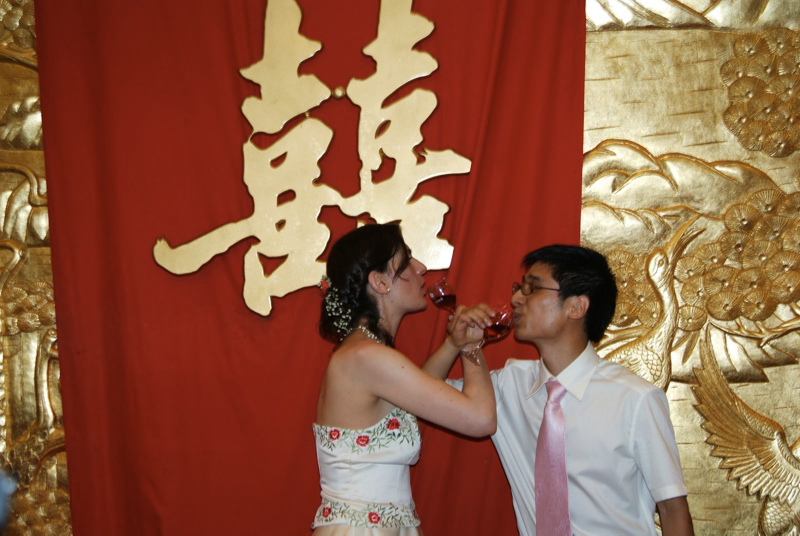
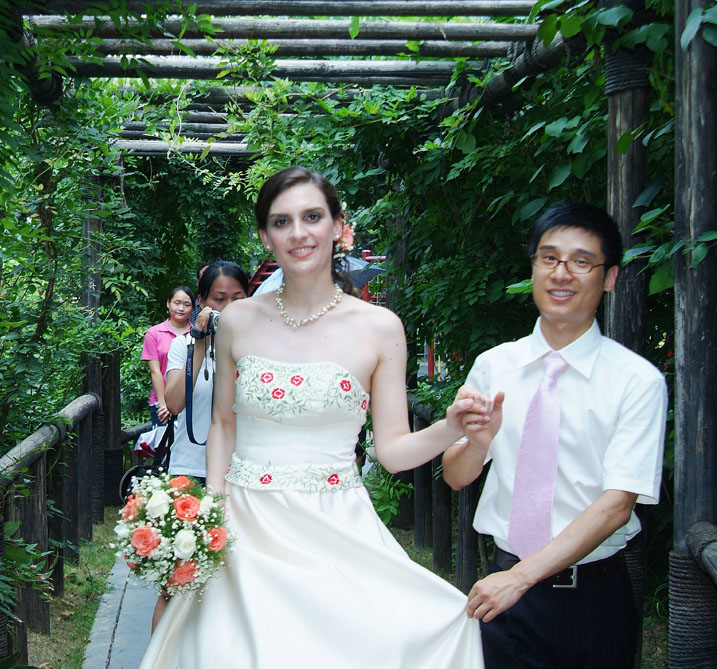
Instead, I got a big, red banquet in a hotel with more than 150 guests in attendance. The only vegan dishes were prepared for me, on the side. And as for that smoking ban, as much as we tried enforcing it, it was kind of laughable when there were free cigarettes at every setting (typical for most wedding banquets in China).

In fairness to the family here, I should be clear about one thing – I was enormously grateful for the wedding banquet for a number of reasons.

Having a wedding in the US was pretty much an impossibility for my husband and me. So if we hadn’t had the ceremony in China, we wouldn’t have had anything at all. Furthermore, they shouldered all the costs of the wedding, which was incredibly generous of them. And in the process of planning the banquet, they allowed me and my husband to make a lot of decisions. We chose the décor for the stage/backdrop. We organized the karaoke afterparty. We decided on the flowers. We specifically requested those candid photos shot during the event. We even planned to let me sing “our song” during the ceremony (which would have happened, had I not lost my voice). In short, we were given a lot of leeway to lend a personal touch to the event.

But yes, if I had planned it all according to my wishes, like brides in America do, I would have had a completely different wedding banquet altogether. (And nobody would have gotten those free cigarettes at the table!)

It was my husband who helped me understand the reality in China – that wedding banquets matter not just to the bride and groom, but to the entire family. As I wrote in Why Your Chinese Wedding Ceremony Will Always Be Big, Fat and Loud:

You can think of Chinese weddings literally as a family affair — a sort of public face that impacts the entire family, beyond you and your groom. And for Chinese families, good face comes from putting on the biggest, fattest, loudest possible affair. Reputation is everything here! After all no one wants guests to remember them as, say, the family who put on that small and pathetic little wedding banquet, or the family who served crappy food or booze. You get the point.

It’s no wonder, then, that often your fiancee’s parents and the rest of the family will have a hand in some, if not most, of the planning of that Chinese wedding ceremony. John’s family sure did.

There’s also another important reason why the wedding banquet must go on – because many families don’t consider you married without it.

Even though my husband and I registered our marriage years before our wedding banquet, the family didn’t consider us married until we, as the Chinese say, had our “happiness wine”.

So yes, your Chinese family wants and expects a wedding banquet. While there are probably lots of things you can have a say on – from the flowers to the décor to even your photographers – the actual wedding banquet isn’t one of them. Not even close.

But I say, if you’ve got to do it, embrace the experience. And believe me, there are benefits to getting married over here. How about having more than one dress in your ceremony? Or getting your hair and makeup redone several times during the event? Or even having those stunning wedding/engagement photos done? Trust me, there’s lots of potential to enjoy the whole “princess” treatment here.

As for me, I don’t regret the way my wedding banquet turned out. Maybe it wasn’t the “perfect day” I imagined long ago, but that’s OK. After all, my husband and I honeymooned in that magical island of Bali.

Yeah, you can envy me now. 😉
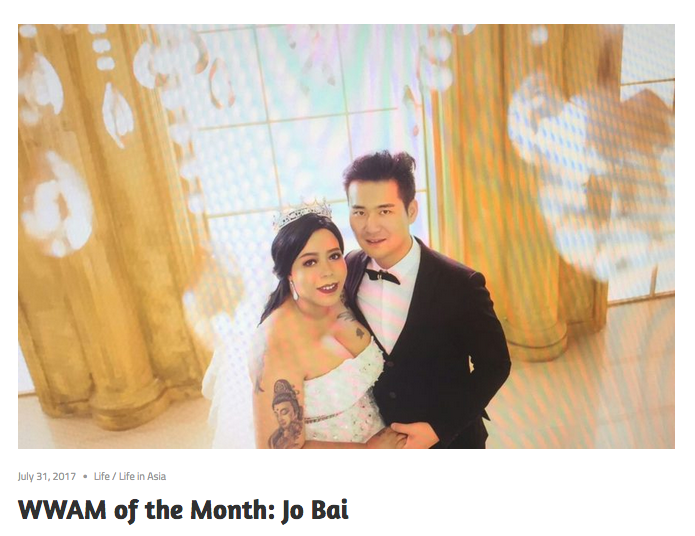
WWAM of the Month: Jo Bai – Pub’d on WWAM BAM

My interview with Jo Bai, the fabulous blogger at Life Behind the Wall, was just published on WWAM BAM! Here’s the introduction to the interview:

If you asked me to name some of the most influential and inspiring bloggers I’ve met in China, I’d count Jo Bai among them. She’s the voice behind the popular blog Life Behind the Wall, where she’s written about everything from Chinese culture and dating to things China newbies do incorrectly. But I also admire her for her entrepreneurial spirit (she launched her own online clothing business Heilan Fashions) and willingness to take risks in the name of living out her dreams.

We sat down with Jo Bai to learn more about how she’s making great things happen in China, what it takes to make a WWAM relationship work, and more.

To learn more about Jo Bai (and see stunning photos of her and her husband Jet) head on over to WWAM BAM to read the full article.

P.S.: Are you a part of the WWAM (Western women & Asian men) community? Would you like to be featured as our WWAM of the month? We’re always on the lookout for outstanding women and men to feature in this column. If you’d like us to spotlight you through an interview, send an e-mail to [email protected]

We Really Need To Talk About Repatriation – Pub’d on WWAM BAM

The group blog WWAM BAM just published my post titled We Really Need To Talk About Repatriation. For those of you who don’t know, repatriation is when you return to your country of citizenship after living abroad. Here’s an excerpt from the post:

…I’ve witnessed a number of bloggers over the years who struggle to write after repatriation. For some, their blogs go silent, as mine did after moving to America. Others might grapple with writer’s block and a host of other foes determined to keep them from putting their thoughts down.

But the bottom line is, when you’ve started to blog from a foreign country and you move back to your own country, there’s a good chance you might find it tough to blog.

Head on over to WWAM BAM to read We Really Need To Talk About Repatriation. And if you love it, share it!

I’m in Awe of How My Husband Eats Fish With Bones, Unshelled Sunflower Seeds & More

(Photo by Alpha via https://www.flickr.com/photos/avlxyz/3225213462)

Whenever my husband and I happen to be back at the family home in rural Hangzhou, China, you can almost guarantee there’s fish for dinner, prepared just how my husband likes it. His mom stews the whole fish with ginger, garlic, soy sauce, hot chili peppers and Shaoxing wine, and finishes it with a sprinkle of fragrant green onion.

And if there’s fish on the table, you’ll also find something else next to my husband’s rice bowl – a neat little pile of fish bones. No, he didn’t pull the bones out first and then eat the fish. He sorted the meat from the bones with his mouth, something that amazes me to no end.

Of course, it’s not just fish with bones. I have a similar sense of awe for the way he deftly devours unshelled sunflower seeds. By the time I’ve clumsily cracked open one of them and spilled out the seed, he has easily consumed three or four of them.

I’ve also witnessed his mouth do other extraordinary things at the table, including removing the rough skin from Chinese jujube dates after chewing on them and separating the rough fibers from celery. Every time he does something like this, I’m filled with wonder, thinking, “How does he do it?”

But then again, I feel the same way about the rest of his family, whose dinner table socialization included a how-to on managing some challenging comestibles.

In the America I grew up in, the kind of fish my husband’s family serves up – from head to tail – was never on the menu. I wanted my fish batter fried and served with a heaping side of French fries and hush puppies, just like those greasy fast seafood dinners. No muss, no fuss and no bones. I was so picky on this point that I even shunned my dad’s favorite fish snack – kipper snacks – because of the bones.

This ethos – that food should be as convenient as possible – applied to much of what I ate. It wasn’t just bones I didn’t care for (which turned me off chicken wings and ribs). Unshelled seeds and nuts were a no-go as well. I even got fussy about fruit when it had seeds inside; I would rather pick the watermelon seeds out of my slice first, rather than burden my mouth with the task of spitting them out.

Looking back, though, I now wonder if I missed out on something critical. Would I have enjoyed food much more if someone had schooled me in the many ingenious ways for eating challenging things? Would I have been more adventurous as a child and more willing to try new things?

As an adult, I’ve been playing catch up on that score. I now happily devour watermelon and oranges with seeds. I’ve learned it’s not so hard to eat unshelled nuts and seeds with a little practice (and, sometimes, patience).

But as for bones, I’ll never have the chance to exercise my mouth in that regard. I’m a vegan after all. And as much as I’ll always admire my husband’s ability to process those bones in his mouth, a part of me is relieved I’m exempt. What can I say? I’m still a little picky at heart – and still don’t like bones. 😉

3 Things People Wrongly Assume I Learned From My Chinese Husband

When you happen to be an American woman married to a Chinese man, people make certain assumptions – and sometimes they get it totally wrong. Here are three things people wrongly assume I learned from my Chinese husband.

(Photo by Kevin Dooley via Flickr: https://www.flickr.com/photos/pagedooley/2033195014)

#1: Mandarin Chinese

Whenever folks in China hear me utter a few words in the language of the land – and also discover I’m married to one of their own – they frequently assume my husband was also the primary individual who taught me Mandarin.

Not exactly.

While my husband did school me in a multitude of useful phrases and expressions in Mandarin Chinese, he’s can’t take credit for my basic fluency. By the time we met each other, we could easily converse in English and Chinese about your average everyday topics (thanks to two incredible tutors I had in China). It’s a tradition that still continues to this day.

Personally, I’ve also experienced firsthand just how difficult, if not impossible, it is to turn your lover into your language tutor (see Why It’s a Really Bad Idea to Teach Your Spouse Your Language). I’ve also discovered there’s a curious relationship between the language you use with someone when you’re falling in love and the language (or languages) you choose to communicate in (see The Relationship Between Language and Falling in Love).

While I’ve yet to meet a single couple where one person taught the other their language, I stand by what I wrote before: “…if you insist that spouses should teach each other a language, then I suggest sticking only to the most universal language of all – love.”

#2: How to Use Chopsticks

I wouldn’t call myself the most accomplished person when it comes to holding chopsticks. In fact, I’m pretty sure that my technique looks clumsy at times. I tend to hold mine in the middle, more novice than expert.

Still, since I eat almost every meal with the eating utensil of choice in China – including at parties and social gatherings – it’s not uncommon for a new friend or acquaintance to come to a simple conclusion after observing me. That my Chinese husband must have shown me how to use them.

Except, they’d be wrong on that count too.

I’ve used chopsticks ever since I was a teen, a time when my sister and mother were both fond of Chinese cuisine and introduced me to many new dishes, along with the preferred utensils in China. We always kept a stash of bamboo chopsticks along with our cutlery, ready for whenever we happened to dine on Chinese food for dinner. It was my closest family who observed my first blunders with chopsticks.

Plus, I lived over two years in China before Jun and I started dating – two years where I was expected to use chopsticks in almost every restaurant, stall and dive I ever dined in. Trust me, when you’re hungry you figure out pretty fast what it takes to down a meal with these utensils. 😉

By 迷花不事君 – http://cc.nphoto.net/view/2008/10424.shtml, CC BY-SA 2.5 cn, https://commons.wikimedia.org/w/index.php?curid=6520398

#3: Tai Chi Chuan

When Jun and I used to live in America, practicing a little Tai Chi was one of my favorite relaxation habits. My technique was even uglier than the way I hold chopsticks; some of my old Tai Chi teachers would surely have cringed if they saw me. But it was fun nevertheless and a wonderful way to alleviate the worries of the moment.

However, when my fellow Americans learned I could do some Tai Chi, people automatically assumed there was only one person responsible – my Chinese husband.

Not really!

While there are many things I have learned from Jun when it comes to Chinese culture, Tai Chi isn’t one of them. I actually studied with teachers in America and China (including a retiree of the People’s Liberation Army who would only instruct me at the crack of dawn).

And why should my husband have to be my teacher? The idea that everyone Chinese knows martial arts and related practices (such as Tai Chi) is an old stereotype that dies hard.

Still, I’m glad that my love of Tai Chi isn’t lost on Jun. He’s actually learning some moves (thankfully, not from me because my form is terrible!) – and someday, I’m sure we’ll practice together. 😉

My Husband Puts Hot Sauce on Everything – and I Think It’s Fantastic

(By [http://www.flickr.com/photos/snips/etoile] – Flickr, CC BY 2.0, https://commons.wikimedia.org/w/index.php?curid=1225603)
There’s one condiment you’re sure to find on my dinner table: Lee Kum Kee’s Chinese-style hot sauce.

In fact, it’s not just one but two sauces you’ll notice sitting next to our bowls and dishes. One is the extra-spicy fragrant hot sauce, heavy with chili oil and the pungent smell of chili, and the other a milder garlic chili sauce perfect for noodles and hot pot.

At any given meal, you’ll see my husband add dabs of hot sauce to his rice or soup or even noodles. You’ll also hear him utter a delighted “mmmmmm” every time the peppery flavors dance across his tongue. After all, he once confessed that while he could happily go without meat, the same couldn’t be said for hot sauce.

Meanwhile, he’s married to me, a woman who can’t even remember the last time she tasted anything remotely spicy. A woman who was forced to quit even the mildest peppers last year after having her appendix removed. It’s been over a year since that surgery, but I still haven’t found the courage to test my stomach with hot sauce. Not yet. I eye my husband’s favorite condiments with a mixture of curiosity and fear, and for now prefer to have only garlic, ginger, sea salt and soy sauce as my flavorings of choice.

But I’m happy with this arrangement. I’m grateful that my husband’s deepest longings for spicy food are satisfied with these two simple condiments. I’m glad that what could have been a great disagreement about what to eat has now become a moot point, thanks to the presence of two small bottles courtesy of Lee Kum Kee.

Jun was born with a penchant for hot peppers. My husband grew up in a region of Zhejiang known for its more fiery flavors. Milder than Sichuan and Hunan, his hometown dishes up a delicious “fragrant and spicy” regional cuisine. That meant home cooking where nearly every dish – save a few greens and picked vegetables – had a touch of fire, sometimes stronger than you might expect. In fact, his family loved hot peppers so much that his father would even dab his favorite hot sauce into his rice during meals.

(Little did I know, when I first witnessed his father doing this, I would one day watch my husband do the very same thing.)

Meanwhile, I was raised on an average white middle-class diet of American staples – from spaghetti to hamburgers to fried chicken. Though we flirted with hot peppers from time to time, they were mostly absent from our meals. Dinner didn’t need them to be dinner. And some of us, notably my grandmother, wanted nothing to do with them. For her, even some varieties of black pepper were too spicy.

Who would have thought I’d now have hot sauce on my dinner table?

An American friend of mine once wondered if my husband wasn’t “ruining” dinner by putting hot sauce on every single dish. She argued that the hot sauce overpowered the more subtle flavors in every meal. I’m sure she would have thought it sacrilege if I had mentioned to her that Jun even loved hot sauce with his spaghetti.

But I say, who are we to judge his dining preferences? So what if he puts hot sauce on everything at the table? It brings him an immeasurable sense of happiness, and it doesn’t impact my meal in any way. It also means no arguments about whether or not to add hot peppers to the meal.

I’d like to think that our mutual respect regarding cravings has enhanced our marriage in so many ways. It’s how we, a vegan and a guy who has called himself “80 percent vegan” (but still loves his pork and beef and fish), have managed to happily dine together for so many years.

Which is why I’m certain my husband won’t object when I suggest buying a little vegan cheese to satisfy my own deepest cravings – cravings he will never understand either.

I figure we’re even now. 😉

Are China’s AMWF Couples Rarer Just Because Only 25% of Foreigners in China Are Women?

A couple weeks ago, I happened to share a Global Times article titled, “When a Chinese Man Loves a White Woman”, which mentioned me and this blog. Naturally, it generated some conversation on social media. One of the comments came from a guy, asking why the author hadn’t mentioned the preponderance of male foreigners as a reason for the rarity of couples of Western women and Chinese men in China.

For those of you who don’t know, approximately 75 percent of the foreign population in China is in fact male.

It would be tempting to point to this gender imbalance as the primary explanation for why couples of Western women and Asian men are such a minority. But if you did, you’d be missing the big picture.

After all, this gender imbalance fails to explain why there are so few AMWF couples around the world, and why even Chinese American men don’t feel the love from their fellow Americans (see the essay “Are Asian Men Undateable?”). If Asian men who were born and raised in the West have it tough in the dating world, we could hardly expect better for Asian foreign men who come to the West for work or education.

I would argue, then, that even if the foreign population in China was equally split among gender – 50 percent female and 50 percent male – you would still see an imbalance in the interracial dating world in China. You would still see far more couples of Western men and Asian women, and far fewer couples of Western women and Asian men.

The reality is, prejudices and stereotypes are slow to fade. Even 50 years after the Loving versus Virginia US Supreme Court decision, interracial couples still feel the sting of discrimination from their fellow Americans (as reported by NPR). Meanwhile, Hollywood has an abysmal record when it comes to featuring interracial romance on the screen overall (and we’re not even talking about just AMWF couples here).

It’s going to take a lot more than enticing more foreign women to come to China to boost the numbers of Western women and Asian men in love over here.

P.S.: If you’re wondering why couples of Western women and Asian men are so rare, have a look at On the Rarity of Foreign Women and Chinese Boyfriends/Chinese Husbands. See also my piece for the Huffington Post titled Why Won’t Western Women Date Chinese Men?

25 More Stunning Photos of Western Women & Asian Men Who Got Married or Engaged (The June 2017 Edition) – Pub’d on WWAM BAM!

It’s June 2017 and time for another round of stunning photos of Western women and Asian men! The group blog WWAM BAM! just published 25 More Stunning Photos of Western Women & Asian Men Who Got Married or Engaged (The June 2017 Edition). This time around, these fabulous couples didn’t just share photos — they also shared their stories as well. Here’s one preview to whet your appetite:

Kati (Finland) and her husband (Shanghai, China) in a European-style village in Shanghai, China. They reside in Helsinki, Finland, where she also blogs at Mandarin Stories.

Want to see the other 24 couples — and read their stories? Head on over to WWAM BAM! to see the full post.

P.S.: If you missed the legendary first post that started it all, check out 25 Stunning Photos of Western Women & Asian Men Who Got Married.

P.P.S.: Want to be part of the next round of 25 photos? Read our guidelines.


Featured in the Global Times – “When a Chinese Man Loves a White Woman”

The Global Times just published an article titled “When a Chinese Man Loves a White Woman”, and I was honored to be included:

American Jocelyn Eikenburg, founder of the popular Speaking of China blog has played a key role in the integration of the global WWAM community.

“Why don’t Western women date Asian men?” one of Eikenburg’s articles featured in the Huffington Post, wisely invited women to look at the vast ethnic and cultural diversity of Chinese men instead of writing them all off per se as a single, homogenized race.

A huge thanks to Katrin Büchenbacher for inviting me to be a part of the article, which begins like this:

The brunette with sparkling blue eyes beneath long eyelashes could pass for any American exchange student. Dressed in a simple khaki shirt, blue jeans and a spiky bronze necklace, she is stuck in the Shanghai traffic, running late for her video shoot with the Global Times Metro Shanghai. What sets this young lady, Vicky, apart from other expats in this city, however, is the person sitting next to her – a tall, handsome man in a crisp white shirt, speaking with a deep, confident voice. It’s her long-term boyfriend, a Chinese national.

Chinese men dating or married to foreign women are still a rather rare form of interracial love. When they walk down the streets holding hands, they can literally feel people staring at them and whispering to each other, or even pointing fingers.

Head on over to the Global Times to read “When a Chinese Man Loves a White Woman”. And if you like it, share it. 🙂