Is The Family Pressure in China Too Much?

This past Chinese New Year, we noticed a glaring absence from the family gatherings – one of Jun’s relatives, a fellow close to his own age.

At first I figured it was just bad timing. Maybe we missed him because I had woken up a bit late? Or maybe he was dining with other relatives?

But as we visited more family over the holiday – with no sign of this guy — another theory came to mind.

Maybe he was too ashamed to face the family during Chinese New Year after what had happened last year.

In early 2016, he opened a specialty restaurant in the closest city. It was a gutsy move, given that he had zero experience in the restaurant or hospitality business. He had taken out loans to cover the rent (paid years in advance) as well as the costs of renovation and professional kitchen equipment.

After less than six months, just like that, he closed down the place.

It was so sudden. I’m not sure if he failed spectacularly, or if he just lost confidence in himself. Either way, he went back to his old industry and got himself a job again. Except now he was saddled with the burden of his debts and the failure of his business.

If my suspicion was right – that he hadn’t returned for the holidays – it’s easy to understand why. He would be forced to contend with other relatives his age, people awash with more money and all the trappings of success by China standards. You know, cousins who drive BMWs and Audis, giving out those extra-generous hongbao (red envelopes stuffed with money). People in the family might openly compare his situation with theirs – perhaps even wondering aloud why he had bothered to even open that restaurant.

It’s a painful proposition, even for those accustomed to managing criticism.

From time to time, I hear stories about people like this – people who refuse to return home for the holidays, sometimes for years. People who just cannot face the family, because their lives don’t look like what others would consider “success” or “normal”. Sometimes it’s because they’re down on their luck in business or employment, like the guy I mentioned. Sometimes it’s because they’re not married yet.

Whatever the case, they have enough stress in their lives – and could do without the additional stress from their families during the holidays. They don’t want to be compared to so-and-so, who just bought a new BMW or apartment in Shanghai. They don’t want to be told that, say, they’re getting too old for marriage or kids.

While it’s normal for parents to worry about their kids, sometimes I wonder, is the pressure here too much? Is there too much of an expectation for people to conform to a narrow societal norm? Is there too much pressure for people to be “successful”?

Is that why my husband’s relative didn’t come back?
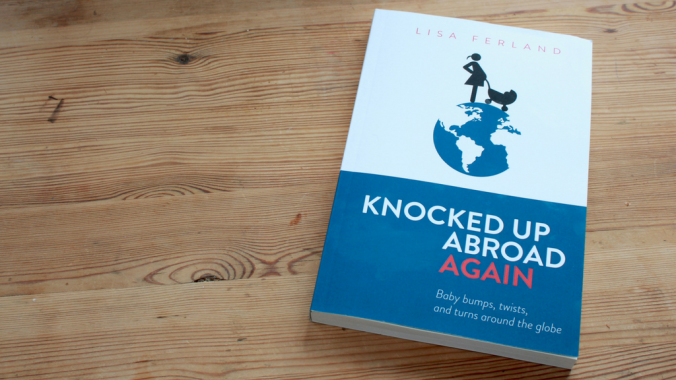
Win a FREE Copy of “Knocked Up Abroad Again” (Ends By Midnight!)

Last month, to help kick off the new blog WWAM Bam (Western Women & Asian Men – Breaking All Molds), I highlighted three must-read essays in the new anthology Knocked Up Abroad Again:

I’ve never been pregnant. But that hasn’t stopped Chinese family and friends from telling me it’s more than past my time to get on board. In fact, just the other day a close Chinese friend was asking me when I’m finally going to have that “cute little mixed-blood baby”.

Sigh.

But I don’t need to imagine what it might be like if I were actually pregnant in Asia. That’s because I just picked up Knocked Up Abroad Again, a new anthology edited by Lisa Ferland that considers the experience of expecting or raising children in another country through the eyes of 26 different writers.

And guess what? Those writers include some fantastic Western women who are living in Asia and also married to Asian men.

You can read my full post on the anthology at WWAM Bam.

Well, now it’s my turn to share the literary love with you, my readers.

Would you like to win a FREE copy of this fabulous anthology, Knocked Up Abroad Again? I’m giving away one copy on WeChat to someone with a mailing address in mainland China! Why not you?

(For those of you not based in mainland China, but with friends or family over in China who could receive it for you, you can enter too!)

Here’s how to enter:

  1. To be eligible to win, you must use WeChat on your mobile phone and have a mailing address in mainland China. (Note – if you haven’t installed WeChat, it’s easy to download. You can find it in most major app stores by searching for WeChat or微信, or get it directly from their website here).
  2. Follow my official WeChat account. If you’re not already a follower, just scan the QR Code below using your WeChat app (here are directions on how to scan QR codes in WeChat): Or, you can search for my official WeChat account under the words “speakingchina”.
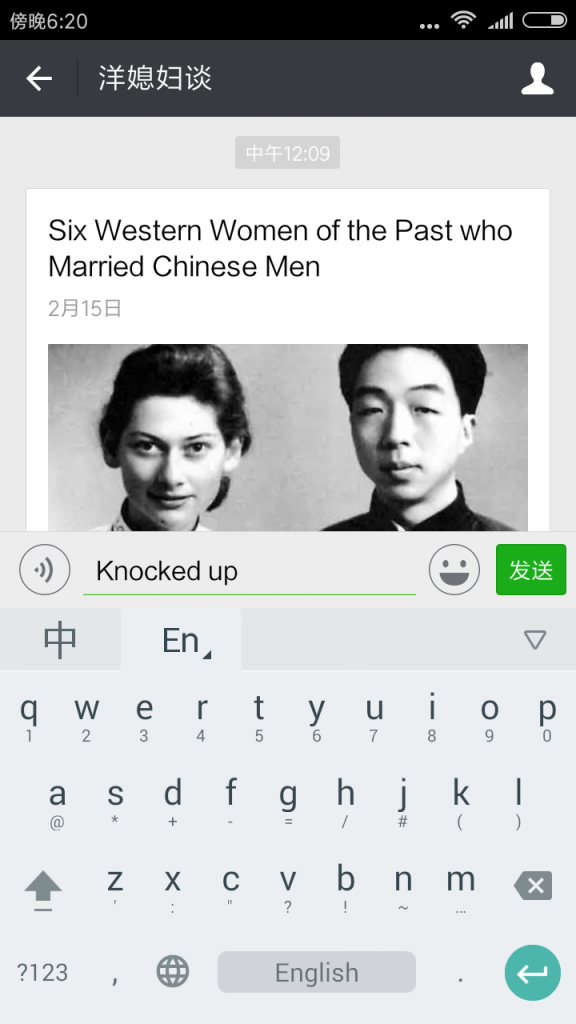
  1. Finally, just send a message to my official WeChat account with the words “knocked up” and you’re entered.

It’s THAT simple.

Remember, entries must be received by 11:59pm tonight (Feb 16) Beijing time (which is also 3:59pm UTC time). Only one entry per person. Tomorrow, on Feb 17, I will randomly choose a winner from all the entries and notify them via my WeChat official account.

Good luck to everyone!

A huge thanks to Charlotte Edwards Zhang (whose essay is one of the three I highlighted in my post on WWAM Bam) for making this giveaway possible. You can also read Charlotte’s writing on her blogs Living in China with Kids and Chinese Potpourri.

P.S.: Knocked Up Abroad Again is available on Amazon.com, where your purchases help support this blog.

Photo Essay: How My Chinese Husband Shows Love in Everyday Moments

Later today after 8pm Beijing time, the new group blog WWAM Bam (Western Women & Asian Men – Breaking All Molds) will be publishing a group post on how our Chinese husbands show their love for us, including a short contribution from me. I wrote:

My husband is the kind of guy who shows his love in those thoughtful everyday moments. You know, the little things he does to tell me — through actions, not words — just how much he cares.

To honor Valentine’s Day, I thought I’d extend that with a photo essay highlighting some of those everyday moments – in no particular order — that remind me just how much he loves me.

#1: Bringing me a steaming hot cup of my favorite dragonwell tea every morning

Jun knows exactly how I love my green tea, and always has it ready just after I wake up. 😉

#2: Putting bandages on my cuts (like when I cut myself shaving)

I’m such a klutz…but Jun is such a sweetie to want to bandage my cuts.

#3: Blow-drying my hair after I shower

Once I step out of the bathroom, Jun is usually ready — blow-dryer in hand — to serve. Thanks Jun!

#4: Tucking the covers around me to help me stay warm

When Jun goes to bed after me or gets up before I do, he often tucks the covers snugly around my shoulders. (He also did it when I was in the hospital last year, which is where this picture was taken.)

#5: Taking the garbage out (and doing other “dirty jobs” around the house)

Ever since we married, Jun has this thing about “dirty jobs” (like taking out the garbage) — he prefers to take care of them. (Did I also mention he loves to help my dad mow the lawn, as he did last year when we went to the US?)

#6: Warming my hands in his when they’re too cold

I love it when Jun holds my hands, especially just to warm them up when it’s cold outside.

Happy Valentine’s Day, Jun. I love you.

How to Celebrate Valentine’s When Your Boyfriend/Girlfriend Is in China

When my husband Jun and I first met each other in China, the last thing I expected was to navigate a long-distance relationship with him.

Fast-forward a couple of years to when I was in Shanghai, and my company decided to post me to their Taipei office. Just as I jumped at the opportunity, a part of me struggled. At the time, it was nearly impossible for mainland Chinese to travel to Taiwan. This chance to work in Taipei meant we’d be separated across the great Taiwan Strait – and also forced to celebrate Valentine’s Day apart for the first time.

How do you celebrate Valentine’s Day – this ever-important holiday for lovers – when your boyfriend or girlfriend is in China? How do you manage the distance and still make the holiday something special?

Here are 3 of the ways Jun and I survived our first Valentine’s Day apart:

#1: Make a virtual date

If Jun and I had been together in Shanghai, we’d have gone out for a romantic dinner for two at one of our favorite vegetarian restaurants, such as the Jujube Tree.

Of course, it was impossible for us to dine together, with him in Shanghai and me in Taipei. But we could do the next best thing – make a virtual date to talk with each other.

Back then, our only choice was the phone. But nowadays, video chat means you can have your loved one beside you (well, virtually) while you’re enjoying your Valentine’s Day dinner or evening (or anything else…hint, hint!). If you have a tablet, you could even set it up across from you at your table, turning it into a virtual table for two!

Photo by Aaron Spraggins

#2: Write them a romantic message

During my stint in Taipei, e-mail became my best friend – because it was one of the best ways for Jun and me to stay in touch every single day. E-mail was also how I sent Jun a romantic (and kind of cheesy) poem I drafted just for him.

Nowadays, with messaging apps (such as WhatsApp and WeChat) it’s even easier to send your loved one a romantic poem or message. You can even add some cute stickers, photos or images to let them know just how much you miss them.

#3: Send your loved one a care package through online shopping

When I was living in Taipei, Taiwanese style mochi – soft rice cakes stuffed with sweet fillings – became one of my favorite snacks. Because I had never had them in Shanghai, I decided to send Jun some mochi to share a little local flavor while reminding him how much I loved him.

This was a great idea in theory, but a lot of trouble in practice. I had to find the nearest post office and give up one of my lunch breaks to get there. There was also the hassle of packaging everything, getting Jun’s address written correctly (in traditional Chinese characters, which I wasn’t used to), and spending more money than I anticipated. Ouch.

Fortunately, Jun received the package. But goodness knows, it could have been lost or snarled up in customs (both of which still happen when people send things to me in China, even today). Let’s just say I was crossing my fingers and praying to the postal deities that it would arrive. 😉

Nowadays, online shopping has made shipping your Valentine’s Day care packages to China a breeze.

If you already have a Taobao or Tmall account, you don’t even need to hassle with customs. Just browse your favorite shops and buy! This is by far the least expensive option. I’m impartial to Tmall’s online supermarket (天猫超市), which guarantees next-day shipping in most major cities and has loads of delicious gifts for your loved one, including imported chocolates and wine. Also, if you choose a reliable provider like Tmall’s online supermarket, you can be confident your package will arrive on time.

But of course, Taobao and Tmall are all in Chinese, and require users to have a Chinese bank account or credit card to use them. Can’t read Chinese? Can’t open an account? No worries.

One option is to find a Taobao agent, such as Taobao Focus, who will shop for you for a small fee. But if you’d prefer to do your shopping on your own, in English, you can still send a romantic care package to China through Gift Baskets Overseas.

Gift Baskets Overseas offers a variety of Valentine’s Day gift baskets – yes, including chocolates and wine – with listings in English, all backed by their 100 percent satisfaction guarantee. (If you’re not 100 percent satisfied with your order, they will either make it right or refund your money. How cool is that?) Gift Baskets Overseas takes care of everything and ships to 317 locations in China, covering just about anywhere your loved one would be.

(As a full disclosure, I am an affiliate for Gift Baskets Overseas. But I wouldn’t recommend them if I didn’t absolutely believe in their products and service.)

If you’d like to make a Valentine’s Day purchase through Gift Baskets Overseas, I’m offering my readers a special 13% discount off all Valentine’s Day gift baskets (including those with wine and chocolate). Just use the code VAL13 when you’re checking out.

Regardless of how you choose to celebrate, wishing all of you a wonderful Valentine’s Day!

Photo Essay: Chinese New Year 2017 in Rural Hangzhou, China

It’s the year of the golden rooster. Happy Chinese New Year! While I’m taking a little time off to recharge a little during the holidays, I thought I’d share some photos from our Chinese New Year celebration in rural Hangzhou, China.

The biggest dinner of the year — Chinese New Year’s Eve dinner!

As always, every Chinese New Year’s Eve includes passing out the hongbao (红包,red envelopes) stuffed with lucky money for the new year.

As always, Jun and I brought some Chinese New Year gifts (nianhuo, 年货) to share with the family. On the left I’m carrying a gift box filled with an assortment of fancy nuts (complete with a “golden egg” design visible on the box); on the right, a gift box of large Xinjiang jujube dates.

On the first day of the new year, it’s time to wear your new clothes! Jun and I are both wearing new sweaters.

With such beautiful weather on the first day of the new year, we couldn’t resist stealing away to the countryside to enjoy the gorgeous scenery. Here we discover a waterfall cascading down the cliffs.

As we wandered beside the river, we were bathed in the golden sunshine. It was one of the most relaxing afternoons I’ve enjoyed in a long time.

The evening of the first day of the new year, I also helped my mother-in-law make migu, a special turnover we enjoy during the holidays. The dough is made from rice flour, and the filling is usually tofu and pickled vegetables and/or bamboo.

We visited Jun’s godfather during the holidays, presenting him with a hongbao and some baijiu liquor. He prepared us some sugar cane to snack on. Above, there he is, peeling off the rough exterior of the cane as I watch in the background.

As usual, we dined on some of the most delicious food of the year. One of our most memorable meals was at Jun’s Aunt and Uncle’s home next door to us. She even prepared a special hotpot of savory tofu and napa cabbage, plus her mouthwatering homemade kimchi. Yum!

Wishing everyone a prosperous and auspicious Chinese New Year!

Why the Trump Immigration Ban Threatens Us All

IMG_20160213_170645So, it’s the year of the cock – and in this new Chinese zodiac year, Trump has decided to stick it to Muslims with his immigration ban.

I learned this appalling news in a haze, still recovering from the lack of sleep. (Anyone who has ever celebrated Chinese New Year in China knows that the fireworks, often set off late into the evening and early into the morning, aren’t that helpful to rest.)

Normally, this is a week when I take time off from the blog. We’re celebrating Chinese New Year, kicking back with family, and recovering from a busy run-up to the holidays here in China. It’s a lot like Christmas and the week after, when everyone spends time with their loved ones (often taking a much-needed break from things like e-mail and the Internet). I always enjoy sharing a few choice pictures from the holidays here.

But after learning about Trump’s immigration ban, I don’t feel right in merely pushing through with the post. I don’t want to ignore what’s going on, because right now I’m sick to my stomach over this immigration ban.

If you’re reading, chances are you probably know a foreigner. Or know someone who was once a foreigner. Or you are/were a foreigner yourself. That means you should understand, more than anyone else, how horrible this policy could be. Just imagine if you or your loved ones were arbitrarily blocked by virtue of arriving from one of seven countries.

But here’s another more important point – once you allow a grave injustice like this to move forward, it isn’t long before more follows. It isn’t long before the people you love become targets. It isn’t long before you become a target. This is the same wisdom that Pastor Niemoller spoke in the 1950s with the “First they came” poem.

I am reminded of the words of the great civil rights leader Dr. Martin Luther King, who once said, “Injustice anywhere is a threat to justice everywhere.” If you care about safeguarding justice for all – including yourself – you need to oppose this ban now.

As I’ve written before, I don’t usually get political. But Trump is different. This is different. Everyone ought to be appalled by what Trump has done. I don’t care how many times they try to spin this, claiming it isn’t a Muslim ban. It is a Muslim ban. This will go down in history along with many other shameful acts by the US, such as the internment of Japanese Americans on US soil. It is an ugly, hateful, racist policy.

This is the time to stand up, to show that hatred and fear will not prevail. #Resist

3 Ways NOT to Impress Family During Chinese New Year

Chinese New Year is coming! If this is your first time spending the holidays with a Chinese family, here are 3 things that will definitely NOT impress:

head-in-her-hands#1: Be totally antisocial

Chinese New Year is all about reuniting with family and friends to celebrate. You’re meant to get out there, attend those dinners, and knock on those doors with red gifts in hand.

Which means the worst thing you could do is be utterly antisocial.

Now, let’s get clear about what antisocial really means in this context. Sitting quietly at the dinner table or among guests, not speaking much, doesn’t necessarily apply. You don’t have to be chatty to win their hearts over. Just being present, butt in seat and chopsticks in hand, will suffice.

But if you spend the whole holiday locked up in your room, only consuming crappy ramen noodles (I actually witnessed someone in my husband’s village who did this), you’re definitely going to piss off more than a few people.

Photo by Garrett Charles

#2: Don’t prepare any gifts

Years ago, when I was getting ready to experience Chinese New Year for the first time ever, a friend clued me in on my obligation to my hosts. “You need to buy them some gifts,” she said, even taking me shopping in the supermarket next door to pick out the perfect one for them.

Chinese New Year gifts are such a big deal that every supermarket creates huge red-and-gold displays filled with all the usual suspects to lure shoppers – from fine alcohol and spirits, to dried fruits and nuts, to even traditional Chinese remedies like ginseng and Dong quai. These are all neatly packaged, often with their own attractive red-and-gold gift boxes or bags. All you have to do is show up at the house, goods in hand.

But if you show up empty handed, you won’t win any favors. Especially if you’re a foreigner. Most Chinese think foreigners have a lot of money, despite your current financial circumstances. They’re probably expecting you to bring some of the best gifts at the table – or at the very least, something as good as everyone else.

With nothing in hand, you’ll be branded as either rude or stingy. And quite possibly might be the talk of the family…but not for the reasons you’d hope.

shoe-682215_960_720#3: Dress in shabby or old clothing

I’m pretty sure my mother-in-law was privately shocked when, one Chinese New Year, I didn’t have a single new sweater or jacket to wear.

It didn’t matter that my down jacket was a gorgeous ruby red that glimmered in the sun, and nicer than most of the jackets I could have bought in the stores in Hangzhou. Or that my sweater was less than a year old and still in fine condition. Or even that my Calvin Klein jeans looked as good as new.

I had broken one of the cardinal rules of Chinese New Year. I was wearing something old, which is totally inauspicious and against the usual custom.

My mother-in-law has often reminded me about the importance of wearing nice clothes. Clothing is like your public face, and how everyone dresses reflects on the whole family.

Now, it’s one thing to wear old clothing…but if you really don’t want to impress the family, show up in something old and shabby. Dress like you’re about to renovate an apartment in the middle of China’s winter, or beg on the streets for a few extra kuai.

(Chances are, your family would be so embarrassed they’d probably give you something decent to wear. And force you to wear it.)

P.S.: Want to know how to impress family during Chinese New Year? Read all about how to impress your boyfriend or girlfriend’s family in China during Chinese New Year, or how you can prepare to meet the family in China.

How to Deal with 3 Major Chinese New Year Annoyances – Pub’d on WWAM Bam

屏幕快照 2017-01-18 下午6.05.14WWAM Bam, the new group blog for Western women who love Asian men, just published my piece titled How to Deal with 3 Major Chinese New Year Annoyances. Here’s the introduction to that article:

As China in January turns into a festive wonderland of red and gold everywhere you look, some of us don’t feel as excited as the Chinese New Year décor might suggest.

The biggest holiday in China is also fraught with a number of annoyances, particularly when you have family there. I know it all too well. There have been some years when I’ve actually dreaded heading home for the holidays.

Fortunately, though, there are ways to manage your way through Chinese New Year, sanity intact! Here are 3 major Chinese New Year annoyances – and how to deal with them:

Read the full piece at WWAM Bam — and if you like it, share it!

How NOT to Give Gifts in China

I’ve written a lot over the years on what gifts to give – so much so, the number one post on this site is all about gifts.

But what are the things to avoid? How should you NOT give gifts in China? Here are 4 ideas you won’t want to try:

cheap
Photo from http://www.thebluediamondgallery.com

#1: Give something really cheap

I once came across a foreign woman in China staying with a family during her trip to Beijing. When I asked her what gifts she had prepared for them, she gleefully dug the hotel shampoo samples out from her suitcase. “Won’t these be perfect?”

I mentally cringed at the sight of those sad little plastic bottles, realizing this girl was on the verge of embarrassing herself in Beijing. That’s when I took her aside and clued her in on the reality. That one of the biggest no-nos for gift-giving in China is giving something cheap (or, worse, free).

Think of a gift as a version of your public face. When you give something cheap, you’re saying you don’t value the person or the relationship enough. Not exactly the kind of Hallmark sentiment you were aiming for, eh?

How much does the quality of your gift matter? Let me put it to you this way – Chinese would rather spend less on themselves just to buy the perfect gifts for their friends, family and valued business partners. It’s that important.

That doesn’t mean you shouldn’t shop around for a good deal. As I write this, I’m currently doing my shopping for Chinese New Year gifts. And trust me, I always hunt around for the best deal. But for me, the bottom line is a good price on quality gifts. It has to be quality, otherwise I won’t buy it.

So ditch the freebies and samples, and go for quality, name brand goods.

Photo by pheezy
Photo by pheezy

#2: Make your gift look sloppy

Growing up, I struggled with the art of wrapping Christmas and birthday presents. My corners bulged. I never seemed to be able to fold the edges without them getting unnecessarily wrinkled. And I used way too much tape. Sometimes, the result looked as though the box had fallen down the stairs a couple of times.

In other words, they were sloppy. Really sloppy.

I got away with sloppy gifts because I was a kid. But in China, if your gifts look sloppy, you may not get the same pass.

How your gift looks matters in China. It’s so important that, during Chinese New Year, most new year gifts include neat little gift boxes or bags. They’re usually a sturdy red plastic, embossed with golden characters and festive décor (such as the year’s Chinese zodiac animal). How cool is that?

Let me tell you, I adore those gift boxes and bags. Not only do they make the gift look gorgeous, but they also mean I don’t have to wrap anything. I’m better off staying far away from wrapping paper – otherwise I’ll end up with a sloppy and totally embarrassing gift.

CC0, https://en.wikipedia.org/w/index.php?curid=30910804

#3: Give a gift that reminds people of funerals or death

Chances are, you’ve probably heard the advice to avoid white colors or clocks . Why? Because white is the traditional funeral color, and the Chinese words for giving a clock (songzhong) sound like sending someone death. (Yikes!)

Let’s face it – invoking death and funerals is not exactly the best way to show you care. Apart from joke gifts or Halloween paraphernalia, I’ve never met someone in the US happy to receive, say, a miniature coffin or a tiny gravestone with their name on it. Why would it be any different in China?

So how do you avoid this trap? Simple. Besides the general moratorium on white or clocks, I’d also avoid sending anyone a wreath of multicolored flowers. Folks in China place them on gravestones.

Photo by Muffet Greed

#4: Be stingy

If you’ve ever attended a banquet in China, then you’ve probably left thinking, “What a waste of food.” Yes, most banquets mean ordering ungodly amounts of food – so much that nobody in their right mind could possibly finish it all. I’ve left many a banquet shocked by the amount of leftovers.

But there’s a reason why hosts will ply their guests with more delicious food than anyone could possibly eat. In China, it’s important to be generous with what you give to others. (This explains why my mother-in-law always tries sending us home with heaping bags of vegetables from her garden or freshly made tofu.)

This idea of generosity is also true for giving gifts. Which is why being stingy with amounts will always get you into trouble.

Whenever I buy gifts, I generally opt for larger sizes or larger amounts. I want to give them an abundance of goodness, whether that’s a heaping basket of extra-fresh fruit or a case of imported French wine. There’s no better way to show you care than with a little more.

What are your gift-giving don’ts for China?

P.S.: Need some suggestions on what to give your friends and family in China? I highly recommend reading my Huffington Post article The Top 6 Gifts Sure To Please Your Chinese Family. You can also peruse my Holiday Gift Roundup post, which includes my most popular post, Giving Gifts to Your Chinese Family – A Modest Guide.

To the American Who Told Me, “Don’t Speak Chinese to Your Husband”

By unknown. Photographer: Heritage Auction Galleries of Dallas, Texas - http://entertainment.ha.com/common/view_item.php?Sale_No=648&Lot_No=22270&type=&ic=, Public Domain, https://commons.wikimedia.org/w/index.php?curid=4583301
By unknown. Photographer: Heritage Auction Galleries of Dallas, Texas – http://entertainment.ha.com/common/view_item.php?Sale_No=648&Lot_No=22270&type=&ic=, Public Domain, https://commons.wikimedia.org/w/index.php?curid=4583301

I always used to think you were cool and open-minded. You voted for Obama. You had a terrific downward dog pose. One of your friends was Chinese.

I figured, surely you would understand how wonderful it is to have a bilingual relationship. I thought you would praise me for speaking more than my native English – for being able to have meaningful conversations in both Chinese and English with my husband, who is from China.

So imagine my shock when you told me not to speak Chinese with my husband – in so many words.

I remember the way you looked so uncomfortable when you said this to me. I’m sure, at some level, you realized how totally inappropriate it was. That the part of you that prided yourself on promoting diversity would be tarnished by this one small action.

But you did it anyway – and you didn’t even apologize about it.

Since you care so much about diversity, let’s make something really clear. Speaking a foreign language is diversity. You can’t say “I love diversity” and then suddenly crap on someone else just because they speak another language.

Also, anyone who cares about diversity should have known that “English only” is just another way to say you’re afraid of foreigners. And guess what? Foreigners are also part of diversity, in case you didn’t notice. You shouldn’t be afraid of them if you like diversity. You should embrace them…which means embracing foreign languages too.

If this is about your own self-esteem issues – that, somehow, my ability to speak Chinese makes you feel bad about your monolingualism – please get over yourself. Nobody forced you to speak only English. You could have studied a foreign language anytime. Heck, you could do it now if you wanted. It’s called education.

Though, honestly, given how much you don’t understand about diversity or racism, you might want to start educating yourself on those.

Oh and by the way, there’s something else you should know. Saying you have a friend who is Chinese doesn’t prove you’re not a racist. In fact, white people have been using the excuse, “I’m not racist, I have a black friend” for years. It’s still lame, even when you replace “black” with “Chinese” or any other minority group.

I’m embarrassed that people like you call themselves “diverse” and “open-minded”, and then say things in public that would make anyone want to revoke your so-called diversity credentials instantly. So maybe the one who shouldn’t be speaking isn’t me — it’s you.