The other night, I received a frantic message from one of my closest friends back home. “I’m getting divorced,” she typed to me in an online chat.
It was the culmination of years of troubles brewing between her and her husband. They had fought over their beliefs. She was fed up with how almost all the domestic and child-rearing responsibilities were on her shoulders, despite the fact that she too had a full-time job. She also had it with her husband, who was turning out to be another child to manage instead of a source of support. Therapy had failed to resolve a single thing.
Did I mention she and her soon-to-be-ex-husband are both white Americans, with similar cultural backgrounds?
I wasn’t surprised she filed for divorce. So many of our recent conversations had revolved around the growing rift between her and her husband. There was always a tension lurking in the background, the feeling that things were slowly unraveling between the two of them with every confession of how he just didn’t get it…and probably never would.
So much is written about the vulnerability of intercultural and international couples, that we’re supposedly more likely to divorce. While new studies suggest this just isn’t true, a lot of people still believe you’re better off marrying someone from your own culture/country.
Or rather, that marrying someone from your culture/country will guarantee happiness and stability.
My friend’s story, however, doesn’t fit that narrative.
Australian Marie Smurthewaite (aka 江南) and her Chinese husband Wang Shuai (王帅), from Jilin, China, are a breathtaking sight among the splendor of Beijing’s Forbidden City. You can follow this pair (who sing and perform together in their group 帅江南组合) on Sina Weibo at 帅江南组合-王帅 and 澳大利亚的江南.
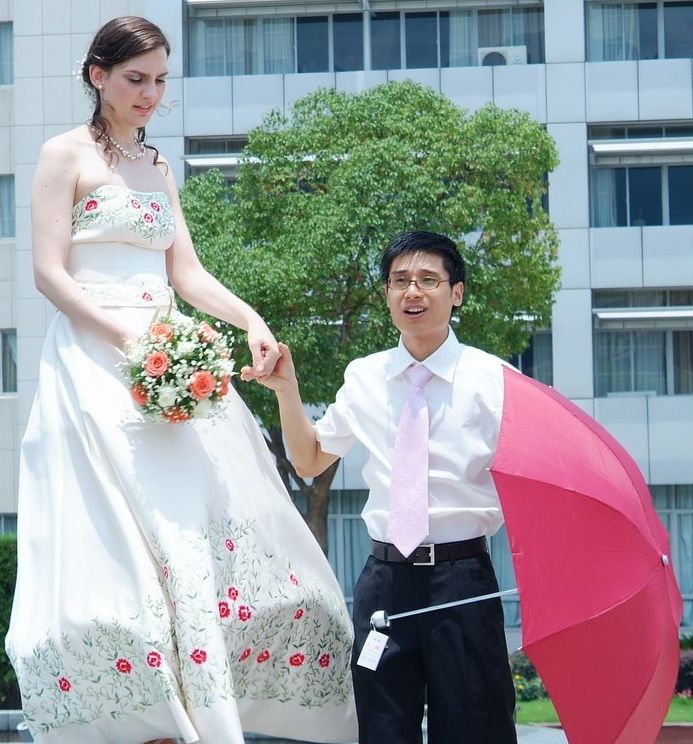
If the community of Western women and Asian men had a magazine, these two could easily grace the cover. This editorial fashion shot pre-wedding picture of Xenia Olivia of Spain and her Hong Kong husband J was taken in Interlaken Village in Shenzhen, China.
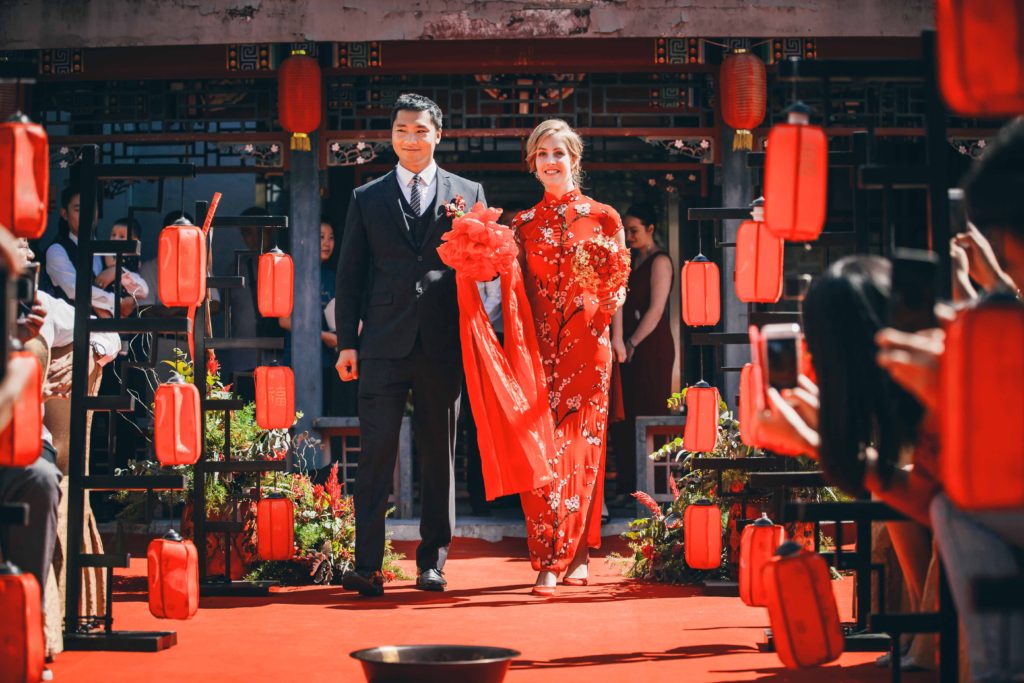
They truly raised the red lanterns in celebration of this gorgeous wedding in Beijing, China between Morag, who hails from Scotland, and her husband Peng, a native of Beijing, China.
The old saying goes that the way to a man’s heart is through his stomach. But what of a woman’s heart? I have to wonder if that’s even more true for us, especially after the culinary feat my husband accomplished in the past few months.
In case you didn’t know, my husband is now the chef in our family. He’s the one who toils every evening in the kitchen to put together some of the most scrumptious meals I’ve ever tasted.
That’s quite a feat from a fellow who once shied away from the wok. Whenever people asked him if he could cook, he’d always laugh and reply, “I only know how to add in oil and salt.” He always used to claim I was the one more skilled in this arena, preferring to leave the spatula to me.
But in the past few years, my husband started shouldering more of the cooking responsibilities. Until at some point (I still can’t remember exactly when) he took over preparing all the meals in our home. It was a godsend in many respects, especially when I was in the hospital last year and couldn’t have managed the recovery without his support in the kitchen.
The last thing I expected, however, was for my husband to prepare that infamous eggplant dish, just for me.
Jun and I have a fascinating history with eggplant – specifically, a Chinese-style dish I’ve nicknamed “Italian Eggplant”. It’s one of the first dishes I ever prepared for him when we started dating years ago. It’s also a dish that led to one of our first heated (no pun intended) arguments.
I remember that muggy summer evening in Hangzhou, proudly setting that blue and white porcelain bowl on the dinner table after toiling over the wok. The whole apartment was redolent with the savory aroma of eggplant stir-fried with tomatoes, garlic, ginger, soy sauce, a dash of vinegar, and a touch of sea salt. I inhaled with satisfaction as I thought of all the friends who had tasted the very same dish, heaping on the compliments as big as the second and third helpings they enjoyed at my place.
Surely, Jun was going to love this dish just as much. Or so I thought…until he started eating.
“Too sour. Too much soy sauce. Too much tomato,” he said. Jun grimaced with every bite – and I could feel my anger rising with every complaint. How dare he insult the food I so lovingly prepared for him! Where was his appreciation for my hard work?
I let him have it, as I slammed my chopsticks on the table and asked him what the hell was wrong with him?
Admittedly, I was a little hot-headed at the time. But it had to do with how I’d been raised – to always say thank you to the chef, even if you didn’t like the food. It was a lesson I’d learned well after years of dining at my paternal grandmother’s house. She was a notoriously horrible cook who would entertain us with things like soggy, tasteless macaroni and veggies from a can. Even though I could sometimes barely stomach the stuff on my plate, I would force myself to say how good the food was.
When I told Jun about this, his face turned as red as the tomatoes in the dish. Turns out, he had a completely different experience growing up at the table. Every dinner included a course of blunt feedback about how everything tasted – even if that meant saying the food was unequivocally bad.
I apologized for my outburst, and he apologized for criticizing my food, instead of saying thanks.
Meanwhile, I figured that was the last time we would ever dine on my Italian Eggplant.
Except, it wasn’t.
Over the years, Jun surprised me by actually giving the dish a second chance – and loving it. It gradually became a favorite for us. Yes, a favorite! Who would have thought?
Then, after Jun assumed the role of chef in our home, he surprised me again.
One evening, our house was once again redolent with the aroma of dinner, courtesy of Jun. And it smelled very familiar. Was that eggplant and tomato in the air? And soy sauce? I followed my nose to the table, only to discover that Jun had cooked Italian Eggplant just for me, from scratch.
With one bite, I found myself in ecstasy once again. “Mmmm, this is so delicious!” I exclaimed, unable to contain myself over the delectable flavor. How had he so perfectly replicated the dish I once lovingly crafted for him all those years before?
Jun likes to say he transcended himself in finally learning to make this dish. I like to say he did it for love. But honestly, whenever it’s on the table, we don’t say much at all. We just eat and eat and eat, thankful that the food that we once argued over brought us together in delicious harmony.
On November 3rd, [2015] my sister Alison gave birth to her first child, a beautiful baby boy named Nathan. Five days later while recuperating at home, Alison suddenly had a seizure and was rushed to the hospital where a CT scan showed a large mass in her brain. Tragically, a biopsy has confirmed that Alison has a high grade glioblastoma brain tumor, a very aggressive form of brain cancer. Alison’s tumor is inoperable and average life expectancy is less than 18 months without treatment.
Miraculously, Alison is still here and still fighting, with the support of her family. At the request of a loyal reader, I wanted to share some updates with you on how she’s doing from Logan Lo’s blog. Here’s an update from February 20, 2017:
…I spoke to a cancer researcher last week too. He said that Alison was the longest lived butterfly glioma patient he’s ever heard of. It’s a dubious distinction, and still not enough for us.
On that note, had numerous friends and relatives ask if she can get a break: Can’t she just have a few months without swallowing 30 pills a day, without having needles stuck in her every week, without wearing a helmet of magnets 24/7, without inhaling an astringent four times a day?
The short answer is no.
Because they don’t become friends with other glioblastoma patients and caregivers. They don’t have to hear: We put David in hospice this week. Jessica had three new tumors on her last scan. Maddie passed away today.
It’s tough to hear because you hope everyone else can pull through. You hope your loved one can pull through.
But the truth is a powerful thing. The truth is, most people are dead from this damn thing within 18 months. And most of those people are people that can walk and use their arms. People that had 100% of their cancer removed. People that went to the best cancer centers in the world.
Most people start off far better than Alison and still died.
If there’s any way at all for her to survive this, it’s because she doesn’t stop until the job is done.
No one’s asked me but I’m sure people are wondering: “What are you doing with all the money you’ve raised?” It’s only fair I answer it.
Originally, we weren’t sure how much our original insurance was going to pay towards Alison’s treatment. Her cancer was on the aggressive side of aggressive. The only “lucky” thing about our situation was that we were already on the platinum level of Obamacare, which essentially meant that we pay 10% and insurance pays 90%.
It has been a godsend to us. At last count, Alison’s 2016 cost of care was around $2.8 million dollars. Without the Affordable Care Act, Nathan and I would be bankrupt and Alison would be dead. It’s that simple.
But we’re not and she’s not, thanks to the ACA and everyone’s generosity.
With what’s left of our money, we’re paying for normal expenses – mortgage, food, bills – some experimental drugs, physical and occupational therapy, and exploring future options, like a potential cancer vaccine in Germany.
Mainly, though, we’re saving up to see what happens with the ACA. So we’re watching the news daily to see what unfolds.
One of the smartest women I’ve ever met pretty much never went to school, worked in a factory for years, and doesn’t shy away from even the toughest jobs around the house and the neighborhood. She can also carry enormous piles of sweet potatoes balanced off of a bamboo rod, knows where to forage for the tastiest wild ferns in the mountains, and cooks some of the most delicious food I’ve ever had in China. Meet my mother-in-law.
I never expected to forge a close relationship with a woman like her, whose life feels as distant from my own as the thousands of miles that lay between her hometown and mine back in Cleveland, Ohio, USA. Yet we’ve bonded in so many ways, especially through our mutual love of cooking great food. I also admire her indomitable spirit. She has survived many hardships in her lifetime and yet faces life with a courageous optimism. This has inspired both me and my husband during our own trials and tribulations. Mother-in-law, thank you for being there for us!
Every morning, Jun loves to deliver me a steaming hot cup of my favorite dragonwell tea and a bowl of oatmeal. He’ll set it up right next to my bed so I can stay warm under the covers and enjoy a warm breakfast in bed.
I got a cut the other day when I was shaving my legs, and Jun insisted on putting on the bandage himself.
Sometimes, when I fall asleep before him or he wakes up early before me, he’ll tuck the covers around me tightly to make sure I stay warm and cozy.
After I shower, he’s the one who blow dries my hair, sometimes even combing it afterward. The way he looks at me when he finishes, it’s like he’s admiring his own work of art. It totally warms my heart.
Jun has taught me that love can be found in the details, in the quiet moments we share. It’s this kind of love that has kept our marriage strong for over a decade. I love you, Jun.
People have called China endlessly fascinating. But you could say the same about the expat scene here. In the seven-plus years that I’ve lived in this country, I’ve come across some real characters here – people I could have sworn were straight out of a novel.
I’m reminded of many of them after reading Ray Hecht’s new book South China Morning Blues, which features a motley cast of young expats and Chinese locals living across Shenzhen, Guangzhou and Hong Kong….
Through 12 distinct viewpoints, South China Morning Blues takes readers on a tour of the dark underside of the expat scene in China, culminating in a dramatic life-and-death situation that brings everyone together. It’s a fresh take on life in 21st century China and definitely worth a read.
Intrigued? Ray Hecht will be in Shanghai tomorrow, Friday March 24, to do a special reading of South China Morning Blues at 7pm at Garden Books, 325 Changle Lu (静安区长乐路325号), which is conveniently located near the South Shaanxi Road Metro Station. For more information you can contact Garden Books at 021-5404-8728.
To celebrate Ray’s special appearance tomorrow in Shanghai, I’m giving away one copy of South China Morning Blues on WeChat to someone with a mailing address in mainland China! Why not you?
(For those of you not based in mainland China, but with friends or family over in China who could receive it for you, you can enter too!)
Here’s how to enter:
1. To be eligible to win, you must use WeChat on your mobile phone and have a mailing address in mainland China. (Note – if you haven’t installed WeChat, it’s easy to download. You can find it in most major app stores by searching for WeChat or微信, or get it directly from their website here).
2. Follow my official WeChat account. If you’re not already a follower, just scan the QR Code below using your WeChat app (here are directions on how to scan QR codes in WeChat):Or, you can search for my official WeChat account under the words “speakingchina”.
3. Finally, just send a message to my official WeChat account with the word “scmb” and you’re entered.
It’s THAT simple.
Remember, entries must be received by 11:59pm tonight (March 23) Beijing time. Only one entry per person. Tomorrow, on March 24, I will randomly choose a winner from all the entries and notify them via my WeChat official account.
Here are 4 awkward things I’ve heard in China as a married woman with no kids:
#1: “How many children do you have?”
In China, asking if you’re married and have kids is as common as the question “How are you?” in the West. A way to show people care. After all, the assumption for most people in China is, if you’re married you have kids. It’s filial to give birth to the next generation and carry on the family line.
It’s why people are stunned to discover I’m child-free.
Sometimes, people will leapfrog over the question of whether I actually have kids – thinking I’m just like the average married couple in China – to how many I have. Never thinking, of course, that I actually have no kids at all.
Oops.
There’s no avoiding awkwardness here. I invariably have to say something like, “Uh, sorry, I don’t have children.” Sometimes leading to an embarrassing pause in the conversation.
But more often than not, this is followed by another awkward question:
My marriage to a Chinese man wasn’t just the culmination of a beautiful love affair. It also kicked off the start of a new education for me, his white American wife. A true initiation into the world of racism, prejudice, and all of those unfortunate stereotypes I wish Westerners didn’t have about Asians, including Asian men.
Here are 3 stereotypes about Asian men that I’m tired of hearing:
#1: Asians = great at computers
I can’t tell how many times people have told me, “Wow, your husband is SO great with computers!”
Whenever I hear that, I want to flash them a painful grimace. As if I just witnessed that person step right into a big, smelly pile of…you know.
Seriously, people. Just because my husband knows how to delete the trash files from your iPad – and is Asian — doesn’t mean he’s the almighty computer guru. In fact, I’m the one who troubleshoots our tech problems, from deciphering error messages on the PC to configuring a complicated wifi network at home.
Being Asian doesn’t automatically make someone a wizard at things like math, science and medicine. But if you think otherwise, that definitely makes you naïve.
#2: Asian men are short
True story. An academic in America once had the audacity to tell my husband Jun, “All Asians are short, right?”
You know, it’s easy to see a couple like Jun and me together, and then draw that kind of conclusion. But once again, you’re mucking around in stereotypes, as Alex Tizon reminds us in his wonderful memoir Big Little Man:
Are all Asian people small, and have they always been so?
The answer to both questions is no — a fact commonly known among educated Asians and Westerners who have traveled widely through Asia….
Today, the giant men of the Chinese national basketball teams, whose centers are among the tallest in the world, almost all come from northern and central China. The former Houston Rockets standout center Yao Ming is seven foot six, which even among tall nationalities is aberrantly tall…. Up until 2009, both the tallest man and the tallest women in the world hailed from northern and central China…. The tallest woman on record, Zeng Jelling, who died in 1982, was eight foot one.
Anecdotal records indicate that, during the time of the first waves of Chinese migration to America, men of northern China averaged about five foot seven, with a fair number exceeding six feet. This would have been roughly equivalent to the height of white male conscripts in the U.S. Army and many European immigrants of the time.
#3: Any question about the size of an Asian man’s penis
Who in the Asian community – or in an interracial relationship with someone Asian — hasn’t heard this lamest of all stereotypes? It’s right on par with toilet humor, and ought to be flushed into oblivion.
I’ve noticed that, by and large, it’s men who seem content to hurl this one into conversations. Usually anonymously, in a really seedy Internet hangout. Or in a typo-ridden comment… the kind that ends up in your spam folder.
In my opinion, any guy who goes around speculating about the size of someone’s manhood already has serious inferiority issues. Or just needs to get a life.
…to my Asian brothers out there: don’t give any guy, girl, or internet troll two seconds of your time when they joke about your dick. Your wang is the wangiest of all wangs. Keep it up, hold it proud, and use it wisely. After all, 60% of the world’s population is Asian which means one thing: we may have a negative stereotype about our shlongs, but at least we’re getting laid.
When Chinese students in the US returned to universities in 2017, they began a new semester under a cloud. The Los Angeles Times reported that, in the wake of Trump’s election, the Chinese Consulate in San Francisco warned students of rising anti-China sentiment that might be dangerous. The Consulate’s letter cited instances of verbal abuse directed at Chinese students. Meanwhile, Asian Americans Advancing Justice has recently reported a huge uptick in hate crimes against Asians, thanks to Trump’s demonization of China as America’s enemy.
But it would be naïve to assume that all of this started with Trump’s election. In fact, there has always been a negative bias against Chinese students in the US
Much of the mainstream news coverage of Chinese students in America has a negative slant – from stories like “Heavy Recruitment of Chinese Students Sows Discord on US Campuses” (Wall Street Journal) to more exaggerated headlines such as “How Chinese Students Are ‘Cheating’ To Get Into US Universities” (Forbes) and “Fraud frenzy? Chinese seek US college admission at any price” (CNN). Meanwhile, that bias has trickled down to the public. I’ve had many conversations about Chinese students in America with academics and the general populous; most often, people allege Chinese are ruining the quality of education, or stealing admissions spots from more deserving American students. Even Google displays this bias; when I searched for Chinese students in the US, of the four suggested search strings, two were the following: Chinese students in the US problems, and Chinese students in the US rich.
The negative bias against Chinese students in America needs to stop.
Whenever I think of Hollywood teen movies, I cringe.
It’s bad enough that white actors get all the best roles, with almost no exceptions. But a Hollywood teen movie also gave the world one of the most racist, stereotypical portrayals of Asian men ever – Long Duk Dong in the John Hughes’ movie Sixteen Candles. Talk about one enormous “screw you” to the whole Asian community, including the many talented Asian male actors out there who deserve better roles and representation.
Thank goodness for the new teen movie The Edge of Seventeen, just released in late 2016.
The film features one of the most refreshingly unstereotypical portrayals of an Asian man in a teen movie – the breakout role of Erwin Kim, played by Hayden Szeto.
And surprisingly, The Edge of Seventeen even shares some common ground with, of all movies, Sixteen Candles (Vanity Fair noted “Steinfeld’s character is derivative of Molly Ringwald circa Sixteen Candles”). Who’d have thought?
If you’re hungry for a good teen movie, one with a positive portrayal of an Asian guy, you must see The Edge of Seventeen, featuring Hayden Szeto. Here are 5 reasons why:
This website uses cookies to improve your experience. We'll assume you're ok with this, but you can opt-out if you wish.AcceptRejectRead More
Privacy & Cookies Policy
Privacy Overview
This website uses cookies to improve your experience while you navigate through the website. Out of these cookies, the cookies that are categorized as necessary are stored on your browser as they are essential for the working of basic functionalities of the website. We also use third-party cookies that help us analyze and understand how you use this website. These cookies will be stored in your browser only with your consent. You also have the option to opt-out of these cookies. But opting out of some of these cookies may have an effect on your browsing experience.
Necessary cookies are absolutely essential for the website to function properly. This category only includes cookies that ensures basic functionalities and security features of the website. These cookies do not store any personal information.
Any cookies that may not be particularly necessary for the website to function and is used specifically to collect user personal data via analytics, ads, other embedded contents are termed as non-necessary cookies. It is mandatory to procure user consent prior to running these cookies on your website.


 The other night, I received a frantic message from one of my closest friends back home. “I’m getting divorced,” she typed to me in an online chat.
 Australian Marie Smurthewaite (aka 江南) and her Chinese husband Wang Shuai (王帅), from Jilin, China, are a breathtaking sight among the splendor of Beijing’s Forbidden City. You can follow this pair (who sing and perform together in their group 帅江南组合) on Sina Weibo at
  If the community of Western women and Asian men had a magazine, these two could easily grace the cover. This
  They truly raised the red lanterns in celebration of this gorgeous wedding in Beijing, China between Morag, who hails from Scotland, and her husband Peng, a native of Beijing, China.


 Intrigued? Ray Hecht will be in Shanghai tomorrow, Friday March 24, to do a special reading of South China Morning Blues at 7pm at Garden Books, 325 Changle Lu (静安区长乐路325号), which is conveniently located near the South Shaanxi Road Metro Station. For more information you can contact Garden Books at 021-5404-8728.
 Or, you can search for my official WeChat account under the words “speakingchina”.




 The group blog WWAM Bam (Western Women & Asian Men – Breaking All Molds) just published my post titled