Initially, not knowing Chinese at all created some stressful and even embarrassing situations for me when I first arrived in China. I hated going out to run even the simplest errands, like mailing a letter, because I’d have to spend an hour trying to memorize a few phrases and then still end up understanding almost nothing they would say to me. Or I’d have these moments in small stores where I would turn as red as the little Chinese dictionary in my hands, paging through it in an often futile effort to express myself. I’m confident I entertained quite a few shopkeepers during my first few months in China.
Be polite. At Speaking of China, we believe in the general rules of respectful civil discourse. In other words, be nice to each other, and help make this blog a welcoming forum for diverse points of view. We agree with what your mother probably told you — if you can’t say it in public, then don’t say it here in the comments.
No obscenities. We know obscenities exist and people use them. We just think there are many other beautiful ways to express yourself without resorting to crude language.
Stay on topic. In other words, if I’m writing about a love story that happened in Hangzhou, China, nobody’s going to want to hear about an alleged three-headed rabbit running loose in Siberia. (I’m sure there’s a blog for that, just not this one.)
Then I saw this photo in a WeChat group I belong to, where one of the women recounted her horrifying discovery of a bloodied Chinese woman, stabbed to death by a katana sword, while passing through Beijing’s popular Sanlitun neighborhood.
Did you happen to notice the white foreign man hovering over her? Here’s another photo from the scene – you can’t miss his blood-soaked T-shirt.
I saw this on Twitter:
A friend knows the Sanlitun victim: She’s a tattoo artist who just a few days ago was married to her French husband~
Then a friend on WeChat said, “There have been a lot of random beatings of foreign men with Chinese women in Gongti [District in Beijing] and Wudaokou [District in Beijing]. I wonder if [it is] connected or not.”
I immediately typed in the words “foreign men Chinese women wudaokou” into my Internet browser, and sure enough, the evidence surfaced – especially a story on The World of Chinese titled Group accused of attacking foreigners arrested, which notes several attacks where the victims were foreign men walking with Chinese women (or, in one case, a Korean woman who appeared Chinese to attackers).
Whoa.
Still, it’s one thing to beat someone, and another to stab someone to death.
The following day, I discovered this Tweet (via an updated version of the story at Beijing Cream):
@prchovanec@zhongnanhai Victim was friend’s friend’s fiancee. Motivation was apparently nationalist — “Chinese who sleep w/ 老外 should die.”
Years ago, a fellow blogger with a Chinese husband wrote to me, “I follow some blogs by Western women married to Japanese men. You’d probably like them too.” It was the kind of friendly recommendation that you often get from other bloggers – except it came with a warning. “But shhh, don’t tell our husbands!”
Why did a suggestion to read someone’s blog suddenly get slapped with a cautionary note, as if all blogs written by Western women with Japanese husbands might be hazardous to our health? Simple. Like most Chinese men, her husband didn’t care for Japan – and neither did mine:
“Japan? I never want to visit Japan,”[John] hissed. “I’m anti-Japanese.” He launched into a brief history of Japanese aggression in China, from the first territorial swipes at China during the Sino-Japanese War, to the Second Sino-Japanese War, with Holocaust-like atrocities that Japan had yet to acknowledge publicly.
Yes, my marriage to a Chinese man has taught me a valuable lesson — that Asia is not the great, united, happy family (as some Americans might believe). That “Asians” don’t necessarily like being lumped together.
I didn’t realize the extent to our cultural amnesia about the true state of affairs in Asia until I met and married a man from China. A self-proclaimed “military fan” whose interest went deeper than tanks, submarines and aircraft carriers. A husband who schooled me in the many disagreements, wars and massacres between China and its Asian neighbors.
I’ve learned that Japan has yet to fully acknowledge the “Asian holocaust” it perpetrated against China and others, from the gruesome horrors of Unit 731 to the “comfort women” forced into prostitution. I’ve learned of the skirmish between Vietnam and China that led to a short war. I’ve learned about the border disputes between China and India, serious enough to lead my Lonely Planet guidebooks to print “The external boundaries of India on this map have not been authenticated and may not be correct” on their maps. And now I’ve learned everything there is to know about the emerging military alliance between Japan and the Philippines, especially how it affects China.
In America, we speak of “Asian” cuisine like it’s all the same – as if you could substitute one country for another – never realizing the countries here wouldn’t agree. That the Thai restaurant down the street from my father’s home serving Chinese delicacies alongside a sushi menu would look totally blasphemous to people in China, who still haven’t forgotten what Japan did to them.
I’m reminded of what Alex Tizon wrote about in his memoir Big Little Man:
As a journalist in my twenties and thirties, I wrote extensively about these [Asian] communities. No surprise, I found each group exuberantly complex and instinct, and perceiving themselves as separate from — and often antipathetic to — other Asian ethnicities. The parents and grandparents clove to their countrymen, the Vietnamese with other Vietnamese, Koreans with Koreans, Cambodians with Cambodians.
It was the children and grandchildren, the ones growing up in America, who would find — or be coerced into — common ground. Years of checking “Asian” on countless forms, of being subjected to the same epithets and compliments, of living in the same neighborhoods and housing projects, and sharing similar challenges and aspirations — the most important to become Americanized — all of these would compel young Vietnamese, Cambodians, and Filipinos to accept their belonging to the category known as Asians.
Perhaps the most unifying force was the perception that everyday Americans saw them as the same, and what made them the same was their “racial uniform,” to use a term coined by sociologist Robert Park. The uniform was thought to consist of a certain eye and nose shape, hair and skin color, and body type, usually shorter and skinnier — identifiers of the Yellow or Mongoloid or Oriental and finally now the Asian race.
…We Asians were now in the same boat. Our uniform did not lie. Like Lisa said on the Grand Concourse: Japanese, Chinese, Filipino — same thing!
Yep, this is what happened in America – we just clustered everything from Asia together, and assumed that it was one great unified map. Never realizing that it was one great lie.
Asia isn’t that great, united land where countries always peacefully coexist. But that doesn’t mean friendships don’t happen to cross unlikely borders. After all, even if he still dislikes Japan’s government, my husband has actually changed his feelings towards the country as a whole. He has Japanese friends. Still, there is one thing though:
“So, does this mean I can buy you a Toshiba someday?” I prodded him, with a grin.
“Not really. I still have standards, you know,” he smiled.
John still loves coming up with what he calls “birthday programs” for my special day and this year was no exception. First, he declared the day a vacation day for us — no work under any circumstances! — and shelved my laptop away. But with the oppressive sunshine burning up the city streets, it was also no time to be outdoors; instead we decided to watch movies on demand at home. We just pulled the curtains, cuddled up in bed, and pretended we were at the movie theater. Simple but fun!
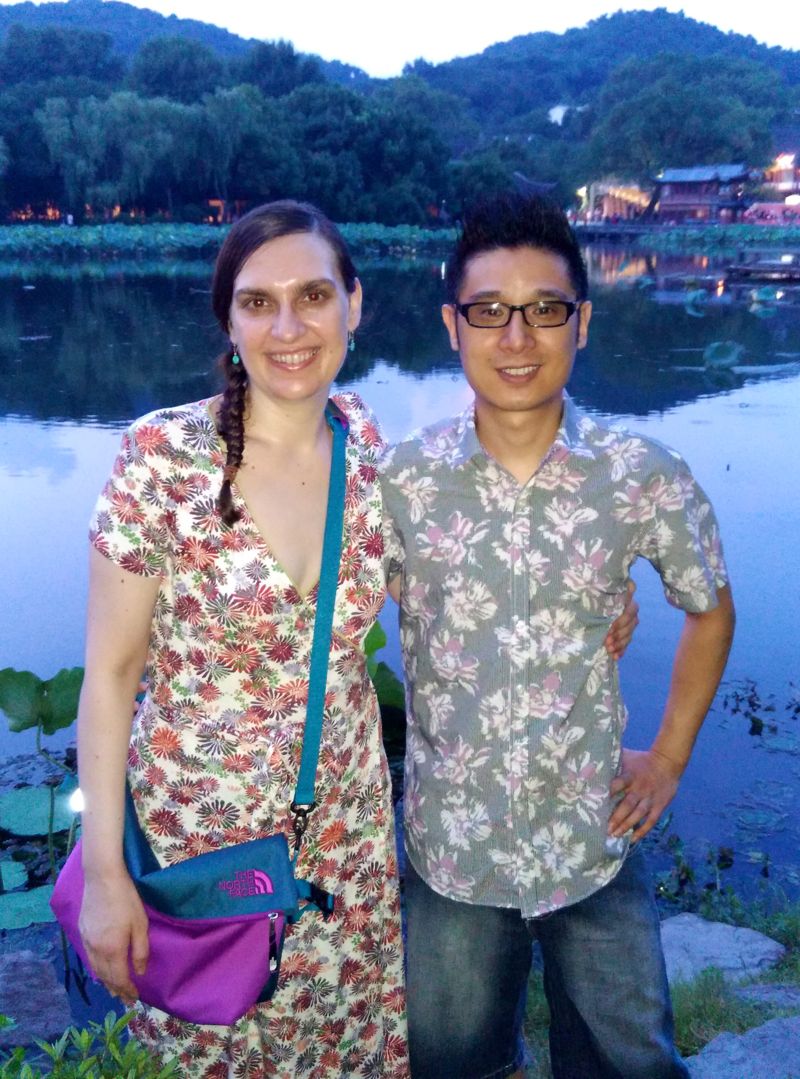
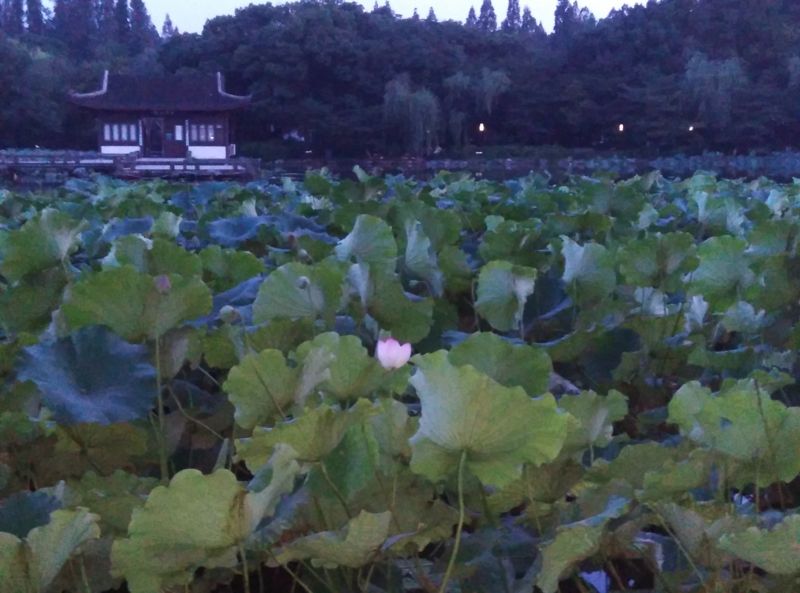
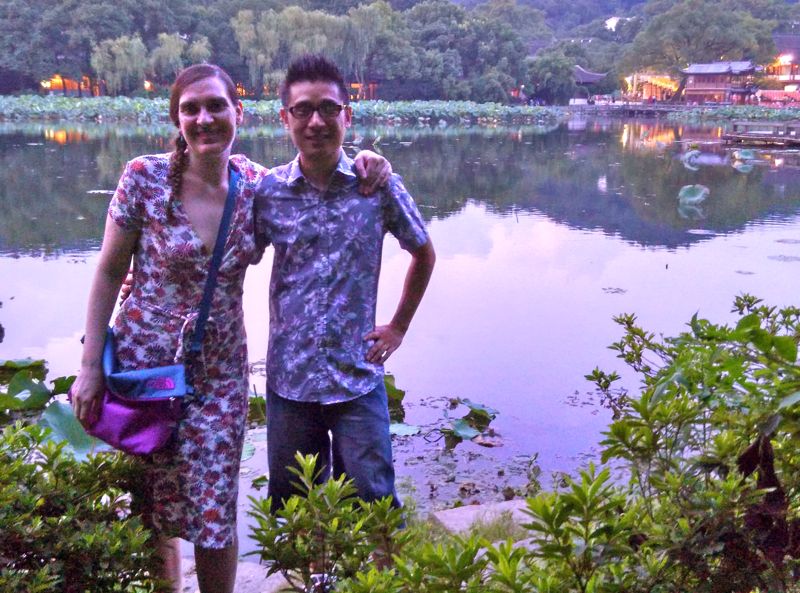
Come evening, however, John and I dressed up to step out into town — or rather, step out beside the West Lake to marvel in the lotus leaves dappling the lake’s surface as well as the dazzling show of lights from the city.
When July rolls around, I’m guaranteed two things – plenty of sultry summer weather (especially here in Hangzhou, considered one of China’s “furnace” cities) and the yearly round of congratulations from American friends and family on another wedding anniversary with Jun. Nowadays it comes virtually through e-mails and Facebook messages; when we used to live in the US, it would arrive via greeting cards with silver-embossed print and sentimental prose neatly tucked into pale pink envelopes.
As a child and adolescent, I watched my parents mark their yearly wedding anniversaries with the appropriate festivities – fancy dinners out, weekend getaways, and of course gifts like jewelry. I also grew up in a culture so invested in the idea of celebrating wedding anniversaries that there’s an entire etiquette surrounding the appropriate gifts to mark wedding anniversaries. (Did you know, for example, that you’re supposed to give silverware on your fifth wedding anniversary?)
So it might surprise you to learn that whenever someone congratulations me on our wedding anniversary, sometimes it feels strange.
Why would something I was raised on now seem foreign to me? Well, there’s a personal reason for that – namely, my Chinese husband John. He doesn’t celebrate wedding anniversaries, which is how people are in China. And after years of being married to him, the idea that wedding anniversaries demand celebrations has fallen off my radar.
Why is it that people here don’t celebrate wedding anniversaries? Well, given that people in China hardly celebrate their own birthdays (or, for that matter, birthdays of family/friends), is it any shock that wedding anniversaries don’t count as a significant event? I wonder if it has to do with attitudes towards love and marriage here. In China, love is something implied, inherent in any marital relationship. It doesn’t need to be restated again and again (the way Americans and other Westerners can’t stop saying “I love you” to their spouses or partners). By that rationale, maybe it doesn’t need to be celebrated in some obvious, Hallmark kind of way either.
The thing is, as blasphemous as it might sound, I like the simplicity of this all. I like the fact that a wedding anniversary doesn’t require the cards, dinners out, getaways or gifts. I like knowing that, here in China, my anniversary isn’t something in the spotlight. It’s something that’s private and personal. Something that John and I can celebrate however we want to.
John and I may never mark our anniversary the same way my parents used to – and that’s okay in my book. The most important thing is that we’re still together as a couple, still married for over 11 years (yes!) and still crazy in love.
When I stepped into our muggy kitchen the other night to start dinner, I never guessed my husband, Jun, a native of the Hangzhou, China, region where we live, would turn up the unbearable summer heat with one simple statement.
“The other day, my aunt asked me when we’re going to have a baby.”
Suddenly, I felt my blood pressure rising like steam from the sizzling wok before me. “Why are you telling me this?” I snapped back.
“I just want to prepare you, so you’ll have a thicker skin. My relatives are all waiting for us to have a child.”
I let out an exasperated sigh. “As if I needed another reminder.”
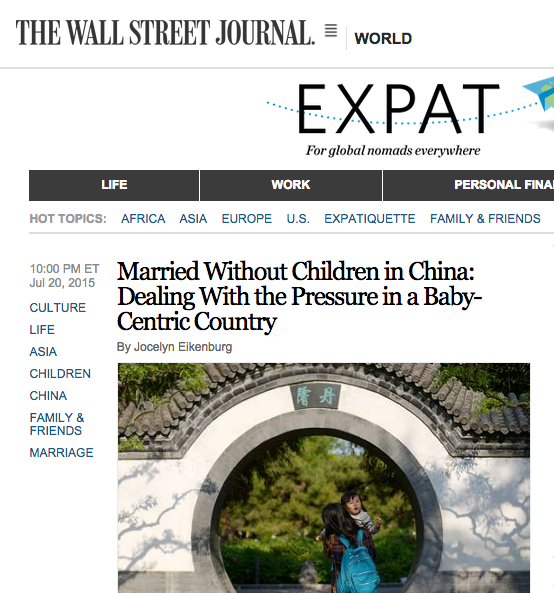
In China, “Are you married?” and “Do you have children?” can be the equivalent of asking, “How are you?” An American who met my husband while working at an Internet company in China, I never cared what his family said about us when we lived in the U.S. – oceans and time zones away. But since we moved back to China in 2013, I have gradually collected all these “reminders” until they accumulated painfully in my mind.
If my July 2015 was a person, it would be one of those diehard boot camp sergeants yanking you out of bed at 5am and hounding you into exhaustion. Welcome to my busy summer (and please excuse me if I happen to keel over in the middle of this blog post).
Fortunately, one of the joys of blogging for more than six years is that you’ve amassed a wealth of content (including a lot of cool articles that, chances are, many of you haven’t read yet). This week, I’m sending you to the archives to enjoy three of my classic articles from 2011, which are also personal favorites of mine:
My Chinese Husband Calls Me Laopo. Ever since John and I began dating, “wife” turned into one of his favorite names to call me. And even though it sounded like the verbal equivalent of turning a marriage into a form letter, I came to love it.
I Love You, Just Not in Chinese. Years before, I was surprised to learn that, for John, it was easier to say “I love you” in English rather than Chinese. Read on to find out why!
And don’t worry — I finally have a couple of weeks to catch my breath, which means I’ll be delivering a new post to you next Monday. Have a great week and enjoy your July!
It’s a familiar phrase we’ve all heard time and again applied to relationships that failed. He wasn’t good enough for her. She couldn’t commit to anyone. They were always arguing.
But what if someone says this ONLY because it was an interracial and intercultural relationship?
Yikes.
Yes, when you choose to date outside the lines, even your breakup attracts a level of scrutiny that nobody should have to endure during this painful time.
What are some of the myths about failed interracial and intercultural relationships? Here are three major ones:
Myth #1: Racial and/or cultural differences mainly caused your breakup
Back when I started dating Chinese men years ago in China, I didn’t just encounter surprised looks from fellow foreigners; I also learned that many foreigners assumed it could never work out. Why? Because they believed the cultural differences were too great and would eventually bust our relationship.
Just substitute “racial differences” for “cultural differences” – that’s what you’ll hear back places like the US (and other Western countries) for relationships like mine.
Can race or culture play a role when interracial and intercultural relationships fail? Yes, sometimes. Race might get in the way if, say, your girlfriend’s racist grandpa won’t leave you alone about the fact that you’re Chinese. And I’ve met many a yangxifu (foreign wife of a Chinese man) griping about how their in-laws or even husbands don’t agree with them on how to raise the kids (sometimes, to the point of a divorce).
But it’s wrong to assume that race and/or culture is always the culprit for a breakup or divorce.
I wanted to show how people sometimes justify their relationship problems as cultural differences when they are involved with someone from another country. This happens with people from all over the world and isn’t unique to Asia by any means. What I’ve learned is that when something doesn’t sit well with someone, it doesn’t sit well. It doesn’t matter if this issue stems from a cultural difference or a personality one. Respect is crucial for a successful relationship.
Exactly!
Myth #2: You’ll never want to date someone else like your ex
Years ago when I first came to China, I fell fiercely in love with a Zhengzhou native who quickly became my steady boyfriend. I had never fallen so hopelessly in love with a man like this and I was completely charmed by him – from his rugged James Dean good looks to the romantic way he would wine and dine me out on the town. (For the first time in my life, I even pondered the prospect of marriage with him.)
Well, it all came crashing down on me months later when, while he studied abroad in Europe, we broke up. I wept for days over what I had secretly dubbed my first real adult love, asking myself again and again how this could have happened?
But not once did I ever say to myself, “I’ll never date Chinese men or Asian men again.”
Yet I’m sure some folks read that story and concluded something like this: “Good god, why did she marry that Chinese man? She should have known it would never work.”
Yes, Kim Lee and Li Yang, a cautionary tale of why you should never date people outside the racial/cultural lines.
You could arguably say the same about Susan Blumberg-Kason’s memoir Good Chinese Wife, the heart-wrenching tale of her own personal “love affair with China gone wrong.”
But is it fair to come to these conclusions? Personally, I don’t think so.
It’s always a foregone conclusion that when people get together, a certain percentage of them will eventually break up or divorce. It happens all around the world. I’ve seen it happen in the yangxifu community in China over the years too (including this very public divorce).
Divorce or breakup doesn’t have to be the obvious conclusion to an intercultural or interracial relationship. So why should anyone use a broken up or divorced couple to represent every intercultural or interracial relationship?
Meanwhile, those people who do break up or divorce have enough trouble to deal with – heartache, stress and, in the case of divorce, all sorts of unpleasant legal issues that will keep you up late at night. The last thing they need is someone holding them up as a “bad example” or another “I told you so!”
Ugh.
As I often say on this blog, love just happens – and sometimes, it happens to create an interracial or intercultural couple.
Whether you’re happily coupled up, contemplating a split, already apart, or hoping to land your perfect partner, here’s hoping for a little less judgment and a little more understanding in the world for all of our messy, imperfect but ultimately beautiful lives.
When John first told his parents about me, here’s what his father said: “You can be friends with foreign women but not date them.”
Anxious doesn’t even start to describe the way I felt after John said this to me. And, believe me, I had reason to worry. My previous relationship with a Chinese guy ended in an ugly breakup simply because he could never take me home to meet the parents. He said his mom and dad would never accept having a foreign woman in the family. Ever.
Yikes!
Growing up in a very white, very middle class suburb of Midwestern America did nothing to prepare me for surviving meeting the parents in China. It’s the complete opposite from the casual way I used to shake hands and chat with a white guy’s mom and dad back in America, even on the first date! How was I supposed to know that meeting the parents in China was as serious as an engagement announcement, a promise of wedding bells in the near future? For that matter, how could I have ever guessed on the many other cultural pitfalls on the pathway to becoming the foreign wife of a Chinese man?
Here are four things that I’ve found challenging about meeting the parents and family in intercultural and international relationships:
1. When the Family Doesn’t Want You to Date
When your boyfriend’s father says you should be friends but not date, it’s the polar opposite of getting that ever-coveted family blessing. And even if your boyfriend smiles and reassures you it’s not a big deal (like John did), in your mind you’re envisioning all of the future family feuding over your relationship. And, quite possibly, a breakup on the horizon.
Sigh.
Yes, it’s a huge headache and then some. Still, John and I survived it, all because he insisted on staying by my side. (Never thought I would say this, but thank goodness for John’s stubbornness!) We’re living proof that you can indeed overcome this, provided you and your partner are totally committed to the relationship. Just realize you might be in for a very bumpy ride if the parents initially say “no” – the kind that could make the movie “Meet the Parents” look like kindergarten stuff.
2. When Relatives Say Totally Inappropriate Things About Your Relationship
“Are you happy about those secrets?” said a voice from beside me.
“What? I’m sorry?” I said. It was my girlfriend’s grandpa.
“The nuclear secrets. I know you came here to steal from us,” said her grandpa,
“I go to school…” I say, protesting.
“You’re Chinese, I know you are,” he says quietly, triumphantly, like he’s got me checkmated.
“Yes,” I say, now seriously confused, not quite believing what I’m hearing.
Oh my. There’s nothing like a racist comment or two from grandpa to turn meeting the family into one of the most chilling experiences you’ll ever have.
Sometimes it’s not even a direct attack, but an assumption based on stereotypes or prejudice. Like how I’ve heard some relatives praise John for being great at computers (because, of course, all Chinese are that way….). If only they knew that my husband calls on me for all things computer and tech-related. (I’m the one who just set up his new smartphone!)
People have even expressed concern about the fact that John and I have a bilingual relationship, and have cautioned us against speaking one language too much over another. (Insert image of me banging my head on a wall.)
What makes this super-hard is the fact that you’re often related to the people in question. You’re not exactly going to win points with family by calling grandpa a racist.
That doesn’t mean you always have to let these things go. Over the years, I’ve had some really thoughtful conversations with family about racism and prejudice. John and I have educated relatives about what modern racism actually looks like (it’s not what you think it is) and, in the process, become even closer as a family. Who’d have thought you could bond over stuff like this?
3. When the Family Gets Confused by Your Relationship
@jossailin I don’t think our families could comprehend our relationship at first. They were too confused by it. 😛
— My Chinese Boyfriend (@MyChineseBF) May 15, 2015
I don’t think our families could comprehend our relationship at first. They were too confused by it. 😛
What happens if parents aren’t in opposition to you, but they just don’t understand why you would want to be with this person?
I’ve only ever experienced this with other expats – people totally mystified by how a white American woman would even think of dating Chinese men in China. Let me tell you, it already hurts even when someone you’re not related to suddenly thinks it’s weird to date this amazing person you’re deeply in love with. I can only imagine the pain you’d feel when people who you’re stuck with by marriage or blood think this way about your relationship.
Love just happens between two people for good reasons. Why can’t the people we care about understand why we love someone as well?
Of course, it’s unrealistic to think that everyone will always understand us 100 percent of the time, including relatives. Which means that some of us will get the questions and odd looks from family when we decide to date “outside the box”, so to speak.
I don’t know that I can say anything to make a situation like this better. I’d like to hope that things will get better for you with time, and chances are they will, but who really knows?
Still, whatever challenges you face with the family, remember that you’re not alone. There are lots of people out there in interracial, intercultural and (like in my case) international relationships who have survived all sorts of familial scrutiny. People like me, who have lived to tell the tale – and will be happy to listen to your stories, nodding as we say, “Yes, I’ve been there and I’m here for you too.”
This website uses cookies to improve your experience. We'll assume you're ok with this, but you can opt-out if you wish.AcceptRejectRead More
Privacy & Cookies Policy
Privacy Overview
This website uses cookies to improve your experience while you navigate through the website. Out of these cookies, the cookies that are categorized as necessary are stored on your browser as they are essential for the working of basic functionalities of the website. We also use third-party cookies that help us analyze and understand how you use this website. These cookies will be stored in your browser only with your consent. You also have the option to opt-out of these cookies. But opting out of some of these cookies may have an effect on your browsing experience.
Necessary cookies are absolutely essential for the website to function properly. This category only includes cookies that ensures basic functionalities and security features of the website. These cookies do not store any personal information.
Any cookies that may not be particularly necessary for the website to function and is used specifically to collect user personal data via analytics, ads, other embedded contents are termed as non-necessary cookies. It is mandatory to procure user consent prior to running these cookies on your website.