The Love Stories of East German Women and North Korean Men in New German Documentary “Loved, Engaged, Lost”

Loved Engaged Lost German DocumentaryWhen North Korea sent some 357 men over to the former East Germany in the 1950s to train them, the two countries also unexpectedly set in motion some of the most dramatic and bittersweet stories of forbidden love that I’ve ever encountered.

For example, consider the case of Renata Hong, who waited for 47 years before reuniting with her husband in North Korea:

Renate returned to Germany on Tuesday after a 12-day reunion with her long-lost husband in North Korea – a highly unusual episode given the Communist government’s policy of keeping most of its people without mail or telephone links to the rest of the world, not to mention the Internet.

Traveling with Renate were their two sons. Peter Hyon Zol was 10 months old, and Renate was pregnant with Uwe, when the family broke up in the vortex of the Cold War.

Renate Kleinle and Hong Ok Geun met in 1955, when they attended the same freshman chemistry class at Friedrich Schiller University in Jena, East Germany. Hong was a humorous exchange student from North Korea, then East Germany’s Communist ally.

They fell in love. Because both governments frowned on marriages between North Korean students and East Germans, the couple married in 1960 in a rural town where the local authorities were unaware of the national government’s policy. There were no guests.

The couple’s happy time lasted only one year, however. In 1961, the Pyongyang government recalled all 350 of its students in East Germany, a measure believed prompted by a few North Korean students’ defections to the West. Hong was given 48 hours to pack.

Holding 10-month-old Peter, Renate bid a tearful farewell to Hong at the Jena train station.

I’m tearing up just imagining that scene for myself.

Well, German filmmaker Sung-Hyung Cho stumbled upon Renate’s love story and it inspired her to discover more of these couples, ultimately leading to a new documentary film released in June 2015 titled “Verliebt, Verlobt, Verloren” (“Loved, Engaged, Lost”). Here’s the trailer on Youtube for the documentary film, presented in German (folks in China, you’ll need a VPN to view it):

I’ve also discovered an excellent interview with Sung-Hyung Cho about the film. Here’s a snippet:

DW: What was the idea behind the film?

Sung-Hyung Cho: The story of Renate Hong was very popular in South Korea. In 2006, her story became the talk of the town after a South Korean historian – who had conducted some research in Jena about the relationship between North Korea and East Germany – met Renate Hong by chance.

She narrated her story, and he propagated it on the Internet. The response was overwhelming. The Koreans were blown away by the sad but beautiful love story.

Most Koreans, myself included, know the story. Moreover, I was greatly interested in knowing and better understanding former East Germany. I also wanted to know more about North Korea, even if only indirectly.

Have you ever heard about this fascinating chapter of AMWF history between Germany and North Korea? And, for those of you who have seen the film, what did you think of it?

P.S.: Thanks to Ruth of the wonderful blog China Elevator Stories for tipping me off to this!
Can Interracial and Intercultural Relationships Be a Transcendental Experience?

13925672946_4c22373bed_z

Recently, I shared the story of my own unlikely pathway to marrying a Chinese man, including what I originally thought of Chinese men before coming to China, in an opinion piece for the China Daily. Here’s an excerpt from that:

When I think back to the months I spent in preparation for that year of teaching English in Zhengzhou, I draw a blank on Chinese men, apart from one simple thing. I assumed they weren’t dating material for me, and I wasn’t alone. An American man who had once taught in China famously told me, “You don’t have to worry about the students falling in love with you.”

It made sense to me. I had only ever forged friendships with foreign Asian men at my university, feeling romance was never a possibility, and had yet to move past “Hello” with any of the Chinese men on campus, who almost never noticed when I smiled or waved at them while passing by on the way to classes. I never saw white women dating Asian men on television or in the movies. Even the handful of Asian men who went to high school with me in my very white, very middle-class suburb didn’t seem to date anyone, let alone a girl like me. It was as if the universe decreed that there was a racial and cultural line that I was never meant to cross if I wanted to find love.

Yep, in my mind, white American girls like me just didn’t date Asian men, let alone Chinese men. And when I read stories like Why Did I Assume I’d Never Find a Man to Date in China? from Rosie in Beijing, I know I’m not the only one.

But beyond all expectations, love happened to me in China – and it was a love deeper and more passionate than anything I had ever experienced before. It was as if I had never truly loved before. Here was China, giving me a real-life lesson in what it actually meant to be intimately connected with someone else.

None of this would have happened if I hadn’t opened my heart to the possibility of love – if I hadn’t transcended my own past assumptions and biases about dating in China.

For me, the interracial and intercultural relationships I’ve enjoyed in China – including, most of all, my marriage to John – have been a transcendental experience. They’ve allowed me to go beyond what I used to believe about Chinese men and Asian men, and have made me more aware of how prejudices and stereotypes against certain racial groups still loom large in the dating world.

Granted, I know that one person isn’t a lot. But I’d like to think that every time someone like me ends up loving beyond their own boundaries — their own perceptions of what it means to be in love – it brightens our world a little more.

Do you think that interracial/intercultural relationships can be a transcendental experience?

Pub’d on The Wall Street Journal: “Mom, If Only You Could Have Known the Expat I’ve Become”

WSJ_JEikenburg_MomThe Wall Street Journal just published my article titled “Mom, If Only You Could Have Known the Expat I’ve Become” (which was inspired by a blog post I ran earlier this year to coincide with Mother’s Day) on their Expat Blog.

Here’s an excerpt from the piece:

My heart aches as I stare down at my old Dr. Seuss Cat-in-the-Hat doll, now covered in splotches of mold. I chastise myself for burying it in the closet: How had I forgotten about the ferocious humidity of Hangzhou, the Chinese city I once called my home and whose climate ultimately claimed this most precious of childhood relics from my late mother. She never imagined this doll would follow me to China.

I was only 17 years old when she died of cancer. At the time, there was nothing to suggest I would end up in China, though China would eventually become a part of me, giving me a home, a career, and a husband.

Read the full article at The Wall Street Journal. And as always, if you love it, share it!

I Was Just on TV in China. Now Watch the Show Online!

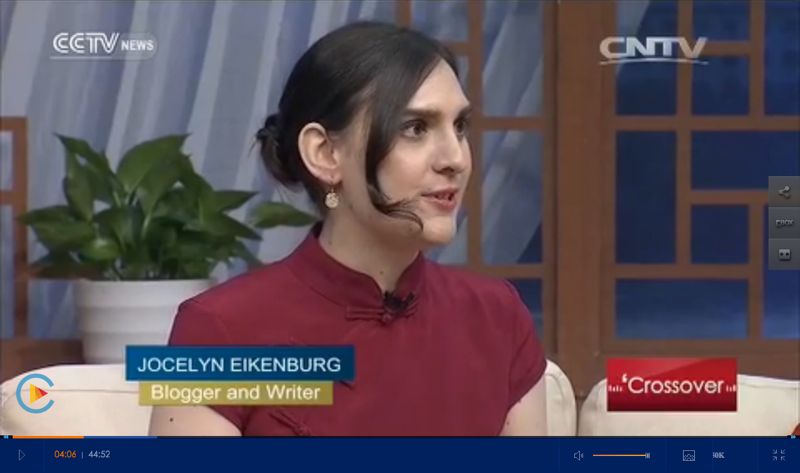
Jocelyn Eikenburg on CCTV Crossover_closeupChina Central Television just broadcast the episode of “Crossover” on Foreign Wives in China that I blogged about last week, and it’s now available for streaming online. Hooray!

So for any of you out there who wonder what I look like and sound like in person, well, here’s the next best thing. You’ll also see the “magical dress” in action and that lovely pair of earrings that the host Eyee Hsu lent me on the set just before we started filming (see my first post on this TV appearance for the full “backstage” story).

Besides me, you’ll also have the opportunity to meet two other amazing yangxifu: Marie Smurthwaite and Jess Meider (who I just featured on the blog).

Jocelyn Eikenburg on CCTV Crossover

Click here to stream the show online. And once you’re finished watching, sound off in the comments to let me know what you thought about the show!

Pub’d in the China Daily: I Never Expected to Marry a Chinese Man

IMG_2145

The China Daily, China’s major English-language newspaper, invited me to write a piece on my cross-cultural marriage — and they’ve just published it on their site. Titled “I Never Expected to Marry a Chinese Man“, it covers everything from how I assumed I would stay single in China to some of the cultural differences in dating and marriage I’ve noticed over the years.

Here’s an excerpt from the article:

The idea of dating or marrying a Chinese man never really crossed my mind before I first came to China in 1999. That’s probably the last thing you expected to hear from a woman known for writing and blogging about her marriage to a Chinese man, but it’s true.

When I think back to the months I spent in preparation for that year of teaching English in Zhengzhou, I draw a blank on Chinese men, apart from one simple thing. I assumed they weren’t dating material for me, and I wasn’t alone. An American man who had once taught in China famously told me, “You don’t have to worry about the students falling in love with you.”

You can read the full article at the China Daily. And as always, if you love it, share it!

Watch Me on China Central Television (CCTV) Saturday Sept 26

mmexport1433086245275

Back in June, I blogged about being invited to be a guest on the China Central Television (CCTV) English-language show “Crossover” for a show all about the foreign wives of Chinese men.

I’m thrilled to report the show will finally be broadcast in China on Saturday, September 26 at 10:15pm Beijing Time on the CCTV News channel. (Not to be confused with the CCTV 13 channel — the CCTV News channel is in English and it’s listed simply as “CCTV News” without a number.)

Now, I know a whole lot of you out there aren’t in China, but are still dying to see the show. No problem! Just head on over to the “Crossover” website on CCTV, where you’ll find the full episode available to watch online. (I’ll also make sure to post a link to that episode after it’s up on the website.)

To all of you who plan to tune in, thanks in advance for watching! 🙂

From the Archives: Loving Smiles and Surprises from China’s Countryside

IMG_2426

Today, I’m heading off to the family home in the countryside for a little break from the hustle and bustle of city life, not to mention the work that has kept me incredibly busy for the past few weeks. And just recently, a close friend who reads the blog told me that one of his favorite posts was The power of a smile in China’s countryside. So I thought, this might be a good time to bring it out of the archives, along with another one of my personal favorite posts about countryside life.

I’ll be back next Monday. In the meantime, enjoy the following:

The power of a smile in China’s countryside. My husband reminds me that, no matter what difficulties you’ve encountered in life, there’s still room for a smile, a nod and a little small talk. Sometimes, it’s also the best remedy for those sad and lonely days I experience here in China, where the world seems crazy and unfair and impossible.

8 Surprising Things I’ve Learned from Living in China’s Countryside. It’s amazing how you can adapt and learn in a new environment. Over time, I’ve found myself feeling extremely at home in this home and this village. And in the process, I’ve experienced and learned things that, when I think about the woman I once was back in the US, really surprise me at times.

My Family Recipe for Vegan Chinese Shaobing (Stuffed Flatbread), Featured on The Almost Indian Wife

Featured on The Almost Indian WifeThe Almost Indian Wife just featured me on Family Fridays, where I shared my own family recipe for vegan Chinese shaobing (stuffed flatbread), a snack food I’ve learned to prepare from my mother-in-law. Here’s an excerpt:

One of the coolest things about my mother-in-law is that she’s totally accepting of my vegan lifestyle. I never expected that a woman who grew up in Hangzhou’s mountainous countryside – where people tend to be pretty traditional when it comes to food – would embrace my dietary needs. But she does. Maybe it’s because the two of us have really bonded over food. I love asking her about her secrets for, say, crispy tofu or spicy pickled daikon radish. But when I discovered that one of the local snack foods was shaobing, a fried flatbread stuffed with savory salted veggies and then pan-fried until crispy, I knew I had to learn how to make it myself!

Most shaobing include bacon-like bits of fatty pork, making the food typically off-limits to vegans like me. But thanks to my mother-in-law, I’ve learned an amazing recipe for vegan shaobing. It’s even a little reminiscent of pizza back from home, so much so that I often jokingly call it “Chinese pizza”.

FYI, here’s what the shaobing look like when they’re done:

IMG_1944

Head on over to The Almost Indian Wife for the full post and recipe. And if you love it, share it!

People Who Feel Like They Own the Opposite Sex of Their Race and Culture

mmexport1439450389962
This photo of a marriage registration in Beijing was taken two days before the woman was stabbed to death by a Chinese man who hated Americans. I wondered, did he mean “American men” by that, and was he another example of someone who thinks they own the opposite sex of their own race/culture?

It’s funny how things in life mysteriously collide – that two seemingly unrelated events I’ve heard about recently actually have something in common. Specifically, the concept of people who feel like they own the opposite sex of their race or culture.

The first is the stabbing murder of an innocent Chinese woman in Beijing just married to a French man, a confirmed hate crime prompting my recent post, Is Beijing Becoming Dangerous for Couples of Foreign Men and Chinese Women?

In the discussion in the comments section, I noticed that people started linking this murder to the idea of people who feel like they own the opposite sex of their race/culture. See this comment from A. Madhavan:

I can’t help but notice the deep misogyny in this murder – many times when we date out of our race/nationality, men of our race will try to “claim” us and shame us for dating/marrying outside of it. As if we are pieces of property and only belong to them. I have seen this happen with white men to white women; black men to black women; Indian men to Indian woman – how dare a [sic] we women marry outside her race and have complete autonomy over our decisions? It is threatening to A LOT of people…

And this comment from R Zhao:

This sometimes happens in America, too. It happened to me when I was dating a black American man. I was accused by a small group of black women (who I didn’t know) of “taking one of theirs.” I didn’t realize it at the time, but I think there is a lot of frustration. Black women face a lot of discrimination while dating and have a significant smaller dating pool than white women do because of cross-race dating preferences. This happens to Asian men as well.

To be sure, there is a shortage of women here in China because of the gender imbalance, leading to a growing population of unmarried bachelors in China’s countryside known as “bare branches”. According to this article from Tea Leaf Nation, “an estimated 12 to 15 percent of Chinese men — a population nearly the size of Texas — will be unable to find a mate within the next seven years.” Personally, I’ve even heard Chinese men who lament that China is “exporting” far too many of its women overseas.

The Shanghaiist confirms in a recent story that the Sanlitun killer “said he ‘hated Americans’ before attacking Chinese-French couple in Beijing,” specifically asking the woman’s husband if he was an American before stabbing him and his wife. And while it’s never explicitly stated, I can’t help but wonder, does this man represent the anger and frustration of millions who feel a certain entitlement to Chinese women over foreigners because of the shrinking dating pool?

Obviously, this is an incredibly complicated and potentially delicate issue, depending on who you are and whether you’re one of the folks facing a more limited dating pool simply because of your race and/or culture.

What’s your take on this? What do you think about the idea of people who think they own the opposite sex of their own race/culture? Is it ever justified? Sound off in the comments.

UPDATE: I’ve edited this post because that some of the content was inappropriate and insensitive towards the Jewish community. I made some poor choices in what I had written and failed to consider how my words might actually come across to readers (including the individuals I had specifically mentioned in this post). I want to apologize for this mistake.

Thank you to those people who were courageous enough to reach out to me to point out the errors in the original content. I wanted to append this apology to let you know I’ve learned a tremendous lesson in the importance of being sensitive about how groups of people are portrayed on this blog, as well as what should and should not be quoted in posts. 

Why Did I Assume I Would Stay Single in China?

Earlier this month, Rosalie (the blogger behind Rosie in BJ) publicly explored some of her own prejudices in a post titled, “Why Did I Assume I’d Never Find a Man to Date in China?

As I was reading her article, I suddenly realized that I too had a pre-China backstory worth sharing – one of relationships that never came to be, and what ifs that point to my own prejudices. So here goes:

—–

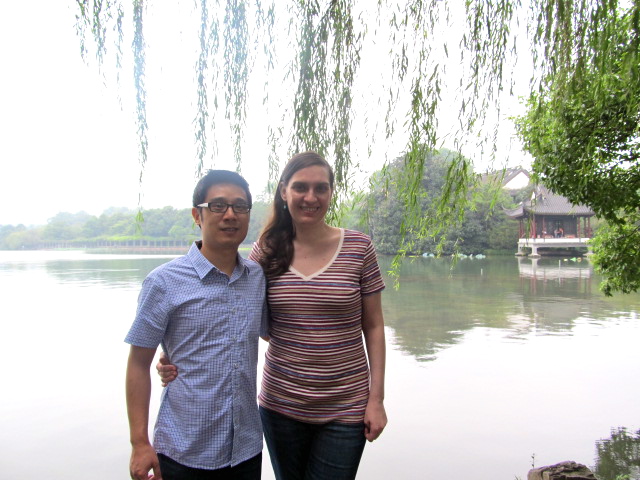
In coming to China, the last thing I expected was to end up dating a local guy, let alone marrying one (as I ended up doing with John, pictured here with me). Why?

“You don’t have to worry about the students falling in love with you.”

Before I embarked on my first trip to China, where I would teach English at a college, I met up with one of the former teachers several times for dinner or drinks. And when the subject of student crushes came up – something he had been forced to navigate very delicately – he negated the possibility of anything similar happening to me.

Of course I didn’t question his words. Hadn’t I already envisioned my year-long assignment much like a vow of chastity? I spoke to friends of my interest in studying Tai Chi over there and visiting some local temples, as if I were about to spend my months as a nun instead of an English teacher. It was an opportunity to travel to a new country, a way to postpone my post-graduate dilemma regarding career decisions, and nothing more than that.

Or so I thought.

Then I moved to Zhengzhou, China – and found myself with a crush on one of the first guys I met there, a former student from the program I would teach for. Over a month later, he introduced me to his friend, a guy who was also a former student – and would become so much more to me in the weeks that followed:

Yao came into my life, in all of his sleek, sexy and sullen James Dean perfection, dressed in a black leather jacket as dark as his mysterious melancholy. When my heart raced after our first dinner together, I thought it was just another adolescent crush. Embarrassed, I wanted to just box my feelings away like all of the Barbie Dolls and little girl hairclips of my past.

Then he took me to that teahouse one Sunday afternoon. Over two Taiwanese bubble teas, the truth bubbled through to the surface of my own heart — I loved him with an uncontrollable depth that plunged far beyond the bottom of my tea cup. And, I began to realize, so did he, because he overflowed with confessionals that he had never before poured over with anyone else.

Not long after, our our passions percolated over into romance — a real boyfriend/girlfriend love that translated into steamy weekends at his apartment, hand-in-hand walks around the gardens of Zhengzhou University, and the occasional afternoon out at the Taiwanese teahouse, his favorite in the city. Bubble tea never tasted so sweet.

In his arms, it was so easy for me to forget that I had once secretly declared this year a lonely one without a single chance for dating. And it was also very easy for me to turn a disdainful eye to my female coworkers at the school, all Americans who had no interest in the local men.

I couldn’t help but wonder, why did I assume that I would be single in China? Why did I think I would never date Chinese men? Was it merely that I grew up in an incredibly white middle-class suburb (I could count on one hand the Asian men I knew from kindergarten to high school graduation)? Was it the overwhelming absence of positive images of Asian men in the whitewashed world of American popular culture?

I think back to my college years, a time when I met many foreign Asian men – including Japanese and Cambodian. I called many of them close friends, yet why did I never let them get any closer to me? Why did I always immediately relegate them to the “friend zone” and nothing more? Why did my white girlfriends and I only giggle over white celebrity heartthrobs in high school, like Tom Cruise?

It’s just not right.

All I know is this — in China, I found the sexiest and most amazing men that I had ever known. I ended up marrying one and I’m still crazy in love with him. (Thank you, John!) It took crossing an entire ocean and time zones to realize that my assumptions about dating in China were a lie.