Last week passed in a huge blur as July entered my life, along with a lot of new things that will keep this blogger SUPER busy through the entire month! That’s why I’ve been late to tell you about an article published in late June that I’m sure will resonate with many of you: Debunking the “Model Asian” Myth: Five Ways Asian-Americans Still Face Discrimination.
The accomplished Kaitlin Solimine (she’s also a contributor to the new anthology How Does One Dress to Buy Dragonfruit) asked me a few months back about doing a piece for HIPPO Reads, a website known for “Real World Issues, Academic Insights.” Originally, it all started when I shared an article about the bias against Asian students in academia (one of the most shocking findings from a recent Wharton School study) and she brought up doing a guest post for HIPPO Reads. So I said, “Sure, I’ll do it.”
Well, the article soon morphed into something far beyond the problems that Asians face in higher education in America, and now offers a more comprehensive snapshot of the many ways Asians just aren’t getting ahead in America (despite the “model minority” label Americans love to attribute to Asians).
In April 2014, the public was collectively shocked when University of Pennsylvania’s Wharton School unveiled the results of a study examining racial gender biases in faculty mentoring. This finding particularly struck a chord: “We see tremendous bias against Asian students and that’s not something we expected. So a lot of people think of Asians as a model minority group. We expect them to be treated quite well in academia, and at least in the study and in this context we see more discrimination against Indian and Chinese students than against other groups.”
For most of the American public, such a finding was confounding. After all, for many Americans, it seems Asians reign at elite colleges and universities and go on to live the American dream. Eugene Volokh, for example, in this Washington Post piece, points to the overrepresentation of Asians at the Silicon Valley behemoth of Google as an example of “how the Asians became white.”
Statistics can be deceptive, just like our own stereotypes about Asians in America. If Americans think Asians have truly made it—or even have an unfair advantage—perhaps it’s time to think again:
In my mind, soccer — also known as football — is synonymous with romance. That’s because it’s the relationships I’ve had in China (especially my marriage to John) that introduced me to the sport and made me a fan.
(photo by Chris Brown via Flickr.com)
Who’d have thought that the woman who in 1994 had no idea the US was hosting the World Cup now has her own list of can’t-miss matches for this year’s World Cup in Brazil?
Before I came to China, and starting dating the men here, the World Cup — and, for that matter, the entire sport of soccer — was completely off my radar. I knew what a soccer ball looked like and had a handful of girlfriends who played in kids’ leagues growing up…and that was about it. In fact, when I first arrived in China in August 1999, the name David Beckham meant absolutely nothing to me.
All that changed in the fall of 1999 with my first relationship with a guy named Yao, where I spent part of my weekend evenings snuggled in his arms as we watched the English League soccer matches. He schooled me in the rules of the game, the best teams, and of course, all his favorite stars (including, of course, David Beckham). We even played the FIFA soccer video game together a number of times.
As it turned out, Yao was no exception. Every single man I’ve dated in China — especially my husband John — has been a big fan of the sport. In fact, John even famously cut work during the summer of 2002 just to watch matches. Yes, that big.
Now I’m not saying that every Chinese man here in China will go to that extreme for soccer — or even likes the sport. But there’s a good chance that any man you meet here will be a fan of some kind.
So if you’re going to fall in love with a fellow from the Middle Kingdom — and you’ve never been into soccer — get ready to experience a different kind of relationship with the sport (one with decidedly Chinese characteristics).
Here are four things you should know about soccer and Chinese men if your sweetie is a fan:
1. Get ready for some late night soccer time (including when you least expect it)
(Source: http://www.cqnews.net/)
John often says, “Chinese soccer fans have the hardest time.” Take a look at the scheduling of the matches in Beijing time and you’ll understand why.
Essentially, China gets “the graveyard shift” of all World Cup scheduling. Matches start at either 12am, 3am, 4am or 6am.
My eyes are already going bloodshot just reading those kickoff times.
Chinese fans don’t even get a break during the official soccer season in the European leagues, where the games kick off late into the evening or after midnight or even in the middle of the night. Remember the UEFA Champions League Final last month in Lisbon? If you wanted the privilege of watching Ronaldo score goals in real time in China, you would have had to wake yourself up at 2:45am in the morning and then survive more than two restless hours before it was all over.
But anyone who knows China’s history also knows the Chinese people never flinch from a challenge — including when it comes to watching soccer matches. This is why as I write this, there are literally tons of sleep-deprived soccer fans scattered across China, including the really hard core folks who will stay up all night to catch World Cup matches. (It’s a dangerous occupation — three people have already died from staying up multiple nights in a row.)
Fortunately, John isn’t crazy enough to give up his life over some World Cup matches. But yes, almost every night he’s been catching the first half of the soccer games that start at midnight here. And because John is a morning guy (who, without fail, rises and shines sometime after 6am), he often catches the entire last game — if not most of it. And if I’m unlucky, his early morning matches snap me straight out of my dreams and into the hard life of a Chinese soccer fan.
The most infamous experience in our relationship has to be the Euro Cup matches during the summer of 2004 in sweltering Shanghai. Of course, John couldn’t miss the semifinal or final matches, which all started sometime around 3am or so. The flickering of the TV and the hum of the crowds in the background became the late night wake up call I never asked for. I remember mumbling something to the effect of, “What are you doing?” Up until that moment, I never knew that my husband would actually sacrifice part of his nighttime rest just to enjoy the excitement that comes when the announcer screams, “Goooooal!”
But then again, I’m just as guilty. Wasn’t I the one who dragged John out of bed for all of those early morning matches during World Cup 2010? And wasn’t I the one checking the score well after midnight the other night in the Argentina versus Iran match while John dozed away beside me? (What can I say? I’m a fan!)
2. You’ll learn the meaning of 2002 and the China World Cup soccer conundrum
China’s national soccer team (photo by Albatross2147 via wikimedia.org)
China’s population exceeds 1.3 billion. So why can’t the country find at least 11 soccer players talented enough to get China to the World Cup finals every time? Call it the China World Cup soccer conundrum, which is something you’re sure to learn about if you date or marry a Chinese man who loves the sport.
John, bless his soccer-loving heart, still dares to watch China’s national team play in real time (usually followed by a string of expletives). I’ve learned all of his horrible nicknames for them (including his favorite, the “head-ball team”), and heard the frustration in his voice when they suffer yet another humiliating loss.
Of course, he’s told me all about 2002, the first time China ever qualified for the World Cup finals — and something you’re sure to learn about from any soccer-addicted Chinese guy. John sums it up in these four disappointing words: no goals, no wins.
Well, with any luck, your home country has qualified for this year’s World Cup finals (and hasn’t been eliminated yet). Maybe you’ll give him — temporarily — some other team to root for. (Sigh.)
3. Your mind will be filled with all sorts of hilarious anecdotes about China soccer that your friends back home will never understand
Huang Jianxiang, World Cup 2006. If my husband wasn’t a soccer fan or from China, this hilarious incident in the China soccer world would never have been on my radar.
It was the Italy versus Australia match on June 26 when CCTV sports commentator Huang Jianxiang went wild on the air during the last few minutes of the match (when Italy scored that decisive goal that allowed them to advance). Between his passionate chanting of “Long live Italy!” and “The great Italian left back” (plus his remarks about not giving Australia any chances), Huang put his own pro-Italian bias on public display. Showing favoritism on the job was a no-no by TV station regulations, leading to Huang’s suspension from working the following match. (He would resign from the station later in 2006.) Huang was unapologetic for his actions, and while some criticized his partiality, the stunt ultimately turn this already legendary soccer commentator in China into one of the most controversial figures of the World Cup that year. Incidentally, the best of his anti-Australia rant (including the “Long live Italy!”) became the must-download cell phone ringtone for Chinese soccer fans everywhere.
Even though this still makes John and me bust out laughing, it doesn’t sound nearly as funny when I have to explain the whole thing to you. Worse, my American friends in the US will probably give me extra blank looks because Americans think soccer is the world’s most boring sport.
Still intrigued? Watch the video for yourself (on Youtube or this China-based site) and see if you find this as hilarious as John and I do.
4. You might just end up like me — another accidental soccer fan, thanks to my husband
I wouldn’t call John soccer-obsessed. But he stays up late (or wakes up early) for certain matches, knows the difference between AC Milan and Inter Milan, fondly remembers watching Maradona play in the 1994 World Cup, and still hasn’t given up on the Chinese national soccer team. He even owns three different jerseys and two pairs of soccer shoes to play the occasional pickup game, a legacy of his university years when he captained his department’s team.
John, showing off his soccer form (and Argentina warm-up jersey)!
In other words, he is a soccer fan for life. And when you spend time with a guy like that, it’s bound to rub off on you.
For me, it’s about learning to love a sport I never expected to love.
To think that once I had the US hosted the World Cup in 1994, and now I know all the big soccer stars from Balotelli and Messi to Neymar and Suarez. I own a T-shirt with US soccer player Landon Donovan’s name on it. Last year, my parents bought us tickets to a friendly match between the US and Belgium for my birthday. I even have favorite teams in this year’s World Cup: Italy, Argentina, Uruguay, France and of course, the disappointing Portugal and (sob) Spain. And let’s not forget that I’ve been checking some late night World Cup scores these days — and even once pulled a half-asleep John out of bed just to watch the World Cup matches in 2010.
I’d like to think the beautiful game is a little more beautiful when you can share it with the ones you love.
And besides, I’m not the only impressionable one in this relationship. Ever since I introduced John to birdwatching back in 2004, he’s now been the one pausing on walks in the parks in Hangzhou to catch of glimpse of a heron or coot.
It’s too bad, though, that our love — and the mutual love of soccer — doesn’t do a darn thing about those past-midnight kickoff times during this World Cup.
When you’re married to a Chinese national, you’re privilege to a lot of things the average expat in China would never experience. The opportunity to be a Chinese bride or groom in an incredibly big, red wedding celebration (emphasis on the “big” and “red”). Spending that explosive holiday of Chinese New Year’s in the family home (where you get to see exactly how folks light those fireworks or learn how to make his mother’s homemade tofu). Watching your sister-in-law raise her only months-old infant and all of the pomp and circumstance this new addition to the family brings with her (such as the 100 days old celebration for my niece).
But then, there are the experiences you get to be privilege to — and wish you weren’t. Like a funeral in China.
How could I have been married to John for nearly 10 years (yes, that’s right, nearly a decade) and never experienced a funeral in China? Luck, perhaps. Or great genes. Sometimes, after seeing many of my close relatives pass away earlier before his — like my paternal grandfather in 2003, and my maternal grandfather in 2011 — and remembering how I lost my own mother at the tender age of 17, I would think of his family somehow like a giant, extended version of the Energizer Bunny that just kept going and going. Of course they would always be there when we returned. Of course everyone would be fine. John’s family was somehow different. (Or at least, I wanted to kid myself into believing that was true.)
But then this morning, our smartphone rang and on the other end was John’s oldest brother, with the news that would usher in my unwanted invitation to this one experience I had never had before (or wanted).
John’s maternal grandfather — his only remaining grandfather — just passed away.
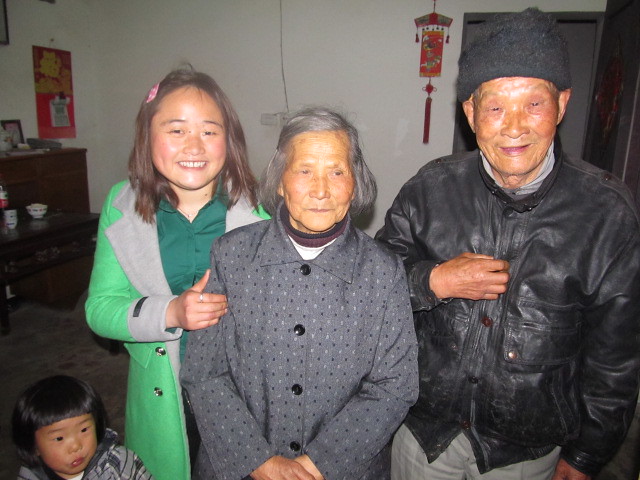
Grandpa at far right, along with Grandma and a cousin.
But shouldn’t we have seen this coming? Once the 2014 horse year galloped into our lives, grandfather kept trotting in and out of hospitals month after month. First it was that Chinese traditional medicine hospital near one of his daughters’ homes. Then it was the hospital in the county seat, where John’s grandmother — who has a heart condition — also joined him for a week or two. Then both of them once again went back into the hospital in the county seat for several weeks in May, only to return to their home the very afternoon before we moved to Hangzhou.
I remember squeezing in that last minute visit only two weeks before to Grandma’s house (Grandma was always the more talkative one, cracking jokes and her lovable grin, so we aways associated the place with her). It was just like any other visit in the past few months, where we found Grandpa lying in his bed in the far corner, looking a little beaten down from his many health concerns (heart, lungs, even his stomach) but still kicking and having survived yet another stay in the hospital. He only flashed us a weak smile from beneath the covers, with his leg akimbo. I told him, “Don’t worry, Hangzhou is so close to here. We’ll be able to visit you often!” Did I see relief in his eyes? A sense of comfort knowing we cared about him? Or maybe just the exhaustion from his time in the hospital? I couldn’t tell. But more importantly, I never realized that this would be the very last thing I would ever say to him, and the very last time I would ever see him alive.
Deep down, a sense of dread surrounds me with each passing moment. A part of me wants to believe it’s my fear of the funeral itself — that I’ve never before experienced a funeral in China, in the custom of my husband’s hometown. That my husband has only shared tidbits and small anecdotes that never even began to paint a picture of what it means to participate in a funeral. But I know that truthfully, what I fear the most is what that funeral signifies — that Grandpa is officially no longer with us.
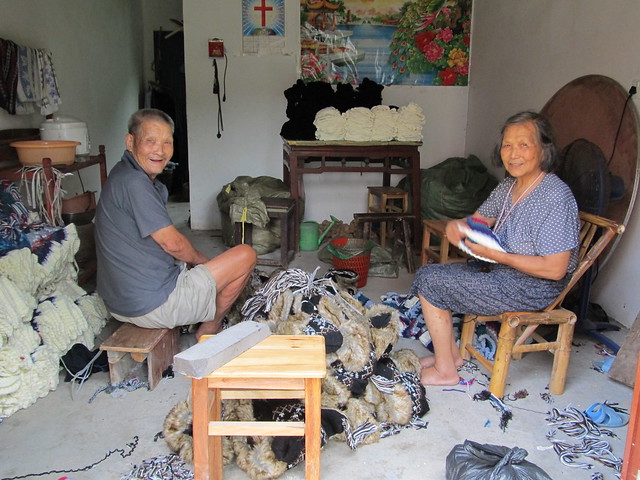
Grandpa and Grandma, knitting hats one summer (a local industry) to earn some money.
And even though I’ve never felt as close to him as Grandma, I worry about her as well. We’ve all watched her health falter throughout the year and breathed a sigh of relief every time she returned home with the same grin and the same unexpected quips and jokes in her local dialect. But what now? How will she cope with an empty home? Will this be the experience that breaks her as well?
I remember how she told us earlier in the year, “I don’t want to die this year.” She’s 81 and for whatever reason, passing away at this age is somehow inauspicious. Personally, I think any passing is inauspicious and especially the people closest to us, the people we love most.
Grandpa’s passing has summoned us back once again to John’s hometown, just at the very moment when he and I seemed to be settling into life here in Hangzhou. And now I’m on the verge of experiencing a Chinese funeral and the loss that comes along with it.
But I’m also married to John and have the support of his family through this all — people who have experienced many a funeral in their lives. While I can’t say it’s a privilege to go through all of this, it is a relief and comfort to know I’m not alone in this process.
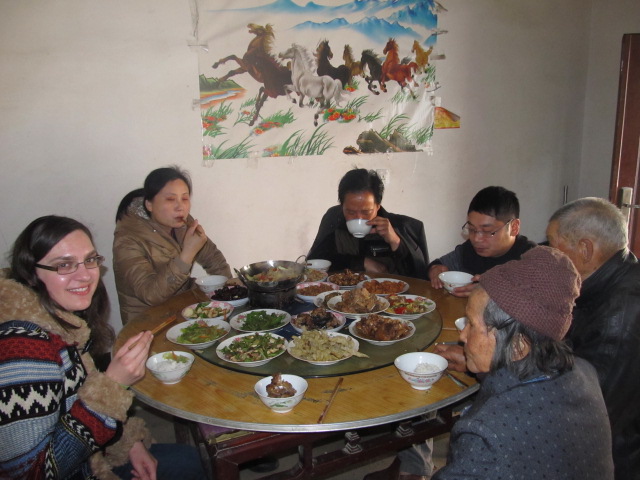
Eating a Grandma and Grandpa’s home during Chinese New Year.
You’ll find my essay “Huangshan Honeymoon” included in the anthology, which explores a very different kind of honeymoon my husband and I enjoyed in 2005.
How was it different?
Well, yes, we planned our vacation around the chance to hike all the way up to China’s Huangshan or “Yellow Mountain”, instead of the typical honeymoon of sunny days spent lounging on golden sand beaches sipping tropical drinks and intimate twilit evenings laying in each others’ arms.
And yes, we chose to set out at the height of summer’s most sultry days, and stay in a region where July and August are feared for the ferocious heat of the “Autumn Tiger” that comes around every year.
But ultimately, this is what made our honeymoon so unusual: John’s father came along with us!
I never thought I would share my honeymoon suite with a man who once advised his son not to date foreign women. (Then again, I suppose he never imagined he’d have a foreign daughter-in-law!)
And as if that wasn’t enough, the heavens also brought us some of the lousiest viewing conditions for the mountain, thanks to the remnants of a typhoon that enveloped the scenery in a misty cloud of rain and fog.
(This is the one and only photo that offers a hint to the breathtaking views we should have enjoyed, had the weather cooperated!)
Why did we bring John’s father along? And how did that experience change my relationship with his father forever? You’ll find all the answers (and much more!) when you buy a copy of How Does One Dress to Buy Dragonfruit and read the essay. Don’t miss out on a collection that I can’t stop raving about! (Okay, yes, I am biased but it’s still really an amazing book.)
Sometimes, I think the love of a Chinese family is one of the best kept secrets in the world. And if ever there was an example of that, it’s our upcoming move to Hangzhou. As we trade the countryside for city life, I still can’t believe how my husband’s family has gone out of their way to help us make the transition.
Okay, I know rice cookers, pressure cookers, dishes, woks and bedding don’t appear out of thin air. But when my mother-in-law suddenly pulled out all of these brand-spanking-new things (and more!) from storage in our house, it felt like some magic trick. Or the wedding registry I never imagined I had signed up for.
Because, after all, we never asked them to buy any of these things. But they bought them anyway!
My mother-in-law has continued this apartment hocus-pocus almost every day leading up to the move, trotting out new things during lunch, and has even pulled a few extra-special surprises out of her own proverbial hat (including honey and even veggies from her garden).
Making it an auspicious move
“It’s not superstition. It’s the Book of Change, a Chinese tradition.” Whether or not you agree with my father-in-law, the fact remains that good luck matters to my in-laws in every important aspect of life — including moving house.
So naturally, once we announced the news on Saturday, my father-in-law whipped out that indispensable little red book in his library — the Chinese Farmer’s Almanac, based on China’s Book of Change. It lists every date in the year, recommending what you should and should not do on that date. According to his almanac, the best upcoming date for our move (and preparing our new bedroom) would be this coming Tuesday, May 27.
And believe me, this stuff counts to them. How much? Enough for my mother-in-law to make a second phone call to my husband’s oldest brother (who initially said he couldn’t move us on Tuesday), convincing him to do it earlier in the day!
Money? We didn’t ask for money!
Compared to so many Americans I know, Chinese families seen to operate on a completely different wavelength when it comes to money — and my husband’s family is no exception.
You don’t even need to ask them, “Could you lend us some money?” It’s a given they will, which I still haven’t quite gotten used to (yes, I am a bag of nerves whenever John has to borrow cash from his family — and John always thinks it’s so funny).
And more often than not, you don’t even need to bring up the topic of money with them — because they’ll do it first.
That’s exactly what my father-in-law did the other day when he sauntered over to John and me in the yard. John’s dad had this serious look on his face that made me all nervous inside, as if he was like my dad and about to lecture us on something we messed up in his house. But this “serious talk” turned out to be nothing more than him saying, “You’re going to need some money for your move. How much?” (A question that, of course, I felt too embarrassed to answer. I mean, here’s my father-in-law approaching me with a gesture that seems too generous to be real, and expecting me to give him a number?)
Days later, I discovered a thick stack of crisp, red bills lying in the corner of our room — an amount that turned out to be more than three times more what I expected!
Sometimes it’s not even a question, but an order. Like, yesterday John’s oldest brother phoned him out of the blue just to say “Open an account so I can send you some money” when John hadn’t even asked for it. After my husband recounted this to me, I was shocked (in a good way)…and then almost wanted to pinch myself.
Nope, it wasn’t a daydream.
In the end, it’s all about the love
My Chinese relatives will never hug or kiss us, or say how much they love us the way my American relatives do. But they’ll pony up brand-new apartment essentials and money without us asking them, and make certain we move on the luckiest possible day. It all comes down to one simple idea — this is how they show us their love.
Now if you excuse me, I’ve got a move to get ready for. Hangzhou, here we come!
In Hangzhou, the city where John and I fell in love — and love with all our hearts!
I’ve spent a total of six years in China and married a man from Zhejiang Province. So of course, whenever I return to the US, invariably the subject of China surfaces in conversations with people.
For the most part, I love this.
I love it when approach me with curiosity about the country, whether they’re just fascinated by the sky-high wonders of Shanghai, interested in the history behind the Great Wall, or simply want to know if China has Pepsi. And there’s nothing like watching my husband hop into the conversation — it’s as if the very mention of “China” flicks a switch on and he’s suddenly as animated as a talk show host.
But on occasion, the conversation strays into a sort of forbidden city I’d rather not visit. Ever. And it goes something like this:
“Wow, you live in China? I once visited China. But boy, all that [negative thing about China] made me so grateful I live here in the US.”
Or this:
“I’ve read about that [negative thing about China]. So glad I’m an American.”
In other words, “China makes me feel so much better about myself and my great first-world country.”
Usually, I’m gobsmacked when I hear something like this. It’s not every day you encounter someone so smug over where they live after traveling to or reading something about China. But more than that, this sort of thing hits me personally — because China is where I live, it’s where my husband grew up, it’s the country we both love deeply despite its flaws and imperfections. It’s like just telling someone all about your great new house, only to have them crap all over it.
Sometimes I wonder, whatever happened to world travel or even international news as a means for enlightening people and opening them up to new cultures? And is it something about Americans, that somehow certain people there need an ego boost and get their fix through slamming the developing world?
What I want to tell these people is that their perfect little piece of American isn’t all that perfect. That there’s more to a great life than their squeaky-clean homes in the suburbs and the shop-till-you-drop malls and outlets they visit on the weekends. That my family’s home in the Zhejiang countryside might look rough on the outside, but in fact is a family that has a wealth of resources, money and even the most important thing of all — love.
Most of all, I’d like to tell them they make me feel grateful too…that I’m not their neighbor, and I never will be.
As John and I stopped to admire a patch of yellow daisies while hiking through his village in Zhejiang, a voice speaking Chinese reached us from across the creek. “Aren’t those flowers beautiful?”
I looked up to see two smiling yet unfamiliar faces staring at my husband and me, both filled with a friendly curiosity. After all, it’s not everyday they find a white foreigner hiking across from their fields.
The warmth from their gazes made me do something so uncharacteristic in China, something I rarely do with strangers here: I waved at them and smiled.
“Yes, they’re very beautiful,” I said to them in Chinese. “And fragrant!”
Soon, we fell into a brief conversation — about why we were hiking around the creek (for fun), about what they were doing (planting some crops in the fields). Even though it was all just small talk, by the time we left and continued on our way home, I felt as if we just made a couple of new friends. And it’s not the first time this has happened.
A woman in the mountains always invites us in for dinner or a little small talk whenever we hike past her house. While cruising down the hill on our bicycles, one fellow standing outside his house with a bowl of rice and bamboo also asked us to come over for dinner. A farmer picking cherries in the fields suddenly pushed his basket of sweet red bounty in front of me, insisting I must take some home — and even forcing the cherries into my hands when I hadn’t taken enough. And then there are the countless individuals who crack an unexpected smile at my husband whenever he greets them in the local dialect with a question like, “Off work?”
It’s amazing how a simple walk through my husband’s village in rural Zhejiang suddenly opens up unexpected doors and hearts. There’s a brilliant friendliness here that shines upon us like the golden sunshine. Maybe it’s because my husband always called these mountains home — and whenever he speaks the dialect of this region, he announces his hometown roots. Maybe it’s in part that the curious presence of a foreigner in a remote mountain village inevitably opens up even some of the shyest people to a little conversation.
Yet I know we would never enjoy the same friendly welcome in a big city like Hangzhou, Shanghai or even Beijing. After living in big cities in China, I know all too well the watchful distance between strangers on the streets — where there’s no such thing as waving hello or asking someone, “What are you up to?” It’s a world where people worry about helping up a fallen little old grandmother in the streets for fear of getting sued…where you automatically assume “swindler” or even “thief” if someone you don’t know approaches you.
So of course, I assumed the same rules applied to us when we moved to my husband’s hometown in the countryside…and how wrong I was.
I’ve also watched my husband transform from the shy wallflower he once was in the US to the confident social butterfly who could charm almost anyone into a smile, even the most impossible grimacing grandfathers on the streets. Even after all of the hardships we’ve faced in the US, my husband still greets everyone in this village with a cheerful optimism that is so inspiring, especially to me.
My husband reminds me that, no matter what difficulties you’ve encountered in life, there’s still room for a smile, a nod and a little small talk. Sometimes, it’s also the best remedy for those sad and lonely days I experience here in China, where the world seems crazy and unfair and impossible. It’s like slowing down to enjoy a patch of yellow flowers — realizing the beauty and love that’s already around us, but that we’ve forgotten in our daily routines.
Someday, John and I will leave his parents’ home for bigger things. Yet a part of us will undoubtedly remain among these welcoming mountains in the countryside, which have taught us to believe once again in humanity and the power of a smile.
Ever since 2011, you’ve made Speaking of China even more fantastic by sharing your stories about love, family and relationships in China as well as AMWF relationships.
I’m looking for more amazing love stories and other guest posts for this site, and I’d love to run yours.
Interested? Head on over to my new Submit a post page, which will tell you everything you ever wanted to know about doing a guest post for Speaking of China.
This website uses cookies to improve your experience. We'll assume you're ok with this, but you can opt-out if you wish.AcceptRejectRead More
Privacy & Cookies Policy
Privacy Overview
This website uses cookies to improve your experience while you navigate through the website. Out of these cookies, the cookies that are categorized as necessary are stored on your browser as they are essential for the working of basic functionalities of the website. We also use third-party cookies that help us analyze and understand how you use this website. These cookies will be stored in your browser only with your consent. You also have the option to opt-out of these cookies. But opting out of some of these cookies may have an effect on your browsing experience.
Necessary cookies are absolutely essential for the website to function properly. This category only includes cookies that ensures basic functionalities and security features of the website. These cookies do not store any personal information.
Any cookies that may not be particularly necessary for the website to function and is used specifically to collect user personal data via analytics, ads, other embedded contents are termed as non-necessary cookies. It is mandatory to procure user consent prior to running these cookies on your website.