Double Happiness: “Enter Zhao Ming…China’s Answer to Arnold Schwarzenegger”

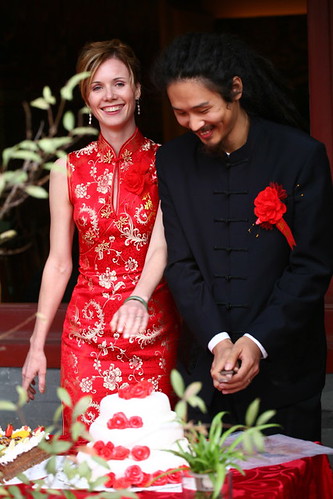
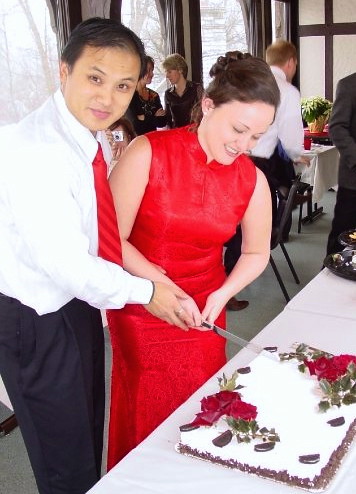
Ming and Rosalie at their wedding in 2007 (Photo courtesy of Rosalie Zhao)

I love stories that challenge stereotypes about Chinese men. Well, you can’t get much better than this love story, where a white American woman goes to China and ends up falling for a guy she considers the Chinese version of Arnold Schwarzenegger. Thanks to Rosalie Zhao for sharing her amazing story, which just might inspire more Western women out there to give Chinese men a chance.

—–

Thanks to a relative’s cute Chinese neighbor, I went through a brief phase of yellow fever in high school. It came and went in the same fashion as most things (Josh Hartnett, Doc Martens) I pined after during my teenage years. I didn’t think my attraction to Asians would resurface, even as I packed my bags for my post-college teach in China stint. Just a week before I left, in February 2005, my cousin Nicky called it, “You’re gonna fall in love in China.” I couldn’t help but laugh.

Fast-forward a couple months later and you’d find me in China, sweating it out at the local gym. I’d never been much of a gym rat, but with a 12 hour per week teaching schedule, virtually no English-language television, and no home internet (remember—this was 2005 and I was in a small Chinese city) all that was left to do was hop on a treadmill.

Me exercising is no picture of grace and beauty, nor is it a time during which I enjoy critique or idle chit-chat. Enter Zhao Ming, seemingly China’s answer to Arnold Schwarzenegger. As I made my feeble attempts to use five pound free weights, Ming took it upon himself to criticize my form. While I understand now that Chinese people often offer unsolicited advice as a gesture of kindness, at the time I was thoroughly annoyed. Who did this meathead think he was? And he could hardly speak English!
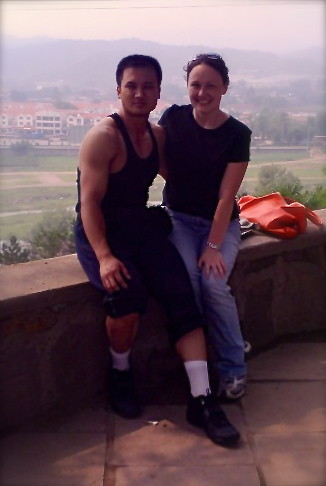
Ming and Rosalie in June 2005 (Photo courtesy of Rosalie Zhao)

Though awkward, I was relieved by our failure to communicate. It meant Mr. Muscles would leave me alone. It wasn’t but a few days later, while I was on the treadmill jogging, thoroughly red-faced, that he made his second approach. I tried to politely ignore him, but as anyone living in China knows, you cannot politely ignore a Chinese person who really wants something. This guy was on a mission. In a tone that sounded a bit rehearsed, he asked, “Can I with you walk home?”

I decided it was best to stick with honesty. “Oh, sorry. I have to go home and take a shower,” I replied. His face was thrown into a state of utter confusion. He really didn’t understand English. Continuing my jog, I began to pantomime while yelling, “US, NO WALK. ME, GO HOME. SHOWER.” His face lit up; he understood. But a second later his expression collapsed, realizing I wasn’t willing to walk with him.

Over the course of the next two weeks we repeated the same song and dance—him asking to walk me home and me gesturing my refusals. It wasn’t until one night that he cornered me at the gym exit that I finally decided to give him a chance. What was the harm in letting him walk with me?

So we walked, with few words, just his bicycle and our foolish grins between us. He stopped and bought us each a yogurt, then carefully unwrapped the straw and stuck it in the drink, smiling at me widely. I felt my insides melt. When we reached my apartment I decided to run upstairs quickly to grab my Lonely Planet phrasebook. Somehow we fuddled through an hour’s worth of “conversation” before it started to rain lightly. We quickly ran into the building’s stairwell, laughing. Then he kissed me. In that moment I somehow knew that I could, in fact, find love in China. And here we are, eight years later, five years married, and still very much in love.
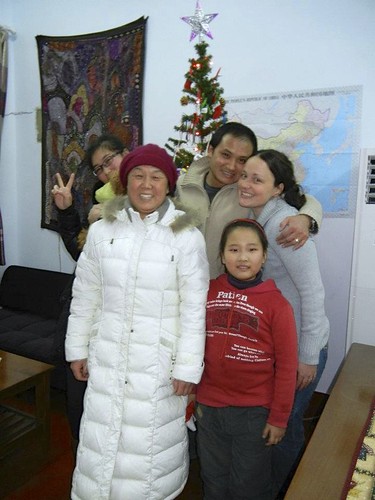
Rosalie with Ming and his family in December 2011 (Photo courtesy of Rosalie Zhao)

Ming later revealed to me that his approach at the gym exit was going to be his final attempt to ask me out. I’m so glad I didn’t turn him down. Looking back, I’m not sure why I found the thought of finding love in China so humorous and inconceivable. In a country of 1.3 billion people, the majority of them male, why did finding a boyfriend seem so implausible? My closed-mindedness and arrogance nearly cost me the love of my life. A cautionary tale? Maybe. But more importantly, just a reminder—anything is possible, even love for the single foreign female in China!

Rosalie Zhao resides with her husband in Hebei, China, where she writes a blog in Chinese and English called An American Woman in China.

—–

We’re looking for a few good stories from Chinese men and Western women in love — or out of love — to share on Fridays. Submit your original story or a published blog post today.

Fenshou: Dreams of a Romantic Fairy Tale Kiss

(photo by ♥ L i l a c ♥ via Flickr.com)

Longtime readers will recognize the name Sveta, who is one of the most active commenters on this site. She also blogs about her latest reads on her book review blog (where she reviews a variety of books , including titles featuring with Asian men and Western women in love).

She shared with me this story of how she met a young Chinese PhD student via myspace, which eventually led to one extraordinary kiss — and, later, a sudden end to their month-long courtship. Thank you for submitting your story, Sveta! Continue reading “Fenshou: Dreams of a Romantic Fairy Tale Kiss”

AMWF Books vs. AFWM Books: The “Good Reads” Question

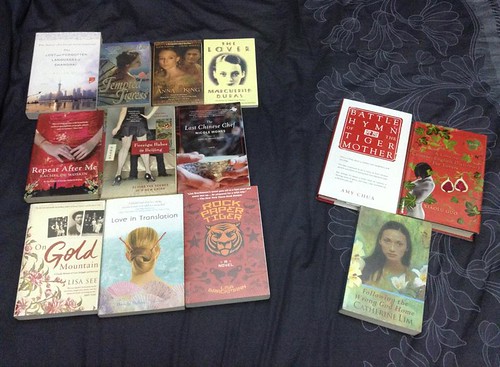
(photo by Christine Tan)

A few months ago, Christine Tan — who writes the fabulous Shanghai Shiok — Facebooked me with this photo and a message:

Hey Jocelyn, quick look at my…bookshelf shows I have more explicitly WF/AM [White Female/Asian Male — also referred to as AMWF] books (yes, I include Anna and the King!) than the opposite, AF/WM [Asian Female/White Male]  (and yes, I include Amy Chua in that one). Wonder why I enjoy the former more even though I’m part of the latter. Maybe I just haven’t come across really good/insightful/not based on creepy stereotypes AF/WM writing. I mean, are there any AF/WM books you like and could recommend?

I chimed in with some suggestions of good AF/WM books, as did others, but her post lingered with me. Of course, there’s no “law” saying we MUST enjoy more those books that best reflect our own relationships and realities. Still, it was fascinating to me that Christine — who is in a AFWM marriage — still enjoyed more AMWF books over AFWM books.

And the thing is, I feel the same way. Continue reading “AMWF Books vs. AFWM Books: The “Good Reads” Question”

Fenshou: When Mary Met Yao

(photo by Steven Lee via Flickr.com)

“Mary” met Yao while at university. And while a series of misunderstandings eventually got in the way of their relationship, she wrote: “I don’t regret getting to know him and being a small part of his life. I feel that my experience dating him has made me grow as a person.” Thanks for sharing your story, Mary! Continue reading “Fenshou: When Mary Met Yao”

Why Aren’t We Talking More About The Rarity of AMWF?

(Screenshot from http://theyreallsobeautiful.com/)

Last month, commentator Eugene Tsui posed this fascinating question in a post on They’re All So Beautiful (the companion website to the documentary Seeking Asian Female):

I don’t see the question posed, of why there are so few Chinese men, with “white” women? This is left out?

What do the Chinese women have to say about that? And what do “white” men, who are married to Chinese women, have to say about that? I don’t hear their opinions about Chinese men with white women?

Of course, when he says “This is left out?” he’s referring to the fact that the documentary — and its companion website — don’t really address the disparity he mentions. But I think that could easily apply to most situations when people discuss yellow fever. Continue reading “Why Aren’t We Talking More About The Rarity of AMWF?”

Dana Sachs Interview: The Secret of the Nightingale Palace

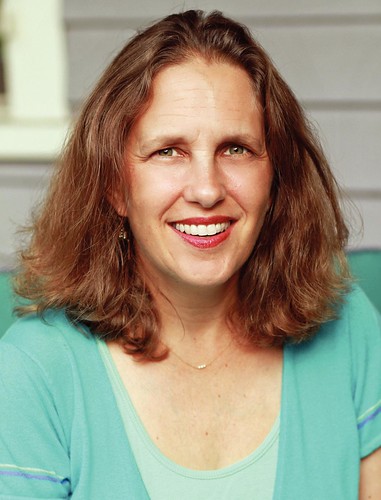
Author Dana Sachs (photo by Cornel Faddoul)

Of all the memoirs by Western women who loved Asian men (and wrote about it), The House on Dream Street by Dana Sachs remains one of my favorites. The writing is exquisite, but more importantly she shares her own vulnerabilities on the page and becomes one of the most delightful narrators I’ve ever encountered.

So imagine my excitement when I discovered that Dana came out with a new novel this year called The Secret of the Nightingale Palace featuring not one, but two stories about Asian men and white women falling in love. The romance at the heart of this novel — which relates to its intriguing title — just stole my heart away. Plus, the book explores a side of World War II that we all too often forget — the US internment of Japanese Americans.

I’m thrilled and honored to have this opportunity to interview Dana Sachs about The Secret of the Nightingale Palace.

Dana is also the author of  the novel If You Lived Here and the nonfiction narrative The Life We Were Given: Operation Babylift, International Adoption, and the Children of War in Vietnam, and co-authored the book Two Cakes Fit for a King: Folktales from Vietnam along with Nguyen Nguyet Cam and Bui Hoai MaiBoth The House on Dream Street and If You Lived Here were chosen as Book Sense Picks.

You can learn more about Dana by visiting her website, her Facebook fan page, or her Twitter stream. Continue reading “Dana Sachs Interview: The Secret of the Nightingale Palace”

Despite the China-America Divide, We’re On The Same Team

The other day, my husband and I were having a conversation in the car about discrimination and racism in America — two things he knew firsthand from his own experiences over here.
“Mean and wicked, that’s what these people were to me,” he said, referring to the Americans who had betrayed him in the past. “They just don’t care, they have no concern for you at all. They think they can just bully you.”

My heart ached to see him this way. “I’m so sorry. It just goes to show how much work in this country is still undone. We Americans have a lot to learn.”

“Don’t say ‘we’! Don’t put yourself in the same category as them, you should be careful of your language!”

“Sorry, I didn’t mean to say ‘we’, it just came out by accident. Just a reflex, that’s all.”

But his words haunted me the rest of the way home. I couldn’t believe that the word “we” — a word that normally brings John and I together as one — could divide us into two in a completely different context. Continue reading “Despite the China-America Divide, We’re On The Same Team”

The Next Big Thing: On “Red All Over,” My Forthcoming Memoir

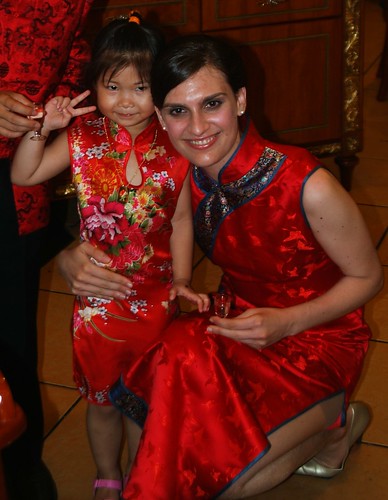
(At my wedding banquet in China, posing with one of our guests)

I am thrilled that Susan Blumberg-Kason invited me to participate in the The Next Big Thing, an Internet meme where writers answer questions about their latest or forthcoming works.

Susan is the author of the forthcoming memoir Good Chinese Wife. This book traces the five years she spent trying to assimilate into a Chinese family, after jumping quickly into marriage with a Chinese man. But over time, she comes to reconsider what she thought it meant to be a wife, have a family, and raise a child — and faces the tough choice of whether or not to leave her Chinese family.

I’ve read portions of her memoir, and I can honestly say it’s a gripping story written from the heart. I loved Susan as a narrator because she shares so many of her vulnerabilities on the page. I liked the unusual, non-linear structure of her book as well, which really adds to the drama of her story and keeps you turning the pages.

And I’m sure many of you, like myself, can’t wait to get your hands on Susan’s book. To learn more, check out her Next Big Thing post from last week, or read the brief introduction to Good Chinese Wife on her website.

Now for my interview questions, which I’ll follow with introductions to several authors to watch for. Continue reading “The Next Big Thing: On “Red All Over,” My Forthcoming Memoir”

Ember Swift Interview Part 2 – How China Changed Her Life

Ember Swift and Guo Jian, during one of their wedding ceremonies (photo courtesy of Ember Swift)

Last week, I introduced you to Canadian artist Ember Swift’s professional career — from how China changed her sound to what’s next for her as a musician/singer-songwriter and a writer. If you missed it, check out Part 1 of my Ember Swift interview. Also, you can purchase her music at iTunes and her website, peruse her must-read blogs, and follow her on Facebook, Twitter, MySpace and Sina Weibo.

But when it comes to her writing, Ember isn’t afraid to get personal. She has written about her marriage to Guo Jian — the lead singer/bassist of Long Shen Dao — from the unique perspective of a queer woman. She has also shared her experience of being pregnant, giving birth and raising a baby in China, including navigating life with a Chinese mother-in-law who assists with child care.

In Part 2 of our interview, I asked Ember about her personal life — from how she met Guo Jian to what it’s like raising a baby in a Chinese family.  Continue reading “Ember Swift Interview Part 2 – How China Changed Her Life”